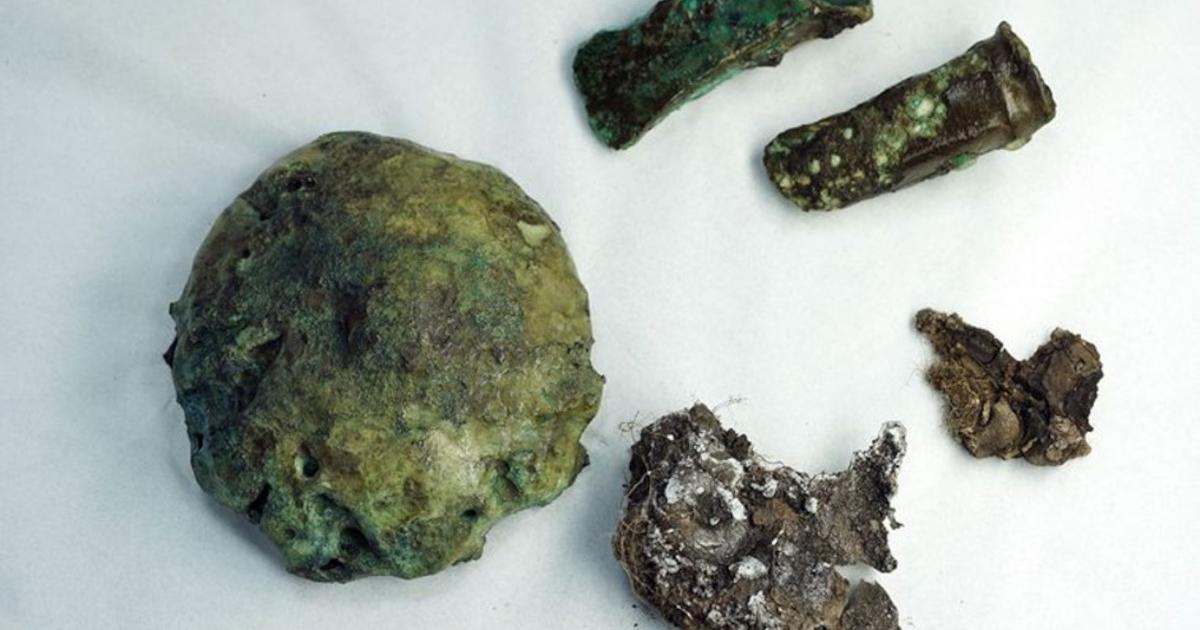

A metal detectorist who recovered one of Scotland's most important Bronze Age treasures has struck again, lifting a second hoard from the ground barely seven miles away and only two years later. Mariusz Stępień's 2022 find, now known as the Blyth Hoard, contains two bronze axe-heads, fragile clay molds and a complete copper ingot, the first of its kind ever recorded in Scotland. Archaeologists believe the modest-looking cache may explain how the extraordinary fittings in the earlier Peebles Hoard were made, and that both collections could be the work of the same Bronze Age craftspeople.
"Having previously discovered the Peebles Hoard, it is quite extraordinary to think that two discoveries I made so close to one another could be connected," Stępień told The Independent.
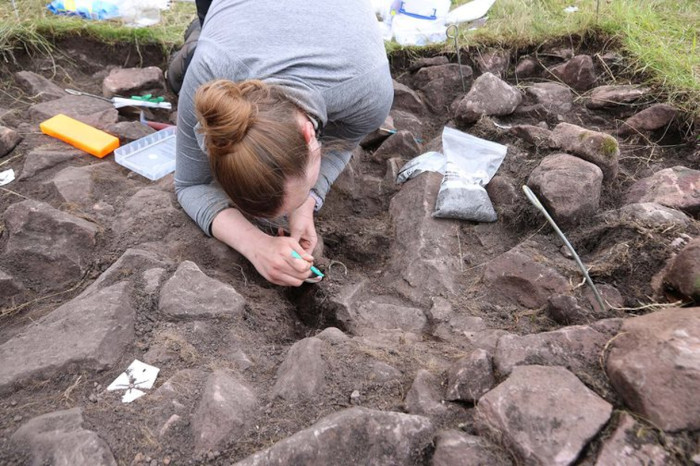
The Blyth Hoard under excavation. (Crown copyright/NMS)
A Signal, a Cairn and a Deliberate Burial
Stępień, from Loanhead, was surveying ground near Blyth Bridge in the Scottish Borders when he noticed what looked like the outline of a round building in the field. A strong, steady signal came from his detector, and he began digging, lifting stones one at a time until an axe-head appeared in the soil. He stopped at once and reported the find to Scotland's Treasure Trove Unit, which alerted archaeologists at National Museums Scotland (NMS), as the BBC reported.
Excavation showed the objects had been tucked inside an ancient stone cairn, with stones deliberately removed and then replaced to conceal them. A small trench produced a second socketed axe-head, the copper ingot, the degraded remains of clay moulds and a layer of burnt material. According to NMS, the Blyth Hoard is rare because metalwork and the debris of metalworking were found together, a combination previously unknown in Scotland.
- Bronze Age Hoard Reveals 3000-Year-Old Silver Secret
- Detectorist Finds Bronze Age Treasure Cache With Sword In Scotland
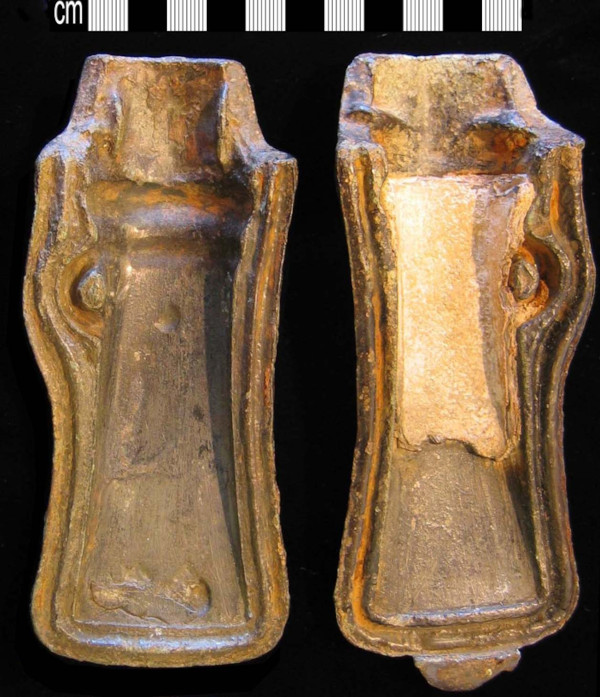
A Late Bronze Age two-part mold used to cast socketed axe-heads, the kind of clay tool that almost never survives in the ground (Portable Antiquities Scheme / CC BY-SA 2.0)
Clay Moulds That Point to a Bronze Age Workshop
Clay crumbles away over three thousand years, which is why casting molds almost never survive in the ground. The Blyth fragments are incomplete, but they carry a distinctive shape that matches the cores or models used to cast some of the unusual bronze fittings recovered at Peebles.
"It's really rare for mold materials to survive at all, so it's a special find in its own right, but the proximity and relationship to the Peebles Hoard makes it all the more extraordinary," said Dr Matthew Knight, curator of prehistory for Bronze Age collections at NMS.
That connection matters because the Peebles Hoard holds more than 500 bronze, leather and wooden components, many of them without archaeological parallel anywhere in the world. Its horse harness fittings, straps and studs are still partly articulated, and two rattle pendants, the first found in Scotland, point to links with Denmark and northern Germany. If the Blyth molds were used to make any of these objects, the two hoards may point to a single workshop, or even a single pair of hands.
- 3,000-year-old Bronze Age Highlander Hoard Discovered in Scotland
- Bronze Age Hoard Unveils 3000-Year-Old Ritual Secrets
An Ingot That Could Trace an Ancient Trade Route
The most intriguing object in the Blyth Hoard is a complete copper ingot, the first found north of the Border. Ingots are far more common in southern Britain, particularly along the south coast, and their arrival in Scotland is evidence that fresh raw metal was being brought into the area 3,000 years ago, rather than old objects simply being melted down. Analysis of the ingot may reveal where the copper was mined, and could also identify the source of the metals used in both hoards.
Copper and tin rarely occur close together, so Bronze Age metalworkers depended on long-distance exchange networks to keep their furnaces supplied. Raw metal travelled across Europe in ingot form, which is one reason researchers can trace the movement of communities and craftspeople far beyond their own shorelines.
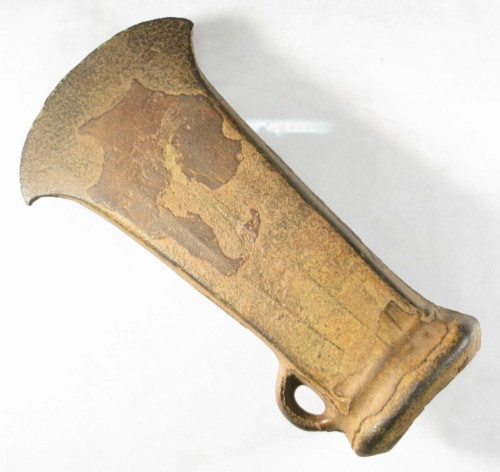
A complete Late Bronze Age socketed axehead of the type recovered at Blyth Bridge, with its casting seams and side loop intact (Portable Antiquities Scheme / CC BY-SA 2.0)
The Silver Secret Hidden in the Peebles Hoard
The Peebles Hoard, found in 2020 and allocated to NMS in 2024, has already overturned expectations. Stępień, who runs a house renovation business, was paid £80,000 for the hoard, and conservation work that began in 2025 revealed something nobody had anticipated: many of the bronze objects carry a silvery sheen. Testing traced the colour to unusually high levels of tin on the surface, the mark of a deliberate enrichment technique used at a time when silver was unknown in Britain.
"Working on the conservation of the Peebles Hoard is a rare privilege and definitely a career highpoint," said Bethan Bryan, Peebles Hoard conservator at National Museums Scotland. Conservation is expected to continue until 2028, and Dr Knight credited the finder's prompt reporting for allowing the team to excavate the material "swiftly and safely". Both hoards remain under study, and the questions they raise, about who buried them and why, are still open.
Top image: The Blythe hoards, the second hoard found in the Scottish Borders. Source: Stewart Attwood/National Museums Scotland
By Gary Manners
References
Archaeology Magazine. 2026. Extraordinary Bronze Age hoard found in Scottish Borders. Available at: https://archaeologymag.com/2026/10/second-bronze-age-hoard-found-near-peebles/
BBC News. 2026. Metal detectorist finds second Bronze Age hoard in Scottish Borders. Available at: https://www.bbc.com/news/articles/cm62y4j5w149o
National Museums Scotland. 2025. What is the Peebles Hoard? Available at: https://www.nms.ac.uk/discover-catalogue/what-is-the-peebles-hoard
National Museums Scotland. 2026. What is the Blyth Hoard? Available at: https://www.nms.ac.uk/discover-catalogue/the-blyth-hoard
The Independent. 2026. I'm a metal detectorist. Here's how I found two Bronze Age hoards in two years. Available at: https://www.the-independent.com/news/science/archaeology/bronze-age-hoard-metal-detector-b3062246.html
The Scotsman. 2026. Metal detectorist's second 'extraordinary' find of Bronze Age treasure arrives at NMS. Available at: https://www.scotsman.com/news/metal-detectorists-second-extraordinary-find-of-bronze-age-treasure-arrives-at-nms-9270244