

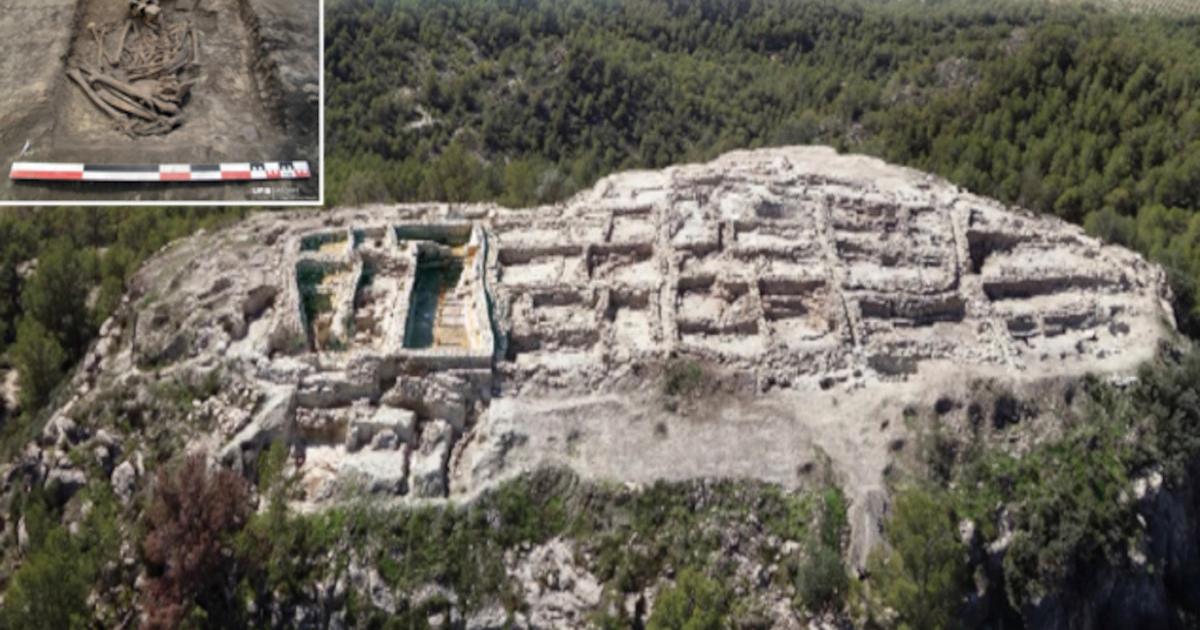

For roughly 3,700 years, anyone crossing the great hall of La Almoloya in south-eastern Spain walked over a man. His lower body lay beneath a hearth, his face sat barely a centimeter below the floor, and a large stone had been jammed between his teeth. His excavators called him "the enemy" and read the burial as punishment. A study in 'Ilu. Revista de Ciencias de las Religiones, reported by Archaeology News Online Magazine, now argues it was a magical ritual to hold down the forces of chaos he embodied.
Sealed Between Two Floors of a Palace Hall
The skeleton, catalogued as AY5, was found in Room H9 of Residential Complex 1 at La Almoloya, the Argaric settlement at Pliego in Murcia. Its excavators from the Universitat Autònoma de Barcelona call it one of the earliest palaces in western Europe. The layer dates to 1750–1550 BC, the third phase of El Argar, a Bronze Age society that dominated south-eastern Iberia for six centuries.
AY5 was about 40 years old, stood around 1.63 meters tall, and his bones carry no markers of heavy physical labor. Other Argaric dead were buried beneath the floors of houses with their possessions, most famously in Tomb 38, where a man and a woman were laid with the richest grave goods ever found in El Argar, among them a silver diadem still on the woman's skull. AY5 received nothing: he was laid between two floor levels, and the lower floor was cut and reshaped to fit his body, so the burial was deliberate and laborious.
- Spanish Skeletons Reveal Deep-Rooted Inequality of El Argar Society
- The Restless Peninsula: The Proud and Colorful History of Iberia
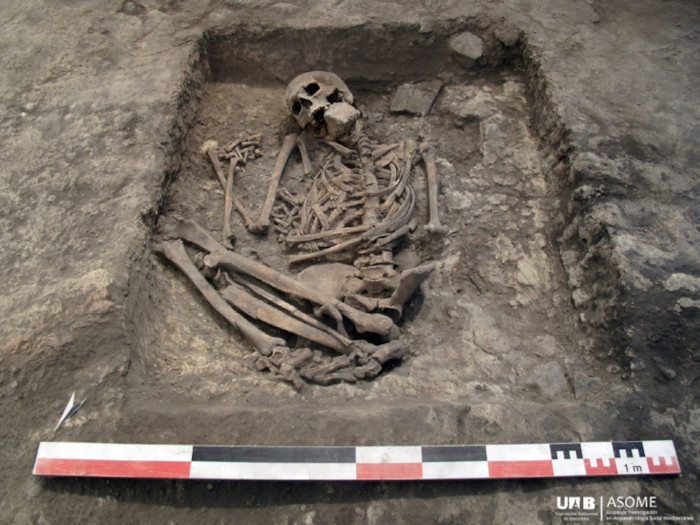
Individual AY5 was interred between two floors at La Almoloya, the lower one modified to accommodate his body, with his face at ground level and a stone in his mouth. (UAB-ASOME / CC BY 4.0).
Marco Mazón Gomariz of the Complutense University of Madrid, who wrote the paper, notes that the builders brought the face as close as they could to the surface. The excavators, led by Vicente Lull, concluded that the stone had been forced into his mouth "as if to silence him forever, as though death itself were not enough." Mazón reads it as more than humiliation.
Kings Who Put Their Foot on Their Enemies
Mazón builds his case from parallels in far older civilizations. In Mesopotamia, reliefs from the Akkadian period onward show rulers planting a foot on defeated rivals; on the stele of Naram-Sin the king stands over corpses wearing a horned crown. In the Babylonian creation poem Enūma Eliš, the god Marduk vows to tread on the neck of Tiamat, the embodiment of chaos.
Egypt pushed the idea further. Bound prisoners were carved into door sockets, the soles of Tutankhamun's sandals and footstools, so that the pharaoh crushed his enemies with every step. The Egyptians saw the world as a struggle between maat, order, and isfet, chaos, and the king was charged with holding the first against the second, a duty examined in Ancient Origins' feature on Maat.
- Ancient Curses: Five Ways to Create Calamity in the Ancient World
- The Most Bizarre, Brutal, and Weird Ancient Death Rituals Revisited
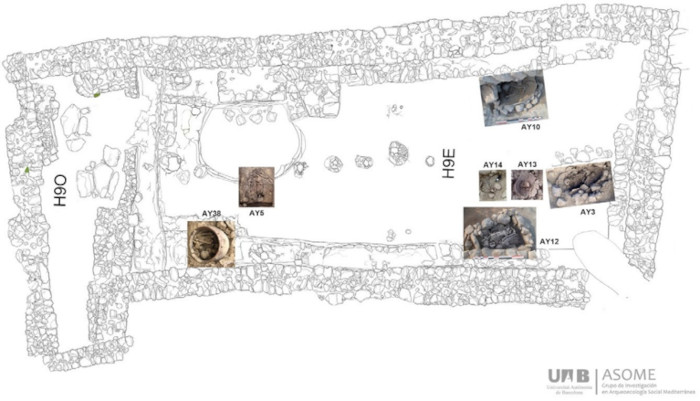
Plan of rooms H8 and H9 at La Almoloya, showing the burials discovered in the main hall, including AY5 beside the hearth. (UAB-ASOME / CC BY 4.0)
A Stone in the Mouth to Silence a Ghost
Assyrian and Mesopotamian anti-witchcraft texts offer a closer fit. Sorcerers made clay figurines of their victims, and victims did the same to the witches tormenting them; the figures were broken or buried beneath busy places so that passers-by would trample them, and spells often targeted a demon's mouth to cut off speech. At Hasanlu in Iran, a man buried between 1450 and 1250 BCE was found with a cylinder seal between his lips.
Mazón suggests the stone in AY5's mouth served a similar purpose. Someone denied a proper burial became a restless spirit — the Mesopotamians called it etemmu and feared it deeply, as Ancient Origins has explored in its account of Assyrian ghosts. Sealing the mouth would have silenced the man both in life and after death.
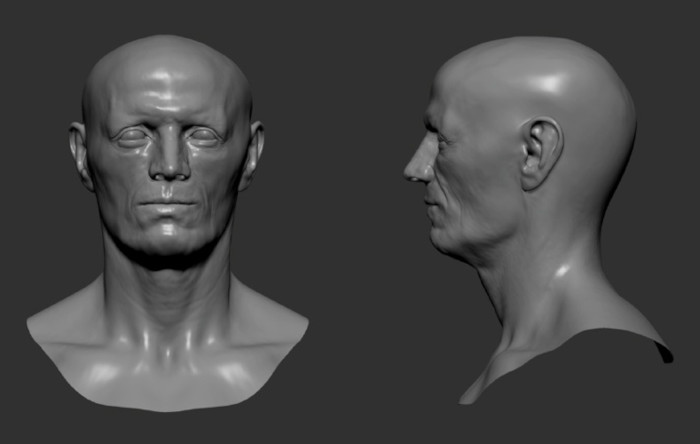
Forensic facial reconstruction of individual AY5, produced for the Argaric facial approximation project. (Araújo, 2021 / CC BY 4.0)
A Priest Who Fell From Grace?
The room itself supports this. H9 was a dim semi-basement of about 70 square metres, with benches for some 50 people, a podium a metre high, and the only sunken hearth of its kind at the site in this phase. Visitors reached it by a winding route hidden from the main street, which Mazón reads as the mark of a sacred space rather than a purely political one. He told La Brújula Verde that in that period "nothing was purely political."
A 2025 study found that AY5 was a third-degree relative — as close as a first cousin — of two other people buried at La Almoloya, making him an insider, not an outsider. Mazón suggests he was a priest or official who fell from grace, since a nobody would not have merited so prominent a resting place. He calls the ritual "plausible, though strictly hypothetical," noting that the Argaric people left no written texts, so every comparison comes from cultures far away and centuries apart. What remains is a man whose name, offence and rank are lost, and a room where the powerful sat in judgement above his face.
Top image: Aerial view of La Almoloya, the Argaric hilltop settlement at Pliego, Murcia, Spain. Source: ASOME-Universitat Autònoma de Barcelona/CC BY-SA 4.0
By Gary Manners
References
Archaeology News Online Magazine. 2026. Bronze Age man buried under a hearth in Spain may have been part of a magical ritual. Available at: https://archaeologymag.com/2026/10/bronze-age-man-buried-under-a-hearth-in-spain/
La Brújula Verde. 2026. A Bronze Age Man Buried Under a Doorway With a Stone in His Mouth in Southeastern Spain May Have Been Trampled Like Egypt's Enemies. Available at: https://www.labrujulaverde.com/en/2026/10/a-bronze-age-man-buried-under-a-doorway-with-a-stone-in-his-mouth-in-southeastern-spain-may-have-been-trampled-like-egypts-enemies/
Lull, V., Micó, R., Rihuete Herrada, C. & Risch, R. 2021. Emblems and spaces of power during the Argaric Bronze Age at La Almoloya, Murcia. Antiquity, 95(380), pp. 329–348. Available at: https://www.cambridge.org/core/journals/antiquity/article/emblems-and-spaces-of-power-during-the-argaric-bronze-age-at-la-almoloya-murcia/B27A3C7AD23625DD39C6D4F2C3981C2F
Mazón Gomariz, M. 2026. Trampling the Enemy: A Possible Magical Ritual of Annihilation in El Argar. 'Ilu. Revista de Ciencias de las Religiones, 31, e97805. Available at: https://revistas.ucm.es/index.php/ILUR/en/article/view/97805
Universitat Autònoma de Barcelona. 2014. Bronze Age Palace and Grave Goods Discovered. Available at: https://www.uab.cat/web/newsroom/news-detail/bronze-age-palace-and-grave-goods-discovered-1345830290613.html?detid=1345676313107
Villalba-Mouco, V., Oliart, C., Rihuete-Herrada, C. et al. 2022. Kinship practices in the early state El Argar society from Bronze Age Iberia. Scientific Reports, 12, 22415. Available at: https://www.nature.com/articles/s41598-022-25975-9























