
A cave in Catalonia has preserved something archaeologists almost never find: the wooden tools of Neanderthals. Spears, bark trays, digging sticks and a club-like object with no known parallel have been identified among wood remains left at Abric Romaní, near Barcelona, between roughly 62,000 and 40,000 years ago. The results, published in Science Advances, come from four decades of excavation at the site. Because wood normally rots, the study restores a branch of Neanderthal craft long missing from the story.
Wood is the blind spot of the Palaeolithic. Stone tools survive by the million, but organic materials vanish, so much of the Neanderthal toolkit has never been found. Abric Romaní is the exception. The shelter sits beneath a cliff of travertine, a porous limestone that forms as mineral-rich water coats branches, trunks and leaves. The wood decayed without oxygen, and the rock kept a hollow copy, sometimes down to the level of individual cells.
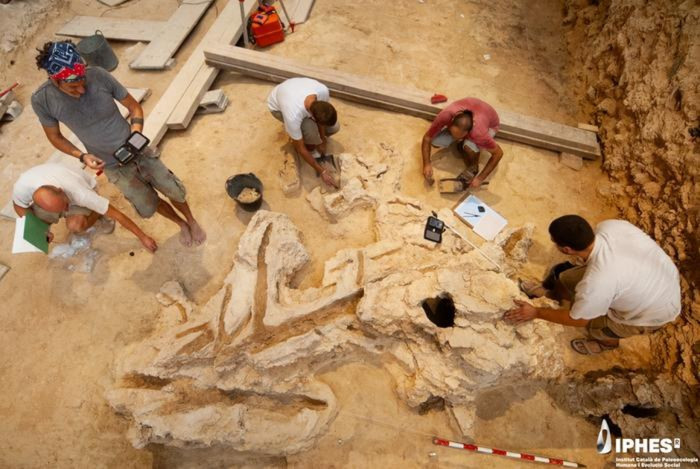
Members of the Abric Romaní excavation team record a long wooden object preserved as a travertine mold in the rock shelter floor. Source: Gerard Campeny / IPHES-CERCA
A Rock Shelter That Kept What Normally Rots
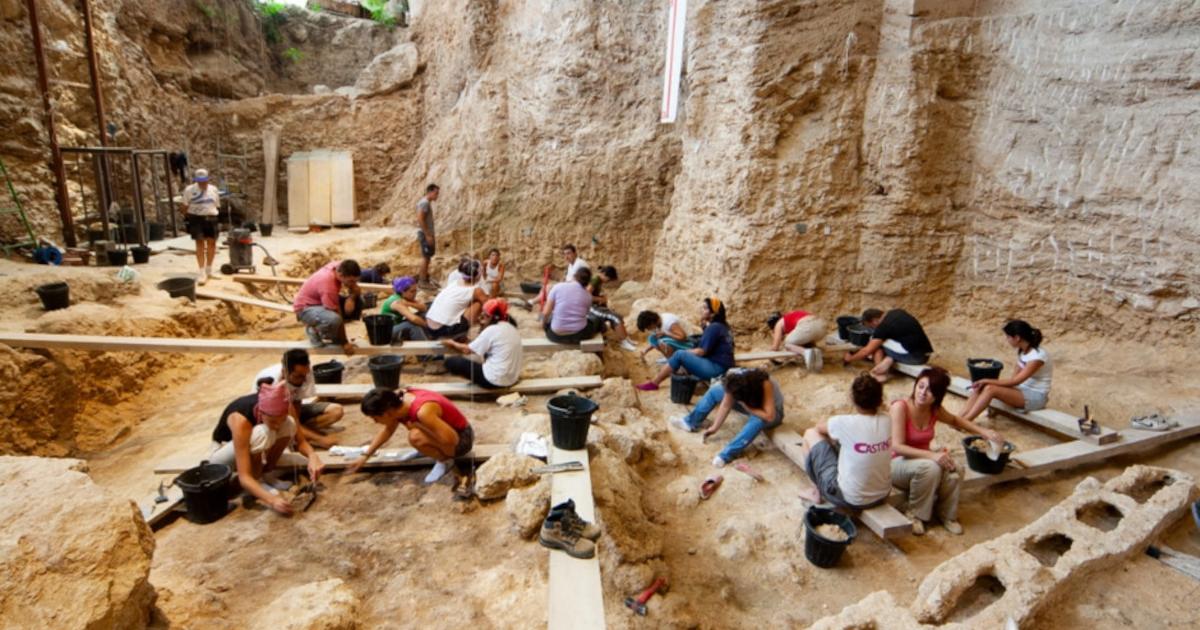
The study, led by Palmira Saladié of IPHES-CERCA and Universitat Rovira i Virgili, examined 597 wooden specimens from 16 archaeological levels, Archaeology Magazine reports. Excavation began in 1983 under Eudald Carbonell and is now directed by Saladié, M. Gema Chacón and Josep Vallverdú. Thirteen of the 597 pieces proved to be objects Neanderthals made or used.
“Neanderthal technology extended far beyond stone,” Vallverdú said.
The sediments piled up quickly, separating each living floor from the next. Hearths, butchered bones, stone tools and wood lie together on the same surfaces, letting the team read them as one scene. Earlier digging sticks from Spain and a complete tool-making tradition found in China hinted at what the study now confirms.
- 300,000-Year-Old Schöningen Spears Reveal Prehistoric Advanced Woodworking
- Neanderthals Linked to 200,000-Year-Old German Spears

Illustration depicting different scenes of Neanderthal groups at Abric Romaní using wooden objects. (Hugo Prades/IPHES-CERCA)
Spears, Trays and an Object With No Parallel
Most of the wood is firewood, including branches and trunks up to 7.2 meters long. Two spears came from Level R: one is 2.45 meters long and built for close-range thrusting, while the second survives only as a mold with a fine point. Comparable wooden weapons are known mainly from Schöningen in Germany and Lehringen.
Household items were found too. Four flat pieces of charred bark, 30 to 55 centimeters long, have a hollowed upper face that makes them look like shallow trays or bowls. They lay beside hearths and working areas, and most are juniper, rare elsewhere in the assemblage. A 5.10-meter pine pole stripped of every branch may have formed one side of a windbreak.
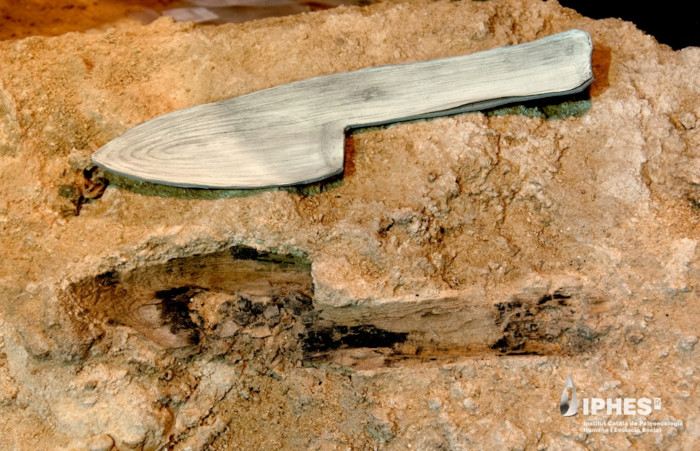
Wooden object impression found at Abric Romaní, interpreted as a wooden club, with a resin cast reproduction shown. (Gerard Campeny / IPHES-CERCA)
Then there is the club. Carved from a single piece of wood, it has a handle about 16 centimeters long that thickens at the base and a triangular head set at a sharp right angle. Scrape marks show it was shaped deliberately.
“All we know for sure is that it’s not a natural shape and we can see scrape marks on the surface,” Chacón said.
- Unique 50,000-Year-Old Neanderthal Bone Spear Point Recovered in Spain
- 60,000-Year-Old Drilled Tooth Reveals Neanderthals Practiced Dentistry!
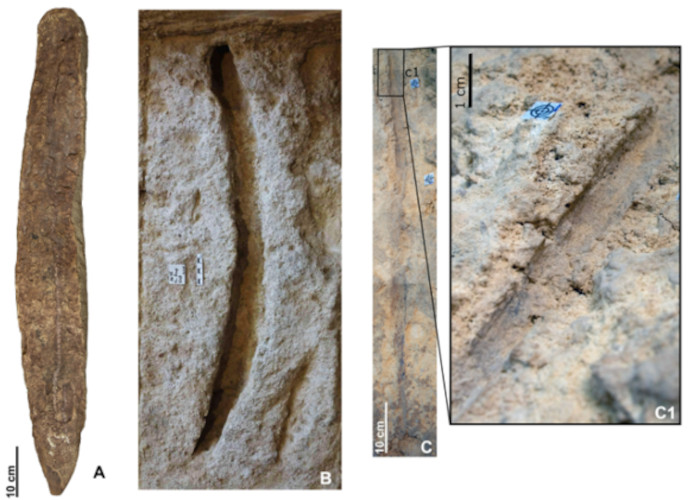
Impressions and remains of Pointed objects identified throughout the site, with (left) polyurethane resin cast made during the excavation of one of the objects. (M. D. Guillén/IPHES [A and C] and G. Campeny/IPHES B/Science Advances)
A Home, Not Just a Workplace
Scots pine accounts for more than 90 per cent of the identified charcoal and forms nearly every object, chosen because it is dense, easy to work, and resinous enough to resist damp.
“We know what was happening in the kitchen, in the sleeping areas, in the hearths,” Chacón said. “It’s like a snapshot.”
Not everyone accepts every reading. Annemieke Milks of the University of Reading, who was not involved, praised the study but noted that the objects survive only as voids in the rock, erasing tool marks. “This is really challenging material that is pushing what we can say with the archaeological record,” she said.
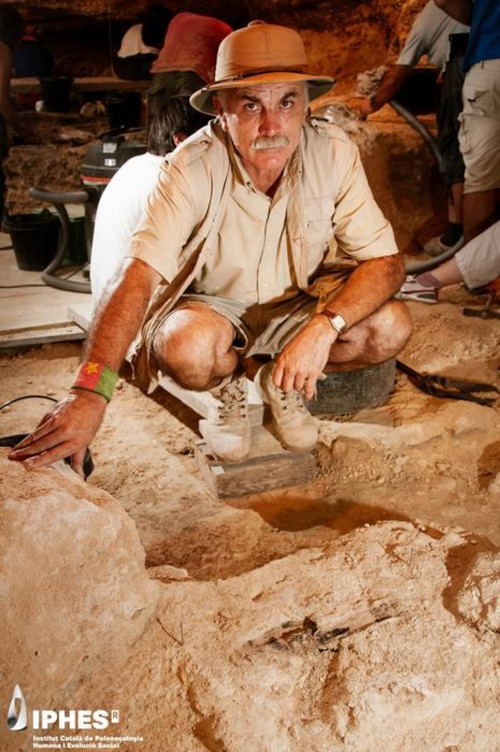
Professor Eudald Carbonell, who began excavating Abric Romaní in 1983, at the location of the club-like object find. (Gerard Campeny / IPHES-CERCA)
What the Wood Says About Neanderthal Minds
The authors argue that the variety is the point.
“Though relatively small, this collection of artifacts is notable for the varied morphology and functionality of the items that comprise it, demonstrating a remarkable technological versatility and the diversified exploitation of wood as a raw material,” they wrote.
Woodwork, they suggest, developed alongside stone tool making rather than behind it.
That fits a broader shift in how Neanderthals are understood, from unimaginative cousins to capable craftspeople who also made string and other organic goods. “Not so long ago, Neanderthals were considered our less complex cousins,” Chacón said. “Now it looks like their behaviors were very close to those of Homo sapiens.” At Abric Romaní, the proof is a set of hollows in stone still holding the shape of tools left behind more than 40,000 years ago.
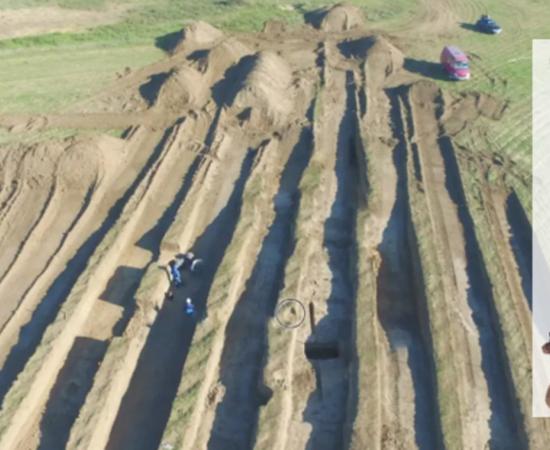
Top image: The archaeological excavation at Abric Romaní, Capellades, Barcelona. Source: Gerard Campeny / IPHES-CERCA
By Gary Manners
References
Archaeology Magazine. 2026. Neanderthal woodworking was far more advanced than we thought, new study shows. Available at: https://archaeologymag.com/2026/10/neanderthal-woodworking-was-more-advanced/
Arnold, P. 2026. Rare traces of wooden tools reveal Neanderthals were skilled woodworkers. Phys.org. Available at: https://phys.org/news/2026-10-rare-wooden-tools-reveal-neanderthals.html
Courthouse News Service. 2026. Researchers peel back layers of Neanderthal woodworking legacy. Available at: https://www.courthousenews.com/articles/researchers-peel-back-layers-of-neanderthal-woodworking-legacy
Ham, B. 2026. Wooden artifacts and imprints show a substantial role for Neanderthal woodworking in the Middle Paleolithic. Popular Archaeology. Available at: https://popular-archaeology.com/article/wooden-artifacts-and-imprints-show-a-substantial-role-for-neanderthal-woodworking-in-the-middle-paleolithic/
Institut Català de Paleoecologia Humana i Evolució Social. 2026. Abundant molds of wooden remains were found in the Abric Romaní site, evidence from 60,000-year-old Neanderthal communities. Available at: https://www.iphes.cat/
IPHES, 2026. The Neanderthal world was made of wood, too. IPHES. Available at: https://comunicacio.iphes.cat/eng/news/new/1174/category/1/news.html
La Brújula Verde. 2026. Neanderthal Wood Tools Almost Never Survive: A Spanish Cliff Has Preserved Spears, Bowls and a Club With No Known Match. Available at: https://www.labrujulaverde.com/
Nautilus. 2026. Neanderthals Were Adept Woodworkers Too. Available at: https://nautil.us/neanderthals-were-adept-woodworkers-too-1285608
Saladié, P., Chacón, M. G., Allué, E., Gómez de Soler, B., Vallverdú, J., Carbonell, E. et al. 2026. Neanderthal woodworking at Abric Romaní: Insights into the role of wood in a Middle Palaeolithic domestic context. Science Advances. Available at: https://www.science.org/doi/10.1126/sciadv.aeh2287
Science. 2026. Neanderthals were skilled woodworkers, first-of-its-kind tool trove reveals. Available at: https://www.science.org/