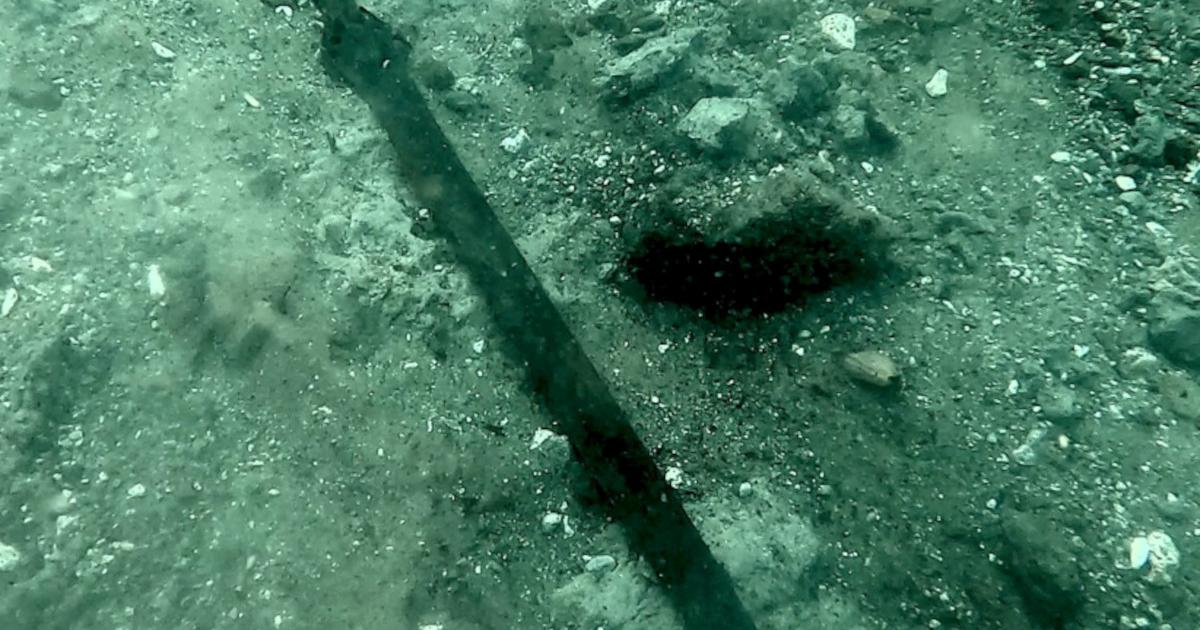

Underwater archaeologists have lifted a bronze sword from a submerged Bronze Age village in central Italy that is more than 3,000 years old – and still sharp enough to cut. The weapon, raised from Lake Mezzano in the Tuscia region of Lazio, is the third sword to come out of the same site since the 1970s. Why so many finely made blades ended up there is a question researchers still cannot answer.
The find was announced by the Soprintendenza Archeologia, Belle Arti e Paesaggio for the province of Viterbo and Southern Etruria, whose Underwater Archaeology Service recovered the blade during the closing stages of its 2026 season, assisted by Carabinieri divers. As HeritageDaily reports, the Superintendency described the recovery as being of "exceptional archaeological relevance".
A Blade That Can Still Cut After Three Millennia
The sword dates to the 13th century BC, in the Late Bronze Age and roughly five centuries before Rome's traditional founding. That the edge survived three thousand years underwater points to both the quality of the metalwork and the protective conditions of the lakebed. La Brújula Verde notes that Italian archaeologists place the weapon in the Bronzo Recente, their term for the final phase of the peninsula's Bronze Age.
The blade was found on 28 September along the southern shore, a sector that had barely been investigated before. Its shape and date sit within the weapons produced in central Italy at the end of the Bronze Age, evidence of how specialised the region's metalworkers had become. Comparable Late Bronze Age swords from the Balearic Islands have recently been re-examined in similar terms.
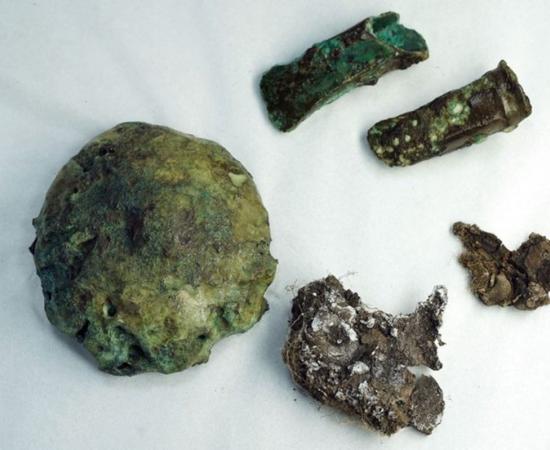
The same season produced complete ceramic vessels, bronze axes, arrowheads, daggers, spearheads, long pins and a razor. Such a haul is remarkable for a site of this age, which more often yields fragments. Conservators from CSR Restauro Beni Culturali stabilised the objects as they came up.
- •Submerged Bronze Age Settlement Reveals Pottery and Wooden Structures
- •Spectacular Bronze Votive Offerings Discovered in Etruscan Ritual Well
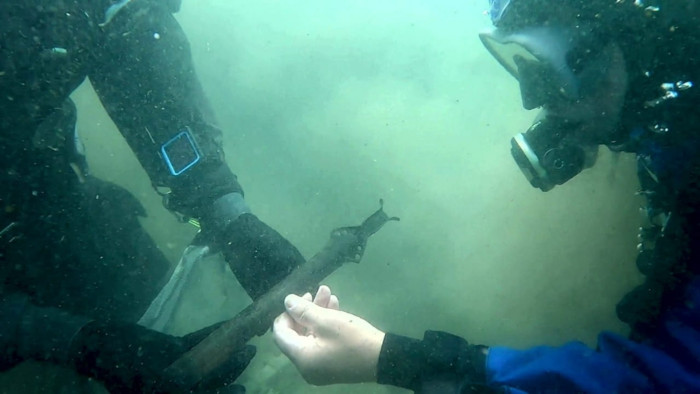
The sword moments before it left the water, held by divers from the Rome Carabinieri diving unit. (Soprintendenza Archeologia Belle Arti e Paesaggio per la provincia di Viterbo e per l'Etruria Meridionale / MiC press image)
A Village on Stilts Inside a Volcano
Lake Mezzano fills the crater of an extinct volcano inside the Latera caldera, in the municipality of Valentano, north of Rome. Its surface covers around half a square kilometre, yet beneath the water lie the remains of an extensive pile-dwelling settlement occupied from the early second millennium BC.
The site was identified in the early 1970s, when the geologist Lamberto Ferri Ricchi recognised three pile-dwelling villages at Mezzano. Investigation lapsed for decades before resuming in 2025, when divers mapped more than 600 wooden posts protruding from the clay lakebed, covering roughly a third of the known settlement. The piles sit between 2.5 and 10 meters down, suggesting the village shifted as water levels changed.
That campaign also recovered more than 25 bronze objects, among them axes, spearheads, brooches, rings and a sickle. Fragments of bronze ingots suggested that metalworking took place in or beside the village, a craft that elsewhere in Bronze Age Europe went hand in hand with political power.
- •Perfect Bronze Age Sword Reveals Secrets of Ancient Metalworking
- •Ornate Bronze Age Sword Discovery in Poland Was Likely a Sacrifice
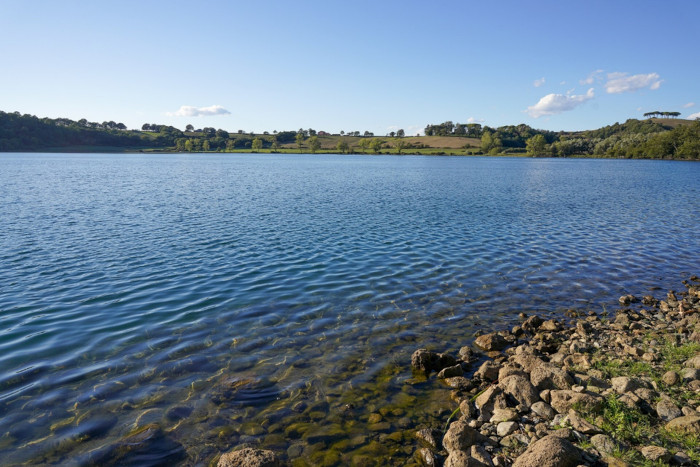
Lake Mezzano occupies the crater of an extinct volcano in the Tuscia region of northern Lazio. (WikiRomaWiki/CC BY-SA 4.0)
Why Did the Weapons Enter the Water?
Bronze swords, axes and spearheads turn up in lakes, rivers and bogs across Europe, and many were never simple losses. Weapons deliberately snapped and thrown into a Scottish loch some 3,000 years ago, for instance, are widely read as ritual offerings to the gods. The Superintendency notes that such wetland finds are often interpreted as deliberate deposits.
At Mezzano, one detail sharpens that reading. The new sword lay close to a bronze razor, a pairing documented at other Bronze Age sites and linked to individuals of elevated status, probably members of a warrior elite. In a period when bronze weapons stood for prestige as much as for combat, the company a blade kept on the lakebed may matter as much as the blade itself. Hoards from Germany and the Czech Republic have been read the same way.
There is a competing explanation. Evidence from 2025 suggests some objects may have fallen or rolled from wooden structures, at least one of which appears to have burned. Investigators have not chosen between accident and intention, although metal artefacts at Mezzano lie at strikingly consistent depths, which may reveal how the deposit formed.
A Bronze Age Archive Still Giving Up Secrets
The lake has preserved far more than metal. Excavations have produced pottery, wooden artefacts, animal remains, grinding stones and structural timbers, plus environmental evidence recording the second-millennium BC landscape. The Superintendency regards Mezzano as one of the most important archaeological and palaeoenvironmental archives in Tuscia, and as a record of communities that lived here long before the Etruscans.
Work will continue, with future campaigns expanding underwater excavation and using three-dimensional mapping to record the position of every object. A selection of the Mezzano bronzes is also earmarked for public display, in an exhibition planned with the municipal administration of Valentano.
What the third sword cannot yet settle is whether its owner lost it, whether it went down with a burning house, or whether someone gave it to the water on purpose. For now, the answer rests somewhere in the silt of a volcanic lake.
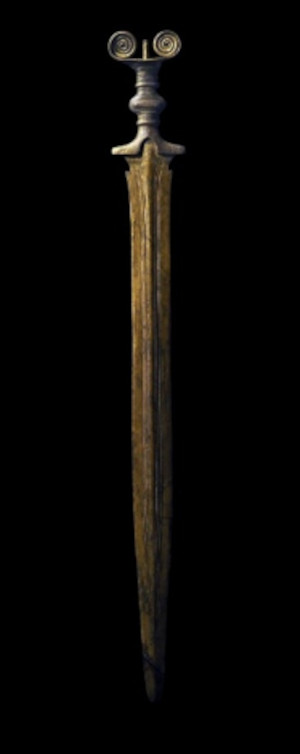
A Late Bronze Age sword with an antenna hilt of a type made in central Europe between about 1300 and 800 BC, on display at the Cantonal Museum of Archaeology and History, Lausanne. (Rama / CC BY-SA 3.0 FR)
Top image: The 3,000-year-old bronze sword where it lay on the bed of Lake Mezzano before recovery. Source: Soprintendenza Archeologia Belle Arti e Paesaggio per la provincia di Viterbo e per l'Etruria Meridionale
By Gary Manners
References
Archaeology News Online Magazine. 2026. 3,000-Year-Old Bronze Sword Found at Submerged Bronze Age Settlement in Italy. Available at: https://archaeologymag.com/2026/10/sword-found-at-submerged-settlement-in-italy/
Finestre sull'Arte. 2026. Lake Mezzano: A Bronze Age Sword in Excellent Condition Has Been Discovered – It Is the Third One Found at the Site. Available at: https://www.finestresullarte.info/en/archaeology/lake-mezzano-a-bronze-age-sword-in-excellent-condition-has-been-discovered-it-is-the-third-one-found-at-the-site
HeritageDaily. 2026. 3,000-Year-Old Bronze Sword Discovered in Submerged Settlement in Italy. Available at: https://www.heritagedaily.com/2026/10/3000-year-old-bronze-sword-discovered-in-submerged-settlement-in-italy/159528
La Brújula Verde. 2026. Sword From the Age of Ramesses II Pulled From an Italian Volcanic Lake Still Has a Sharp Edge. Available at: https://www.labrujulaverde.com/en/2026/10/sword-from-the-age-of-ramesses-ii-pulled-from-an-italian-volcanic-lake-still-has-a-sharp-edge/
Soprintendenza Archeologia, Belle Arti e Paesaggio per la provincia di Viterbo e per l'Etruria Meridionale. 2026. Valentano (VT ) – Eccezionale rinvenimento nel Lago di Mezzano: recuperata una spada dell'Età del Bronzo. Available at: https://sabapviterboetruria.cultura.gov.it/valentano-vt-eccezionale-rinvenimento-nel-lago-di-mezzano-recuperata-una-spada-delleta-del-bronzo/