Vincent Ongkowidjojo

Profile picture for user Vincent Ongkowidjojo
Vincent Ongkowidjojo

Vincent Ongkowidjojo (1979) is the author of Secrets of Asgard (Mandrake, 2011) and Doors of Valhalla (Mandrake, 2016). Earlier he published Runen in de Noordse traditie by a well-known Dutch publisher Ankh Hermes Deventer (2007). His works have always been described as well-written and ground-breaking.

Vincent graduated as a master in Assyriology, at the KU Leuven, having studied both Ancient Hebrew and Aramaic apart from the cuneiform languages.

During his university studies he came in touch with the runes and quickly began corresponding with Freya Aswynn, author of the influential Leaves of Yggdrasil (Llewellyn, 1990). In the year 2005, Vincent and Freya met frequently in London, and this started Vincent’s teaching in Freya’s School of Runes and Northern Mysteries. He now assists her with her rune course and school (www.aswynn.com).

Concurrent with his study of runes and Norse mythology, Vincent began practicing taiji. Since 2007 he also teaches taiji. Later he also started teaching meditation, albeit within the taiji system. Nowadays he still follows classes with Tine Vandromme (http://www.evenwichtinbeweging.be), whose teacher is Patrick Kelly, a student of the late Huang Xing Xian.

Vincent’s vision is rooted in Western and Eastern esoteric philosophies. He currently lives in Belgium.

More information is found on his website (www.alhaz.be) and on Mandrake’s website (http://mandrake.uk.net/vincent-ongkowidjojo). 
Member for

10 years 5 months

View Recent Blogs

The existence of mystery schools in the Viking Age (800-1200 CE) is deduced from myth and folklore. The poems of the Edda display the structure and content of cultic texts used within the framework of initiatic organizations. Later, in Medieval Europe, we hear about secret societies associated with the Wild Hunt, Odin, and the Einherjar. Their mysteries centered around the runes, which were already deployed magically in Ancient Germanic times (400-800 CE). The runic alphabet, or Futhark, is found in the archaeological record from the second century onwards. But its roots are far older. [[{"type":"media","view_mode":"media_large","fid":"22351","attributes":{"alt":"Runic inscription carved into bone. Found in Sweden.","class":"media-image","height":"144","style":"width: 610px; height: 144px;","typeof":"foaf:Image","width":"610"}}]] Runic inscription carved into bone. Found in Sweden. ( CC BY-SA 3.0 ) Origins of
Most people today who have heard that ‘the Nightmare’ is an actual being in European folklore and not just a certain type of dream-state, associate the being with horses. A mare is indeed a horse—but this interpretation is not correct. The mare of ‘the nightmare’ is a demon; and the word for horse and the word for nightmare derive from a different root. Mara – Evil Spirits and The Night Horse In Dutch, the nightmare is known as the maar or mare, sometimes called nachtmaar or nachtmare, analogous to the English word. Over time, the Dutch word changed into nachtmerrie where merrie means female horse. We see that the folk etymology of ‘night horse’ was very common. [[{"type":"media","view_mode":"media_large","fid":"42557","attributes":{"alt":"A nightmarish vision
Modern heathenism has been fascinated by the concept of the Nine Worlds of Norse mythology and readily provides the names of these worlds and their meanings. Academics are equally guilty. Whereas this is a good practice from a psycho-analytical point of view, we should remember that this has little to do with what our ancestors understood by the concept. Only three passages mention the Nine Worlds and they are Voluspa 2, Vafthrudnismal 43 and Gylfaginning 34. One more passage briefly skims the concept, and that is Skirnismal 35. [[{"type":"media","view_mode":"media_large","fid":"27731","attributes":{"alt":"Völuspá is the first and best known poem of the Poetic Edda. \"Odin and the Völva\" (1895) by Lorenz Frølich.","class":"media-image","height":"444","style":"width: 610px; height: 444px;","typeof":"foaf:Image","width":"610"}}]] Völuspá is the first and best known poem of

Modern heathenism has been fascinated by the concept of the Nine Worlds of Norse mythology and readily provides the names of these worlds and their meanings. Academics are equally guilty. Whereas this is a good practice from a psycho-analytical point of view, we should remember that this has little to do with what our ancestors understood by the concept.

Only three passages mention the Nine Worlds and they are Voluspa 2, Vafthrudnismal 43 and Gylfaginning 34. One more passage briefly skims the concept, and that is Skirnismal 35.

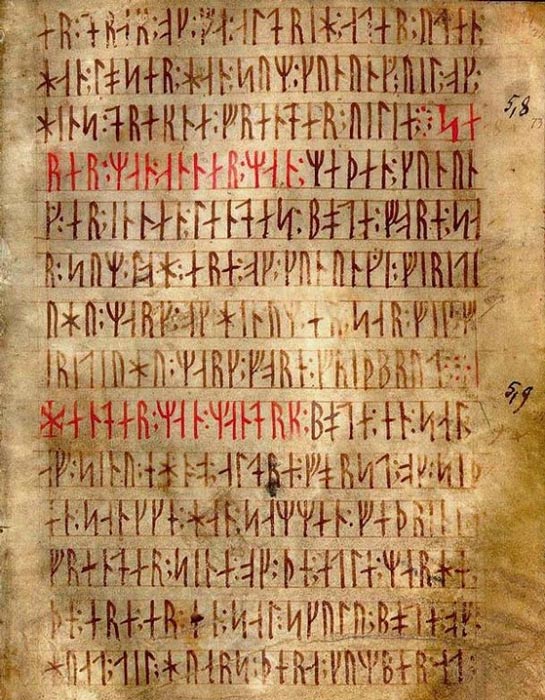
One of the most shrouded mysteries of the rune alphabet is its early history. As a matter of fact, no-one really knows how the Elder Futhark came to be. We know that the runes exist and were used by the Ancient Germanic people, but where did they come from? [[{"type":"media","view_mode":"media_original","fid":"25364","attributes":{"alt":"Codex runicus, a vellum manuscript from c. 1300 containing one of the oldest and best preserved texts of the Scanian law (Skånske lov), written entirely in runes.","class":"media-image","height":"700","style":"width: 545px; height: 700px;","typeof":"foaf:Image","width":"545"}}]] Codex runicus, a vellum manuscript from c. 1300 containing one of the oldest and best preserved texts of the Scanian law (Skånske lov), written entirely in runes. ( Public Domain ) Rock Engravings The first visible traces of a Northern European