Saurav Ranjan Datta

Profile picture for user Saurav Ranjan Datta
Saurav Ranjan
Datta

Saurav Ranjan Datta is a history and travel buff who has been writing for several publications for the last 10 years in both these subjects. By education, he is a post-graduate in management. He belongs to the city of Kolkata from India. He has also been a content researcher for TV and online platforms. He has been a brand manager for top corporate entities in India for the last 15 years. Saurav has just published his first book, ‘Maidens of Fate’, available now on  Amazon.

Member for

6 years 11 months

View Recent Blogs

Some of humanity's most ancient civilizations originated on the current continent of Asia. At the dawn of civilization, places like Mesopotamia, Harappa, China, and others saw various advance settlements that consisted of a large populace. Those settlements were ruled by several powerful monarchs in the succeeding centuries. In fact, the kingdoms of Ancient Asia gave rise to some of the most dynamic kings of antiquity. Those rulers changed history in their own ways during their time, and their impact on the modern world is still evident in many ways. But we have forgotten most of these monarchs. In this article, we will discuss a collection of them, more or less heard of, who ruled large kingdoms in some parts of
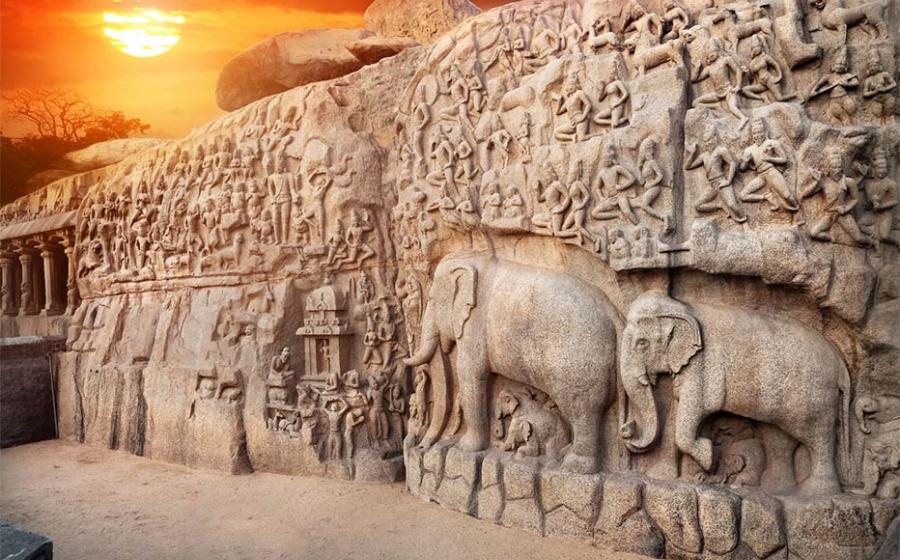
In southern India, the journey from Puducherry to Chennai is without question one of the most pleasurable travel experiences to be found in all of south Asia. The biggest highlight of this trip lies in the scattered ruins of the Group of Monuments at Mahabalipuram, a UNESCO World Heritage Site, home to the remnants of a once-mighty empire that influenced the Indian psyche and much of South-East Asia. All the Mahabalipuram structures are the work of the Pallava dynasty (275 AD to 897 AD), who started temple building with rock-cut structures and then moved on to individual temple buildings. The Pallava dynasty created the architectural style that has made south Indian temple architecture so unique and famous around the world
This is the story of a son in ancient India who killed his father for no other reason than uncontrolled ambition. In the royal dynasties of India, the killing of family members and family rivals is a lot more common than you might think. However, the Haryanka dynasty succession killing is unique because the son, the future King Ajatashatru, had absolutely zero competition for the throne. Ajatashatru’s murder of his father left him feeling immense remorse and he tried hard to find solace through the wisdom of the Gautama Buddha, the first Buddha, who lived from the 5th to 4th century BC. This is the dramatic story of King Ajatashatru of the Haryanka dynasty, whose betrayal of his father continues
Rome, this very name conjures up images of an ancient empire so vast that experts from different ages have been spellbound by the unprecedented magnanimity of its reaches. Ancient Rome defined the very genesis of our Western civilization, but it also attracted hordes of enemies. The most courageous of the enemies of Rome saw its immense power, but still decided to face their formidable opponents – at best they achieved great victories, spurring on rebellions against the Roman army, at worst, they fell to their skilled adversaries. Legendary Beginnings Rome has some very interesting myths regarding its foundation story too. When the Trojan War broke out in the epic Iliad, the city of Troy was breached and destroyed by a
At a glance, history can seem chaotic. We need to delve into the depths of any particular era, and not just focus on particular incidents. History is not just a timeline of earth-shattering battles, but is also a continuous process of cultural assimilation by many groups of people. Often, it is the story of a particular dynasty spreading its wings and bringing the population of a vast area together with its indelible mark of governance and influence. India’s is a complex, mammoth and million-faceted history. Sometimes, its beauty can be appreciated as a continuum, where an empire never disappears completely, but only fades away momentarily to reappear in a different form for the following generations. In India today, the southern
Sometimes, a man acquires a legendary aura due to the benevolence of his heart or due to the greatness of his deeds. But often legends accumulate the collective qualities of various heroes and give them a solitary name and face. In the history of mankind, this singularity has often been witnessed across lands and geographies, and this is likely the case with the multiple Raja Bhoj of India, legend Legendary Kings We all know about King Arthur, his Excalibur and how he bravely defended his land. The character of Arthur was probably drawn from many local leaders and heroes who at various points in English history successfully won battles and looked after the well-being of their respective people. Simultaneously in
The history of the Indian sub-continent’s Bengal region dates back to ancient times. This long history includes India’s most famous epic stories including the Ramayana and the Mahabharata. Ancient Bengali Buddhists were powerful promoters of Buddhism, that spread far and wide across Asia. During the 7th-8th centuries AD Bengal was the center of Buddhist expansion in India and also a key force in the development of Tibetan Buddhism, an off-shoot of Mahayana and Tantric Buddhism. Ancient Bengali Buddhists are today seen as the patrons of early Tibetan Buddhism. The state of West Bengal is inhabited by a community that speaks a language called Bangla or Bengali. Bangla is an Indo-European language also spoken by the people of Bangladesh. The people
As Indians, we have always been brought up on folk tales, several mythological stories with lots of battles fought with wondrous weapons. We have listened to the tales of the great Kurukshetra War from the epic ‘Mahabharata’ between the Pandavas and Kauravas with their use of celestial weapons. We have also been narrated the events of the great war of Lord Rama with Asura King Ravana in the other epic ‘Ramayana’. All these tales have made us fascinated about wars and the valor of the warriors. However, these are mythologies where the writers have added layers of fantasy to an existing structure. Nevertheless, just like the wars of the epics, the real ancient Indian warfare was equally fascinating, minus its
Just like Gaea, the embodiment of Mother Earth in Greek mythology, India also has a concept of Adi Parashakti, the supreme mother who is behind the creation of the entire universe, the cosmos, and the complete cycle of physical life. This weltanschauung of a primordial mother goddess is present in every Indian’s life and resonates with the belief that this feminine super power will look after all her children just like a mortal mother, whose love for her children is considered to be the greatest in this world. A Paradox for Women in India This belief emanates in the cultural and religious life of most Indians, where female deities like goddesses Durga and Kali, the embodiment of Shakti – the
The impact of Alexander III of Macedon better known to us as Alexander the Great, continues to this day. Even in the Indian sub-continent, his legacy is still visible in the names of numerous children who have been christened as Sikandar and Iskandar (the Persian version of his name) in the hope that they too will have a similar influence in this world. Alexander the World Conquering Monarch Alexander is a much-revered figure in India yet today and in general people still consider him to be the pinnacle of all world conquerors. His legacy in this country continues in various forms. A small isolated village in the Indian state of Himachal Pradesh called 'Malana' claims that all its inhabitants are