NisaRyan

Profile picture for user NisaRyan
Nisa
Ryan

Nisa Ryan is an avid devourer of folklore and literature. She enjoys reading manga and watching anime as well as spending times outdoors. Growing up in Japan, her love of all things Japanese led her to get a B.A. in Asian Studies with a focus on Japanese history and religion. She later received her MA in TESOL from Carson-Newman University and works as an ESL teacher overseas. Currently, she is writing a fantasy novel that takes place in an alternate Japan, along with compiling a book of information on Japanese yokai as they pertain to the religious practices of Shugendō. You can read more about her projects at her website: www.nisaryan.com

Member for

7 years 6 months

View Recent Blogs

Kitsune (狐狸精), the Japanese fox-spirit, is also known as the Kumiho (구미호) in Korea and the Huli Jing (狐狸精) in China. They are basically the same creature but with a few differences based on region. 夜の暗闇の中で狐の罠作るのは簡単です In the dark of eveningThe fox’s trapIs easy to make In all three cultures, the fox-spirit is mostly viewed as an evil creature. They were known to enjoy the company of humans for a variety of reasons that almost always end badly for the unfortunate individual who encounters one. The main reason a fox-spirit might search out a human was to suck away their life force or to even eat human flesh and thereby steal any powers that person might have along with all
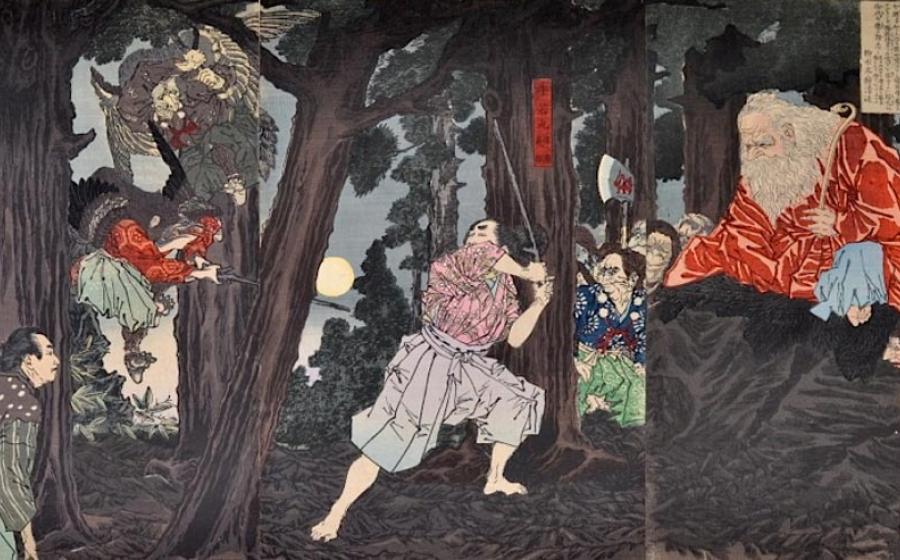
The Tengu were not only protectors of the mountains and the Buddhist faith, they were also known to be mischievous tricksters who, much like their Kitsune cousins, were capable of using magic such as glamour to change their shape. They were known to take humans caught in their mountains as captives for their own entertainment and multiple stories of the Tengu have survived since ancient times. The Man Who Flew – Tonda Otoko (飛んだ男) In 1810 there is a story in Asakusa of a man that fell from the sky, utterly naked, and was left lying in the street. He was found by a farmer who helped the man to his home and nursed him back to health. When questioned
The practice of Onmyōdō has a contentious history in Japan and, for reasons that will become clear, was outlawed for some time along with its close cousin, Shugendō (修験道). Onmyōdō, means literally, ‘the way of the Yin and Yang’. In the 5th/6th centuries, the principles of Yin-Yang and the use of five elements were transmitted to Japan from China along with Buddhism and Confucianism. These esoteric practices combined with local religions to create what came to be called Onmyōdō. By the 10th century its practice had been well established. But by the 19th century it had been made illegal to practice. This will be a very brief history of Onmyōdō, as there is far too much to go into in
The Tengu ( 天狗 ) are possibly the most recognizable of all the Japanese yokai, with their enormous black wings and faces of either a large crow or a red-faced, long-nosed, goblin. They are often dressed as Shugendō priests, having a long-standing association with our ascetics in the mountains. Many Shugendō consider the Tengu to be our brothers and protectors while traversing the Kurama Mountain ranges. But the Tengu did not always look this way. In China, his country of origin, the Tengu is called Tiangou and was depicted as a large black dog that swallowed the sun or moon during eclipses. But, how did the Tiangou go from being a celestial dog to a dour faced bird man guarding