Natalia Klimczak

Natalia Klimczak
Natalia
Klimczak

Natalia Klimczak is an historian, journalist and writer and is currently a Ph.D. Candidate at the Faculty of Languages, University of Gdansk. Natalia does research in Narratology, Historiography, History of Galicia (Spain) and Ancient History of Egypt, Rome and Celts. She is an Egyptologist, polyglot and an author of hundreds of articles and three books. She worked for Ancient Orgins from December 2015 until April 2017.


Member for

10 years 10 months

View Recent Blogs

When archaeologists found a cache of medieval mummies in a Lebanese cave, the amazing discovery took their breath away. The remarkably well-preserved bodies of eight people who were buried in Qadisha Valley opened the gates to a forgotten story. Imagine this meeting of living researchers and people who died centuries ago – although the faces of the deceased were still recognizable, their names and companions were already long gone. The fascinating mummies were brought to light by a team of archaeologists and speleologists (specialists in caves) from the Groupe d'Etudes et de Recherches Souterraines du Liban- GERSL. GERSL’s investigation of the grotto unfolded over several years. The infant later named Yasmine was found on July 13, 1990. During explorations in
Official history says that the Spanish colonizers in America were focused on the territory from Mexico to the end of South America. For centuries, there was the question of why the Spaniards didn't decide to try to conquer further north. However, artifacts from the 16th, 17th and 18th centuries bring a new light to this topic. It is known that the Spanish claimed territories in what is today part of the United States of America. In the 16th century, they had explored the southern area of the country. For example, in Florida, the St Augustine fort was established by the Spanish in 1565. The impact of the Spanish way of understanding Roman Catholicism is evident in this region. The Spanish
Lilith, an ancient mythological figure and one of the oldest known female spirits in the world, has embodied various roles across cultures. In some sources she has been described as a demon, while in others she was revered as an icon who morphed to become one of the darkest deities of the pagans. While her roots can be found within the famous Epic of Gilgamesh, she was also described within both the Bible and the Talmud. Within Jewish tradition, Lilith is regarded as the most notorious of demons, which in other sources she was portrayed as the first woman created on Earth. In fact, according to one legend, God formed Lilith as the first woman of the human race, employing
It is unknown which culture was the first to create music, but a set of beautiful Sumerian instruments from the city of Ur provide us with some insight into the world of ancient music. Over 4,000 years after they were first made, these musical instruments—known as the Lyres of Ur—have been reconstructed for modern audiences to marvel at their melodious sounds as well as their eye-catching splendor. The famous Lyres of Ur, which are somewhat similar to modern harps, are amongst the oldest stringed instruments unearthed to date. They were found in 1929 by a team of archaeologists led by Leonard Woolley. Although he is known as the discoverer of numerous fantastic treasures from this ancient city and the Royal
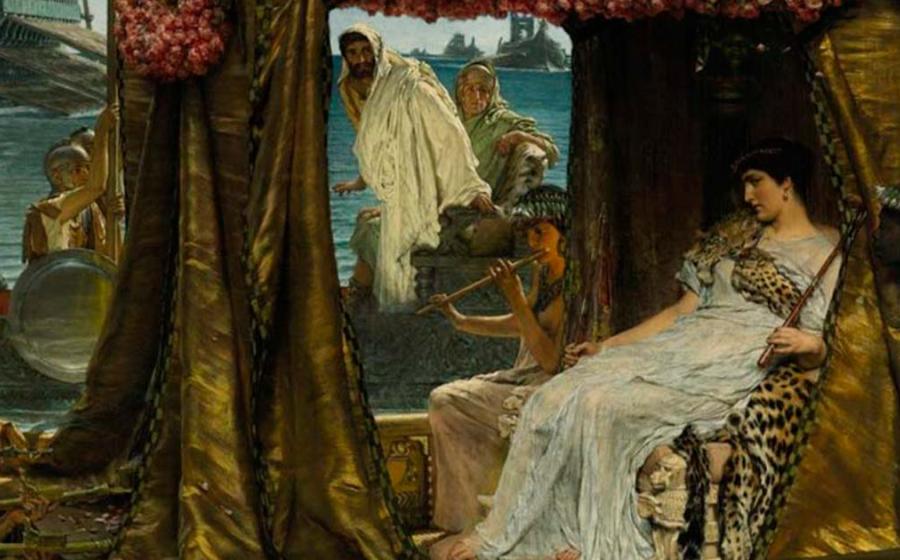
The Battle of Actium proved to be a catastrophic blow to the hopes and dreams of Cleopatra VII and Mark Antony. With unwavering confidence, the renowned duo had nurtured the belief that they were adequately equipped to confront the forces commanded by Octavian. However, their convictions were ultimately shattered as reality proved them wrong. [[{"type":"media","view_mode":"media_large","fid":"110111","attributes":{"alt":"‘The Meeting of Antony and Cleopatra’ (1885) by Lawrence Alma Tadema. (Public domain)","class":"media-image","style":"width: 610px; height: 438px;","typeof":"foaf:Image"}}]] ‘The Meeting of Antony and Cleopatra’ (1885) by Lawrence Alma Tadema. ( Public domain ) Surprising Defeat with Numerical Advantage at the Battle of Actium According to certain researchers, the Roman forces in the Battle of Actium comprised 250 galleys, 16,000 infantry, and 3,000 archers. In contrast, Cleopatra and Antony
There is no inscription or papyrus to confirm who the mother of Cleopatra VII was, but the information that exists about her and the world of the Ptolemaic period suggest that it was Queen Cleopatra V Tryphaena. Otherwise, the girl who grew up a half orphan, wouldn't have had a chance to create such an incredible life. Cleopatra V Tryphaena vanished around the same time as when the future last queen of Egypt was born. She continues to be one of the most mysterious queens of the Ptolemaic Period. She may have lived in Alexandria. The oldest known papyri mentioning her comes from 79 BC. That was the year when she married Ptolemy XII, king of Egypt. In some books
Cleopatra VII had four children. One with Julius Caesar and three with Mark Antony. Until 31 BC the family of the last Ptolemaic queen lived a magnificent life in a golden palace, one of the most luxurious places in the world. However, when Cleopatra and Mark Antony were defeated by Octavian during the naval battle at Actium in 31 BC, this idyllic life came to a close. The future Roman Emperor, who was about to be known as Caesar Augustus, didn't give any mercy to his enemies. He hoped to defeat Mark Antony and take Cleopatra as his trophy to Rome, to humiliate and ultimately put her to death. According to the ancient resources, this didn't happen because in 30
Circe is a complex character within Greek mythology. Feared and desired in equal measure, Circe was a goddess of magic, and even today she continues to be one of the most enchanting and deadly deities of the Greek pantheon, despite playing a minor role within the many legends from her home on the mythical island of Aeaea. Detail from a painting of Circe offering the Cup to Ulysses, the Latin name for Odysseus, by John William Waterhouse. ( Public domain ) The Genealogy of Circe in Greek Mythology In most texts, the mythological Circe is described as the daughter of Helios, the Titan of the Sun, and Perse the Oceanid. In Greek mythology, Circe is described as having several siblings
The mysterious, one-eyed creatures revered in Greek and Roman mythologies remain one of the most riveting of the oldest Mediterranean legends. The mighty Cyclopes were members of a race of giants and have been the subject of damning character assassinations throughout history. But, how much truth is there to tales of their existence? Although most Cyclopes remain anonymous, the ancient sources describe a Cyclops named Polyphemus who lived on an island which is believed to be Sicily. This island was populated by the Cyclopes and other creatures. The name “Cyclops” means “circle-eyed” or “round-eyed.” Their genesis seems to be more complicated than the myths which described them. Searching for any real origins of Cyclopes, and possible evidence of their existence
Witch trials are among some of the cruelest events in European history. Thousands of innocent women were murdered by people who provided fake accusations. In England, one of the most famous witch trials, the Pendle witch trials, took place in 1612, during the reign of King James I (b. 1566 – d. 1625). 400 years later there’s a petition seeking a royal pardon for the witches. When driven by fear of the unknown, some people have always reacted with irrational and cruel actions. Witches were viewed as dangerous creatures to closed-minded people who identified them with evil spirits. Although they never tried to convert the whole world to one religion, witches were seen as a danger to religious doctrines. Witchcraft