
Lara Croft's first adventure arrived in 1996. Thirty years later, Crystal Dynamics and Flying Wild Hog are rebuilding it in Unreal Engine 5 as Tomb Raider: Legacy of Atlantis. A new generation of players will soon meet the island through a game. But what did the one ancient author who described Atlantis actually say?
The game and its route
Game Informer's December cover story is devoted to the game, which the magazine calls "the upcoming reimagining of the original 1996 Tomb Raider." Its editors played it for several hours at Crystal Dynamics, including what the magazine describes as "an exclusive tour of the Greece section." The release date of February 12, 2027, was announced at a PlayStation State of Play in June 2026, and Game Informer noted that this was technically a delay from 2026.
The official Tomb Raider site lists the game for PlayStation 5, Xbox Series X|S, Steam and Nintendo Switch 2. Its product page sends Lara from "the jungles of Peru to the ancient ruins of Greece, the deserts of Egypt," and on to a Mediterranean island "shrouded in myth," as she hunts for the pieces of the Scion. The official text does not name that island, but the Atlantis in the game's title has a much older author.
The only ancient source
Plato wrote about Atlantis in two linked dialogues, Timaeus and Critias. The Stanford Encyclopedia of Philosophy notes that the orthodox view places Timaeus in Plato's so-called late period, though this dating has been debated. Critias, the encyclopedia explains, is the unfinished sequel that was meant to celebrate the victory of ancient Athens over the military might of Atlantis.
Plato does not present the story as his own research. In Timaeus, the character Critias says it came down from the Athenian statesman Solon, who heard it from Egyptian priests at Sais, a city where the Nile divides. One aged priest begins with a famous rebuke, telling him in Benjamin Jowett's public domain translation: "O Solon, Solon, you Hellenes are never anything but children."
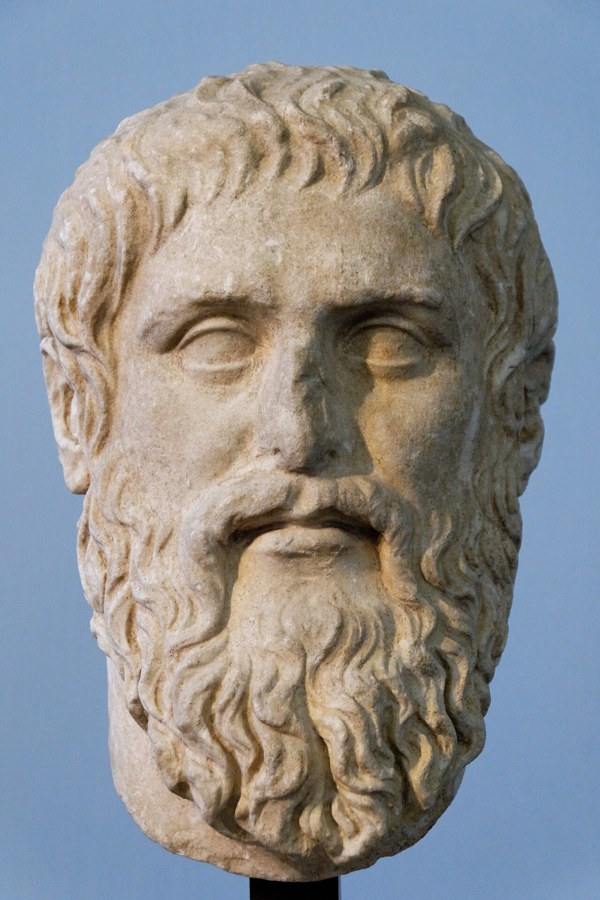
A Roman copy of a portrait of Plato, after an original by Silanion, in the Capitoline Museums in Rome. The sculpture is not from the game. Photo: Marie-Lan Nguyen, via Wikimedia Commons, CC BY 2.5.
What Timaeus says
The priest describes a war fought long before Solon's time. The Egyptian goddess, he says, founded Athens 9,000 years earlier, and Egypt itself a thousand years after that. A great power came out of the Atlantic Ocean and attacked Europe and Asia without provocation. Plato places its home on an island in front of the straits the Greeks called the Pillars of Heracles, and the priest gives its size in one striking line:
"the island was larger than Libya and Asia put together, and was the way to other islands, and from these you might pass to the whole of the opposite continent which surrounded the true ocean."
The empire of Atlantis ruled that island and others, and it reached into Libya as far as Egypt and into Europe as far as Tyrrhenia. Athens led the Greeks against it, and when its allies fell away, it stood alone and defeated the invaders. Then came the ending that has fed every later retelling: "in a single day and night of misfortune all your warlike men in a body sank into the earth, and the island of Atlantis in like manner disappeared in the depths of the sea."
What Critias adds
In Critias, Plato fills in the island itself. When the gods divided the earth by lot, Poseidon received the island of Atlantis as his portion. He fell in love with Cleito, a mortal woman who lived on a low hill, and he surrounded her home with rings of land and water, "two of land and three of water," so that no one could reach it.
Their descendants became ten kings who ruled the island's divisions under laws inscribed on a column of orichalcum, a metal Plato describes being dug from the ground. The kings bridged the rings of water, cut canals to the sea and built a temple to Poseidon. Its outside was covered with silver and its pinnacles with gold, and inside, the walls, pillars and floor were coated with orichalcum.
The dialogue then turns from wonder to judgment. As long as their divine nature lasted, Critias says, the kings were obedient to the laws and cared little for gold. Over time the human side took over, and Zeus saw a race that seemed glorious to outsiders but was, in Jowett's words, "full of avarice and unrighteous power." He gathered the gods to decide their punishment, and the text breaks off in mid-sentence as he begins to speak.
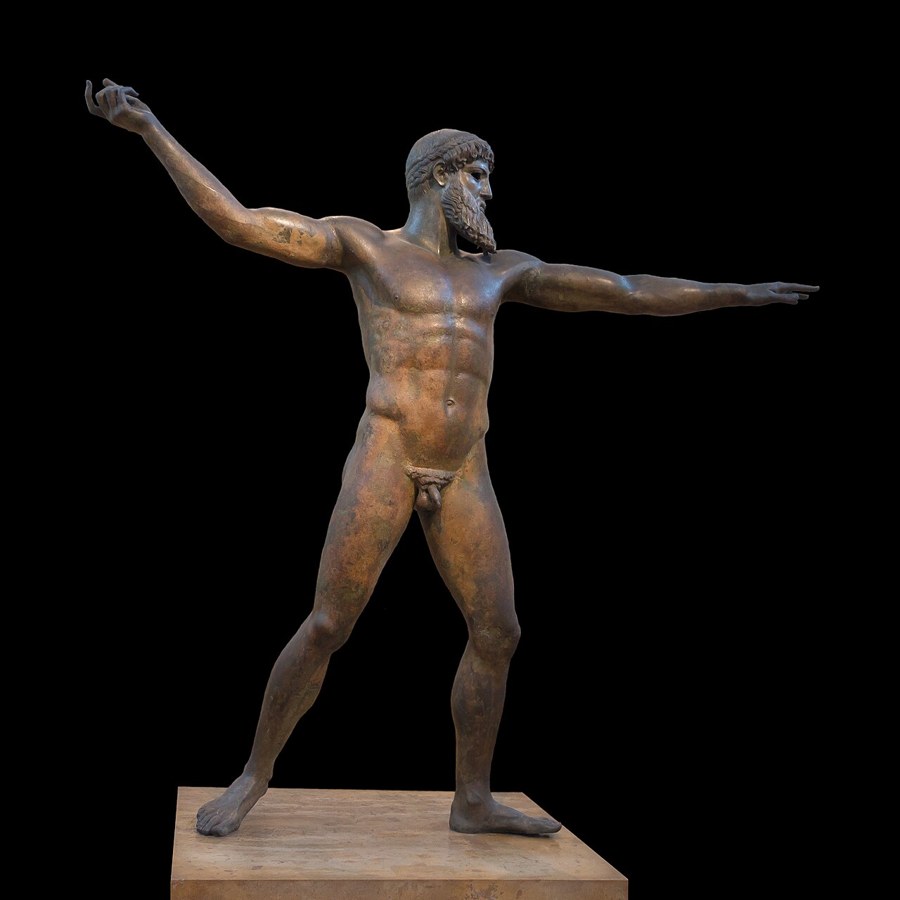
The Artemision Bronze, a Greek statue of about 460 BC recovered from the sea and identified as either Zeus or Poseidon, in the National Archaeological Museum, Athens. The statue is not from the game. Photo: Jebulon, via Wikimedia Commons, CC0.
What the story was for
The classicist Christopher Gill, author of Plato's Atlantis Story, reads the tale as philosophy rather than history. He describes it as "a tale of two cities," set in an idealized past, in which ancient Athens wins and Atlantis is defeated. He links the city of Athens in the story to the ideal state of Plato's Republic, and he argues that Atlantis "functions as a foil or contrast to the ideal."
Gill also points to the question of truth running through the dialogue, explaining it in these words:
"Critias insists that his story is true and accurate but it looks suspiciously unlike a true story, and more like a philosophical fable."
For Gill, the vivid detail is exactly why the story has lasted so long. It is told with such richness, he says, that "people almost feel it must be true."
From Plato to Lara Croft
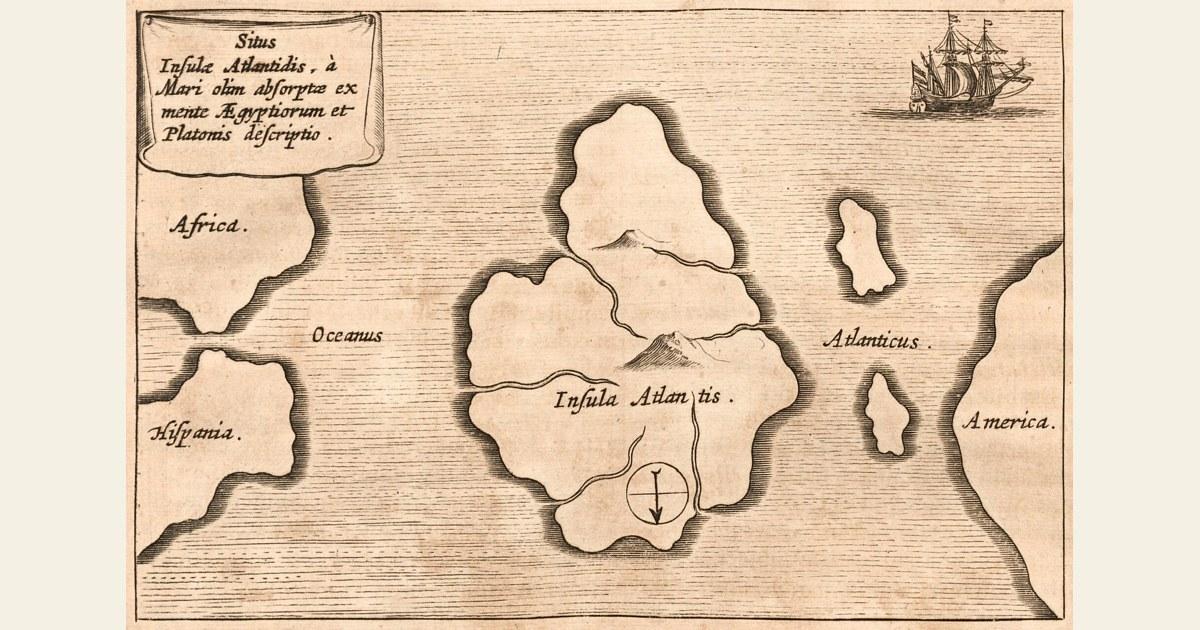
That pull has kept Atlantis on maps and in fiction for centuries. In the 17th century, the Jesuit scholar Athanasius Kircher printed a map of the island in Mundus Subterraneus, placing it in the open Atlantic between the continents. Proposals covered on Ancient Origins range from the Azores to the Aegean, where some have tied the tale to the Santorini eruption and the Minoan collapse. A video game Atlantis is one more version of a story first told roughly 2,400 years ago.
Was Atlantis a real place?
The account of the Egyptian priests survives only through Plato's own dialogues, and no outside record of Solon's conversation at Sais is known. In his 2018 interview with Liverpool University Press, Gill said the story has driven people to search for Atlantis "even though it absolutely isn't there." Readers who want the evidence weighed claim by claim can turn to a fact check on whether Atlantis was a real place, and to an explainer on Göbekli Tepe, the Sphinx and Atlantis. Still, Lara Croft does not need a real Atlantis to go looking for one, and neither did the generations of readers who kept Plato's island afloat.
Athanasius Kircher's map of Atlantis from the 1678 edition of Mundus Subterraneus, drawn from Plato's description. The map is not from the game. Athanasius Kircher, public domain, via Wikimedia Commons.
By Aris Manus
Sources
- Stewart, M. November 3, 2026. Cover Reveal: Tomb Raider: Legacy Of Atlantis. Game Informer. https://gameinformer.com/cover-reveal/2026/11/03/cover-reveal-tomb-raid…
- LeBlanc, W. June 2, 2026. Tomb Raider: Legacy Of Atlantis Gets February 2027 Release Date In New Trailer. Game Informer. https://gameinformer.com/state-of-play/2026/06/02/tomb-raider-legacy-of…
- Crystal Dynamics. Tomb Raider: Legacy of Atlantis (product page) and Pre-Orders are Open for Tomb Raider: Legacy of Atlantis (June 2, 2026). Official Tomb Raider site. https://www.tombraider.com/products/games/tomb-raider-legacy-of-atlantis
- Plato. Timaeus. Translated by Benjamin Jowett. Project Gutenberg. https://www.gutenberg.org/ebooks/1572
- Plato. Critias. Translated by Benjamin Jowett. Project Gutenberg. https://www.gutenberg.org/ebooks/1571
- Zeyl, D. Plato's Timaeus. Stanford Encyclopedia of Philosophy (revised May 13, 2022). https://plato.stanford.edu/entries/plato-timaeus/
- Liverpool University Press. August 29, 2018. The truth behind Atlantis: Christopher Gill on Plato's Atlantis Story. https://liverpooluniversitypress.blog/2018/08/29/the-truth-behind-atlan…