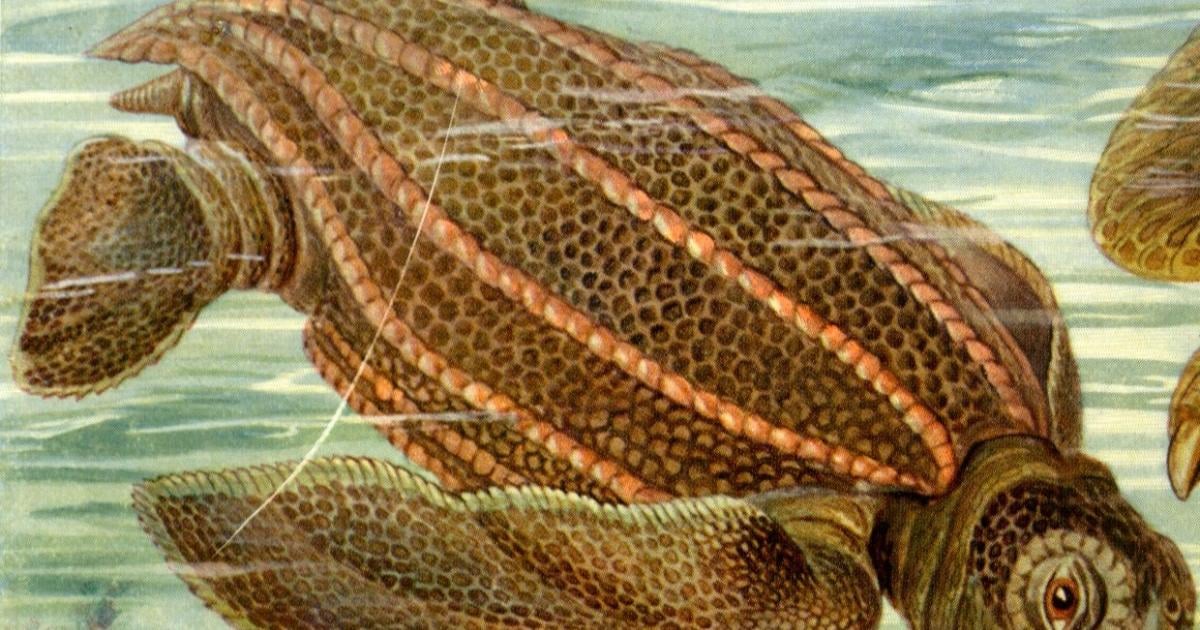

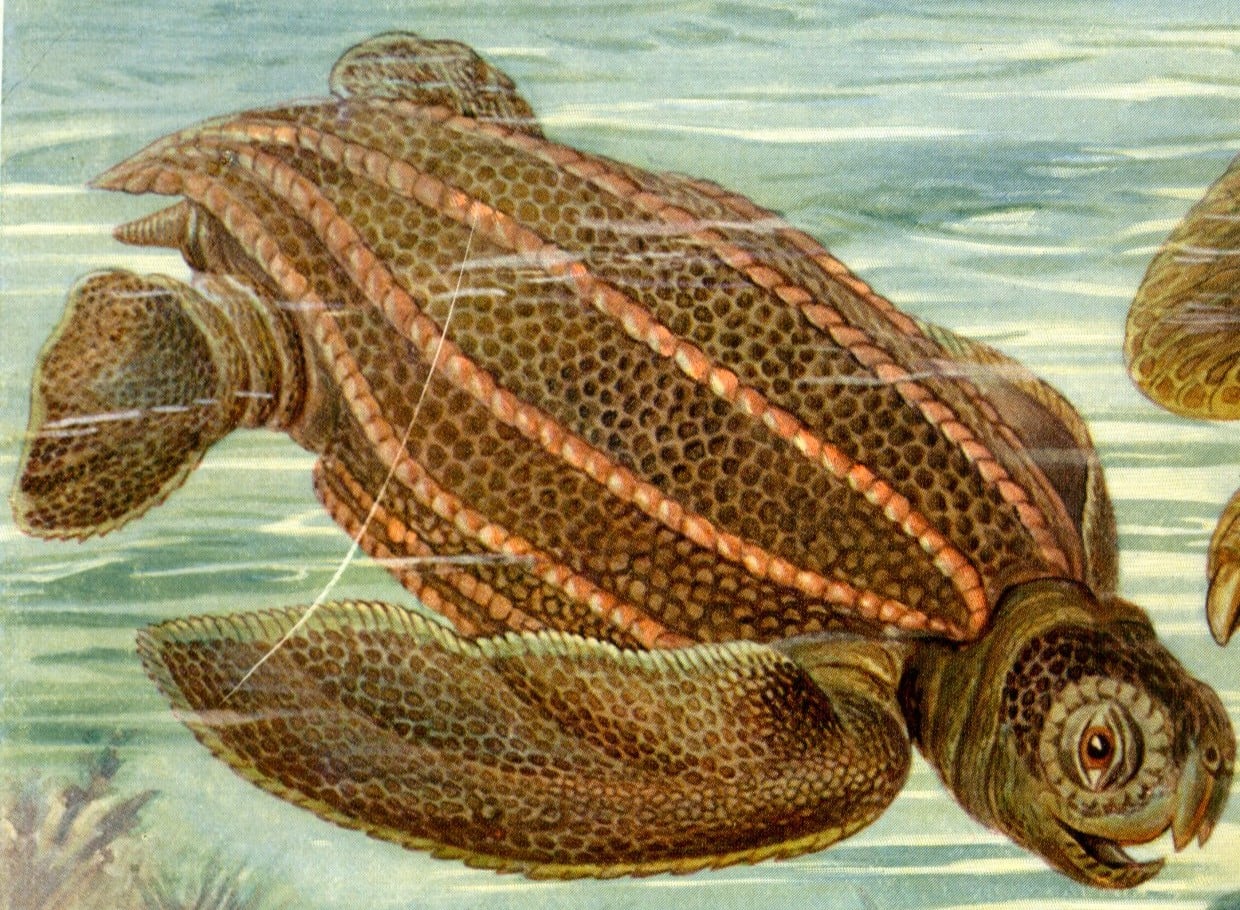
A leatherback turtle as drawn by the German zoologist Ernst Haeckel for plate 89 of Kunstformen der Natur, published in 1904. According to reports of the Sharjah Archaeology Authority's announcement, lines carved along the shells of the Wadi Al Helo turtles resemble ridges like these. This is a comparison image and does not show the Wadi Al Helo engravings. (Ernst Haeckel, 1904, via Wikimedia Commons, public domain. Cropped from the full plate to the leatherback, with the edge of a second turtle visible at right, otherwise unaltered.)
Far from the coast, in a valley of the Hajar Mountains in the Emirate of Sharjah, someone once pecked the outlines of sea turtles into a rock face. The Sharjah Archaeology Authority announced on November 26 that it had recorded five such engravings during its fieldwork this year, and that four of them appear to show leatherbacks, the largest turtles alive today. Their age is the open question. As both newspapers that carried the announcement report, the estimate of about 7,000 years is preliminary and has yet to be confirmed.
According to Khaleej Times, the engravings were found on a newly recorded rock art panel in Wadi Al Helo, and the paper reports that "Members of the local community first identified the location in 2022." The National, covering the same announcement, describes the carvers as people living in the mountains. A photograph credited to the Authority in The National is captioned as showing engravings of turtles and wild asses at Wadi Al Helo.
What the Authority has reported
The Authority's account, as carried by both newspapers, rests on the shape of the shells. Khaleej Times reports that "Four of the five engravings appear to depict leatherback turtles, the world's largest living sea turtle species." According to both reports, researchers recognized the species from lines carved along the shells that resemble the ridges of a real leatherback. A living leatherback has a long, tapering shell covered in leathery skin, with seven ridges running from front to back, so a carver who knew the animal could suggest it with a few long strokes.
The Authority also describes the find as rare. According to The National, "Only two other sites featuring turtle rock art of this kind have been recorded across the entire Oman Peninsula," and Khaleej Times adds that "Sharjah is now the third known location." As reported, the Authority did not name the other two sites. Published surveys in neighboring Oman do record turtle carvings, as described further below, although it remains unclear whether those are the sites the Authority means.
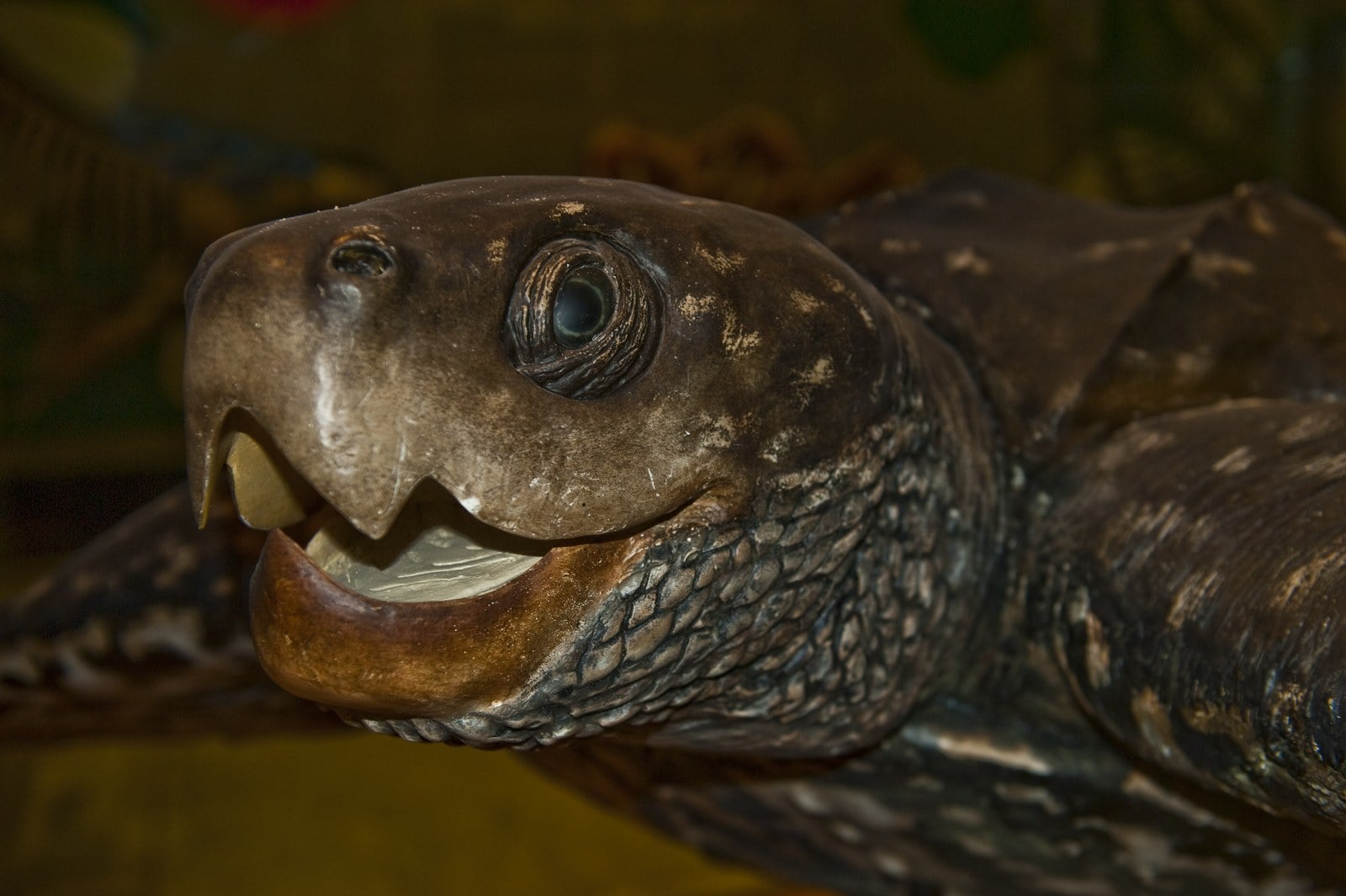
A preserved leatherback turtle in the Senckenberg Natural History Museum in Frankfurt, Germany. It is a comparison image of the species and does not show the Wadi Al Helo engravings. (Hannes Grobe/AWI, 2010, via Wikimedia Commons, CC BY 3.0. Resized from 4,256 by 2,832 to 1,600 by 1,065 pixels, otherwise unaltered.)
An age that has yet to be confirmed
Both newspapers relay the same estimate from the Authority and the same caution. The National writes that researchers believe the carvings date to about 5000 BC, "though their exact age has yet to be confirmed." Khaleej Times likewise reports that "their exact age has not yet been confirmed." No scientific paper on the panel has been published, and the reports do not say how the estimate of about 7,000 years was reached.
That caution matters, because rock art is among the hardest kinds of archaeological evidence to date. An engraving is made by removing part of the rock surface, so there is usually no charcoal, bone or other organic material in it to radiocarbon date. Archaeologists rely instead on indirect clues. These include the style of the images, the animals and objects they show, the order in which one carving cuts across another, and the way the pecked surface has weathered and darkened.
The Italian archaeologist Angelo Fossati, who has recorded rock art in the Jebel Akhdar range of northern Oman for years, set out the problem in a 2017 review. He wrote that "a precise chronology of rock art in Northern Oman is difficult to establish as the discipline is new in the country, and the rocks already studied or published are few." One of the clues he used was the color of the pecked surface, since a fresh carving looks pale and gradually darkens. "The clearer the color of the pecked surface the more recent are the engravings created on the same surface," he wrote.
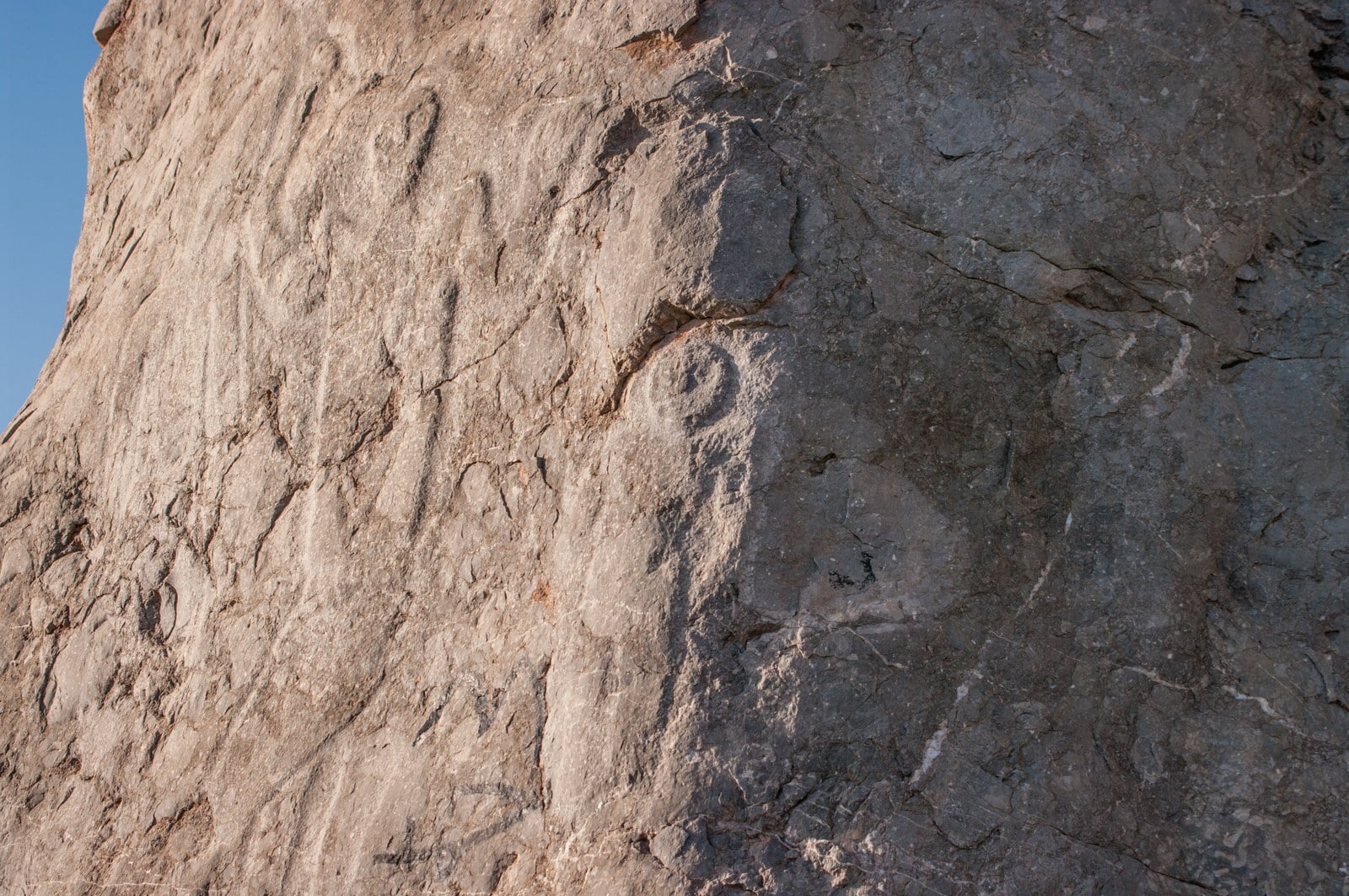
Carvings on the Hasat Bin Salt monolith in the Al Hajar Mountains of Oman, photographed in 2014. Fossati describes carved human figures elsewhere in northern Oman as stylistically related to the reliefs on this monument and probably of the third and second millennia BC. It is a comparison image from the wider mountain range and does not show the Wadi Al Helo engravings. (Martin Prasche, 2014, via Wikimedia Commons, CC BY 2.0. Resized from 4,672 by 3,104 to 1,600 by 1,063 pixels, otherwise unaltered.)
Much of the region's rock art is younger
An estimate of about 5000 BC would place the turtles in the Neolithic, earlier than much of the rock art recorded in the region so far. In Fossati's chronology for northern Oman, for example, horsemen, camel riders and weapons such as the khanjar dagger belong to the last two of his six phases, long after the earliest animal carvings. An earlier Ancient Origins report on the petroglyphs of the UAE described how quarrying has destroyed many carvings in the Emirates.
A 2023 study in the journal Rock Art Research by Xosefina Otero and colleagues shows how such dating works in Sharjah. At Khatm Al Melaha on the east coast, the team noted that a riding scene on one panel "cannot be dated before 900 BCE," which places it in the Iron Age of southeast Arabia, about 1300 to 300 BC. They concluded that the carvings there were made over a long span, from about the third millennium BC to the end of the Iron Age. The same study recorded panels in Wadi Al Helo itself and described "The preponderance of 'riding scenes' and 'weapons' in the motifs of Wadi Al Helo." A Neolithic turtle panel in the same valley would stand apart from much of what has been recorded there, so a published date would carry real weight.
There is, however, a regional parallel. In northern Oman, Fossati placed carvings of "wild maritime animals such as green turtles, anemones and fishes" in the oldest phase of the rock art he recorded, since they are more heavily weathered than the ibex and other animals that overlap them or lie nearby, and in one case two ibex-like figures were carved over a green turtle. He suggested that these earliest engravings were probably made in the fifth and fourth millennia BC "by hunters and early farmers that frequented the Jebel Akhdar Mountains." His date for those carvings is itself an estimate based on style and overlap, so it offers a comparison for the Sharjah claim without confirming it.
Leatherbacks on the ancient coast
The coast of Oman offers firmer evidence that leatherbacks reached the settlements of that period. In a 2018 study in PeerJ, John Frazier and colleagues identified small bones of leatherback turtles at two coastal sites, Ra's al-Hamra and Ra's al-Hadd. At Ra's al-Hamra the bones came from a settlement that radiocarbon dates place at about 5600 to 4500 BC, roughly the period the Authority proposes for the Wadi Al Helo carvings. The authors found no cut marks or burning on the bones, so how people obtained or used the animals remains unclear. They also describe "abundant evidence of intense exploitation and utilization of marine turtles from about 6,500 to 4,000 BP" in the region, where the green turtle is the species usually identified.
The same study notes that leatherbacks still occur in Oman's waters, although the authors found no record of them nesting there, past or present. They mention occasional reports of dead leatherbacks washing up on the Arabian Sea coast. People of the time may therefore have met the animal at sea or as a stranded carcass.
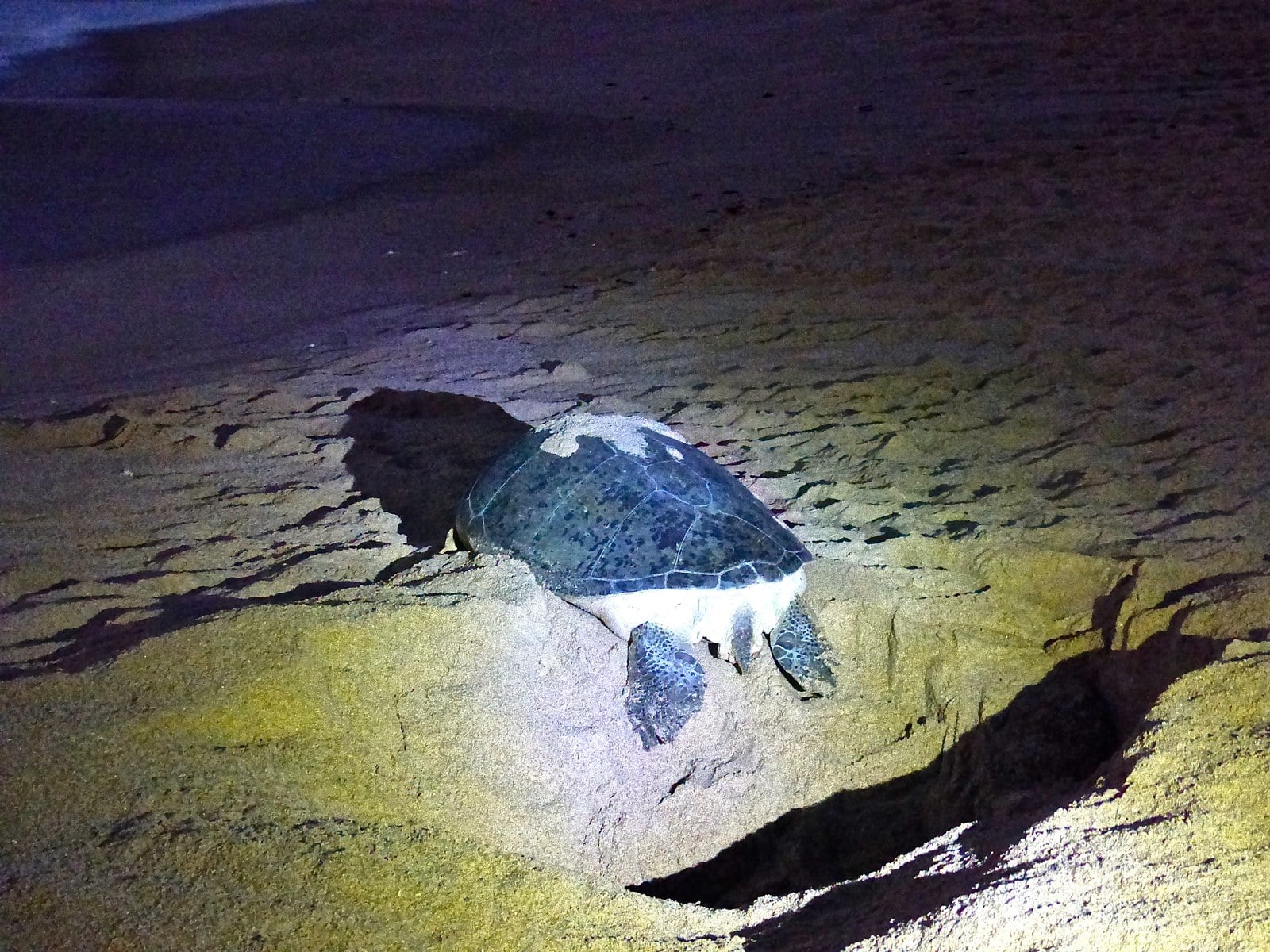
A female sea turtle, most likely a green turtle, returning to the sea after laying her eggs at Ras al-Jinz in Oman in 2016. Turtles still nest in large numbers on this coast. It is a comparison image and does not show a leatherback or the Wadi Al Helo engravings. (John Crane, 2016, via Wikimedia Commons, CC BY 2.0. Resized from 4,000 by 3,000 to 1,600 by 1,200 pixels, otherwise unaltered.)
Why carve a turtle in the mountains?
That leaves the question raised by the Authority itself, namely why people in the mountains would carve a sea animal at all. According to Khaleej Times, archaeologists are weighing three readings. The carvers may have met sea turtles directly, learned of them through contact with coastal communities, or belonged to wider networks linking inland settlements with the sea. The National reports that "Researchers have suggested the animals may have held medicinal or symbolic value for the people who carved them." These are the Authority's suggestions, offered without a published study, and the reports present them as possibilities.
The valley has a well documented record of such links in later periods. In a 2023 submission to the UNESCO Tentative List, the United Arab Emirates described Wadi Al Helo as a center of Bronze Age copper mining and smelting. The submission states that "Wadi Al Helo presents the earliest proof for metallurgy in Southeast Arabia during the transition from the Neolithic to the Bronze Age." Otero and colleagues add that the copper site known as HLO1 lies close to the petroglyphs, with radiocarbon dates from the end of the fourth millennium BC to the Iron Age. They also describe Kalba on the coast as the port for copper and other products from the valley. Those links are documented for later periods, and whether similar contacts reached back to about 5000 BC is exactly what the turtle panel may help to test. The Wadi Al Helo entry in the Ancient Origins atlas gives more background on the valley.
Rock art across Arabia keeps adding to the picture of who lived in its harder environments, as with rock art found in a Saudi desert once thought uninhabitable. For the Wadi Al Helo turtles, the next step would be a confirmed date and a published description that other specialists can examine. Until then, the carved leatherbacks are best read as a promising record whose age is still an estimate.
By Aris Manus
Sources
Almazrouei, A. 2026. 7,000-year-old sea turtle engravings discovered in Sharjah mountains. Khaleej Times, November 26, 2026. Available at: https://www.khaleejtimes.com/uae/sharjah-7000-year-old-sea-turtle-engra…
Fossati, A. E. 2017. Current finds in rock art research of Oman: a review and update. Mediterranean Archaeology and Archaeometry 17 (4), pp. 85 to 98. Available at: https://pdfs.semanticscholar.org/03a0/a6c8051efb5a338debf0e3c5831d58943… (DOI: 10.5281/zenodo.893196)
Frazier, J. G., Azzarà, V., Munoz, O., Marcucci, L. G., Badel, E., Genchi, F., Cattani, M., Tosi, M. and Delfino, M. 2018. Remains of leatherback turtles, Dermochelys coriacea, at Mid-Late Holocene archaeological sites in coastal Oman: clues of past worlds. PeerJ 6, e6123. Available at: https://pmc.ncbi.nlm.nih.gov/articles/PMC6301280/ (DOI: 10.7717/peerj.6123)
Otero, X., Santos-Estévez, M., Yousif, E. and Farjas Abadía, M. 2023. Images on stone in Sharjah Emirate and reverse engineering technologies. Rock Art Research 40 (1), pp. 45 to 56. Available at: https://rockartresearch.com/index.php/rock/article/download/257/252
The National. 2026. Sharjah archaeologists uncover rare 7,000-year-old turtle carvings in mountains. November 26, 2026. Available at: https://www.thenationalnews.com/news/uae/2026/11/26/sharjah-archaeologi…
UNESCO World Heritage Centre. Wadi Al Helo: Testimony of Bronze Age Copper Production. Tentative List, submitted by the United Arab Emirates, 2023. Available at: https://whc.unesco.org/en/tentativelists/6641/

Enjoyed this? Get UNLEASHED for life, $249 once
Ancient Origins UNLEASHED is our Substack for the deeper, longer stories. Until Monday, November 30 at midnight UK time, you can join for life with one payment instead of a yearly subscription.
- The full paid UNLEASHED archive and every future paid post, for as long as the publication continues
- A Founders certificate
- A vote on upcoming topics
- Optional credit on our Founders page, only with your permission
- One welcome one-to-one discussion
Become an UNLEASHED Lifetime Founder, $249
Places are limited to 20 in total. Use the same email you use (or will use) on Substack. We switch on your paid access by hand after payment, so it is not instant. UNLEASHED only; Ancient Origins Premium is not included.
Want everything Ancient Origins makes? The Founders' Lifetime Pass is $349, paid once: Premium for life, all 29 ebooks, 177 webinar and interview recordings, 64 Magazine issues, AO Kids and the full Atlas.