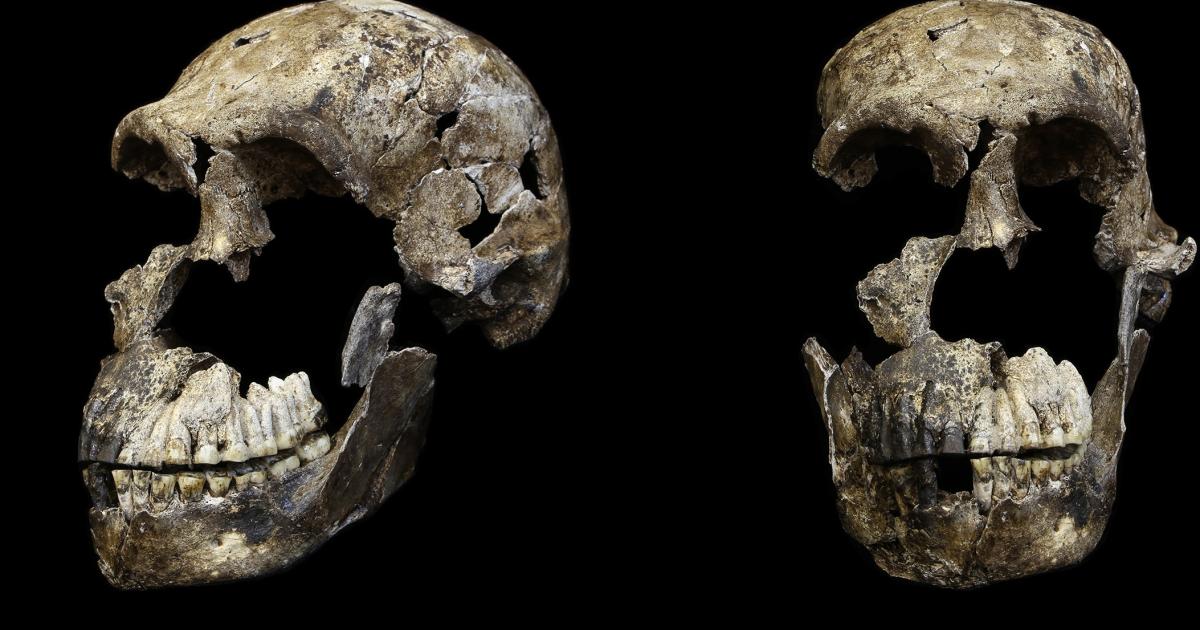

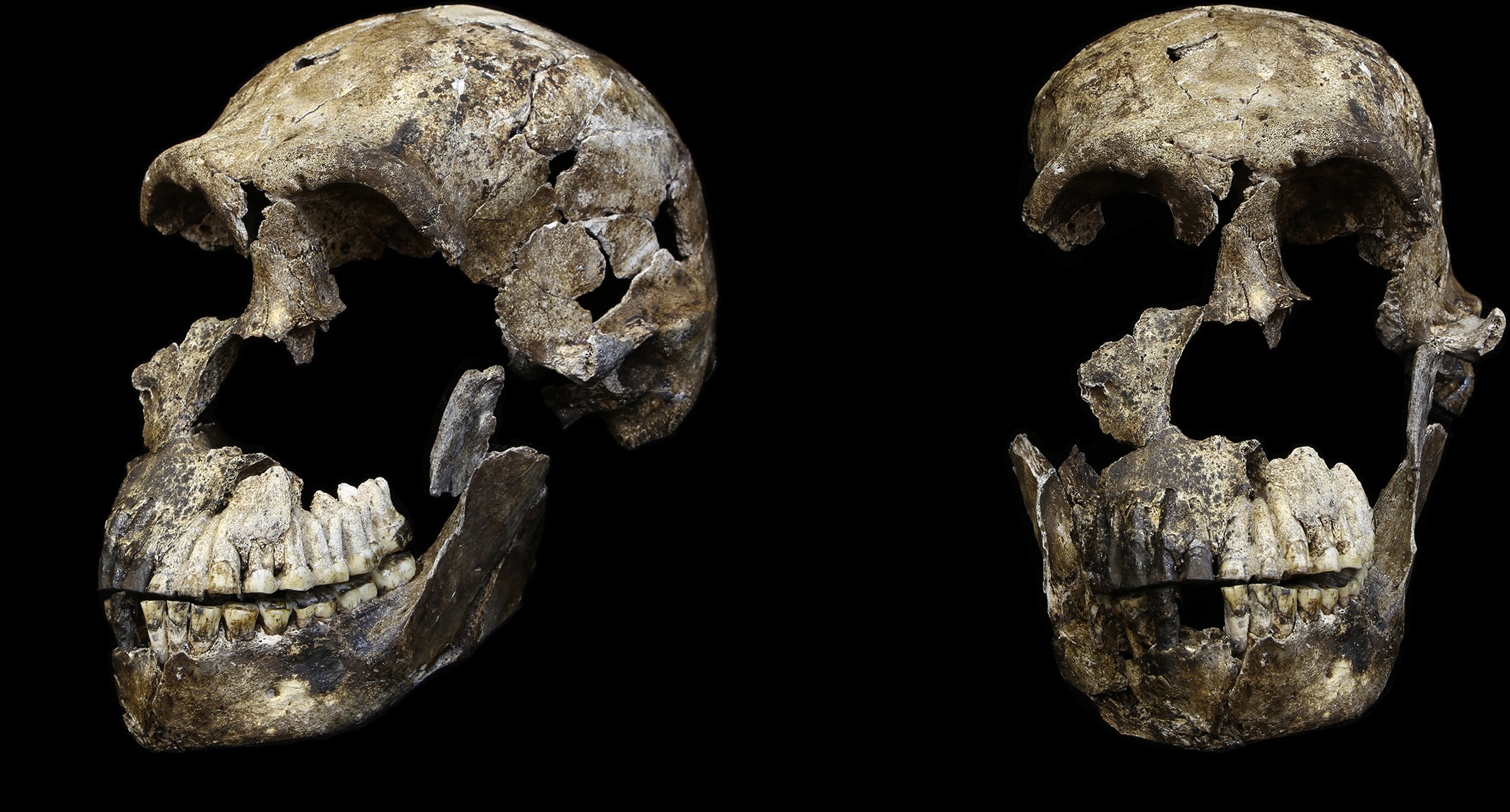
The LES1 skull of Homo naledi from the Rising Star cave system, seen in three-quarter and front views. It is shown for context only. The new study looks at foot bones, and this skull played no part in it. (Image: John Hawks, Marina Elliott, Peter Schmid et al., eLife 2017, CC BY 4.0, via Wikimedia Commons, cropped to the top row of the original figure, from 2,106 x 2,362 to 2,106 x 1,133 pixels, removing the lower two views and the scale bar)
The foot bones of Homo naledi, a hominin from South Africa's Rising Star cave system, have been analyzed from the inside for the first time, and the results suggest a species that walked upright in a broadly human way, though on its own terms. The new paper calls Homo naledi "an enigmatic example of our genus," and its authors stress that the internal bone signals cannot separate climbing from walking over rough ground, so the picture remains an interpretation. So how did a hominin with long, curved toes actually put its weight on the ground?
The paper, led by Andrea Lukova of the Max Planck Institute for Evolutionary Anthropology in Leipzig and the University of West Bohemia in Pilsen, appeared online in Scientific Reports on November 28, 2026. Its authors include Tracy Kivell, Zewdi Tsegai, Matthew Skinner and Lee Berger, lead author of the 2015 paper that named the species. The study is open access.
A Human Relative with Mixed Parts
According to the paper, Homo naledi "shows a mix of human- and ape-like skeletal features ~ 300,000 years ago." The fossils are dated to between 335,000 and 241,000 years ago, so the species may have overlapped in time with Neandertals, Denisovans, Homo erectus and the earliest Homo sapiens.
Its foot is a good example of that mix, as earlier studies of its feet and hands found. From the outside, the authors write, it has well-developed arches, a sturdy big toe set in line with the others and a squarely aligned ankle joint, "but with relatively long, curved toes." The arches and big toe resemble ours, while the curved toes look more like an ape's. Earlier work had found the hand and upper limb well suited to climbing, while the leg and foot looked built for upright walking.
That combination raised the question of whether Homo naledi loaded its feet as modern humans do, or whether its unusual anatomy reflected a different kind of walking. Outside shape alone cannot answer that, so the team looked inside the bones.
What the Bones Remember
The inside of a bone is filled with a spongy lattice called trabecular bone, which adapts during life to the forces that run through it. The outer cortical bone, measured in cross-section, shows how well a bone resisted bending and twisting. Both, in other words, keep a record of how an animal habitually moved.
The researchers used high-resolution micro-CT scans and a whole-bone method to map the trabecular bone in two bones, the talus at the ankle and the first metatarsal behind the big toe. These were the only two Homo naledi foot bones with internal structure preserved well enough for the analysis. The team also measured the cross-sections of all five metatarsals of the fossil foot known as Foot 1.
They compared the results with modern humans, chimpanzees, bonobos and gorillas, and, for the internal bone, with fossils from three other hominins. These were Australopithecus africanus, Paranthropus robustus and the fossil foot known as OH 8, which the authors treat "as a potential example of early Homo."
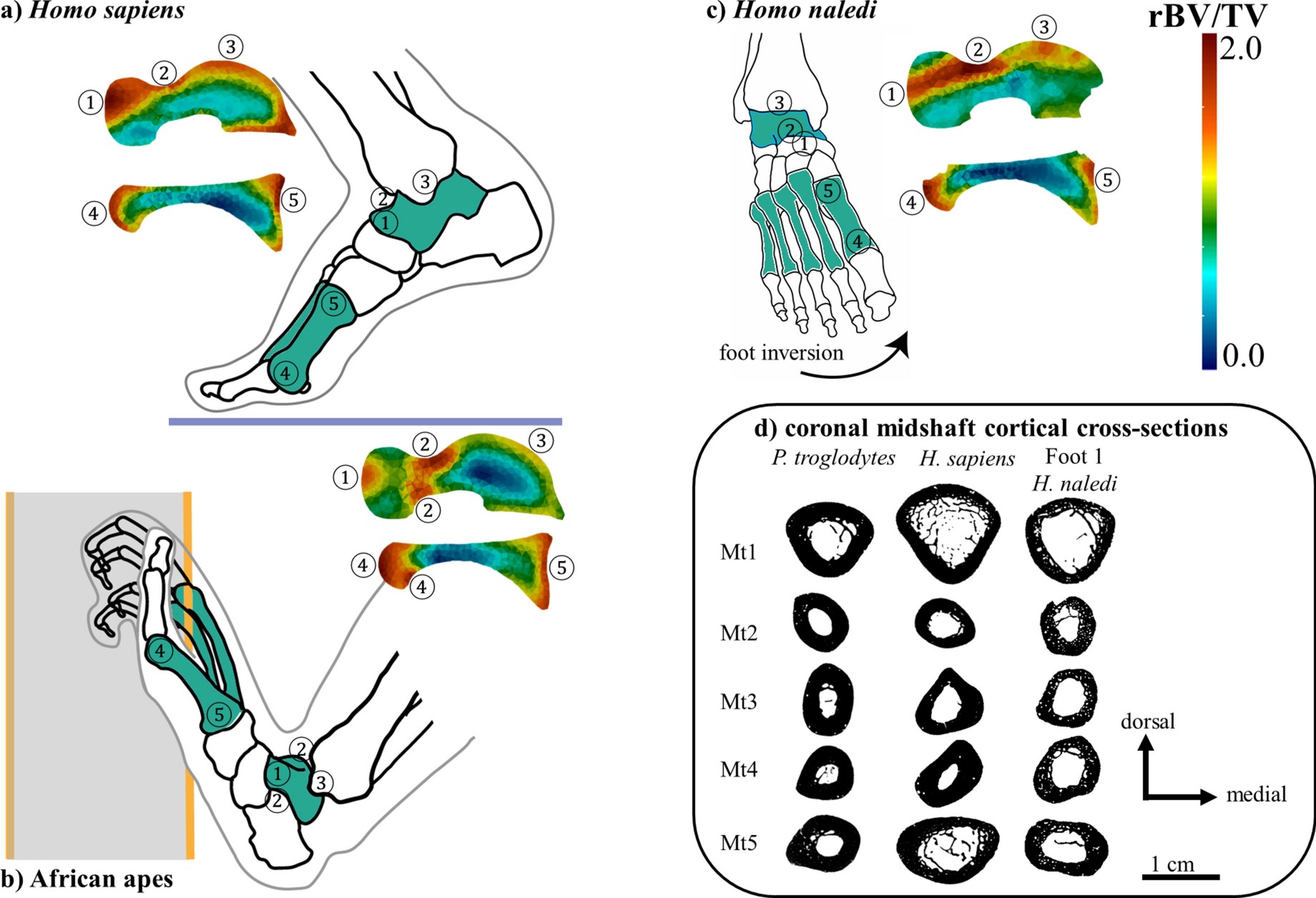
How the ankle bone and first metatarsal are thought to be loaded in modern humans (a), African apes (b) and Homo naledi (c), with midshaft cross-sections of the five metatarsals in a chimpanzee, a modern human and Homo naledi (d). Red marks areas of denser bone and greater load. (Image: Lukova et al., Scientific Reports 2026, Figure 6, CC BY 4.0, via Scientific Reports, shown at full size and converted from PNG to JPEG)
Human Push, Ape Flex
The ankle bone gave a blend of human and ape signals, with human-like reinforcement in its upper joint surface that points to loading with the ankle in a neutral position, while the denser bone also spread farther across that surface than in humans. The authors read that as "indicating greater inversion and loading under more dorsiflexed ankle postures than in humans," meaning the foot took load with the sole turned inward and the ankle flexed upward more than in people today. The head of the talus resembled the pattern in African apes, which suggests a more mobile joint in the midfoot.
The first metatarsal told a more human story. Its base showed mainly human-like reinforcement, though it reached a little farther toward the sole than in people, and it lacked the patterns that chimpanzees and gorillas show from grasping with the big toe. According to the paper, forceful and repeated grasping with the big toe swung out to the side was "not a habitual component of H. naledi locomotion."
The five metatarsals followed the human pattern in one key way. After the big toe bone, the outer bones toward the little toe were the most reinforced and the middle ones the least, as in people, which fits weight moving along the outer side of the forefoot during push off. Yet overall reinforcement was weaker than in modern humans and, scaled for body mass, closer to chimpanzees and bonobos.
Put together, the authors write that each bone "combines predominantly human-like signals of propulsive, extended-limb bipedal loading" with local differences, including greater mobility at the ankle and midfoot. The result is "a mosaic pattern that does not fully match the human, African ape, or OH 8 condition."
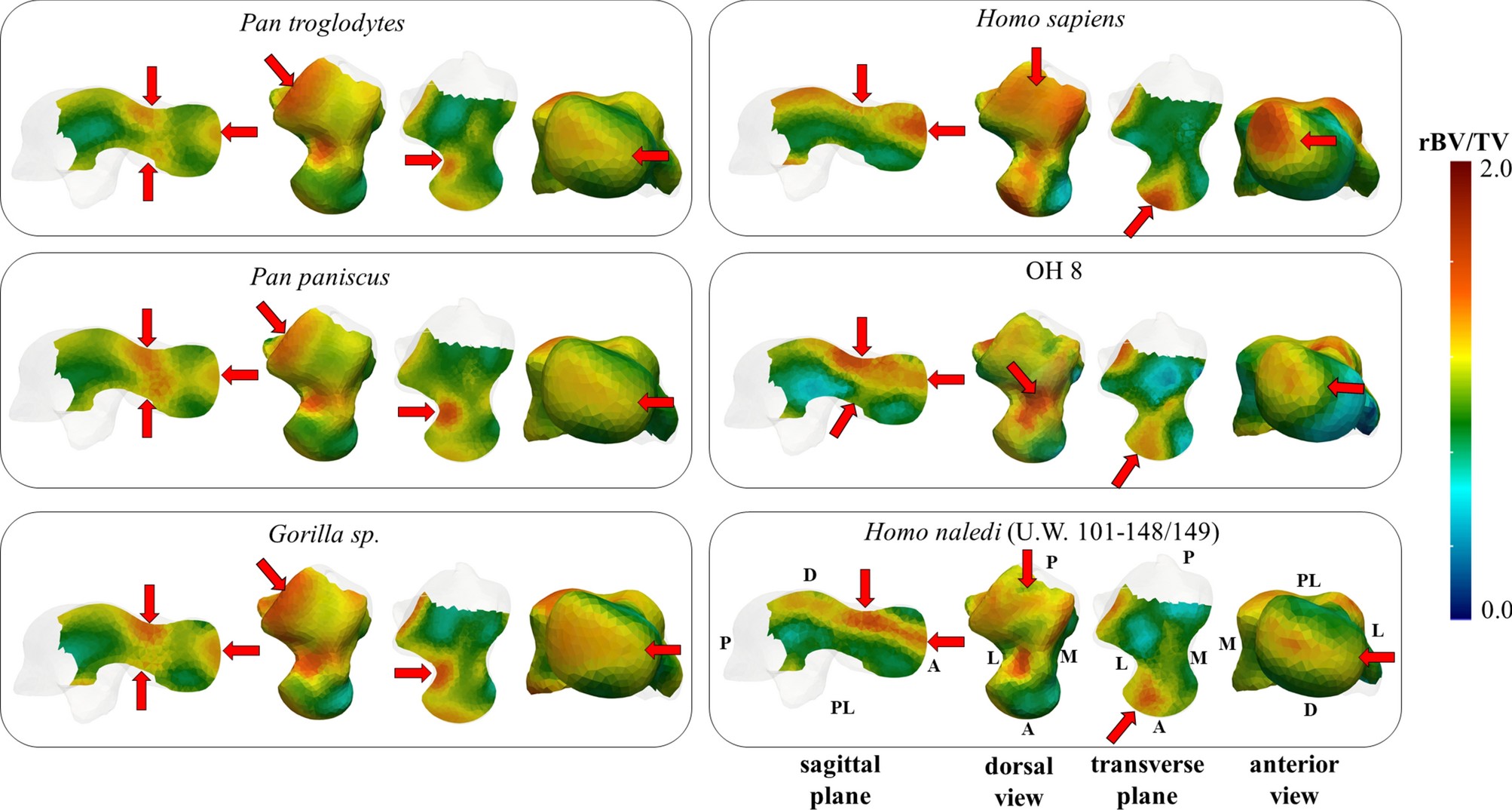
Maps of trabecular bone density in the talus, or ankle bone, of apes, modern humans, the OH 8 fossil and Homo naledi (lower right). Red shows denser bone and greater load, blue shows less. (Image: Lukova et al., Scientific Reports 2026, Figure 2, CC BY 4.0, via Scientific Reports, shown at full size and converted from PNG to JPEG)
Built for the Trail Rather Than the Marathon
The extra flexibility, the paper suggests, gave Homo naledi a foot suited to rough ground. In the authors' words, "the results show a human-like, extended-limb gait well-suited for uneven terrain and/or climbing, but not habitual running."
They stress that the extra mobility does not mean Homo naledi walked less well. They describe "human-like bipedal walking in H. naledi" combined with some functional versatility, possibly linked to "rocky terrain or mixed terrestrial-arboreal settings," and they say this does not reflect "any reduction in bipedal walking capability relative to modern humans in our sample."
Running is a different matter. The authors note that endurance running in modern humans relies on extra foot specializations, among them a stabilized ankle and restricted movement in the midfoot. Homo naledi lacks several features linked to running, such as a fully modern arch and a rigid midfoot, and its bone signals "are not specific to running." Their conclusion is that the species "possessed a foot well suited for sustained bipedal walking, but not the derived structural specializations characteristic of modern human long-distance endurance running." The study does not test whether Homo naledi could run at all, only whether its feet show a runner's specializations.
Many Roads to Walking Upright
The findings fit what earlier studies found in the rest of the Homo naledi skeleton, with a thigh bone, knee and pelvis that combine features for upright walking with signs of greater mobility or more varied loading. The authors conclude that the species "represented rather a distinct bipedal solution within the genus Homo."
Earlier hominins such as Australopithecus africanus and Paranthropus robustus, both represented in the study by fossils from South Africa's Sterkfontein and Swartkrans sites, also show mixed foot features, but the inside of their first metatarsals follows a different pattern. Homo naledi lines up most closely with OH 8, though the two differ in important details. In the authors' words, the results suggest "that hominin foot evolution did not proceed along a single linear trajectory toward increased rigidity."
Caveats in the Cave
Of course, the authors are open about the limits of their method, noting that internal bone reflects a lifetime of loading and is also shaped by genes and development. The signals point to habitually loaded joint postures, they write, but cannot be tied to one specific behavior that uses those postures, such as climbing as opposed to walking on uneven ground. Confirming an extended-limb posture would also need internal evidence from the knee and hip. The trabecular analysis rests on just two bones, because no other Homo naledi foot bone was preserved well enough.
Within those limits, the study adds internal evidence to what the outside of the fossils already suggested. How Homo naledi actually used that flexible foot, whether on rocky slopes, in trees or both, remains open, and the authors point to newer biomechanical methods, such as musculoskeletal modeling, as ways to test it.
By Aris Manus
Sources
- Lukova, A., Cazenave, M., Bachmann, S., Dunmore, C. J., Synek, A., Pahr, D. H., Farrell, H. N., Gidna, A., Berger, L. R., Zipfel, B., Kivell, T. L., Tsegai, Z. J. and Skinner, M. M. 2026. Insights into foot loading in Homo naledi from trabecular and cortical bone architecture. Scientific Reports 16, article 40396. Published online November 28, 2026. Open access, CC BY 4.0.
- Hawks, J., Elliott, M., Schmid, P. et al. 2017. New fossil remains of Homo naledi from the Lesedi Chamber, South Africa. eLife 6, e24232, DOI 10.7554/eLife.24232. Source of the LES1 image, via Wikimedia Commons.

Enjoyed this? Get UNLEASHED for life, $249 once
Ancient Origins UNLEASHED is our Substack for the deeper, longer stories. Until Monday, November 30 at midnight UK time, you can join for life with one payment instead of a yearly subscription.
- The full paid UNLEASHED archive and every future paid post, for as long as the publication continues
- A Founders certificate
- A vote on upcoming topics
- Optional credit on our Founders page, only with your permission
- One welcome one-to-one discussion
Become an UNLEASHED Lifetime Founder, $249
Places are limited to 20 in total. Use the same email you use (or will use) on Substack. We switch on your paid access by hand after payment, so it is not instant. UNLEASHED only; Ancient Origins Premium is not included.
Want everything Ancient Origins makes? The Founders' Lifetime Pass is $349, paid once: Premium for life, all 29 ebooks, 177 webinar and interview recordings, 64 Magazine issues, AO Kids and the full Atlas.