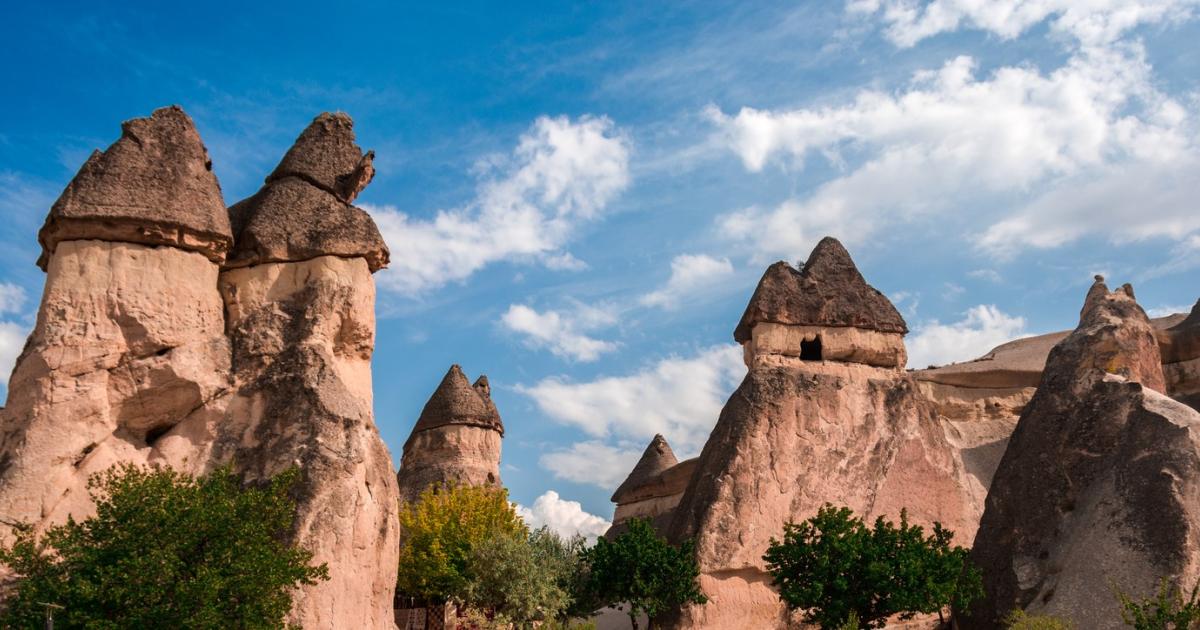

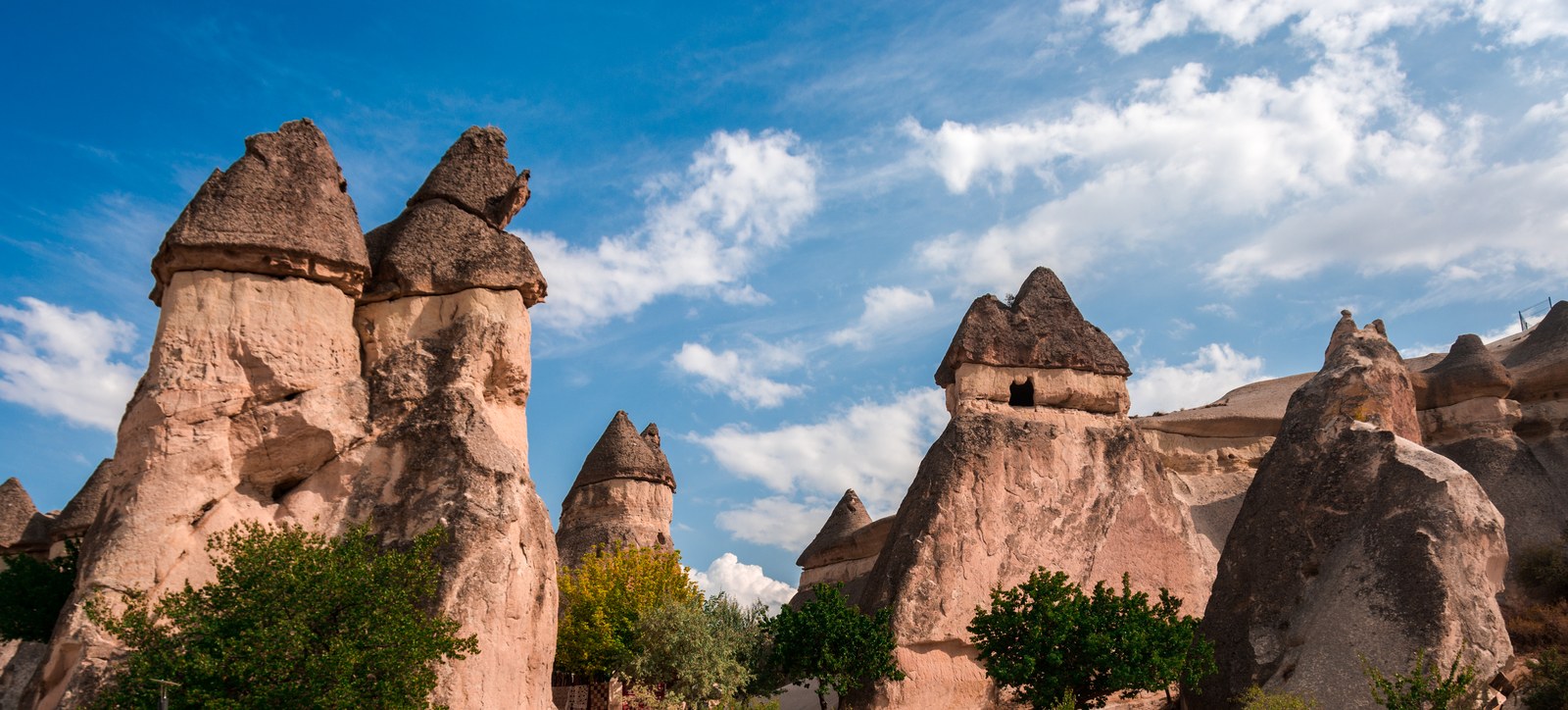
Capped rock pinnacles at Paşabağ, in Göreme National Park, Cappadocia. These are classic fairy chimneys, shown for comparison only. They are not the Develi mushroom rock and do not hold the newly reported grave. (Image: Feridun F. Alkaya, CC0, via Wikimedia Commons, resized from 5999 by 2716 to 1600 by 724 pixels, otherwise unaltered)
On the slopes above the Gümüşören Dam in central Türkiye stands a rock shaped like a giant mushroom, about five meters tall. On its flat top, according to a report by the Turkish news agency DHA on November 23, 2026, there is a rectangular grave cut into the stone, open to the sky with no lid in place. The man who reported it, local history researcher Nezir Ötegen, believes it dates to the Roman period, about 2,000 years ago.
So far, however, the claim rests on Ötegen's own field observations and assessment. No excavation has taken place, and no inscription, human remains or grave goods have been reported. Ötegen has asked the authorities to register and protect the site and has called for academics to study it. So who was buried on top of the rock, and when? And could it really be the only grave of its kind?
A Grave on a Mushroom
Ötegen lives in the Develi district of Kayseri province. DHA reports that he noticed the rock during field surveys around the dam and along the Zamantı River, near the Hüseyinli and Yenice neighborhoods. Revista Galileu, a Brazilian science magazine, reports that he found it on Saturday, November 21, while walking with Yılmaz Çelik, the owner of a local channel, FraktınTv. The Italian magazine Stile Arte places the spot in the Menengi area, about 45 kilometers south of the city of Kayseri.
The grave is the kind that Turkish reports call a "boat tomb". Galileu, citing the Spanish magazine La Brújula Verde, notes that archaeologists use the term chamosorion for a grave of this type, a rectangular cavity cut straight into the rock, somewhat like a bathtub, which normally received a stone cover. Stile Arte points out that such graves are documented in several regions of Asia Minor, including Cilicia, Caria and Pisidia, and that they also appear in Roman and later contexts.
Ötegen raised the problem of the open grave himself. "Academically, the boat tomb needs to be studied first, and then the mushroom rock. Normally boat tombs have a lid on top, but the top of the tomb here has been opened," he told DHA (translated by Ancient Origins).
Why Build a Tomb So High?
In Ötegen's view, the answer lies in the setting of the rock, which stands among old settlements and in plain sight. "In the Roman period, it was apparently a tradition to build tombs beside the river and in high places where everyone could see them," he told the agency (translated by Ancient Origins). He went on to explain that "Because this mushroom rock, which formed in very ancient times, also stood in the middle of the settlements and in a place where everyone could see it, they built a tomb on top of it" (translated by Ancient Origins).
Stile Arte offers a similar reading, arguing that a burial five meters above the ground could become a landmark that people would recognize from afar, keeping the memory of the dead in view. Galileu adds that, according to the discoverers, the height would also have made the grave harder for animals and looters to reach. However, both magazines stress that these ideas remain untested, and Galileu notes that no specific study of the monument has yet examined them.
Cappadocia has other examples of graves set into tall rock. The Kapadokya Geopark describes a Roman tomb carved into a fairy chimney south of the village of Taşkınpaşa, on the road to Soğanlı. In its words, "tombs carved on high rock blocks are important both in terms of being close to the sky and in terms of protecting the tomb."
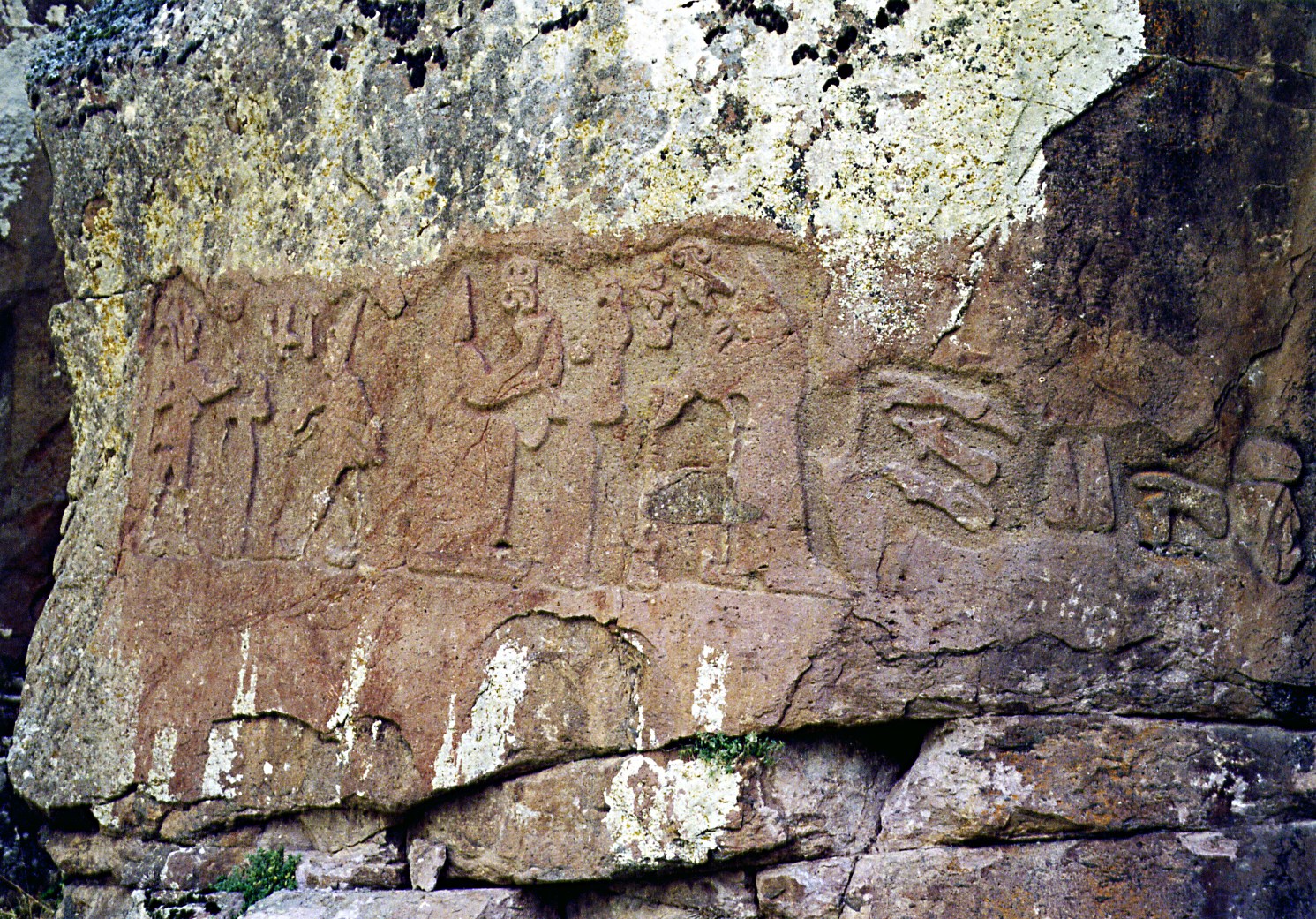
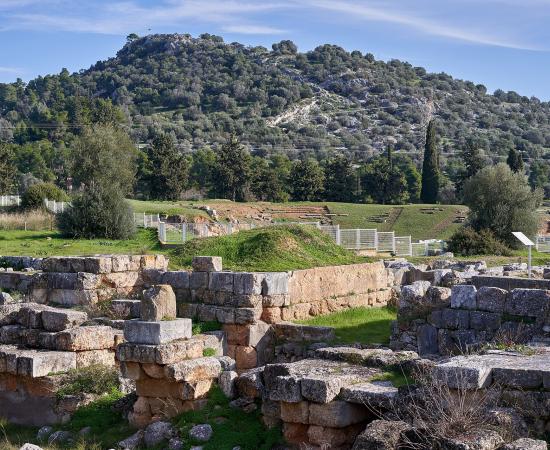
The Hittite rock relief at Fraktin, which lies near the newly reported grave in the Develi district. By Stile Arte's reckoning it is about 1,250 years older than the Roman date proposed for the grave. It is shown for context only and is not the Develi mushroom rock. (Image: Klaus-Peter Simon, CC BY 3.0, via Wikimedia Commons, re-saved as JPEG at the original 1491 by 1041 pixels)
A Valley Full of Tombs
The rock does not stand alone, and in his interview with DHA, Ötegen named nearby sites such as the Fraktin rock monument, the Çinçin Caves and Direkli Cave, and the Çukuryurt rock tombs across the valley. Arkeonews adds that a 2021 inventory by Türkiye's Ministry of Culture and Tourism recorded five rock-cut chamber tombs and four rectangular rock-cut graves at the nearby Çakmaktepe necropolis, along with road remains attributed to the Roman period.
The Fraktin relief is the most famous neighbor. According to Galileu, it was carved in the 13th century BC and shows the Hittite king Hattusili III and his queen Puduhepa making offerings to the gods. Ancient Origins has reported on even older rock art in Kayseri that predates the Hittites. Stile Arte notes that Cappadocia became a Roman province in AD 17, under Tiberius, so if the Roman date is confirmed, the grave could belong to the first centuries of Roman rule in the region.
How Mushroom Rocks Form
The rock itself is natural, and Galileu explains that it formed through differential erosion, in which softer lower layers wear away faster than a harder cap, leaving a narrow stem under a broad top. DHA describes wind-blown sand and gravel grinding away the lower parts of the rock, and Galileu says that water also plays a part.
Galileu also warns readers not to confuse such rocks, which it says are known in Türkiye as devil's tables, with Cappadocia's famous fairy chimneys, which have their own geology. Those chimneys feature in the Ancient Origins guide to the must-visit sites of Cappadocia.
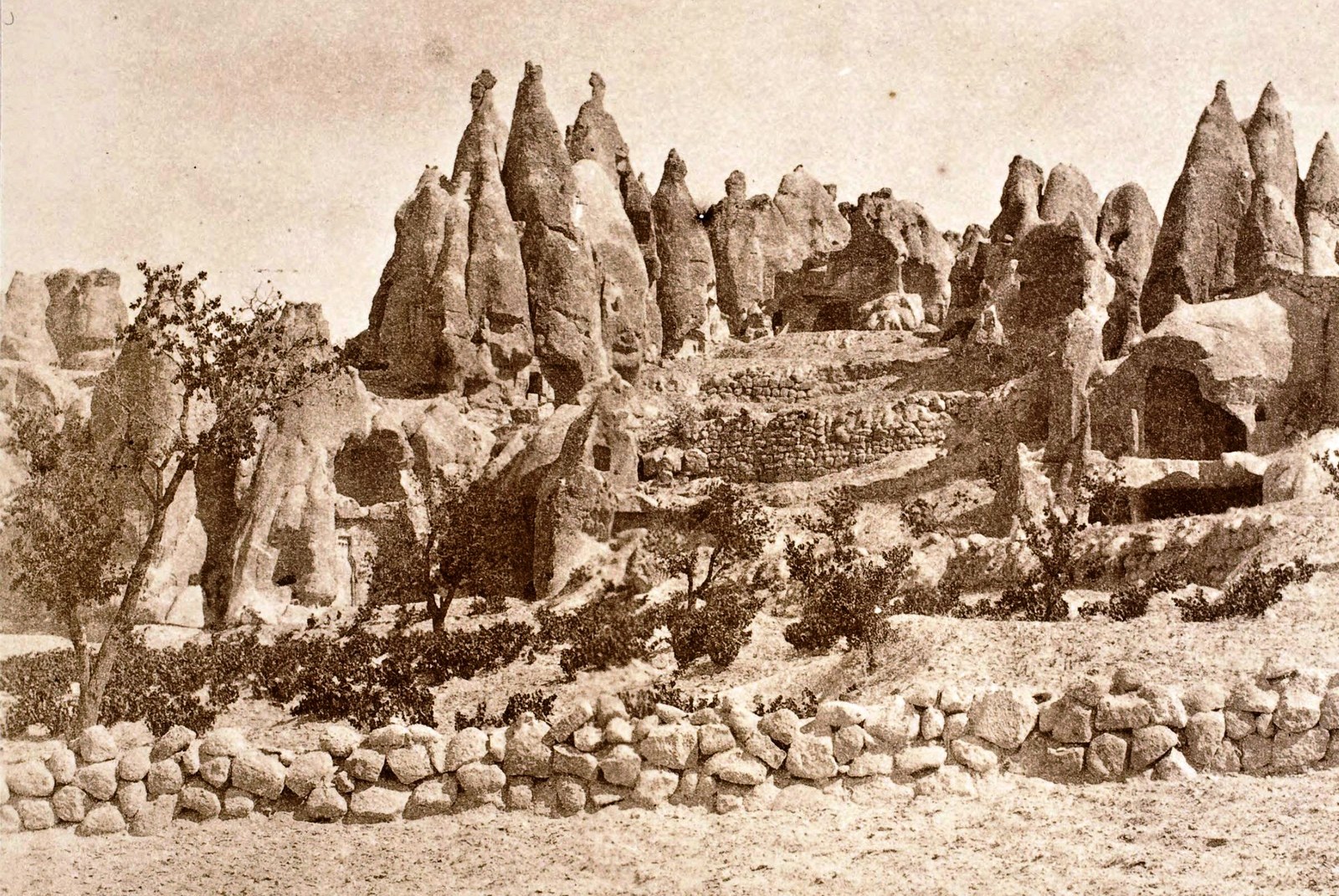
Rock pinnacles with carved openings at Göreme, Cappadocia, photographed in 1887. Shown to illustrate how people in the region have long cut into tall rock. This is not the Develi mushroom rock. (Image: John Henry Haynes, public domain in the UK and EU because the photographer died in 1910, more than 70 years ago, via Wikimedia Commons, from an albumen print in the Harvard Fine Arts Library, resized from 2400 by 1607 to 1600 by 1071 pixels)
Arkeonews adds that geologists have yet to work out how much the Develi rock has changed since the grave was cut. Its builders may have chosen a rock that already looked like a mushroom, or erosion may have given it that shape in the centuries since.
The First of Its Kind?
Ötegen believes the find matters for geology as well as archaeology. "We think we have brought something new to the literature of geological heritage," he told DHA (translated by Ancient Origins). Arkeonews goes further, suggesting that the grave "may represent a previously undocumented form of rock-cut burial architecture."
Arkeonews looks to the Eastern Rhodope Mountains of Bulgaria for one of its most interesting parallels. Citing a 2015 chapter by the archaeologist Georgi Nekhrizov, it describes a grave near Bashtino, at Alla Kaya, cut into the top of a naturally pyramid-shaped volcanic rock. It also mentions a natural mushroom-shaped rock between Zhenda and Sokolite with eight niches cut into its sides, though their purpose is still debated. Ancient Origins has explored Perperikon, another rock-cut site in the same mountains.
However, no systematic survey has yet confirmed that the Develi grave is unique. Galileu, citing Heritage Daily, says as much, and Arkeonews concedes that "a limited review of comparable monuments has found no exact equivalent" to the Develi grave. Elsewhere in Cappadocia, rock-cut sites are still yielding surprises, such as the 93-room rock-cut complex at Meryem Ana Mountain.
What Excavation Could Settle
Galileu notes that without inscriptions, grave goods or human remains, a precise date cannot be set. Stile Arte calls for a three-dimensional survey of the rock, a record of the tool marks, an examination of the cavity and a survey of the surrounding area, alongside a geological study of the rock itself. Such work could show when the grave was cut, whether its cover survives nearby, and how the rock looked when the grave was first cut into its top.
Ötegen has already taken his request to the authorities, telling DHA: "We request that this place be taken under protection as a registered structure" (translated by Ancient Origins). DHA reports that the relevant institutions are expected to examine the area following his application.
Ötegen himself is clear about why the rock deserves a closer look. As he told DHA, in geological heritage the mushroom rock "exists all over the world, but having a tomb on top of it gives this rock a distinct character" (translated by Ancient Origins).
By Aris Manus
Sources
Altuntaş, L. 2026. "Ancient Tomb Atop a Mushroom Rock in Cappadocia May Be the First of Its Kind." Arkeonews, November 26, 2026. Available at: https://arkeonews.net/ancient-tomb-atop-a-mushroom-rock-in-cappadocia-m…
Almeida, A. 2026. "Túmulo romano é achado na Ásia em rocha no formato de cogumelo." Revista Galileu, November 25, 2026. Available at: https://revistagalileu.globo.com/ciencia/arqueologia/noticia/2026/11/tu…
Bernardelli Curuz, E. 2026. "C'è una tomba romana sopra questo fungo." Stile Arte, November 25, 2026. Available at: https://www.stilearte.it/tomba-romana-roccia-fungo-cappadocia-develi/
Kapadokya Jeopark. No date. "Taşkınpaşa Fairy Chimney Shaped Roman Tomb." Available at: https://www.kapadokyajeopark.com.tr/en/Geopark/taskinpasa-peribacasi-ic…
Kavuklu, F. 2026. "Kayseri'de mantar kayanın üzerinde Roma mezarı bulundu." DHA (Demirören Haber Ajansı), November 23, 2026. Available at: https://www.dha.com.tr/yerel-haberler/kayseri/develi/kayseride-mantar-k… (quotations translated by Ancient Origins)

Enjoyed this? Get UNLEASHED for life, $249 once
Ancient Origins UNLEASHED is our Substack for the deeper, longer stories. Until Monday, November 30 at midnight UK time, you can join for life with one payment instead of a yearly subscription.
- The full paid UNLEASHED archive and every future paid post, for as long as the publication continues
- A Founders certificate
- A vote on upcoming topics
- Optional credit on our Founders page, only with your permission
- One welcome one-to-one discussion
Become an UNLEASHED Lifetime Founder, $249
Places are limited to 20 in total. Use the same email you use (or will use) on Substack. We switch on your paid access by hand after payment, so it is not instant. UNLEASHED only; Ancient Origins Premium is not included.
Want everything Ancient Origins makes? The Founders' Lifetime Pass is $349, paid once: Premium for life, all 29 ebooks, 177 webinar and interview recordings, 64 Magazine issues, AO Kids and the full Atlas.