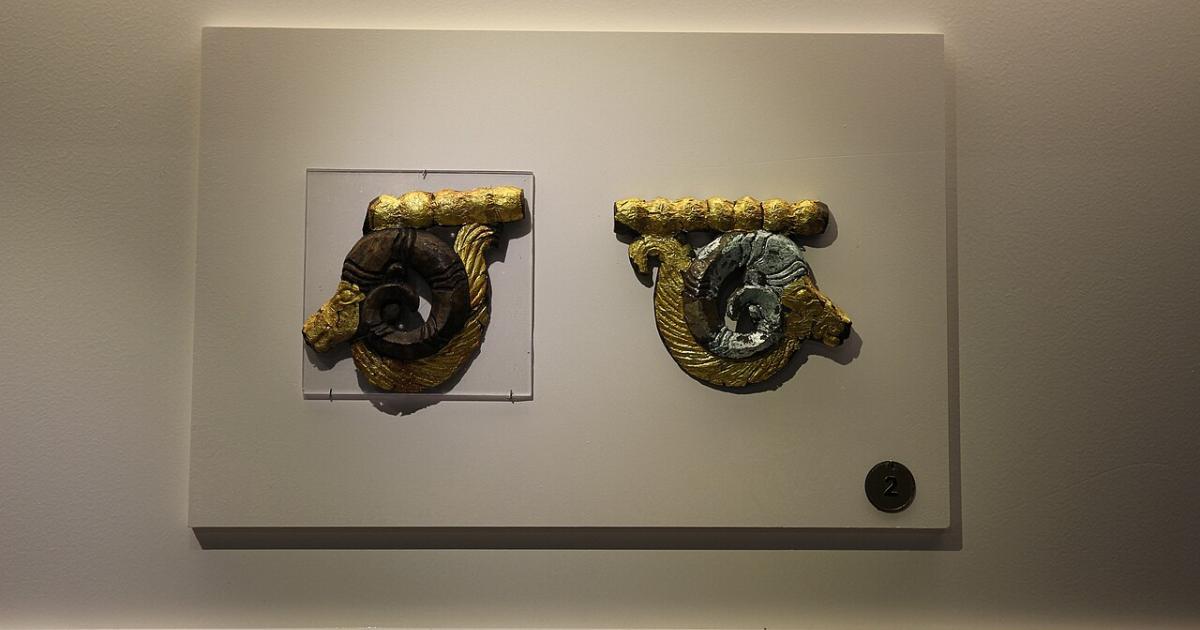

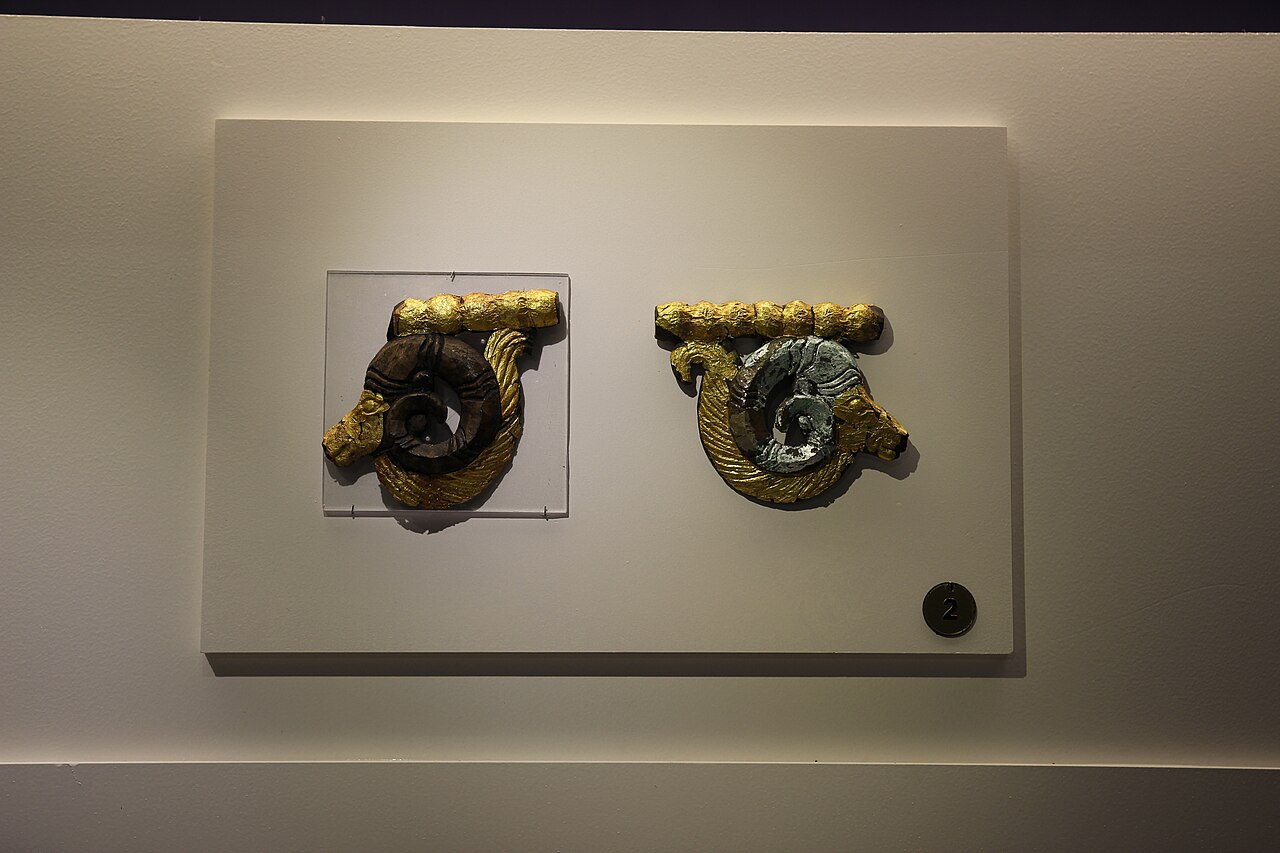
Wooden pendants in the form of argali heads, 4th to 3rd centuries BC, from the Berel burial ground in East Kazakhstan, photographed in the National Museum of the Republic of Kazakhstan. They are shown to illustrate gilded wooden animal carving from the Altai region and are not the newly found predator head. (Image: Muzaffar Turgunov, Wikimedia Commons, CC0, resized from 5,184 by 3,456 to 1,280 by 853 pixels, otherwise unaltered)
In a high valley of the Altai Mountains, the Pazyryk kurgans have already given the world some of its best preserved ancient textiles, saddles and wooden carvings. Now a team reworking those same burial mounds has found one more object that earlier excavators missed, a carved wooden head of a predator covered in thin gold foil. But which animal does it show, and how did it go unnoticed for so long?
TASS reports that the find was announced on November 24, 2026, by academician Vyacheslav Molodin, head of the Department of Paleometal Archaeology at the Institute of Archaeology and Ethnography of the Siberian Branch of the Russian Academy of Sciences, speaking at the TASS press center. According to the agency, the work was led by the State Hermitage, together with Molodin's institute and Gorno-Altaisk State University.
A Figure Among the Logs
The team was carrying out a renewed study of five kurgans at Pazyryk. Surviving parts of their log chambers had never been removed from the burial complexes, and the head turned up while those old timbers were being dismantled.
Molodin described the moment to TASS. "While these logs were being dismantled, this remarkable figurine made of wood and overlaid with gold was found, which at the time escaped the archaeologist's eye," he said (translated by Ancient Origins).
He went on to say that the head was made in a manner typical of the Pazyryk culture. The technique of carving the figure in wood and covering it with gold foil, he added, was also typical for the people of this culture, and the figurine has been saved and treated.
Which animal the carving shows is still unclear. According to TASS, Molodin said it is hard to tell which predator the ancient carvers were trying to depict, and that it could have been either a snow leopard or a bear.
The original position of the head in the tomb and its purpose have not been reported. However, some Russian outlets went further than the scientists did. A Lenta.ru headline said the little golden beast had "guarded" the tombs for 2,500 years (translated by Ancient Origins), setting the verb in quotation marks as a figure of speech, and no researcher quoted in these reports has said what the head was for.
Back to Rudenko's Kurgans
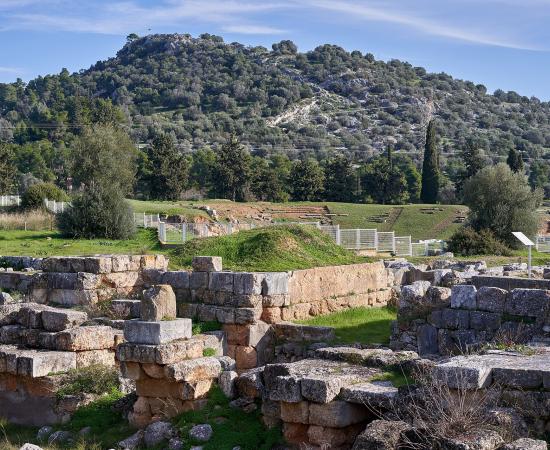
The Pazyryk kurgans are a group of Iron Age burial mounds in the Altai that TASS describes as an archaeological site of world significance. In a 1990 article for the Penn Museum's Expedition magazine, Karen S. Rubinson explained that eight kurgans had been excavated there, one in 1929 by M. P. Gryaznov and seven from 1947 to 1949 by Sergei Rudenko.
Each tomb was a chamber of logs set in a pit, with earth heaped over it and a cairn of stones on top. Rubinson writes that the stones shaded the ground beneath from the sun, "causing lenses of permafrost that retarded the decay of the organic materials."
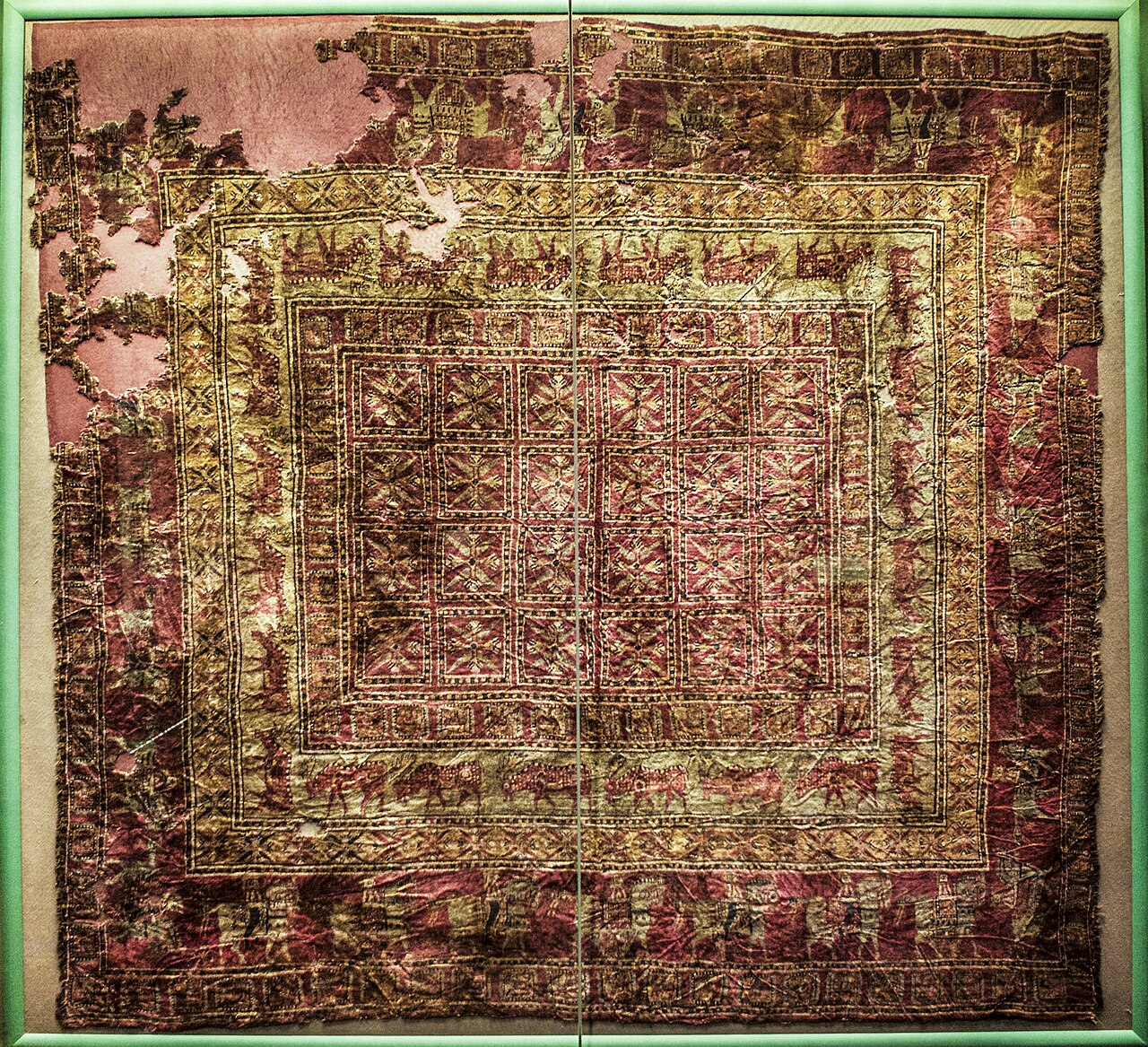
The Pazyryk carpet, found in Pazyryk kurgan 5 and now in the State Hermitage Museum in Saint Petersburg, photographed in 2013. It is shown for context and is not part of the new find. (Image: Ninara, Helsinki, Wikimedia Commons, CC BY 2.0, resized from 2,500 by 2,280 to 1,280 by 1,167 pixels, otherwise unaltered)
The tombs were broken into shortly after the burials, yet ground water flowing into the broken chambers froze and preserved what the robbers left behind. Rubinson lists horses with harness, saddles and saddle blankets, felt hangings, carpets, portable wooden tables and Chinese silks among the finds. She also notes that wooden objects at Pazyryk were embellished with gold foil, paint and leather.
The most famous of these finds is the Pazyryk carpet. Karen Rubinson also wrote the Encyclopaedia Iranica entry on pre-Islamic carpets, where she describes it as the earliest well-preserved pile carpet ever excavated and dates kurgan 5 to the end of the 4th or the beginning of the 3rd century BC. Readers can find more of the site's story in the Ancient Origins Pazyryk archive, which covers the carpet, the tattoos and the frozen burials of the Altai.
What Happens to the Old Timbers
The new work is partly a rescue of what remains of those chambers. Molodin told TASS that much still has to be saved and turned into museum displays, because remains of the log structures were left inside the burial complexes.
"And so these log frames are being conserved, then taken to the Gorno-Altaisk republican museum, where these complexes are being reconstructed," he said (translated by Ancient Origins). Ancient Origins has previously reported on a similar project, in which a Pazyryk culture log tomb was lifted out of the permafrost and rebuilt.
Where the gilded head will be kept has not been decided. Molodin said he did not know whether it would stay in Gorno-Altaisk or go to the Hermitage, and that the specialists working on it would decide. According to Lenta.ru, everyday objects from Pazyryk can already be seen in the Hermitage.
The age of the head is also less settled than some headlines suggest. Lenta.ru, in its write-up of the TASS report, described the little beast as more than 2,500 years old, although the TASS text itself gives no age for the head. TASS describes the Pazyryk culture as a culture of the Scythian world that existed in the Altai from the 6th to the 3rd centuries BC. Rubinson, for her part, writes that the Pazyryk burials took place more than 2,300 years ago, in the second half of the 4th and the beginning of the 3rd century BC. No separate date for the head itself has been published.
A Possible Forerunner in Ust-Koksinsky District
A second Altai report came from the same scientist. On November 24, RIA Novosti reported Molodin as saying that a team led by corresponding member Natalia Polosmak had finished many years of work on a huge kurgan 50 meters (about 164 feet) across in the Ust-Koksinsky district of the Altai Republic.
At first the excavators expected it to belong to the well-known Pazyryk culture. "It turned out that this is an earlier layer, so far even an unknown culture," Molodin told reporters (translated by Ancient Origins).
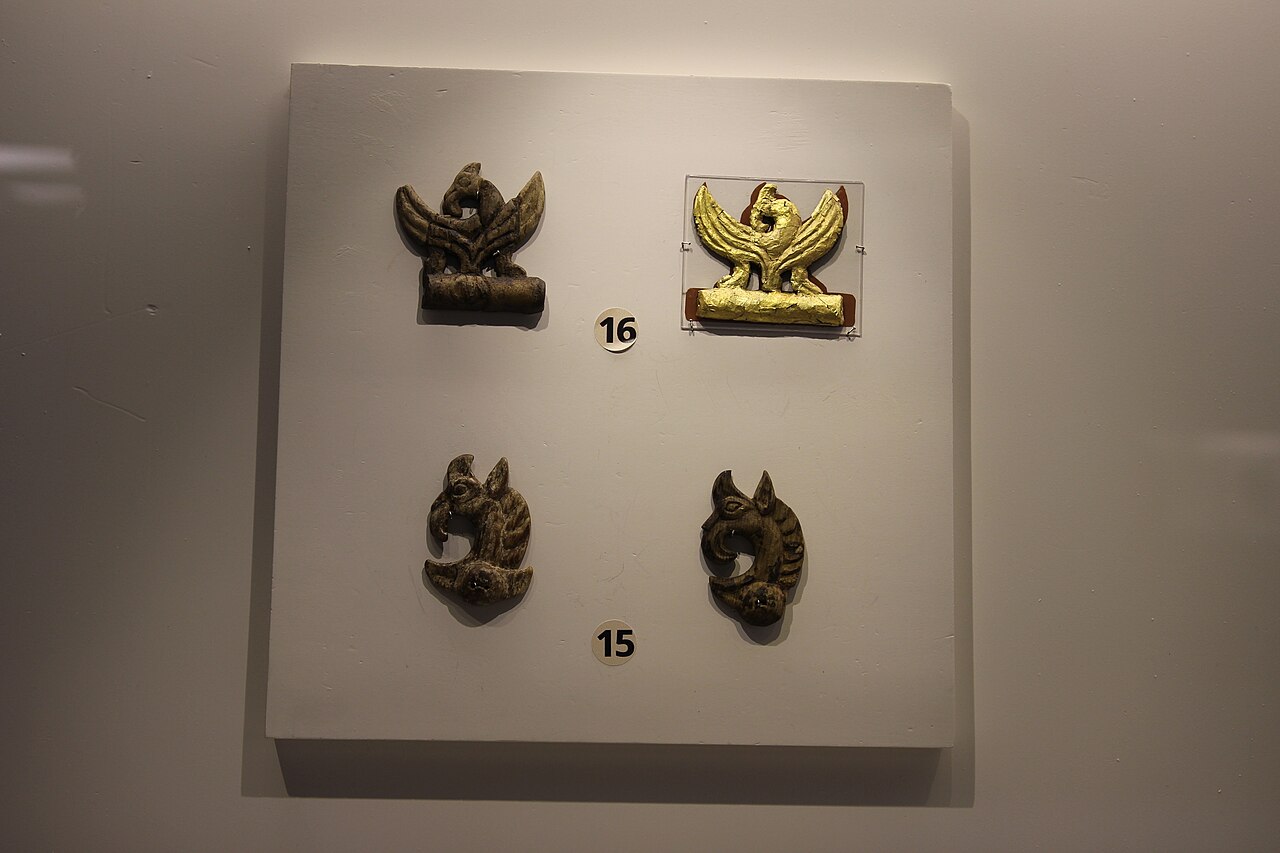
Wooden pendants in the form of vulture heads and of vultures with spread wings, 4th to 3rd centuries BC, from the Berel burial ground in East Kazakhstan, in the National Museum of the Republic of Kazakhstan. They are shown to illustrate animal-style carving in the region and are not from the Ust-Koksinsky kurgan. (Image: Muzaffar Turgunov, Wikimedia Commons, CC0, resized from 5,184 by 3,456 to 1,280 by 853 pixels, otherwise unaltered)
According to RIA Novosti, Molodin said the central burial of the mound had been robbed in antiquity. However, the team found the burials of several horses and figures of animals wrapped in gold foil, and the work of interpreting them is still under way.
Molodin also sees links between the new kurgan and Pazyryk. "Perhaps this is precisely the forerunner of the Pazyryk culture, because the animal style is very reminiscent of the Pazyryk people," he said, according to RIA (translated by Ancient Origins).
These are early statements and no study has been published. Paleogeneticists are now examining material from the kurgan to compare it with Pazyryk material, RIA reports, so the idea of an earlier culture remains a working hypothesis.
Ancient Echoes of Scythian Burial
Greek writers knew of mound burials among the Scythians long before archaeologists reached the Altai. Herodotus, writing in the 5th century BC about the Scythians north of the Black Sea, describes a royal burial in a great four-cornered pit with horses and golden cups, after which the mourners "all build a great barrow of earth, vying eagerly with one another to make this as great as possible."
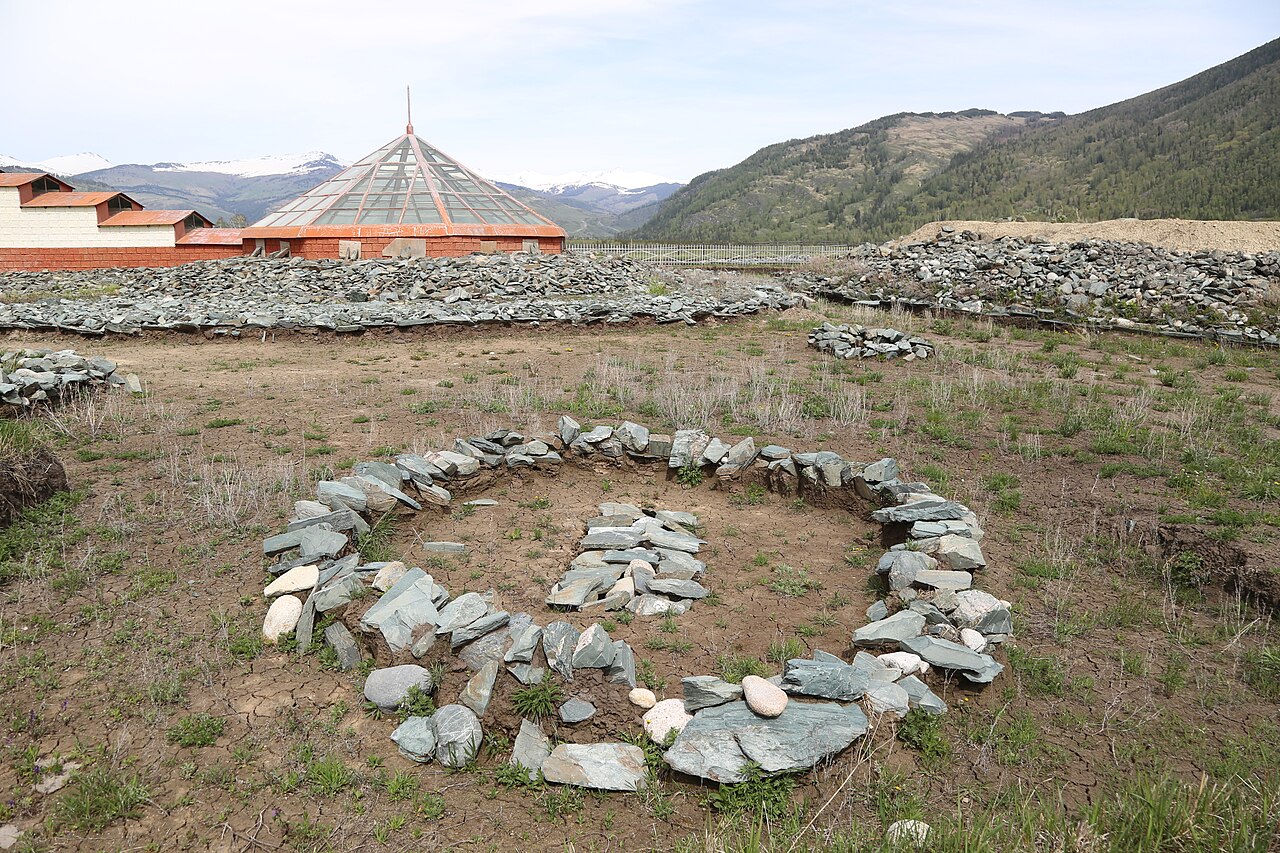
Stone rings of the Berel kurgans in the Kazakh Altai, photographed in May 2018. The site is shown as an example of an Altai kurgan field and is not Pazyryk or Ust-Koksinsky. (Image: Mheidegger, Wikimedia Commons, CC BY 4.0, resized from 5,472 by 3,648 to 1,280 by 853 pixels, otherwise unaltered)
Herodotus was describing peoples thousands of kilometers to the west, and his account cannot be read as a description of Pazyryk itself. Nevertheless, the kurgans of the Altai belong to that same wider Scythian world of horse riders, animal art and great burial mounds.
The Altai kurgans are also graves, and the frozen burials found there, including that of a noblewoman on the Ukok Plateau often called the Siberian Ice Maiden, are the remains of real people. The gilded head is a different kind of find, an object made by those communities, and it adds a small detail to what is known about how they furnished their tombs.
Which animal did its carver intend, where in the tomb did it sit, and what was it for? For now those questions remain open. Yet more than seven decades after Rudenko's excavations, the old timbers of Pazyryk have shown that there is still much to learn.
By Aris Manus
Sources
Herodotus. The Histories, Book 4, chapter 71. Translated by A. D. Godley. Cambridge, MA: Harvard University Press, 1920. Perseus Digital Library. Available at: https://www.perseus.tufts.edu/hopper/text?doc=Perseus%3Atext%3A1999.01…
Koshechkina, V. 2026. Уникальный золотой зверек 2500 лет «охранял» гробницы России (A unique golden beast "guarded" Russia's tombs for 2,500 years, translated by Ancient Origins). Lenta.ru, November 25, 2026. In Russian. Available at: https://lenta.ru/news/2026/11/25/unikalnyy-zolotoy-zverek-2500-let-ohra…
RIA Novosti. 2026. На Алтае археологи обнаружили следы неизвестной ранее скифской культуры (In the Altai, archaeologists have found traces of a previously unknown Scythian culture, translated by Ancient Origins). November 24, 2026. In Russian. Available at: https://ria.ru/20261124/arkheologi--2133570312.html
Rubinson, K. S. 1990. The Textiles from Pazyryk: A Study in the Transfer and Transformation of Artistic Motifs. Expedition 32 (1). Penn Museum. Available at: https://www.penn.museum/sites/expedition/the-textiles-from-pazyryk/
Rubinson, K. S. 1990, updated 2017. Carpets vi. Pre-Islamic Carpets. Encyclopaedia Iranica, vol. IV, fasc. 8, pp. 858 to 861. Available at: https://www.iranicaonline.org/articles/carpets-vi/
TASS, via News Mail.ru. 2026. На Алтае археологи нашли древнюю фигурку загадочного хищника (In the Altai, archaeologists have found an ancient figurine of an enigmatic predator, translated by Ancient Origins). November 24, 2026. In Russian. Available at: https://news.mail.ru/society/73215254/

Enjoyed this? Get UNLEASHED for life, $249 once
Ancient Origins UNLEASHED is our Substack for the deeper, longer stories. Until Monday, November 30 at midnight UK time, you can join for life with one payment instead of a yearly subscription.
- The full paid UNLEASHED archive and every future paid post, for as long as the publication continues
- A Founders certificate
- A vote on upcoming topics
- Optional credit on our Founders page, only with your permission
- One welcome one-to-one discussion
Become an UNLEASHED Lifetime Founder, $249
Places are limited to 20 in total. Use the same email you use (or will use) on Substack. We switch on your paid access by hand after payment, so it is not instant. UNLEASHED only; Ancient Origins Premium is not included.
Want everything Ancient Origins makes? The Founders' Lifetime Pass is $349, paid once: Premium for life, all 29 ebooks, 177 webinar and interview recordings, 64 Magazine issues, AO Kids and the full Atlas.