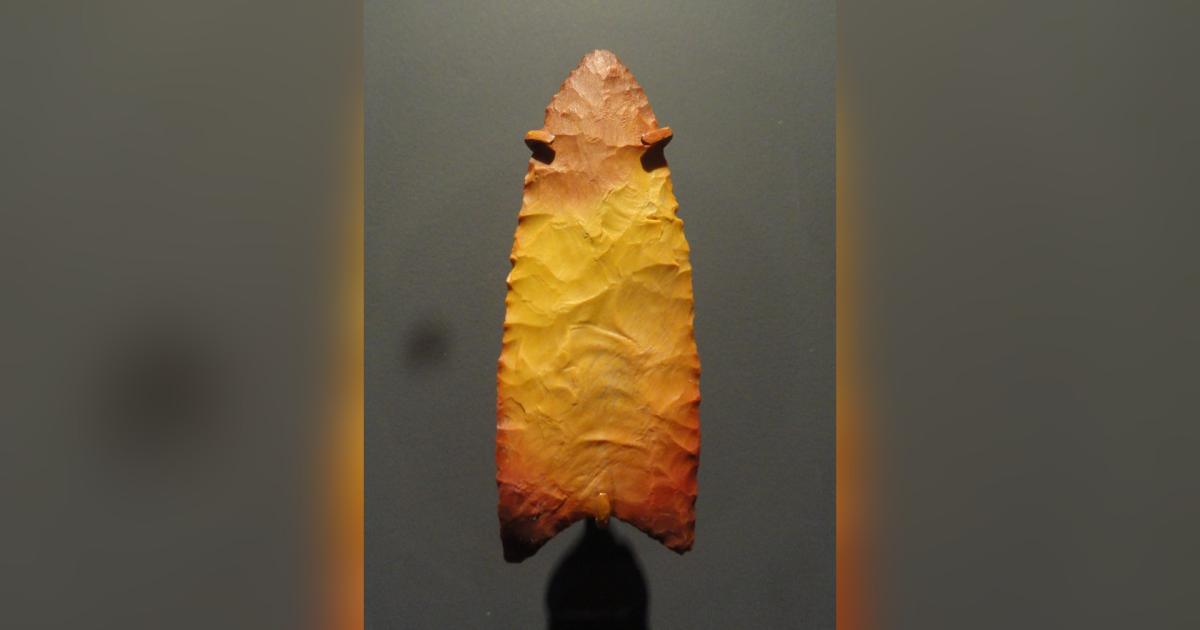

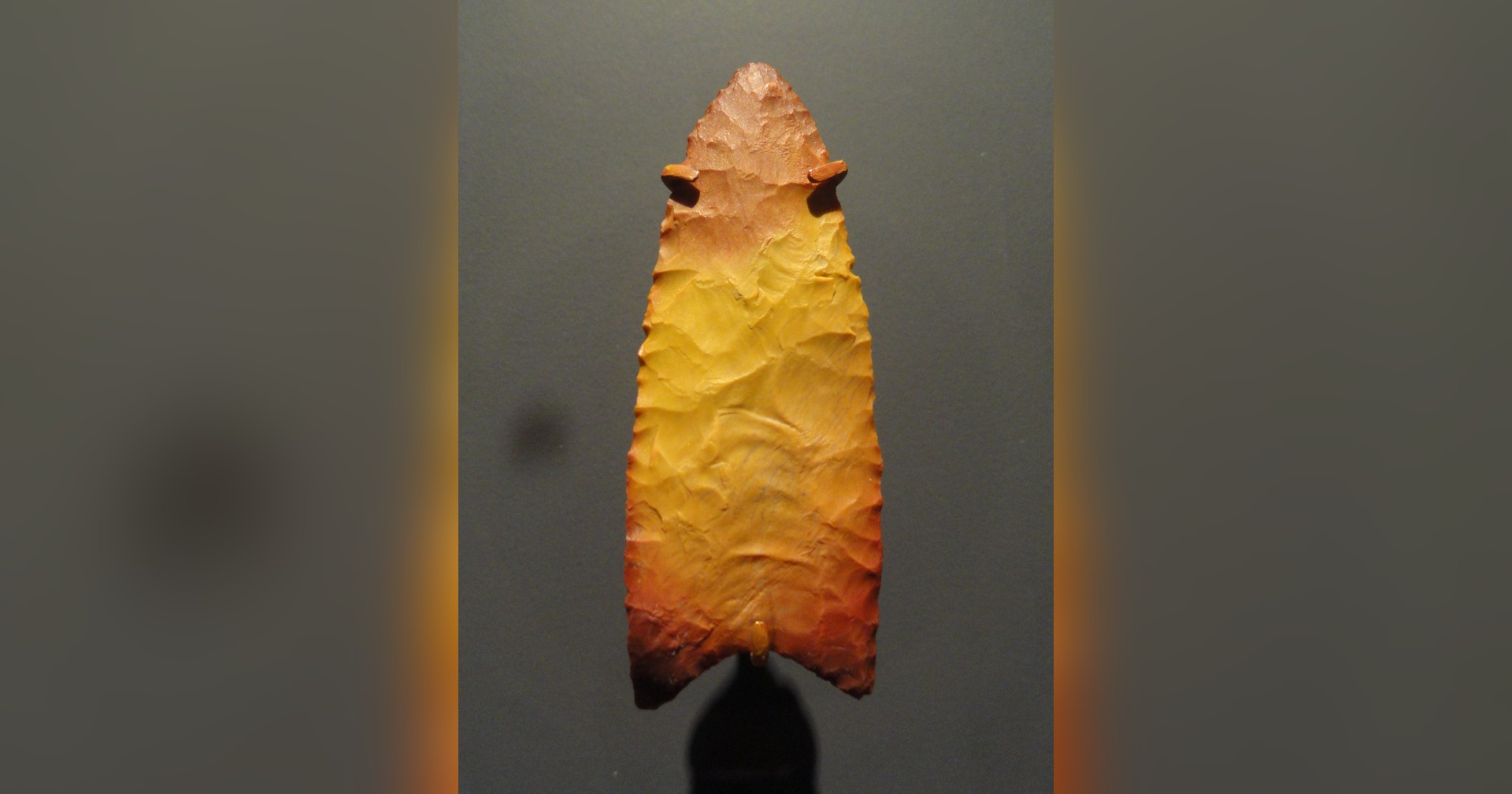
A Clovis point from Sevier County, Utah, on display at the Natural History Museum of Utah. It is shown for comparison only and is not one of the La Prele finds. (Image: Daderot, CC0 1.0, via Wikimedia Commons, resized from 3,240 x 4,320 to 756 x 1,008 pixels and placed on a wider canvas, with a blurred fill made from the same photo added at both sides)
Archaeologists working at the La Prele mammoth site near Douglas, Wyoming, have reported a Clovis point and a broken Folsom point lying on the same ancient ground surface, a pairing that the standard timeline says should not happen. The claim comes from an interview with the Wyoming news site Cowboy State Daily and a short 2024 conference abstract, and no peer-reviewed paper has been published yet. Could two cultures long placed one after the other really have overlapped here?
According to Cowboy State Daily, which spoke to Todd Surovell, director of the George C. Frison Institute of Archaeology and Anthropology at the University of Wyoming, Surovell calls the pairing an "unprecedented find." Surovell told the outlet: "These people were using Clovis points and Folsom points at the same time in the same place." He also cautioned, "I can't say for certain that we're looking at a single event or a single occupation, but it sure looks like one."
Why the Order Matters
For about a century, the textbook sequence for the earliest well-defined cultures of the Great Plains and the West has put Clovis earlier and Folsom later. The Folsom story began in 1927, when, as a 2020 paper in American Antiquity recounts, the scientists A. V. Kidder and Frank H. H. Roberts confirmed that stone artifacts lay with the bones of extinct bison near Folsom, New Mexico. Soon afterward, points later classed as Clovis turned up with mammoth bones at the Dent site in Colorado.
The Clovis name comes from Blackwater Draw near Clovis, New Mexico, which the site's managers describe as "the type site of the Clovis Culture, the oldest positively defined cultural group in North America." According to the same source, it "was discovered in 1929, and excavations began in 1932." Over the following decades, Clovis points became linked in the literature with mammoth hunting, and the smaller, finely fluted Folsom points with bison.
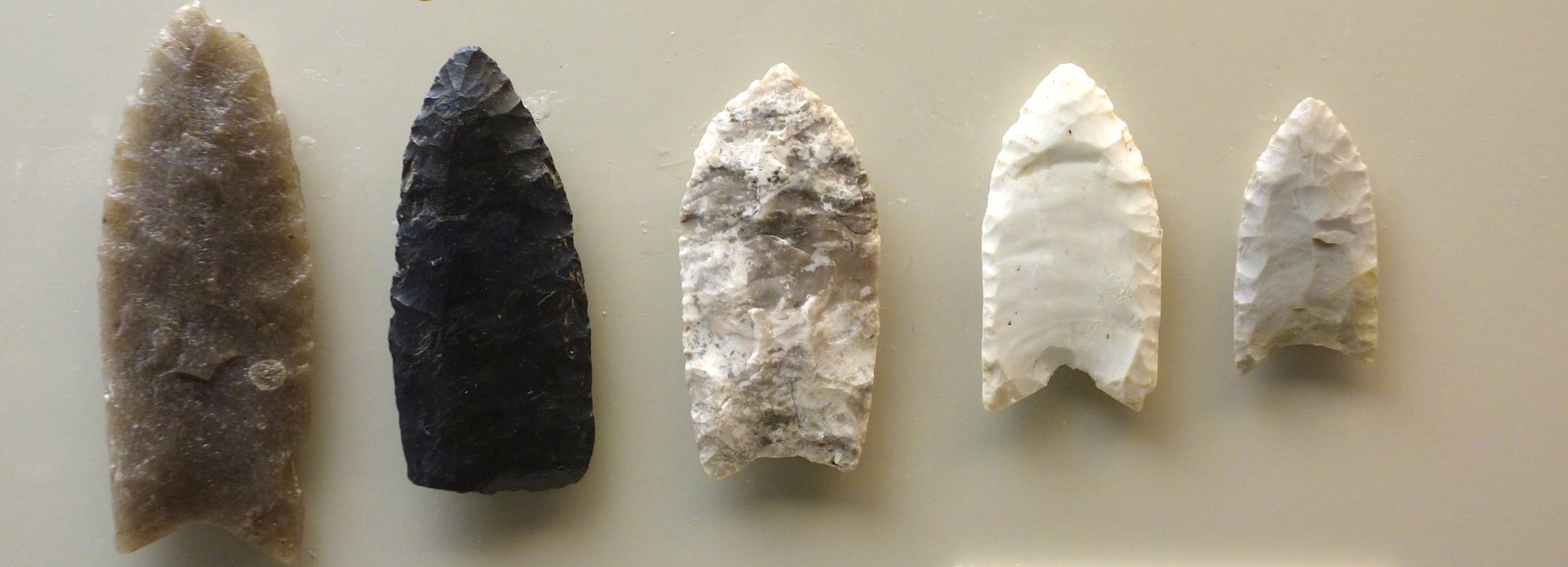
Fluted spear points exhibited at the Wisconsin Historical Museum, which labels them Late Paleo and Early Archaic, 8000 to 6000 BC. They are shown only to illustrate fluting. By the museum's dating they are later than the Clovis period, and they are not from La Prele. (Image: Daderot, CC0 1.0, via Wikimedia Commons, cropped to remove the museum's wall text and label, then resized to 1,920 x 694 pixels)
"The story is that Folsom comes after Clovis, and we've been saying that for almost 100 years," Surovell told Cowboy State Daily. He explained that "Clovis points were designed for hunting mammoths and Folsom points were designed for hunting bison, and this faunal association (at other sites) has stuck with these two-point types." In that model, Folsom appears on the Plains only once the mammoths had gone, and the two point styles mark two separate chapters.
What Was Found at La Prele?
La Prele is a Clovis mammoth site in Converse County. According to the 2020 paper by Madeline Mackie, Surovell, Spencer Pelton and colleagues, the site was found in 1986 and a Columbian mammoth was first excavated there in 1987. That study confirmed a cultural association with the mammoth and placed the site at about 12,850 years ago, within the Clovis period. Cowboy State Daily reports that Pelton, Surovell and other archaeologists then dug there every summer from 2014 to 2024, on private land that is listed on the National Register of Historic Places.
As reported by Cowboy State Daily, the team found a Clovis point in Block C, less than 40 feet from the mammoth in Block A. Nearby Block D, an area dense with artifacts, held a broken Folsom point, identified by its size, shape and deep central flute. Surovell mapped each piece in three dimensions with a total station, and the points, according to the outlet, all fell within the same layer, "buried within 10 vertical millimeters of each other."
"All these diagnostic artifacts are sitting exactly on the same surface in a single component," Surovell said. The 2024 conference abstract adds that Block D, the densest activity area, "also returned a diagnostically Folsom fluted point along with mammoth ivory, bone needles, ocher, and butchered mammal remains." Cowboy State Daily reports that the bison bone there showed signs of butchering and that two pieces of ivory were found.
In the passage setting out Surovell's supporting evidence, the report carries a quote, not tagged to a named speaker, that takes care over the ivory: "We don't know if this ivory came from (the La Prele mammoth), but it's telling us almost certainly that people were working ivory in this area." The report adds that a chert flake from Block E fit onto another flake from Block A, linking those two areas, and that a shape study with Briggs Buchanan of the University of Tulsa placed both La Prele points within their expected types.
A Prediction That Came First
The idea of an overlap between the two traditions has been building in the scientific literature for some years. In 2022, Buchanan, Surovell and colleagues ran a Bayesian model of radiocarbon dates from Clovis and Folsom sites in American Antiquity. They estimated that the Folsom complex first appears between 12,900 and 12,740 cal BP (radiocarbon years converted to calendar years before present), while Clovis disappears between 12,720 and 12,490 cal BP. The authors concluded that "the two complexes likely co-occurred in the West for nearly eight generations."
Surovell is a co-author of that model, so La Prele should be read as a possible field example of it and cannot count as a fully independent test. A 2010 study led by Mark Collard in the Journal of Archaeological Science had also suggested that Folsom first appeared around 12,800 years ago in the northern High Plains and spread from there. Surovell now suggests Folsom may have begun on the eastern slopes of the Rocky Mountains, telling the outlet, "The Folsom are getting older."
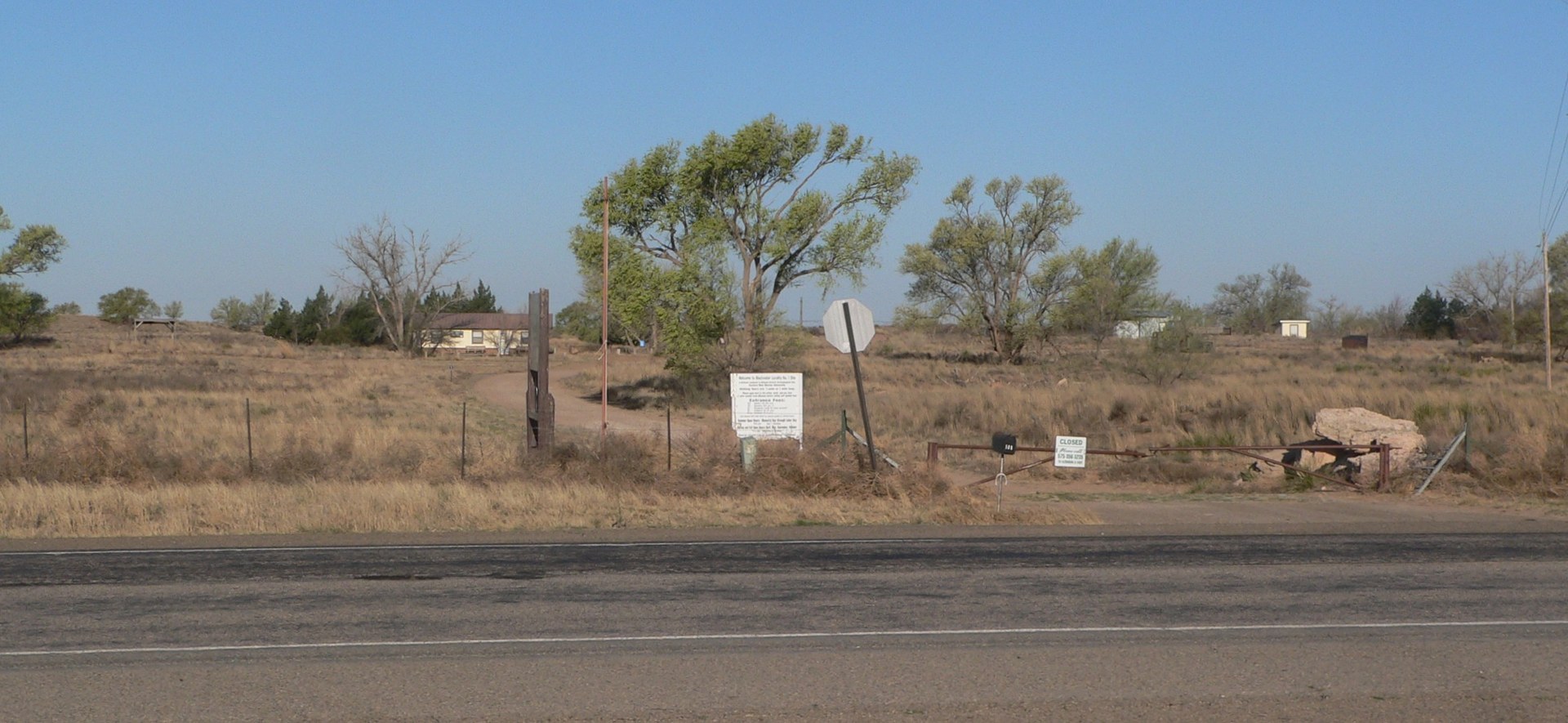
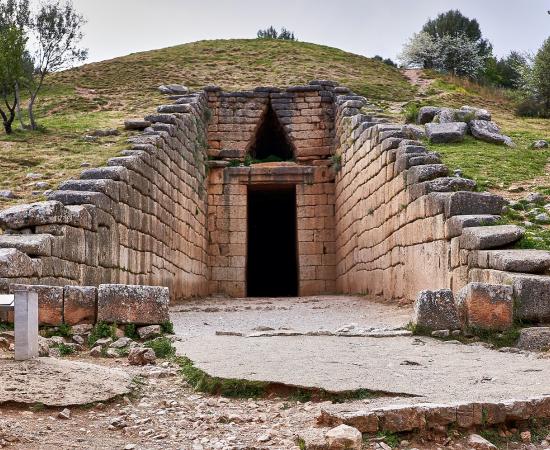
The entrance to Blackwater Draw, the Clovis type site near Portales, New Mexico, photographed in 2016. It is shown for context and is not La Prele. (Image: Ammodramus, CC0 1.0, via Wikimedia Commons, resized from 2,337 x 1,077 to 1,920 x 885 pixels)
Is One Surface Enough?
The weak point, as Surovell admits, is whether everything on that surface was left at one time. "I knew that people would question our interpretation that (La Prele) is a single event, and I think it's completely reasonable to question that," he said. Wyoming State Archaeologist Spencer Pelton said, "If I had to guess, the site was probably occupied longer than a day, no more than a month," and called it "one occupation."
There is a cautionary case from elsewhere in the American West that shows why archaeologists ask. At Owl Cave in Idaho, mammoth bone and Folsom-like points came from the same strata, and a 2017 study in American Antiquity tested whether Folsom people hunted mammoths there. Its dating indicated that "all of the mammoth remains predate Folsom," and it read the deposits as "part of a palimpsest of terminal Pleistocene materials." The 2020 La Prele paper also reported extensive bioturbation at the site, which it judged mostly the work of insects and small rodents and which, the authors said, had shifted some artifacts vertically.
Of course, neither caution settles La Prele either way, and the team's close three-dimensional mapping is exactly the kind of evidence a full report would need to lay out. Still, the dates, the precise positions and the geology have so far appeared only in a newspaper interview and a 2024 abstract. Surovell said the team has "over 60,000 artifacts to analyze and put together into a coherent story," and the excavations ended in 2024.
It is a promising lead, but it remains a preliminary claim until the evidence appears in a peer-reviewed paper and other archaeologists can test it. If the full study holds up, it would join the radiocarbon model in pointing to a Clovis and Folsom overlap. For now, the case for two cultures at one moment at La Prele remains less proven than intriguing.
By Aris Manus
Sources
Blackwater Draw Archaeology, Eastern New Mexico University. Blackwater Draw National Historic Landmark. Available at: https://www.bwdarchaeology.com/bwdnationalhistoriclandmark
Buchanan, B., Kilby, J. D., LaBelle, J. M., Surovell, T. A., Holland-Lulewicz, J. and Hamilton, M. J. 2022. Bayesian Modeling of the Clovis and Folsom Radiocarbon Records Indicates a 200-Year Multigenerational Transition. American Antiquity 87(3): 567 to 580. DOI: https://doi.org/10.1017/aaq.2021.153
Collard, M., Buchanan, B., Hamilton, M. J. and O'Brien, M. J. 2010. Spatiotemporal Dynamics of the Clovis-Folsom Transition. Journal of Archaeological Science 37: 2513 to 2519. Available at: https://www.unm.edu/~marcusj/Collard%20et%20al%202010.pdf
Henrikson, L. S., Byers, D. A., Yohe, R. M. II and De Carlo, M. 2017. Folsom Mammoth Hunters? The Terminal Pleistocene Assemblage from Owl Cave (10BV30), Wasden Site, Idaho. American Antiquity 82(3): 574 to 592. DOI: https://doi.org/10.1017/aaq.2017.14
Mackie, M. E., Surovell, T. A., O'Brien, M., Kelly, R. L., Pelton, S., Haynes, C. V., Frison, G. C., Yohe, R. M., Teteak, S., Rockwell, H. M. and Mahan, S. 2020. Confirming a Cultural Association at the La Prele Mammoth Site (48CO1401), Converse County, Wyoming. American Antiquity 85(3): 554 to 572. DOI: https://doi.org/10.1017/aaq.2020.8
Mackie, M., Surovell, T., Pelton, S., Kelly, R. and O'Brien, M. 2024. Clovis-Folsom Overlap at the La Prele Mammoth Site. Abstract, 89th Annual Meeting of the Society for American Archaeology. tDAR id 498136. Available at: https://core.tdar.org/document/498136/clovis-folsom-overlap-at-the-la-p…
Rossi, A. 2026. [Report on new discoveries at the La Prele Mammoth Site, with interviews of Todd Surovell and Spencer Pelton]. Cowboy State Daily, November 27, 2026. Available at: https://cowboystatedaily.com/2026/11/27/bombshell-discoveries-at-wyomin…

Enjoyed this? Get UNLEASHED for life, $249 once
Ancient Origins UNLEASHED is our Substack for the deeper, longer stories. Until Monday, November 30 at midnight UK time, you can join for life with one payment instead of a yearly subscription.
- The full paid UNLEASHED archive and every future paid post, for as long as the publication continues
- A Founders certificate
- A vote on upcoming topics
- Optional credit on our Founders page, only with your permission
- One welcome one-to-one discussion
Become an UNLEASHED Lifetime Founder, $249
Places are limited to 20 in total. Use the same email you use (or will use) on Substack. We switch on your paid access by hand after payment, so it is not instant. UNLEASHED only; Ancient Origins Premium is not included.
Want everything Ancient Origins makes? The Founders' Lifetime Pass is $349, paid once: Premium for life, all 29 ebooks, 177 webinar and interview recordings, 64 Magazine issues, AO Kids and the full Atlas.