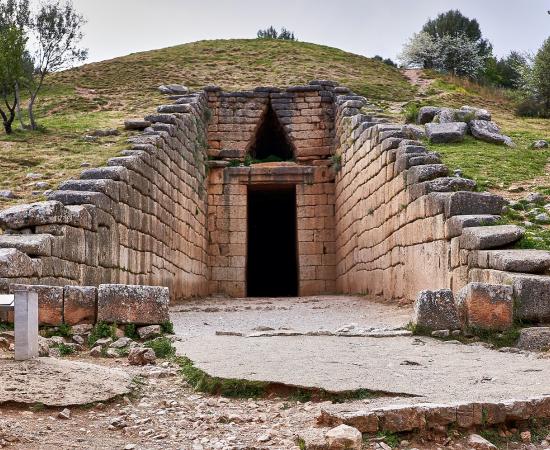

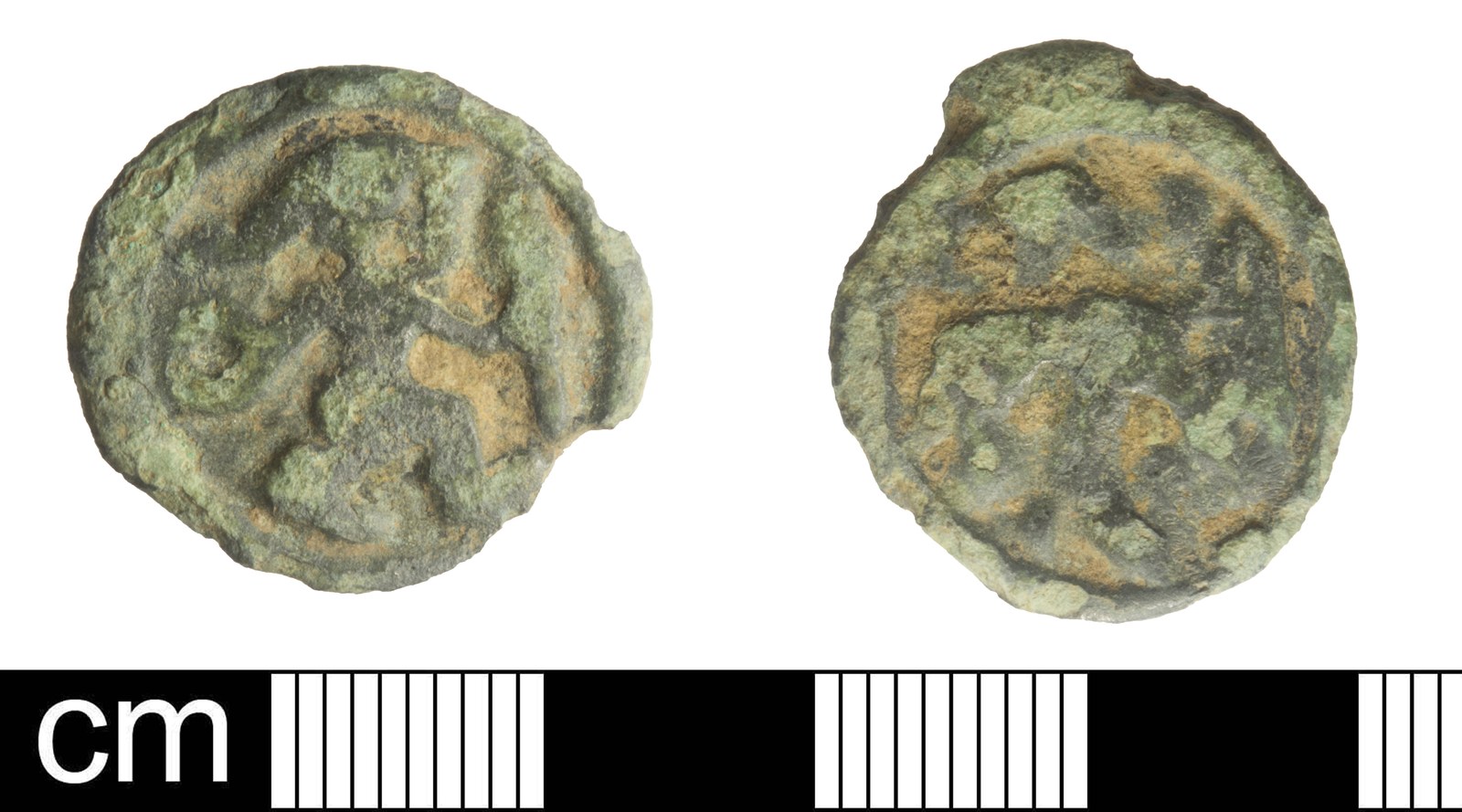
A cast potin coin of the Remi, neighbors of the Leuci, dated to about 150 to 100 BC and found in Hampshire, England, shown from both sides. It is shown for comparison only and is not one of the Bure coins, which are of a different type. (Image: Andrew Williams, The Portable Antiquities Scheme, CC BY 2.0, via Wikimedia Commons, resized from 6490 by 3605 to 1600 by 889 pixels, otherwise unaltered)
A small pit holding 28 cast Gallic coins and a miniature metal wheel has been found in the wall of a large Iron Age timber building at Bure, in the Meuse department of northeastern France. Fragments of a human skull lay in one of the building's corner postholes. France's National Institute for Preventive Archaeological Research (Inrap), which announced the find on November 23, 2026, sees in the finds a possible sanctuary of the Leuci, a Gallic people of the region, but it has not yet been able to confirm that reading.
The excavation, which Inrap's photographs date to August 2026, was carried out ahead of Andra's Cigéo deep geological storage project, under the supervision of the regional archaeology service of Grand Est. According to HeritageDaily and Stile Arte, the scientific lead was Luc Sanson of Inrap. Readers who know the name Bure from elsewhere should note that this site has no connection with the Camp celtique de la Bure, a hilltop site in the Vosges.
A Building With a Lean
The building survives only as the bases of its timber posts. Inrap describes four large postholes forming an inner frame of about 7.5 by 5.5 meters, each set in a pit around one meter across and more than 0.8 meters deep. Because the field has been eroded, Inrap suspects the posts were once sunk even deeper.
The postholes also show a slight inward lean. Inrap reads this as a sign of a rectangular building that narrowed toward the top, giving it a slightly prismatic or pyramidal shape, as seen on other sites of the same period. The building dates to the Late La Tène period, the final phase of the Iron Age in Gaul before the Roman conquest.
Inrap summed up where the evidence leads in its own announcement, writing that the finds were "pointing the research toward the hypothesis of a Gallic sanctuary, in the territory of the Leuci tribe" (translated by Ancient Origins).
Coins Cast in a Mold
The 28 coins are potins, which Inrap explains were cast in molds rather than struck between dies. On some of the Bure coins the casting sprue, a small stub of metal left from the mold channel, is still visible.
Most carry what French numismatists call a "tête d'indien" on one side, a stylized head that Inrap traces back to the coins of Philip II of Macedon, the father of Alexander the Great. Over generations, Gallic engravers turned the original into a design that is almost impossible to recognize. The other side of most coins shows a "sanglier-enseigne", a boar standing above a small motif like a fleur de lys or an inverted letter T. Inrap identifies it as a military standard, much as the eagle was for Roman legions, and notes that this type of potin was widespread across northeastern Gaul.
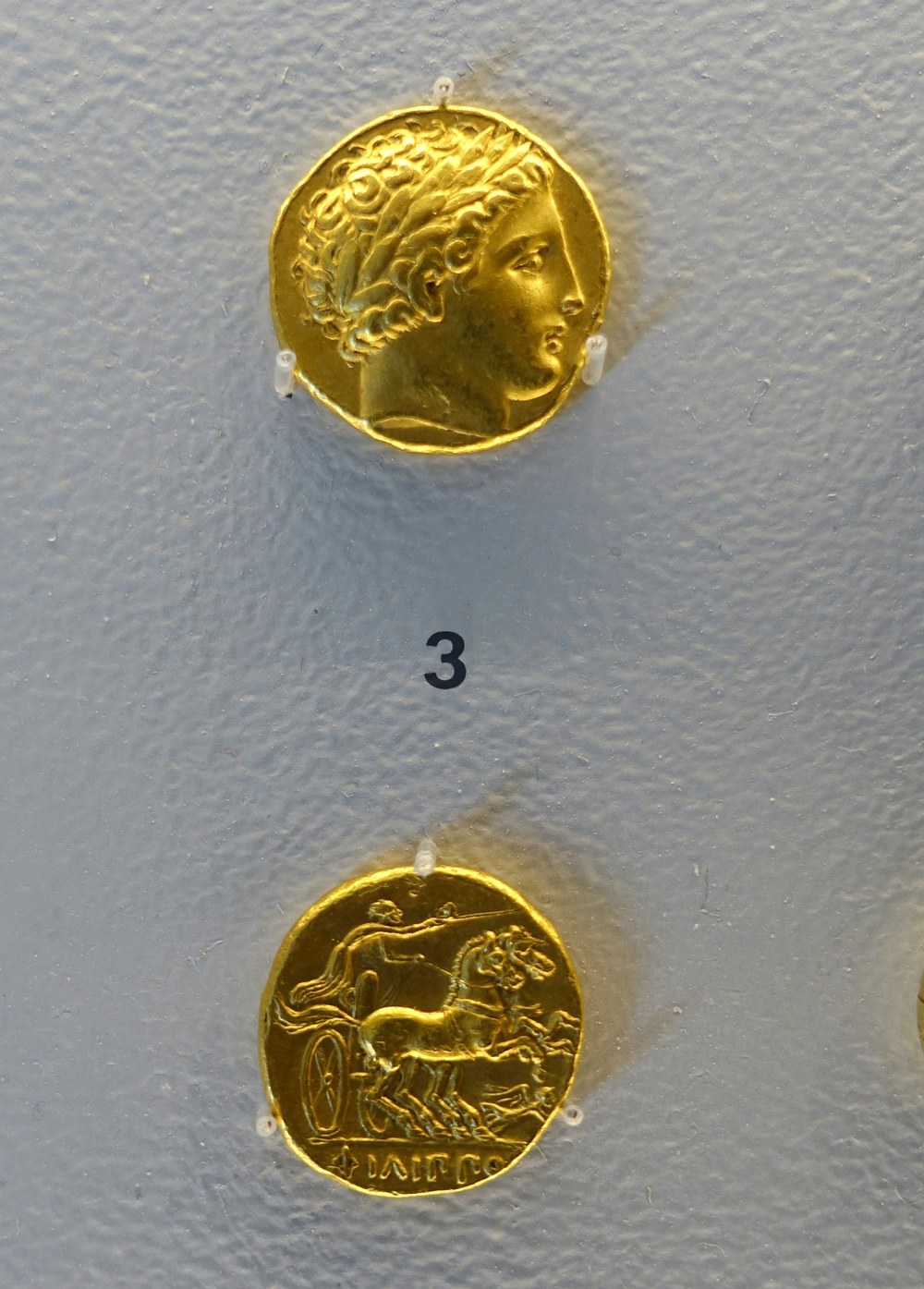
A gold stater of Philip II of Macedon, struck at Pella in about 336 to 328 BC, now in the Arthur M. Sackler Museum at Harvard University. The head is usually identified as the god Apollo. Inrap traces the head on the Bure potins back to coins of Philip II. It is shown for comparison only and is not a find from Bure. (Image: Daderot, CC0, via Wikimedia Commons, resized from 2131 by 2973 to 1000 by 1395 pixels, otherwise unaltered)
Ancient Origins has reported on another Celtic coin find this year, the two kilograms of Celtic silver buried at Szombathely in Hungary, where the question was why the owner never came back for the hoard.
A Wheel Beside the Coins
The same pit held a rouelle, a miniature metal wheel about five centimeters in diameter. Inrap writes that "The rouelle is a small metal wheel whose function is rather poorly understood, but which is often found in a cult or votive context" (translated by Ancient Origins), suggesting it may have served as an amulet or an offering.
Inrap therefore describes the pit as "probably a hiding place for this coin deposit and the rouelle that went with it" (translated by Ancient Origins). Neighboring postholes produced a few more coins, a detail that, as HeritageDaily puts it, suggests "that deposition was not confined to a single pit."
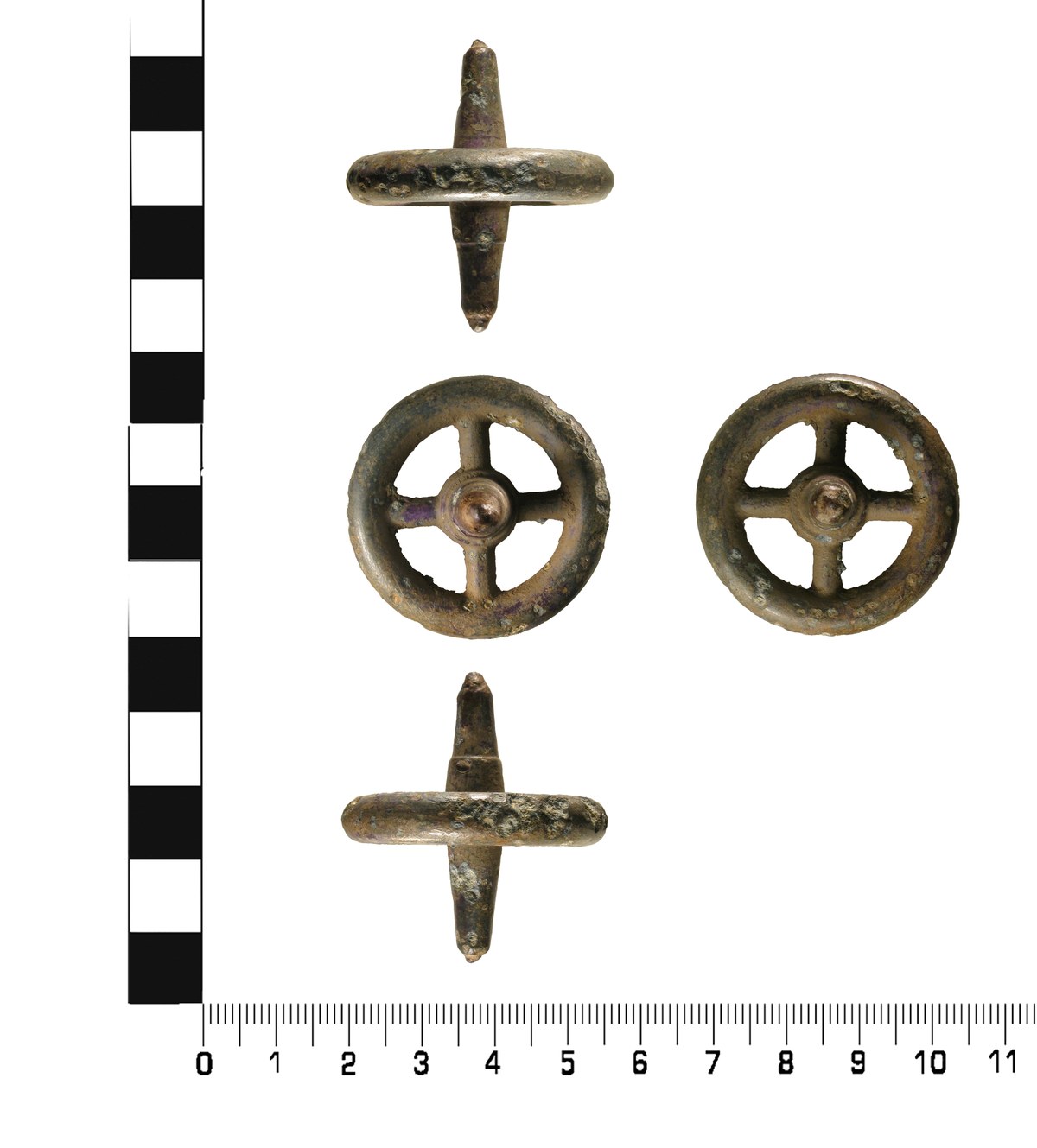
A cast copper alloy miniature wheel, a possible votive offering of probable Late Iron Age to early Roman date, about 100 BC to AD 100, found in Northamptonshire, England. Its wheel measures about 36 millimeters across. It is a British comparison object and is not the Bure rouelle. (Image: Aimee Hinds, Birmingham Museums Trust, The Portable Antiquities Scheme, CC BY 2.0, via Wikimedia Commons, resized from 4909 by 5436 to 1200 by 1329 pixels, otherwise unaltered)
Rouelles are known from many Iron Age and Gallo-Roman sites, Stile Arte notes, and they are only one of the small metal objects thought to have been left as offerings. Ancient Origins recently reported on another, a Bronze Age neck ring on the Lötschen Pass in the Swiss Alps.
Skull Fragments in a Corner
In one of the corner postholes, the excavators recovered fragments of human bone. Inrap reports that, broken as they are, most come from a skull, including part of a lower jaw. No date for the bones has been reported, and HeritageDaily lists the human remains among the finds still to be studied.
The meaning of the bones remains open, and Inrap notes that "It is fairly common for Gallic sanctuaries to produce human skulls, even if it is not impossible to find them in a domestic setting" (translated by Ancient Origins). Stile Arte, an Italian art and archaeology magazine, makes the same point, warning that the bones alone do not prove the building was a sanctuary.
Where Is the Ditch?
That is the problem for the sanctuary reading. Inrap writes that, in the best known cases, "sanctuaries normally have a very clear boundary with a deep ditch" (translated by Ancient Origins), and it names Gournay-sur-Aronde in the Oise and Ribemont-sur-Ancre in the Somme as examples.
At Gournay, Jean-Louis Brunaux and his colleagues reported in 1978 that offerings, mainly iron weapons and animal bones along with a few human bones, had been thrown into a ditch about 2.5 meters wide and 1.8 meters deep. Nothing of the kind has turned up at Bure. HeritageDaily and Stile Arte both report that a geophysical survey carried out about a month after the dig found no ditch, fence or palisade around the building, although erosion may have removed shallower traces.
With these factors taken into account, Stile Arte suggests that the Bure building may belong to a different kind of sacred space, or that it may have had no religious role at all. HeritageDaily adds that the coins, the wheel and the bones may yet prove to be separate deposits. Ancient Origins has an overview of the Gauls for readers who want to know more about the peoples involved.
Leuci Country
The Leuci lived in what is now southern Lorraine, Stile Arte explains. Their main center was the oppidum of Boviolles, about 20 kilometers north of Bure. HeritageDaily and Stile Arte add that the borders of the Remi and the Lingones lay about 15 kilometers to the west and south.
If the sanctuary reading is confirmed, the find would stand out in the region. According to Inrap, as reported by HeritageDaily, a sanctuary containing a substantial coin deposit from a documented context "would be unprecedented in Leuci territory and exceptionally rare in Belgic Gaul." Stile Arte carries the same claim, and Arkeonews also frames it as conditional on the sanctuary reading being confirmed.
What Comes Next
Further study of the coins, the rouelle, the bones and the building itself may show whether the finds belong together. In the meantime, Bure remains less a confirmed sanctuary than a well documented possibility, and a rare chance to see Gallic coins in the place where someone chose to leave them.
By Aris Manus
Sources
Inrap. 2026. "Un dépôt monétaire de la tribu des Leuques découvert à Bure (Meuse)." November 23, 2026. Available at: https://www.inrap.fr/un-depot-monetaire-de-la-tribu-des-leuques-decouve… (quotations translated by Ancient Origins)
Milligan, M. 2026. "Gallic coin hoard discovered at possible Iron Age sanctuary." HeritageDaily, November 23, 2026. Available at: https://www.heritagedaily.com/2026/11/gallic-coin-hoard-found-at-traces…
Buyukyildirim, O. 2026. "Gallic Coins and Human Skull Fragments in France Point to an Ancient Sacred Site." Arkeonews, November 26, 2026. Available at: https://arkeonews.net/gallic-coins-and-human-skull-fragments-in-france-…
Bernardelli Curuz, F. 2026. "Scoperto tempio gallico con 28 monete, una ruota votiva e frammenti di un cranio umano." Stile Arte, November 24, 2026. Available at: https://www.stilearte.it/santuario-gallico-scoperto-leuques-bure-deposi…
Brunaux, J.-L., Marquis, P. and Méniel, P. 1978. "Les recherches à Gournay-sur-Aronde : bilan et perspectives." Revue archéologique de l'Oise 13, pp. 27 to 28. DOI: https://doi.org/10.3406/pica.1978.1101

Enjoyed this? Get UNLEASHED for life, $249 once
Ancient Origins UNLEASHED is our Substack for the deeper, longer stories. Until Monday, November 30 at midnight UK time, you can join for life with one payment instead of a yearly subscription.
- The full paid UNLEASHED archive and every future paid post, for as long as the publication continues
- A Founders certificate
- A vote on upcoming topics
- Optional credit on our Founders page, only with your permission
- One welcome one-to-one discussion
Become an UNLEASHED Lifetime Founder, $249
Places are limited to 20 in total. Use the same email you use (or will use) on Substack. We switch on your paid access by hand after payment, so it is not instant. UNLEASHED only; Ancient Origins Premium is not included.
Want everything Ancient Origins makes? The Founders' Lifetime Pass is $349, paid once: Premium for life, all 29 ebooks, 177 webinar and interview recordings, 64 Magazine issues, AO Kids and the full Atlas.