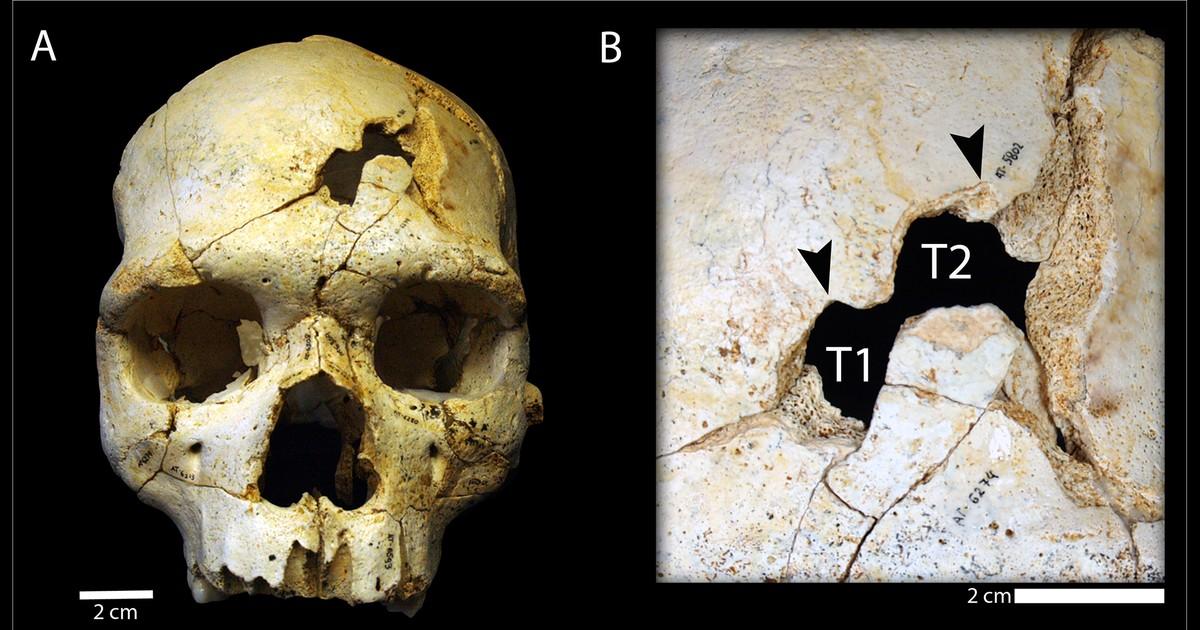

Cranium 17 from the Sima de los Huesos in northern Spain, about 430,000 years old, with the two fractures on the forehead labeled T1 and T2 by the researchers. Figure by Nohemi Sala, Juan Luis Arsuaga, Ana Pantoja-Pérez, Adrián Pablos, Ignacio Martínez, Rolf M. Quam, Asier Gómez-Olivencia, José María Bermúdez de Castro and Eudald Carbonell, from PLOS ONE (2015), CC BY 4.0, via Wikimedia Commons. Cropped to the top two of four panels (2069 by 1110 pixels, keeping the scale labels), with a narrow black margin added at each side, and resized to 1200 by 630 pixels.
In the Atapuerca hills near Burgos in northern Spain, at the bottom of a shaft, lies a chamber that excavators call the Sima de los Huesos, the pit of bones. Among the many fossils found there is a skull that researchers have numbered Cranium 17, and it carries two holes in the forehead, side by side and almost the same shape.
In 2015 Nohemi Sala and eight colleagues published a close study of those two holes in the journal PLOS ONE. They are about 430,000 years old by the team's account, and the person belonged to the lineage that led to the Neanderthals, close relatives of Homo sapiens.
This week a viral post made a sweeping claim. It said that for about 285,000 years there is almost no evidence of humans harming each other, and that violence appears only around 14,000 to 12,000 years ago. So what do the bones actually show?
In short (Fringe): Homo sapiens burials at Jebel Sahaba in Sudan, directly dated as far back as 18,200 years, show repeated violence, and a far older skull from a close human relative shows a deliberate killing about 430,000 years ago. Scholars still argue, however, over how early organized group warfare began.
What the pit of bones shows
Sala and colleagues describe Cranium 17 as showing "two clear perimortem depression fractures on the frontal bone," meaning breaks made around the time of death. The two outlines proved almost indistinguishable in 3D, which pointed to one object striking twice from different directions and, in their view, ruled out a fall or a falling stone.
"Given that either of the two traumatic events was likely lethal, the presence of multiple blows implies an intention to kill," they write. They call it "the earliest clear case of deliberate, lethal interpersonal aggression in the hominin fossil record." The paper presents this, on the basis of fracture analysis, as the most plausible explanation.
The same paper notes that "Cranial and postcranial trauma are relatively common among Middle and Upper Pleistocene hominins and in most cases show signs of healing." A healed wound does not say who or what caused it, which is why lethal cases with clear signs of a weapon are so rare. Of course, Cranium 17 belonged to a close relative rather than to Homo sapiens, so on its own it cannot settle a claim about modern humans.
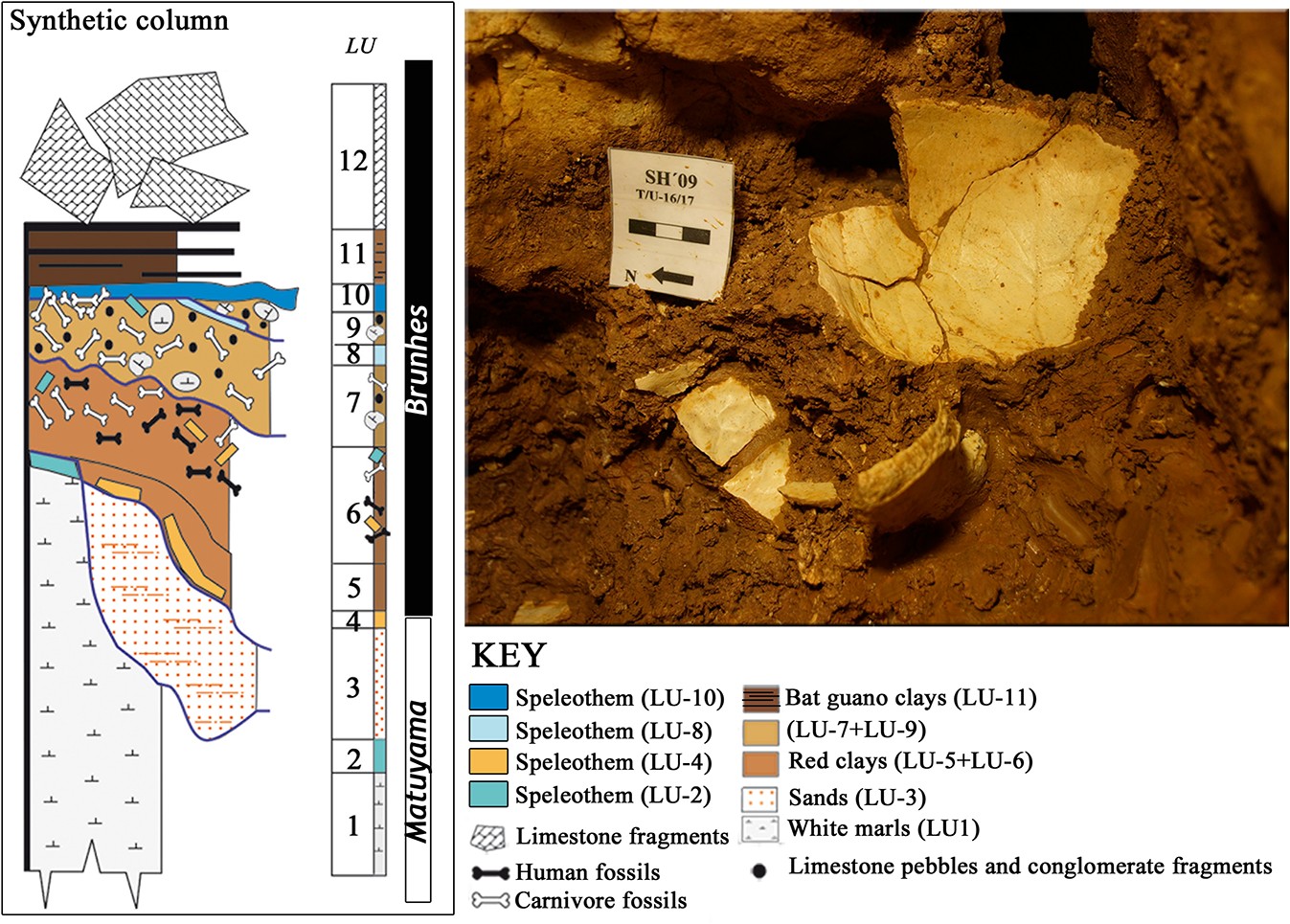
The layers of the Sima de los Huesos, with human fossils marked in the red clays, beside a photograph taken during excavation. Figure by Nohemi Sala and colleagues, modified from Arsuaga and colleagues, from PLOS ONE (2015), CC BY 4.0, via Wikimedia Commons, shown at its original size of 1347 by 965 pixels.
Neanderthals and early modern humans
Sala's team counts only two other fossils tentatively seen as cases of lethal violence. The Shanidar 3 Neanderthal has a penetrating wound to the left ninth rib, and the paper adds that "some bone remodelling is apparent," so the individual survived for several weeks, and it is unclear whether the wound caused the death.
The other is Sunghir 1, an Upper Paleolithic Homo sapiens with a sharp injury to a vertebra that has been read as the likely cause of death, although a hunting accident was not ruled out. A 2018 study in Nature by Judith Beier and colleagues found that Neanderthals and early Upper Paleolithic modern humans "exhibit similar overall incidences of cranial trauma."
Jebel Sahaba and the Nile
The site most widely cited as an early example of widespread violence is Jebel Sahaba, a cemetery in the Nile Valley of northern Sudan, excavated in the 1960s. In 2021 Isabelle Crevecoeur of the University of Bordeaux and colleagues reexamined the remains of 61 individuals, most of them now in the British Museum, and reported in Scientific Reports "Over 100 previously undocumented healed and unhealed lesions." Direct radiocarbon dates placed the burials between 13,400 and 18,200 years ago.
Most injuries came from projectile weapons, and 62.3 percent of the individuals showed healed or unhealed trauma, including children. A quarter of those with lesions had both kinds, which the team says confirms for the first time that the violence was repeated. The team dismissed the idea that the cemetery reflects a single warfare event and concluded that most deaths "are likely to have been the result of skirmishes, raids or ambushes." Earlier Ancient Origins coverage set the site beside Nataruk.
Nataruk and the argument over war
At Nataruk, west of Lake Turkana in Kenya, M. Mirazón Lahr of the University of Cambridge and colleagues reported in Nature in 2016 that "Ten of the twelve articulated skeletons found at Nataruk show evidence of having died violently at the edge of a lagoon." They described the find as evidence "that warfare was part of the repertoire of inter-group relations among prehistoric hunter-gatherers." Nature's editorial summary places the encounter some 10,000 years ago, and Ancient Origins reported the find when it was announced.
Christopher Stojanowski of Arizona State University and colleagues replied in Nature that the burials are not contemporaneous and that most of the cranial damage was inconsistent with blunt force trauma, so "the inference of inter-group warfare is premature." Mirazón Lahr's team answered that "their interpretation is incorrect on both counts." The sources read do not settle that exchange.

The southern shore of Lake Turkana, Kenya, in July 2024. The Nataruk site lies west of the lake. Photo by Predatorywasp, CC0, via Wikimedia Commons, resized from 4608 by 3456 pixels to 1200 by 900 pixels.
What the bones can and cannot tell
There is an honest kernel in the viral claim. The Nataruk paper itself opens by saying that "The nature of inter-group relations among prehistoric hunter-gatherers remains disputed, with arguments in favour and against the existence of warfare before the development of sedentary societies." Ancient Origins has also covered the argument that early prehistory was largely free of war. Sala's team notes that violence has "only very rarely" been proposed as a cause of death in Pleistocene fossils, and Beier's team stresses "the importance of preservation bias," so any count from that era rests on very few cases.
A 2016 Nature study led by José María Gómez, comparing causes of death across mammals, put the share of human deaths predicted to come from interpersonal violence at 2 percent, a figure "similar to the percentage seen in prehistoric bands and tribes."
However, this is not proof that early humans fought wars. A blow to one skull is a killing, and a cemetery full of projectile wounds is something larger. Even Crevecoeur's team calls Jebel Sahaba "one of the earliest sites displaying interpersonal violence in the world." Until older cemeteries turn up, the start of organized war will remain far less certain than the existence of violence.
How we checked this
Ancient Origins read the full open access papers on Cranium 17 and Jebel Sahaba, and the abstracts or opening paragraphs of the five Nature papers, with Nature's editorial summary of the Nataruk study. The 2009 Churchill paper on Shanidar 3 returned a challenge page and was not read, so the Shanidar details here come from the Sala paper.
By Aris Manus
Claim by claim
- Fringe: Humans showed almost no evidence of violence against each other until about 14,000 to 12,000 years ago. Reason: Homo sapiens burials at Jebel Sahaba, directly dated as far back as 18,200 years, show repeated violence, Sunghir 1 has a likely lethal wound, and Cranium 17 shows deliberate killing among close relatives far earlier.
- Established: Lethal interpersonal violence is documented in the Middle Pleistocene. Reason: fracture analysis led Sala and colleagues to read the two fractures on Cranium 17 as repeated blows with one object.
- Established: Jebel Sahaba shows repeated violent episodes at least 13,400 years ago. Reason: Crevecoeur and colleagues found healed and unhealed wounds on the same skeletons and direct dates of 13,400 to 18,200 years.
- Disputed: Nataruk is the earliest known massacre of hunter-gatherers. Reason: Mirazón Lahr's team argues for inter-group violence, Stojanowski's team calls that inference premature, and the authors reply that the critique is incorrect.
- Disputed: Organized group warfare is rare or absent in the record before about 13,000 years ago. Reason: The Nataruk paper calls the question disputed, and Crevecoeur's team explains Jebel Sahaba as repeated raids and skirmishes rather than one warfare event.
Sources
Sala, Nohemi, Juan Luis Arsuaga, Ana Pantoja-Pérez, Adrián Pablos, Ignacio Martínez, Rolf M. Quam, Asier Gómez-Olivencia, José María Bermúdez de Castro and Eudald Carbonell (2015). Lethal Interpersonal Violence in the Middle Pleistocene. PLOS ONE 10(5), e0126589.
Crevecoeur, Isabelle, Marie-Hélène Dias-Meirinho, Antoine Zazzo, Daniel Antoine and François Bon (2021). New insights on interpersonal violence in the Late Pleistocene based on the Nile valley cemetery of Jebel Sahaba. Scientific Reports 11, 9991.
Mirazón Lahr, M. and colleagues (2016). Inter-group violence among early Holocene hunter-gatherers of West Turkana, Kenya. Nature 529, pp. 394 to 398. Abstract and Nature's editorial summary read, full text behind a paywall.
Stojanowski, Christopher M., Andrew C. Seidel, Laura C. Fulginiti, Kent M. Johnson and Jane E. Buikstra (2016). Contesting the massacre at Nataruk. Nature 539, pp. E8 to E10. Summary paragraph read, full text behind a paywall.
Mirazón Lahr, M. and colleagues (2016). Mirazón Lahr et al. reply. Nature 539, pp. E10 to E11. Opening paragraph read, full text behind a paywall.
Beier, Judith, Nils Anthes, Joachim Wahl and Katerina Harvati (2018). Similar cranial trauma prevalence among Neanderthals and Upper Palaeolithic modern humans. Nature 563, pp. 686 to 690. Abstract read, full text behind a paywall.
Gómez, José María, Miguel Verdú, Adela González-Megías and Marcos Méndez (2016). The phylogenetic roots of human lethal violence. Nature 538, pp. 233 to 237. Abstract read, full text behind a paywall.
Churchill, Steven E., Robert G. Franciscus, Hilary A. McKean-Peraza, Julie A. Daniel and Brittany R. Warren (2009). Shanidar 3 Neandertal rib puncture wound and paleolithic weaponry. Journal of Human Evolution 57(2), pp. 163 to 178, doi 10.1016/j.jhevol.2009.05.010. Not read, the publisher page returned a challenge, citation from Crossref.

Enjoyed this? Get UNLEASHED for life, $249 once
Ancient Origins UNLEASHED is our Substack for the deeper, longer stories. Until Monday, November 30 at midnight UK time, you can join for life with one payment instead of a yearly subscription.
- The full paid UNLEASHED archive and every future paid post, for as long as the publication continues
- A Founders certificate
- A vote on upcoming topics
- Optional credit on our Founders page, only with your permission
- One welcome one-to-one discussion
Become an UNLEASHED Lifetime Founder, $249
Places are limited to 20 in total. Use the same email you use (or will use) on Substack. We switch on your paid access by hand after payment, so it is not instant. UNLEASHED only; Ancient Origins Premium is not included.
Want everything Ancient Origins makes? The Founders' Lifetime Pass is $349, paid once: Premium for life, all 29 ebooks, 177 webinar and interview recordings, 64 Magazine issues, AO Kids and the full Atlas.