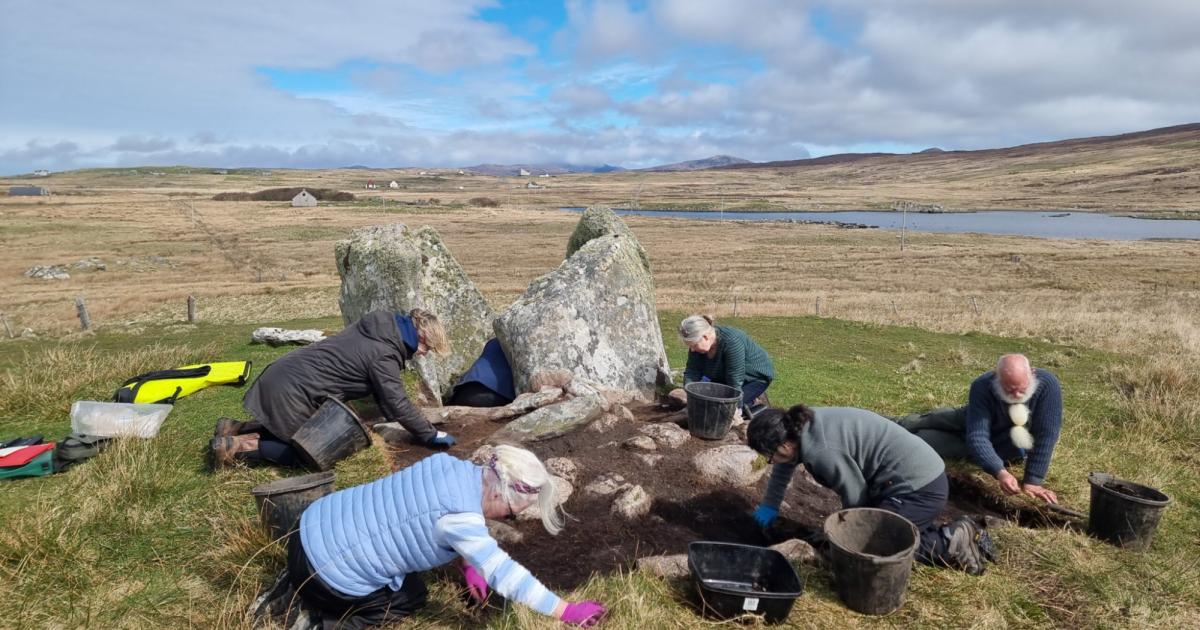

The Witch's Grave towers over the slopes of Leaval (Layaval) above Loch Aisebhat in Scotland, where archaeology and folklore have intertwined over the centuries. Archaeologists maintain that the monument is the remains of a Neolithic chambered cairn, approximately 6,000 years old. The site's Gaelic name is recorded as Leac-na-Bana-Bhuidseach ("The Witch's Table Stone"). The English name "The Witch's Grave" developed later as local Scots tried to explain the mysterious stone chamber standing alone on the hillside. Longtime residents noted that the surrounding district was known simply as "The Graves," reinforcing its reputation as a place associated with the dead and the supernatural. Though no medieval records confirm the burial of a witch at the cairn, local folklore preserves the stories of potions and curses. Some say a powerful witch lived near the village. The missing capstone was her table, where she practiced her magic and summoned spirits. When she died, villagers buried her in the huge stone chamber so that the evil of her spirit would never return.
- The Controversy Surrounding Witches’ Familiars and Religious Judgement
- Face of Notorious “Witch” Digitally Reconstructed 300 Years after her Death
Folklore and Witness Accounts Spin Tales of Spells and Potions
The University of Edinburgh Archives has general folklore about witches in South Uist preserved in local oral traditions. According to researchers from Scotland’s Earliest Megalithic Monuments Project, the stories may have started long after the monument had become a mysterious ruin, with its true Neolithic origin forgotten. After Christianity spread across Scotland, prehistoric monuments were frequently reinterpreted. Ancient cairns, standing stones, and stone circles were associated with the supernatural: fairies and giants, druid gatherings, or the Devil himself. Local villagers of South Uist in the Outer Hebrides preferred the mystery and intrigue that drew travelers to local shops to the factual descriptions of Neolithic tombs.
- Ancient Witchcraft and the Spell of the Pella Curse Tablet
- Landscape of Scottish Mythological Gods, Goddesses and Giants
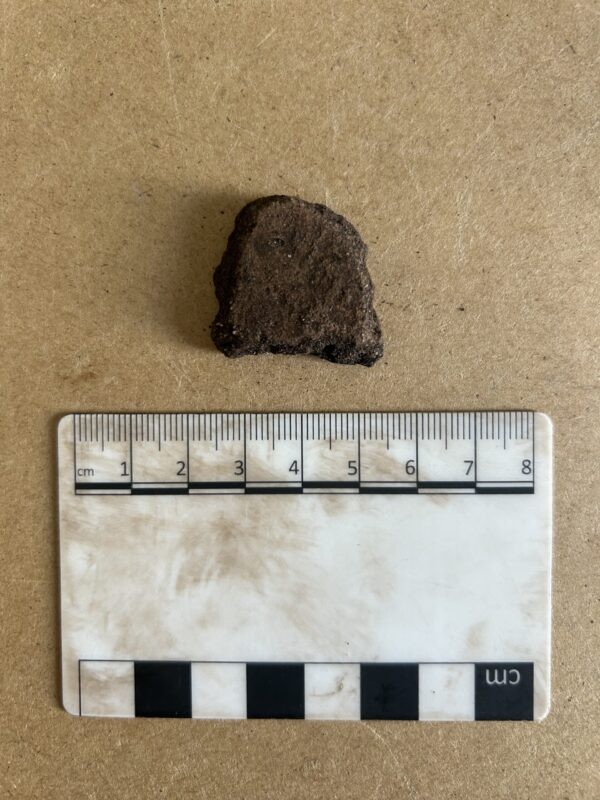
A prehistoric pottery fragment recovered during the excavation of the Leaval chambered cairn ("Witch's Grave") on South Uist. The sherd was discovered beside packing stones inside the chamber and may help archaeologists establish when the monument was constructed and used. (Archaeology Scotland/Uist Community Archaeology Group)
Excavations Continue to Expand Understanding of the Cairn’s Influence
Leaval chambered cairn was surveyed by Audrey Henshall in the 1960s, as part of her second volume of the Chambered Tombs of Scotland (1972). The site was later excavated by a team from Cardiff University, led by Vicki Cummings and Niall Sharples. Now, Scotland's Earliest Megalithic Monuments Project is working alongside the Uist Community Archaeology Group to conduct a new excavation. Currently, they have uncovered Neolithic pottery fragments, flint tools, and quartz that support Neolithic activity inside the chamber. According to the Uist Archaeology Group, the cairn is formed by four upright stone slabs. The monument is thought to have been built approximately 6,000 years ago as a burial chamber. The top of the cairn is missing.
- Detectorist Finds Bronze Age Treasure Cache With Sword In Scotland
- Neolithic Halls and Bronze Age Hoard Discovered in Scotland
Evidence of Bronze Age Enclosure Shows Continued Use
The excavations unearthed what researchers believe to be the line of a Bronze Age enclosure running east to west across the cairn. This discovery supports evidence from earlier surveys of the monument’s continued influence on the landscape long after the Neolithic Period.
A second unusual discovery is a circular feature within the chamber. Archaeologists speculate that it could be a posthole placement from a building that predates the cairn, evidence of cairn construction, or a pit left by previous attempts to rob the monument.
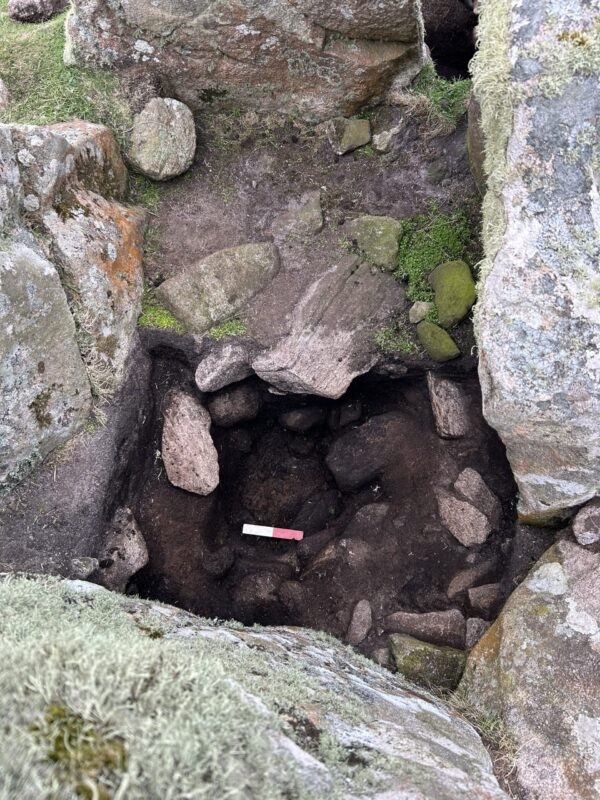
Excavation inside the Leaval chambered cairn ("Witch's Grave") revealed a circular cut feature beneath the chamber floor that may represent an earlier posthole, part of the monument's construction, or evidence of later disturbance. Soil samples were collected for scientific analysis. (Archaeology Scotland /Uist Community Archaeology Group)
Researchers plan to analyze phosphate samples for traces of organic material that may provide clues about the pit's use. Investigation of one of the monument’s western chamber stones may contribute to a better understanding of Neolithic building techniques.
The Witch’s Grave: Folklore and History
Though the name of the Witch’s Grave belongs to folklore, the efforts to investigate Scotland’s megalithic monuments will improve archaeologists' understanding of the Neolithic communities that raised the stones 6000 years ago.
Top Image: Archaeologists and community volunteers excavate around the surviving upright stones of the Leaval chambered cairn on South Uist, traditionally known as the “Witch’s Grave.” The investigation exposed surviving cairn material and produced prehistoric pottery and worked stone. Source: Archaeology Scotland/Uist Community Archaeology Group
By Ramsey Hardin
References
Gal, Emily. “Must-See Archaeological Sites in Uibhist (Uist).” Dig It!. Accessed July 18, 2026.
https://www.digitscotland.com/must-see-archaeological-sites-on-uibhist-uist/
Harrison, Eleanor. 2026. “Exploring the Witch’s Grave: Excavations at Leaval Chambered Cairn.” Archaeology Scotland. https://www.archaeologyscotland.org.uk/exploring-the-witchs-grave-excavations-at-leaval-chambered-cairn/
Milligan, Mark. 2026. “Witch’s Grave” excavation sheds new light on Neolithic monument. Heritage Daily. https://www.heritagedaily.com/2026/07/witchs-grave-excavation-sheds-new-light-on-neolithic-monument/158555.
The Megalithic Portal. “The Witches Grave, South Uist.” Last modified May 24, 2024. Accessed July 18, 2026.
https://www.megalithic.co.uk/article.php?sid=60366
“Wee Love Stornoway.” “New Exploration of ‘Witch’s Grave’ Planned.” October 25, 2025.
https://www.welovestornoway.com/index.php/news/general-news/40351-new-isles-exploration-of-witchs-grave-planned