
Epidaurus is a name most travelers link with a single place: the great theater in the hills of the Argolid, where Greek drama is still staged every summer. Yet the ancient Epidaurus was a town on the sea, with a harbor, a government and a life of its own, as the archaeologist Vassilis Lambrinoudakis told Diazoma on November 10. Its healing god had a shrine there too, and the Greek traveler Pausanias, writing in the 2nd century AD, met it first when he walked into the city. That shrine has since been identified on the ground, and beneath the great sanctuary in the hills excavators now describe a building older than anyone expected. So what did Pausanias actually see?
Following Pausanias Into Town
Pausanias left a short and precise description in the second book of his Description of Greece, in the translation by W. H. S. Jones and H. A. Ormerod:
The most noteworthy things which I found the city of Epidaurus itself had to show are these. There is, of course, a precinct of Asclepius, with images of the god himself and of Epione. Epione, they say, was the wife of Asclepius. These are of Parian marble, and are set up in the open.
For centuries, nobody could say where that precinct stood. Excavations by the National and Kapodistrian University of Athens (NKUA), working with the Ephorate of Antiquities of Argolis, have now located it close to the Small Theatre at the center of the ancient town, about 20 meters (66 feet) from the theater, according to Greek City Times.
The find itself is not brand new, since a Ministry of Culture press release reported the sanctuary in January 2024, and the Archaeology in Greece Online report of that year described it as previously unknown and mentioned by Pausanias. What is new is the fullest public account so far, given by Lambrinoudakis at a ceremony at the University of Athens in early November to honor the excavation's supporters, among them the Stavros Niarchos Foundation.
Water From the God to the Worshipper
The excavators uncovered an organized religious complex with an open-air enclosure, a monumental fountain, a large reservoir, a western stoa and a nymphaeum, according to Ta Nea. A pottery fragment inscribed with the name of Asclepius strengthens the identification of the site as the precinct Pausanias described.
Lambrinoudakis described the layout to Diazoma in some detail. The fountain building measured about 20 by 11 meters (66 by 36 feet), with a drawing area fronted by two Ionic columns. In the middle of the sacred enclosure, where the statues Pausanias mentions probably stood, there was a well. Water ran from it into the cistern and from there to the worshipper, a route he likened to stage design, flowing from the god's precinct to the human visitor. In Roman times a stoa was added in front of the enclosure, probably for incubation, the ritual sleep in which patients hoped the god would visit them.
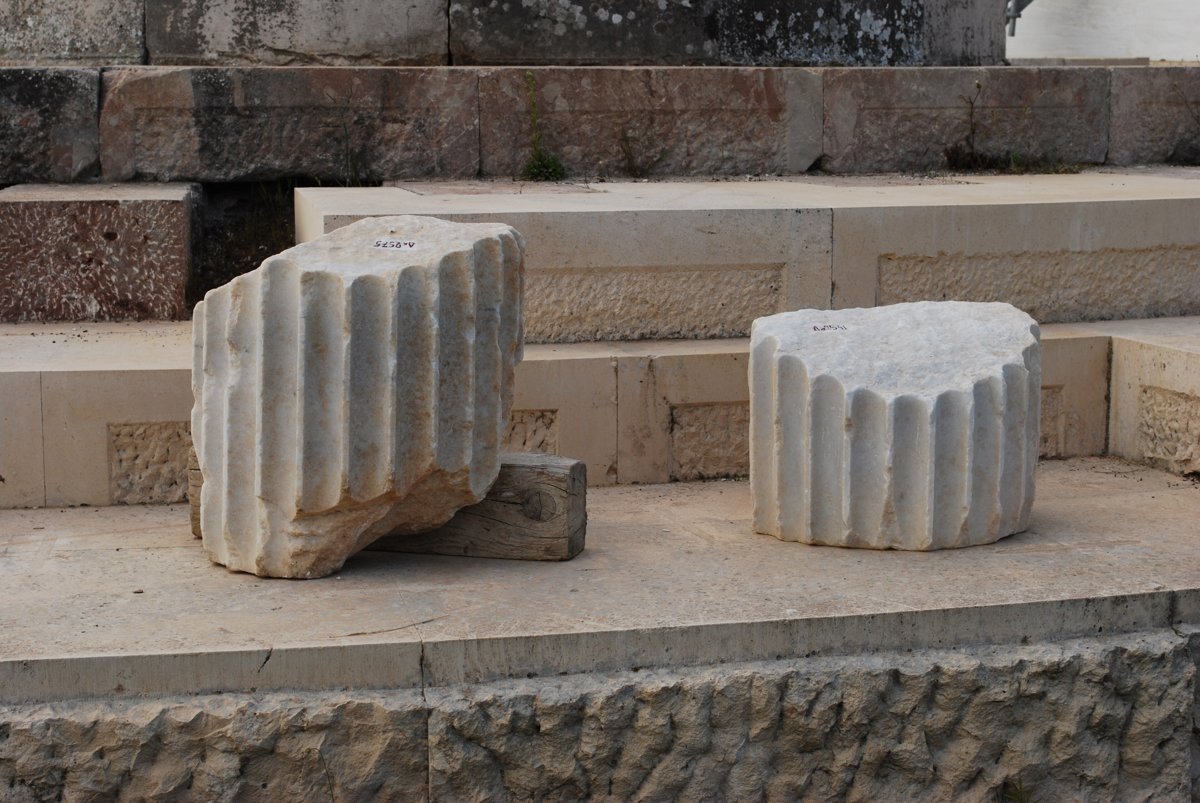
Fluted column drums on the stone steps of the Tholos in the great Sanctuary of Asclepius at Epidaurus, photographed in April 2010. (Photo: Jean Housen, via Wikimedia Commons, CC BY 3.0)
According to the 2024 report, the sanctuary goes back to the 4th century BC, but its preserved form reflects a major renovation in the 2nd century AD. That rebuilding was likely tied to the visit of the emperor Hadrian in AD 124, the report adds, which would mean Pausanias saw the shrine not long after it had been refreshed.
A Goddess of Renewal and an Unnamed Statue
Some of the finds point beyond Asclepius himself. Small terracotta discs carry reliefs of female busts, and fragments of larger figurines found nearby show similar subjects. Researchers associate them with a female deity of motherhood and the renewal of nature, who may have been identified locally with Epione, Greek City Times reports.
Then there is the statue, a marble figure of a woman wearing a chiton and himation found in the ancient city in 2021 and carved from Parian marble, the same stone Pausanias names. The possibility that she is the Epione he saw standing in the open remains open, although the archaeologists have yet to confirm it.
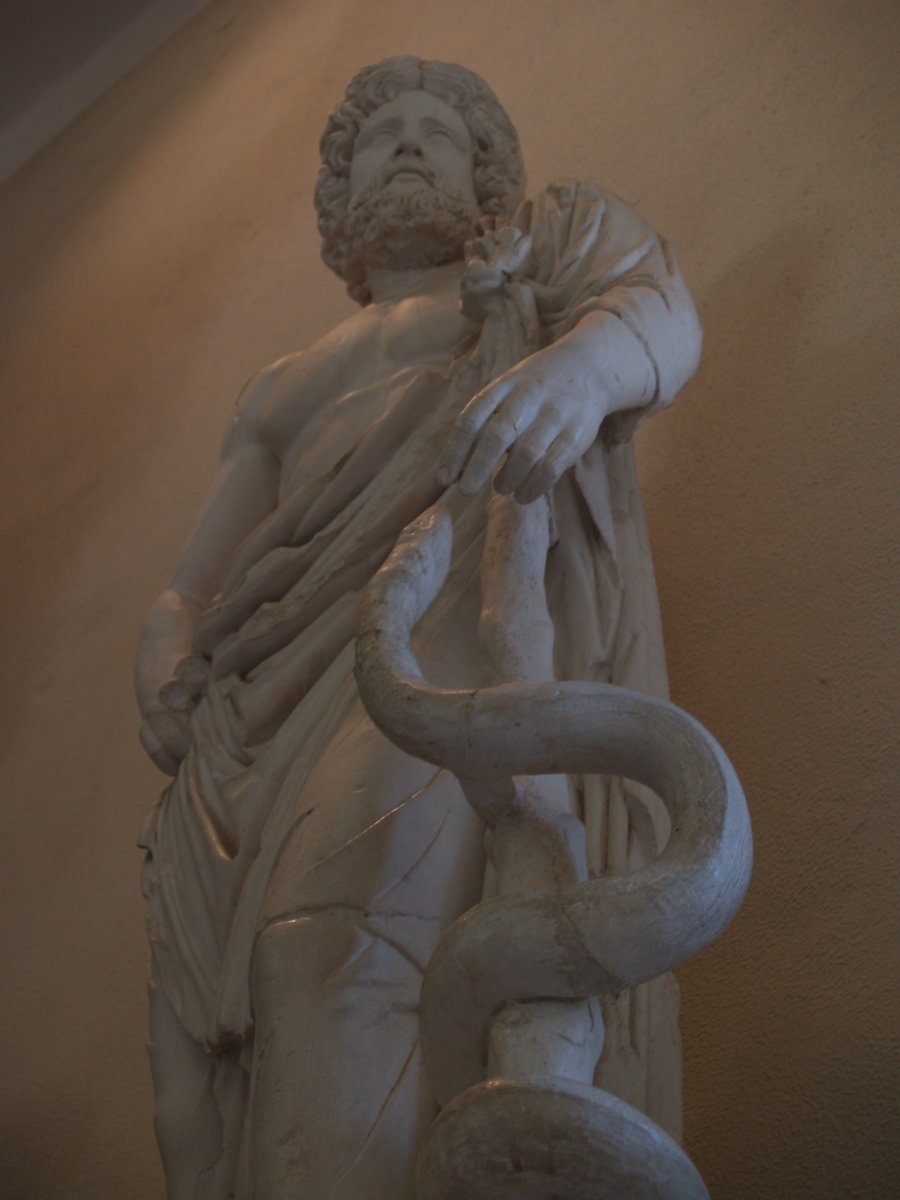
A statue of Asclepius with his snake-entwined staff, photographed in the Museum of the Epidaurus Theatre. (Photo: Ken Russell Salvador, via Wikimedia Commons, CC BY 2.0)
A Red Chamber Under the Tholos
The second half of the news takes the reader out of town to the great sanctuary, the famous healing center where people from across the Mediterranean came to be cured. Its best-known building is the Tholos, a round structure that Pausanias credits, along with the theater, to the architect Polycleitus. However, something older lay beneath it.
There, archaeologists have uncovered an Archaic building of the late 7th century BC, about six decades earlier than the date previously taken as the start of the cult of Asclepius at the site, according to Ta Nea. It had a ground floor surrounded by columns and, below it, an underground chamber cut into the natural rock. Thick, deep red plaster covered its walls, and a pebble mosaic survives on its floor, which Ta Nea describes as one of the best preserved early examples of its kind in the Greek world.
The building's plan, its western orientation and the descent into the rock-cut chamber support the view that it served a religious purpose tied to the chthonic, or underground, side of Asclepius, before the Tholos was built over it. That reading is the excavators' interpretation, and the god's link with the earth is a familiar theme in his cult, from the snake on his famous rod to the sleeping patients waiting for his visit.
But it didn't end there. In the so-called Building K inside the sanctuary, excavators found a large complex with phases from the Hellenistic to the Late Roman period. One underground room, known as the Crypt, has a three-part plan, reused architectural pieces, openings that let in the midday sun and the lower parts of four amphorae set on the bare ground. Researchers suggest it may have served mystery rites in the Late Imperial period. However, Ta Nea stresses that the room's actual use has not yet been settled by the excavators.
A Town Behind the Theaters
The new findings also change the way the two famous theaters are read. Lambrinoudakis told Diazoma that the Small Theatre belonged to the town and was begun in the mid 4th century BC, while the great theater belonged to the sanctuary outside it. The harbor, he added, helped carry the fame of Asclepius across the Mediterranean, and in 293 BC the Romans sailed there to fetch the god's sacred snake for their own shrine on Tiber Island.
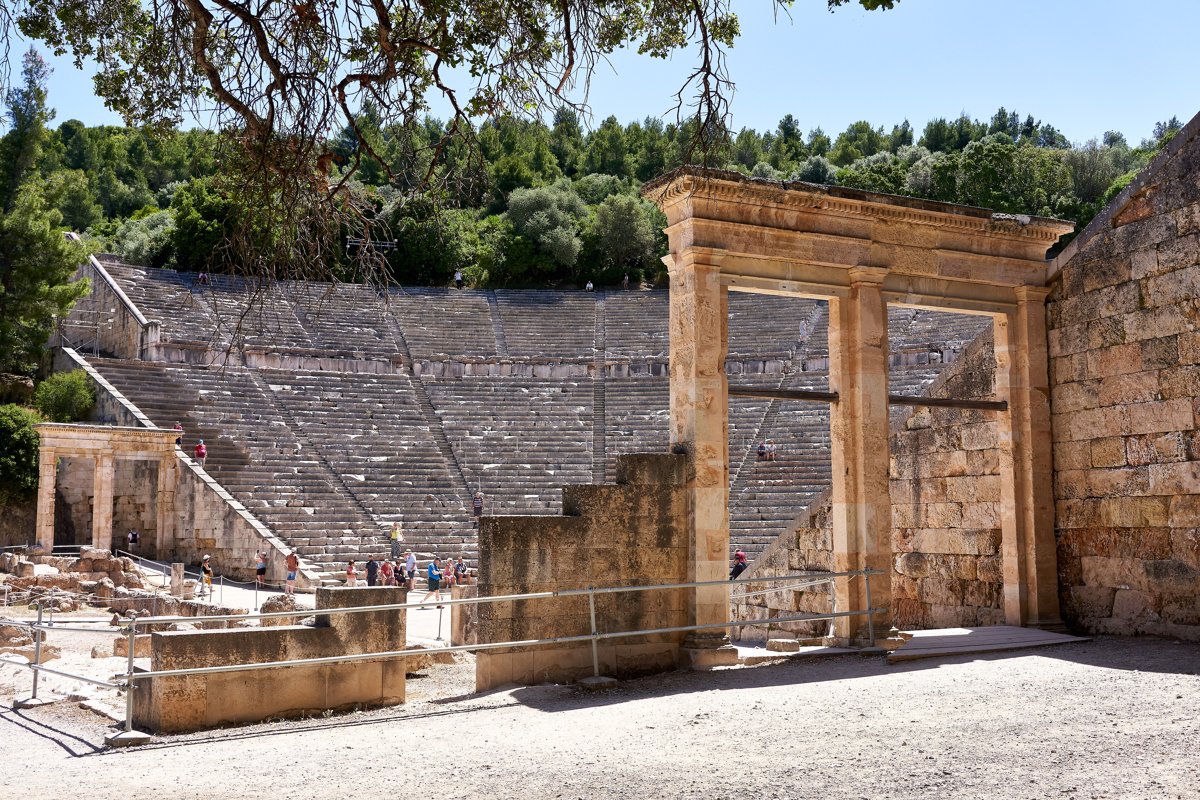
The great theater of the Sanctuary of Asclepius at Epidaurus, the monument most visitors know. (Photo: George E. Koronaios, via Wikimedia Commons, CC0)
Other healing sanctuaries, from the Asklepion at Pergamum in Asia Minor to a temple of Asclepius excavated in Greece a few years ago, show how widely the cult spread from here. A new museum of about 2,500 square meters (27,000 square feet) is planned near the entrance to the site, and Lambrinoudakis hopes it will tell the whole story of medicine there, from magic to practice to science. With the Epione question open, the Crypt unexplained and the red chamber only now described, there is still much to learn about the town that Pausanias walked into first.
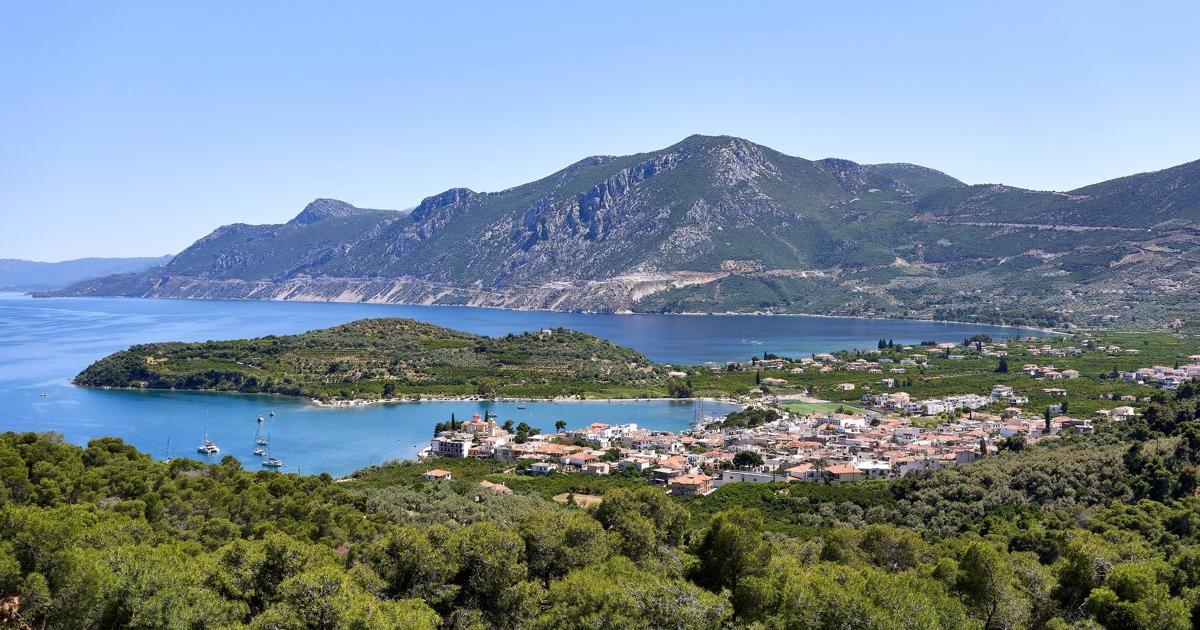
Palaia Epidavros on the Saronic Gulf, the site of the ancient town of Epidaurus and its harbor. Photo: George E. Koronaios, via Wikimedia Commons, CC0
By Aris Manus
Sources
- Pausanias. Description of Greece 2.29.1. Translated by W. H. S. Jones and H. A. Ormerod. Perseus Digital Library.
- Adamopoulou, M. November 10, 2026. Επίδαυρος: Το χαμένο τέμενος του Ασκληπιού. Ta Nea.
- Diazoma. November 10, 2026. Ο Βασίλης Λαμπρινουδάκης μιλάει για την άγνωστη Επίδαυρο, πίσω από τα θέατρα.
- Archaeology in Greece Online (EFA and BSA). 2024. Epidaurus, Sanctuaries of Asclepius and Apollo Maleatas.
- Papadopoulos, K. November 11, 2026. Report on the Sanctuary of Asclepius in the ancient city of Epidaurus.
- Stavros Niarchos Foundation. November 2026. NKUA honors supporters of its excavations at Epidaurus's Sanctuary of Asklepios.