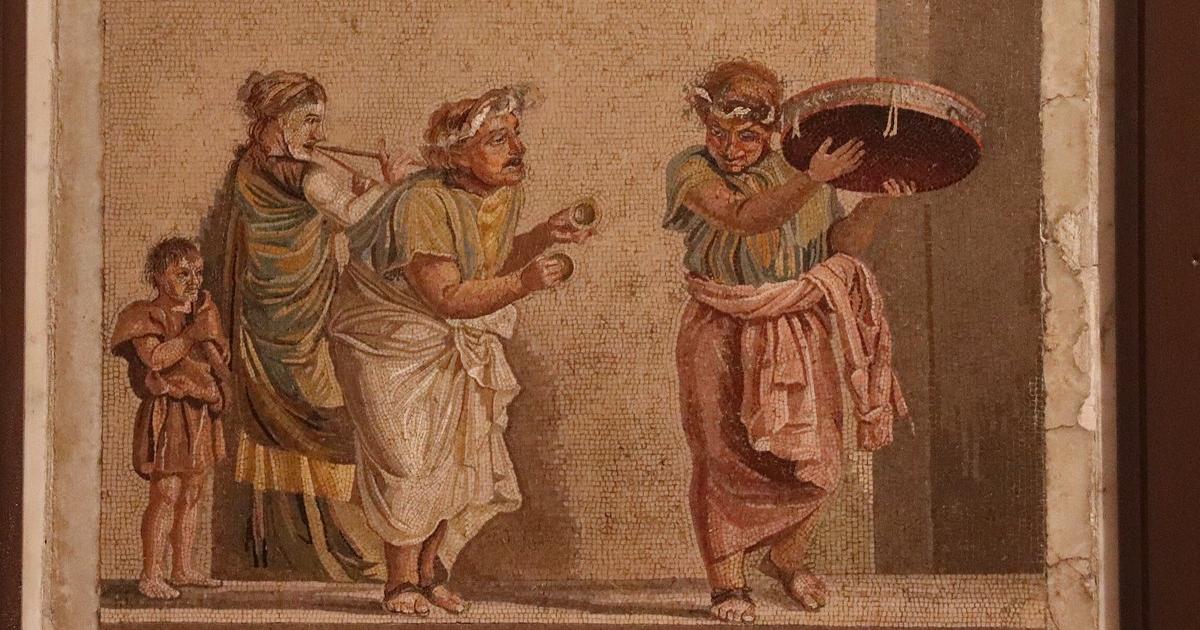

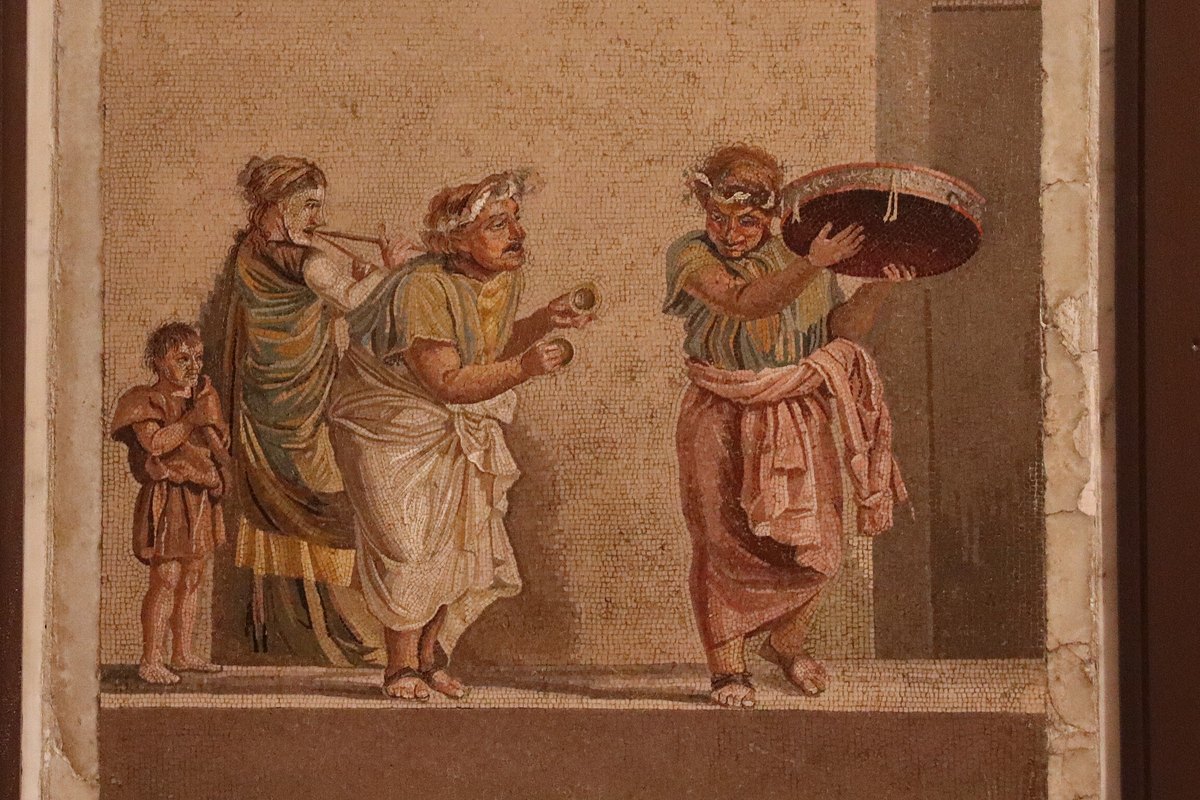
Masked musicians with double pipes, small cymbals and a frame drum, in a mosaic signed by Dioskourides of Samos from the so-called Villa of Cicero near Pompeii, now in the National Archaeological Museum of Naples. Cropped from the full photograph to the figures. (Photo: Gary Todd, via Wikimedia Commons, public domain)
The tibicen, or double-pipe player, was one of the figures a Roman sacrifice could not do without, according to a 2021 study of music at Pompeii, yet nobody knows exactly what his music sounded like. This week a video of reconstructed Roman music by Synaulia, a project that has been rebuilding ancient instruments since 1995, went viral on X. According to the X trending summary updated on November 10, 2026, musicologists stressed how much speculation is involved, since no notations survive. So is this really what Rome sounded like?
The answer depends on which part of the music is being asked about. Some of it rests on bronze, bone and inscriptions dug out of the ground. Some of it rests on mosaics and on the words of Roman writers. And some of it, the melodies in particular, is the work of modern musicians filling the gaps.
A Modern Ensemble With an Ancient Name
The project was conceived and is directed by Walter Maioli, described on his Soundcenter website as a musician and paleorganologist. From 1995 the group performed at experimental archaeology events in the Netherlands, including the Archeon park and museums in Leiden and Amsterdam, and in 1996 its first album, devoted to wind instruments, was presented on the Campidoglio in Rome. Two compositions from that album were later chosen for Ridley Scott's film Gladiator, the same site states.
Synaulia does not claim to play Roman tunes from a score. The Italian page for that first album presents it as a hypothesis of reconstruction of the music of imperial Rome, played on original and rebuilt instruments by Maioli and a team that worked with archaeologists, musicologists, historians and instrument makers. A BBC Music Magazine review published on the Classical Music website put the problem plainly:
Nobody knows what ancient Roman music sounded like, so the project works backwards from assorted Mediterranean traditions and known period instruments.
The reviewer judged the album "as thorough as it is speculative", and added, "To my ears it still sounds quite medieval."
Instruments Pulled From the Ground
The firmest evidence for Roman music comes from the instruments themselves, and one key example was found in the ruins of a Roman hall in Budapest. In AD 228, according to the Aquincum Museum in Budapest, Gaius Julius Viatorinus, a councillor of the town of Aquincum, presented a portable organ to the collegium of textile dealers, an association that also handled fire detection and fire fighting in the town. The organ had 52 pipes in four rows of 13. A fire in the mid-3rd century brought the building down and the instrument fell into the basement, where the archaeologist Lajos Nagy found nearly 400 pieces in 1931. Numerous pieces went missing during the Second World War, and barely 300 survive today.
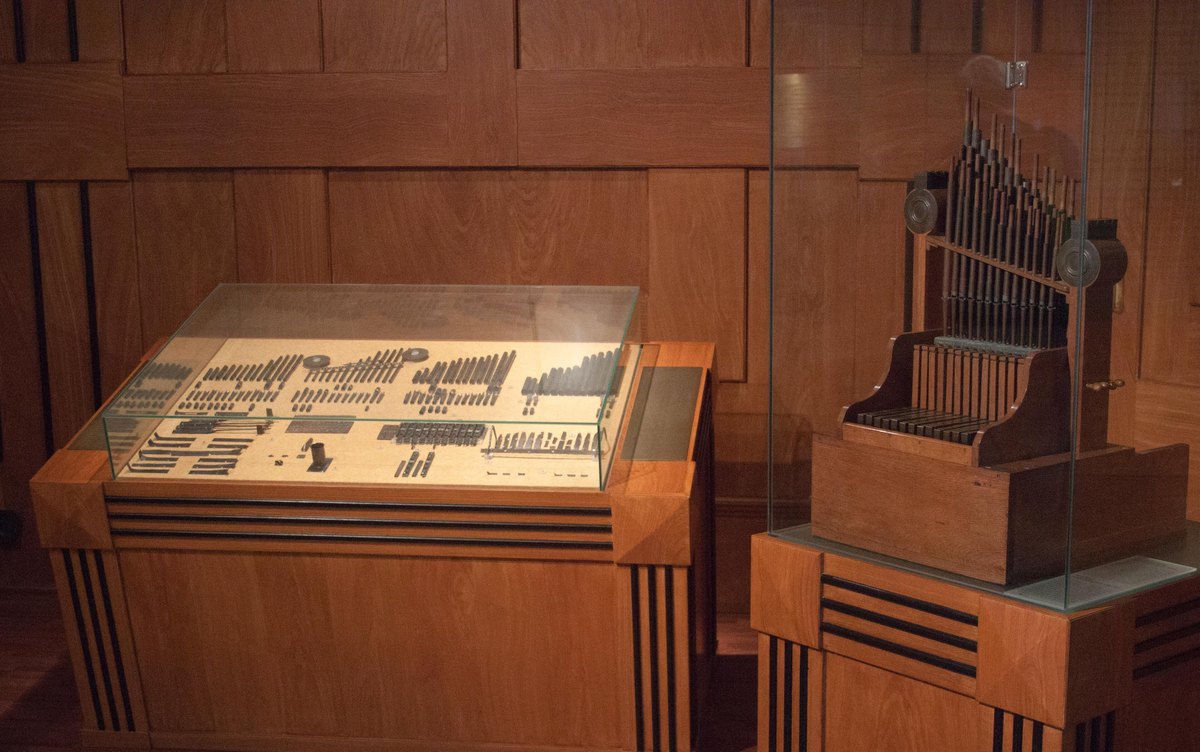
The surviving parts of the Aquincum organ, given to the town's textile dealers in AD 228, displayed beside a modern reconstruction in the Aquincum Museum, Budapest. (Photo: Szilas, via Wikimedia Commons, public domain)
However, even this instrument leaves questions open, and the museum notes that the way it was operated "is still the subject of debate, since, although its name in Latin indicates an organ operated by water, according to some it was operated by air instead."
Pompeii adds the brass and the reeds, according to Mirco Mungari and Kamila Wyslucha, the authors of that 2021 study in the Open Arts Journal. During the 19th century excavations, five well-preserved bronze horns known as cornua were found in the city at an unrecorded location, and they are now stored in the Archaeological Museum of Naples. But it didn't end there. A playable replica based on them has been made for the European Music Archaeology Project. Pompeii has also produced about seventy finds related to tibiae, the Roman double-reed pipes whose Greek name, auloi, is often used as a technical term, including fifteen complete instruments.
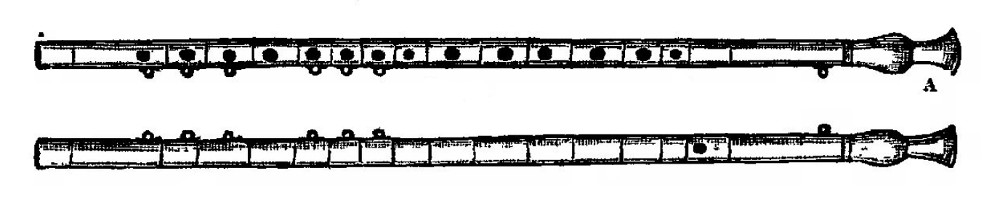
Two sides of an aulos found at Pompeii and displayed in the National Archaeological Museum of Naples, in a drawing by François-Auguste Gevaert (1828 to 1908). (Image: Bibliothèque nationale de France, via Wikimedia Commons, public domain)
Pictures and Words
Images fill in how these instruments were played and by whom. The mosaic signed by Dioskourides of Samos shows masked musicians with double pipes, a frame drum and cymbals, and it is often read as a scene from a comedy by Menander. However, Mungari and Wyslucha warn that such pictures "do not actually record any rituals practised by wealthy Pompeians", as they may simply reflect a taste for Greek-inspired art.
Roman writers offer a different kind of clue. In the tenth book of his work on architecture, Vitruvius described the water organ in detail, from its brazen box and brass barrels with movable bottoms to the "brazen dolphins with chains hanging from their mouths, which sustain the valves", and he admitted the difficulty of the task:
I have done my utmost to give a clear explanation of a complex machine.
Pliny the Elder, as Mungari and Wyslucha explain in their discussion of his Natural History, wrote that a tibia player was often present at sacrifices to exclude noises and unwanted sounds with a continuous accompaniment. In their reading, the music created "a delimited space in which every inauspicious noise was avoided."
Why It Sounds So Strange
The instruments themselves may explain some of the shock. Roman tibiae were double-reed instruments, and Mungari and Wyslucha suggest that modern listeners might picture "the oboe, English horn, bassoon or the Armenian duduk" to get an idea of their sound. One form of the pipe, they add, had a flared extension at the end of the left pipe, which was no doubt responsible for effects that ancient listeners heard as "a hoarse, deep, roaring tone." Bronze wind instruments such as the tuba and the cornu, meanwhile, were used in military contexts, public games and official events, including the arena.
The horns could also play far more than simple signals, and Mungari and Wyslucha write that, "Contrary to the stereotypical idea popularised by Hollywood films, the archaeological evidence suggests that aeneatores were able to modulate quite complex melodies on their instruments, using a wide range of notes and dynamics." The so-called aeneatores were the players of these bronze instruments, and the replica, the authors say, demonstrates what such a horn could do in professional hands.
What no instrument can supply is the tune. Without a surviving score for the music Synaulia performs, the melodies, rhythms and combinations heard in the viral clip are the choices of modern musicians, informed by the instruments, the images and the texts. Synaulia's own description of its work as a hypothesis is the fairest label, and the reviewer's comparison with medieval music is a reminder of how much a modern ear brings to the result.
Still Much to Learn
Music accompanied Roman sacrifices, processions and games, and many of its images at Pompeii were modeled on Greek art. The organ of Aquincum, the cornua stored in Naples and the tibiae of Pompeii preserve the voices of the instruments. However, the songs themselves are gone, and every reconstruction, however careful, remains a modern hypothesis. The viral reaction shows how alien that sound can feel today, and there is still much to learn about how it once moved a Roman crowd.
By Aris Manus
Sources
- X. Updated November 10, 2026. Reconstructed Roman Music Stuns with Unsettling Sounds. Trending story summary of posts on X.
- Soundcenter (Walter Maioli). Synaulia: Sounds, Music and Dance of Ancient Rome and the Antiquity and La Musica dell'antica Roma (Italian).
- BBC Music Magazine. January 20, 2012. Synaulia: Music from Ancient Rome. Classical Music.
- Aquincum Museum. The Aquincum organ.
- Mungari, M. and Wyslucha, K. 2021. Material Music in Ritual Soundscapes of Pompeii. Open Arts Journal 10. DOI: 10.5456/issn.2050-3679/2021s05.
- Vitruvius. On Architecture, Book 10, Chapter 8. Translated by J. Gwilt. LacusCurtius.