
Fact Check verdict: Fringe. The carving shows the Maya king K'inich Janaab Pakal at his death, between the jaws of the underworld and the World Tree, and its glyphs record his parents and the lords before him.
Deep inside the Temple of the Inscriptions at Palenque, in the Mexican state of Chiapas, a carved slab sits over the coffin of the Maya king K'inich Janaab Pakal. For more than half a century it has also been presented as a portrait of a spaceman, so what does the evidence say it shows?
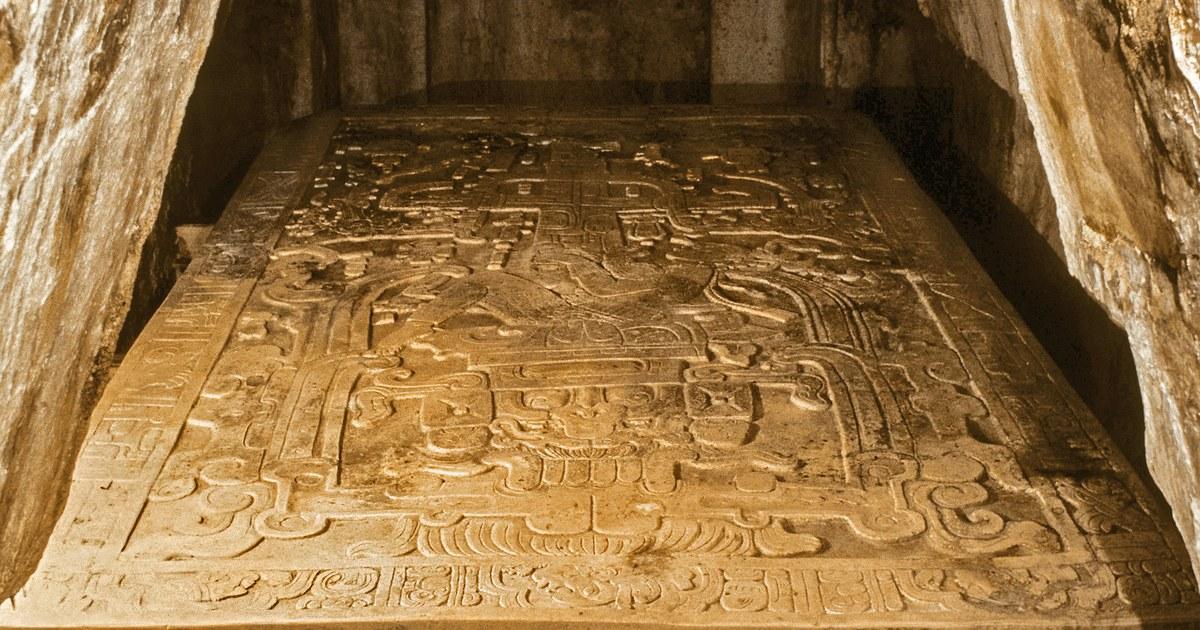
According to Mexico's National Institute of Anthropology and History (INAH), the lid is 3.80 meters long, 2.20 meters wide and 25 centimeters thick. Its texts tell of Pakal's life, his ancestors, and his rebirth and rise to the heavens dressed as the maize deity, says the institute's 2023 bulletin, which is in Spanish.
Where the astronaut idea comes from
The spaceman reading reached a mass audience in 1968. National Geographic reports that the Swiss author Erich von Däniken printed an illustration of the lid in his bestseller Chariots of the Gods? He believed it depicted an "ancient astronaut", an alien visitor later worshipped as a god.
Elaine Day Schele, in a history of the debate over Pakal's age at death published by the research site Mesoweb, notes that the book wrongly placed the lid at Copan, another Maya city. Television has kept the idea alive ever since. In the History channel series Ancient Aliens, as transcribed by the Ancient Aliens Debunked website, one speaker describes Pakal "sitting in some kind of spacecraft" and says "He is manipulating some controls."
The transcript's opening passage adds that ancient astronaut theorists "have dubbed him the Palenque astronaut." The archaeologist who found the tomb had already answered such talk. In a 1977 article quoted in English by Schele, Alberto Ruz Lhuillier wrote that the man he had found "was a real Maya...not at all an astronaut from a faraway planet invented by a writer of science fiction novels."
What the evidence says
Stanley Guenter of Southern Methodist University, in a study of the temple's texts for Mesoweb, writes that Ruz Lhuillier dug from 1949 to 1952. He reached a tomb "deep below the temple in the heart of the pyramid." Guenter dates the opening to June 13, 1952, and INAH gives June 15, while the institute says the lid was raised on November 27 with truck jacks set on tree trunks.
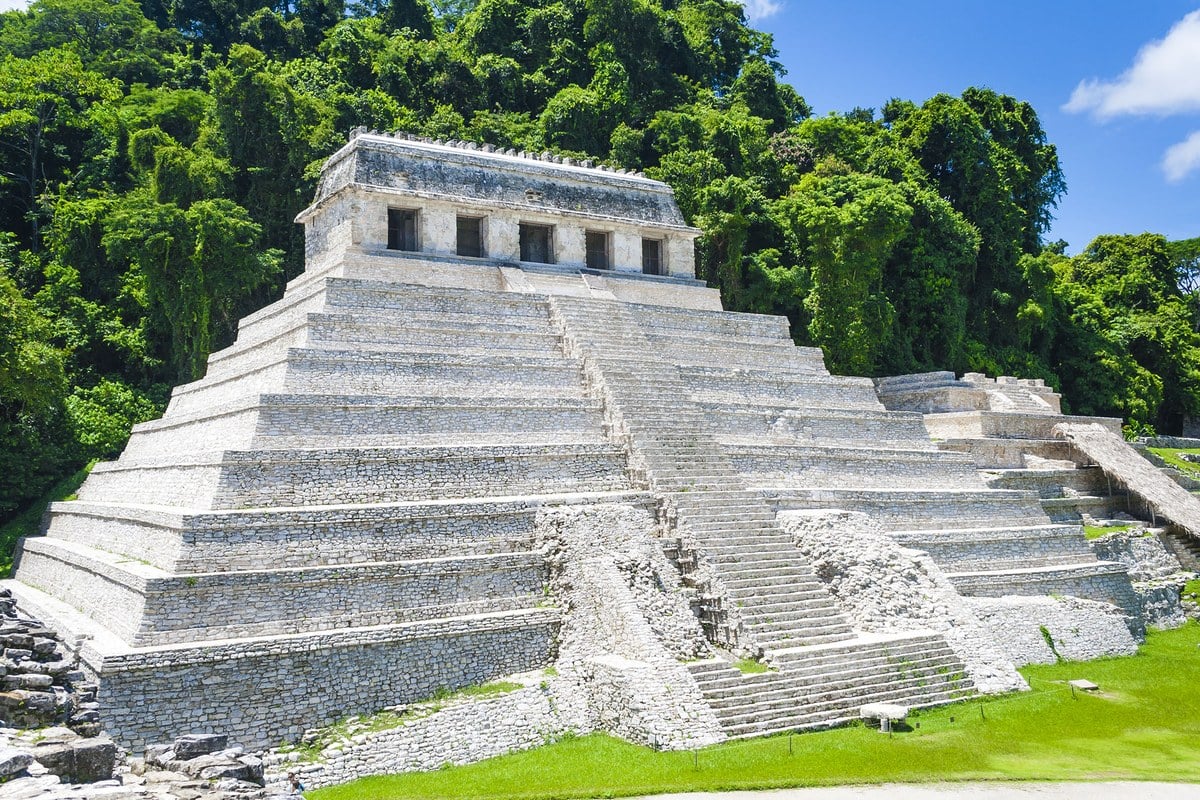
The Temple of the Inscriptions at Palenque, Chiapas, the pyramid that holds Pakal's tomb. Photo by Jan Harenburg, 2008, via Wikimedia Commons, CC BY 4.0, resized.
Inside lay the bones of a man, and his age at death started a long argument. Schele writes that the anthropologists working with Ruz first judged him to be 40 to 50 years old. Guenter, reading the inscriptions, describes a king born in 603 who died eighty years later after a reign of 68 years.
Andrea Cucina and Vera Tiesler of the Autonomous University of Yucatán, editors of a restudy of the skeleton, summarized it in an invited review for the Journal of Anthropological Sciences in 2005. The new work "revealed an age well over 50 without being able to confirm the epigraphic readings of 80." Either way, the bones in the coffin belong to a human ruler.
The writing on the lid offers the clearest guide to what it shows. In Guenter's reading, the glyphs around its edges "refer to the deaths of K'inich Janaab Pakal, his parents, and the preceding lords of Palenque." Small heads in the frame each carry a short caption, and he suggests that the three people they name were high-ranking nobles of Pakal's court.
Reading the lid in Maya terms
INAH's national photo archive, in a Spanish-language catalog entry, describes the scene as the moment of Pakal's death and his fall into the underworld. A band of sky frames it, with signs for day and night at its upper corners. The open jaws of the underworld fill the bottom.
From there the World Tree, the center of the universe, rises to a celestial bird perched on top, the same entry explains. Writing in the INAH journal Lakamha, Sofía Martínez del Campo Lanz describes Pakal suspended between the three levels of the cosmos. He is about to descend and defeat the lords of death, so that he can be reborn as the maize god.
Specialists who study the lid differ on the direction of the journey. Guenter reads the king as "ascending out of the maws of the underworld," shown in the pose of being born. One passage of the edge text, in his translation, speaks of building "the sarcophagus of the Maize God," and he adds, citing Schele and Mathews, that Pakal appears to have been buried dressed as that god.
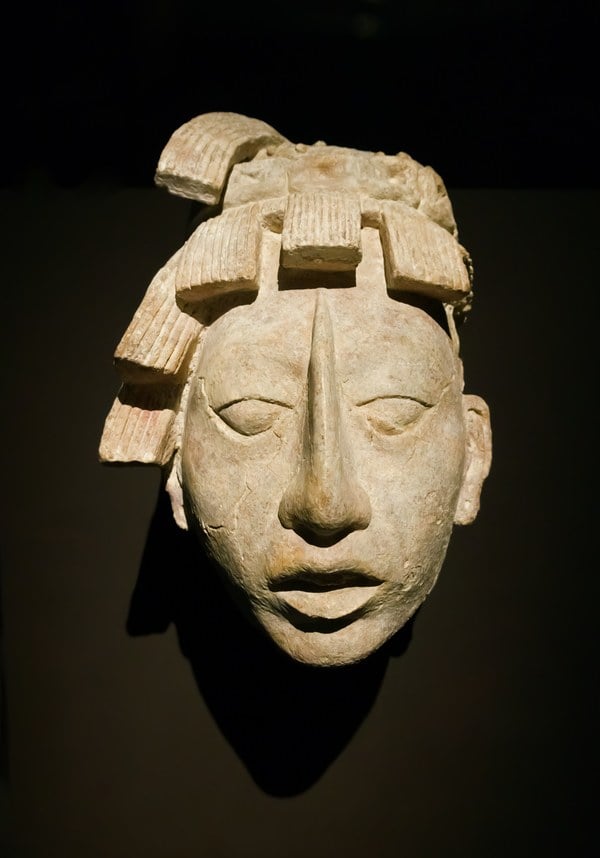
A stucco head from the Temple of the Inscriptions at Palenque, labeled as King Pakal in his youth, shown in the exhibition Mayas at the Musée du Quai Branly, Paris. Photo by Jebulon, 2014, via Wikimedia Commons, CC0, resized.
The alternative view
Supporters of the astronaut reading point to the king's leaning body, his hands and an object near his face that the transcript calls a breathing apparatus or a telescope. One speaker in that transcript compares the angle of the figure to "modern-day astronauts upon lift-off."
National Geographic sets the claim in that moment, after NASA's Project Mercury emerged in 1959 and John Glenn had orbited the planet by 1962, when "spacemen were on everyone's brain." No source opened for this check offers a Maya text, a material or an object from the tomb that supports a spacecraft.
Where this leaves it
The lid is a Maya royal monument, carved for a king whose remains still rest in his sarcophagus, and its glyphs name him, his family and his court. The open questions, his exact age and whether he falls or rises, remain less about visitors from space than about how the Maya pictured death and renewal.
Earlier Ancient Origins coverage toured Palenque and its Temple of the Inscriptions, reported on the decoding of the temple's inscriptions and on the new techniques used to study Pakal's crypt. Background on the city, which UNESCO listed as a World Heritage Site in 1987, is in the Palenque atlas entry.
How we checked this
Read for this check were INAH's bulletin, photo record and journal article, Guenter's study, Schele's history, the Cucina and Tiesler review, UNESCO and National Geographic. Spanish passages appear only as paraphrase.
The History channel's own clip page did not load from the network used for this check. The television claim is quoted from a transcript on the Ancient Aliens Debunked site, cited for the claim only. Earlier Ancient Origins coverage was not a source, and the labels are explained on the evidence standards page.
The carved lid over the sarcophagus of K'inich Janaab Pakal in the crypt of the Temple of the Inscriptions at Palenque. Photo by Chaccard, 1985, via Wikimedia Commons, CC BY 4.0 (https://creativecommons.org/licenses/by/4.0/), cropped and resized
By Aris Manus
Claim by claim
- Fringe: Pakal's sarcophagus lid at Palenque shows an astronaut in a spacecraft. Reason: the scene and its glyphs are Maya royal and religious imagery, and no source reports any machine.
- Established: The lid covers the tomb of the Maya king K'inich Janaab Pakal, found by Alberto Ruz Lhuillier in 1952. Reason: INAH, Guenter and Schele agree.
- Established: The glyphs on the lid's edges record the deaths of Pakal, his parents and earlier Palenque rulers. Reason: Guenter's reading of the text.
- Disputed: The scene shows Pakal falling into the underworld. Reason: the INAH photo record reads a fall, while Guenter reads him rising.
- Disputed: Pakal died at about 80. Reason: the inscriptions give 80 years, while the skeletal restudy found well over 50 without confirming 80.
Sources
Instituto Nacional de Antropología e Historia (2023). Se cumplen 71 años del descubrimiento de la tumba de Pakal 'el Grande', en Palenque. Boletín 372. In Spanish.
Instituto Nacional de Antropología e Historia, Fototeca Nacional. Lápida de Pakal en el templo de las inscripciones, Palenque, Chiapas. Catalog record. In Spanish.
Martínez del Campo Lanz, Sofía. K'inich Janaab' Pakal, dios del maíz, árbol del mundo. Lakamha', INAH. In Spanish.
Guenter, Stanley. The Tomb of K'inich Janaab Pakal: The Temple of the Inscriptions at Palenque. Mesoweb Articles.
Schele, Elaine Day (2016). The Bones of K'inich Janaab Pakal: A History of the Controversy Over His Age At Death. Mesoweb Articles.
Cucina, Andrea, and Vera Tiesler (2005). Past, present and future itineraries in Maya bioarchaeology. Journal of Anthropological Sciences 83, pp. 29 to 42. Invited review.
UNESCO World Heritage Centre. Pre-Hispanic City and National Park of Palenque. World Heritage List, property 411.
National Geographic. Palenque: New Age.
Ancient Aliens Debunked. Pacal's Rocket. Transcript of Ancient Aliens, cited for the claim only.