
Fact Check verdict: Fringe. The skeletons cannot be shown to have died together, many look like burials, and no published test found unusual radiation in them.
Mohenjo-daro, on the Indus River in Sindh, was one of the largest cities of the Indus civilization, which flourished in the third millennium BC.
A small number of human skeletons found during excavations between 1922 and 1931 have since become the center of a modern story. In one popular version the people of the city died suddenly in an ancient nuclear attack, and their bones still carry the radiation, so what do the records actually show?
According to the original excavation reports, as reviewed in 1964 by an archaeologist then preparing new excavations at the site, the remains point to scattered deaths and burials over a long span of time.
What the claim says
The story reached a wide audience through the History Channel series Ancient Aliens. A transcript published by the website Ancient Aliens Debunked quotes the series as saying that "Skeletons were found lying face down in the street" and that "In certain areas of that site you find increased levels of radiation."
The author David Childress made the radiation claim more specific. In his book Technology of the Gods, as quoted by the researcher Jason Colavito, he wrote that "These skeletons are among the most radioactive ever found, on par with those at Nagasaki and Hiroshima."
Both statements raise two questions that can be checked against the record, namely how many skeletons were found and how they lay, and whether anyone has ever measured radiation in those bones.
What the evidence says
The fullest review of the skeletons was published in 1964 by George F. Dales of the University of Pennsylvania Museum, in an article for the museum magazine Expedition. Dales went back to the reports from nine years of digging between 1922 and 1931.
He counted "some 37 skeletons, or parts thereof," that could be assigned with some confidence to the period of the Indus civilization. Many were incomplete or broken apart, and all came from the Lower Town, the likely home district.
Dales pointed out that not one body was found inside the walled citadel, the part of the city where a last stand would be expected. He also stressed that the dates of the groups differ, and he concluded that "they cannot justifiably be used as proof of a single tragedy."
The best known group, fourteen skeletons in a room of a house in the HR area, divided the excavators themselves. The digger in charge judged that because four of them lay above the ruins of the room's southern wall, the whole group dated from after the house had decayed, while Sir John Marshall, the director, thought they were buried "within a few hours of death" to keep animals away.
Other famous finds look different once the reports are read in full. Six skeletons said to lie in a street were, in the words of their excavator, placed so that "from their position they appear to be posterior to the adjacent remains." Dales noted that they lay in loose earth, and Marshall thought they were probably later burials that had cut down between old walls.
A partial skeleton in a lane known as Deadman's Lane was also not resting on the street surface. According to Dales, it lay in debris that built up after the lane went out of use and was probably buried beneath the floor of a later house.
Only one find, two people on a flight of stairs, looked to Dales like a sudden death in place. He wrote that there is "no destruction level covering the latest period of the city, no sign of extensive burning" anywhere in the remains.
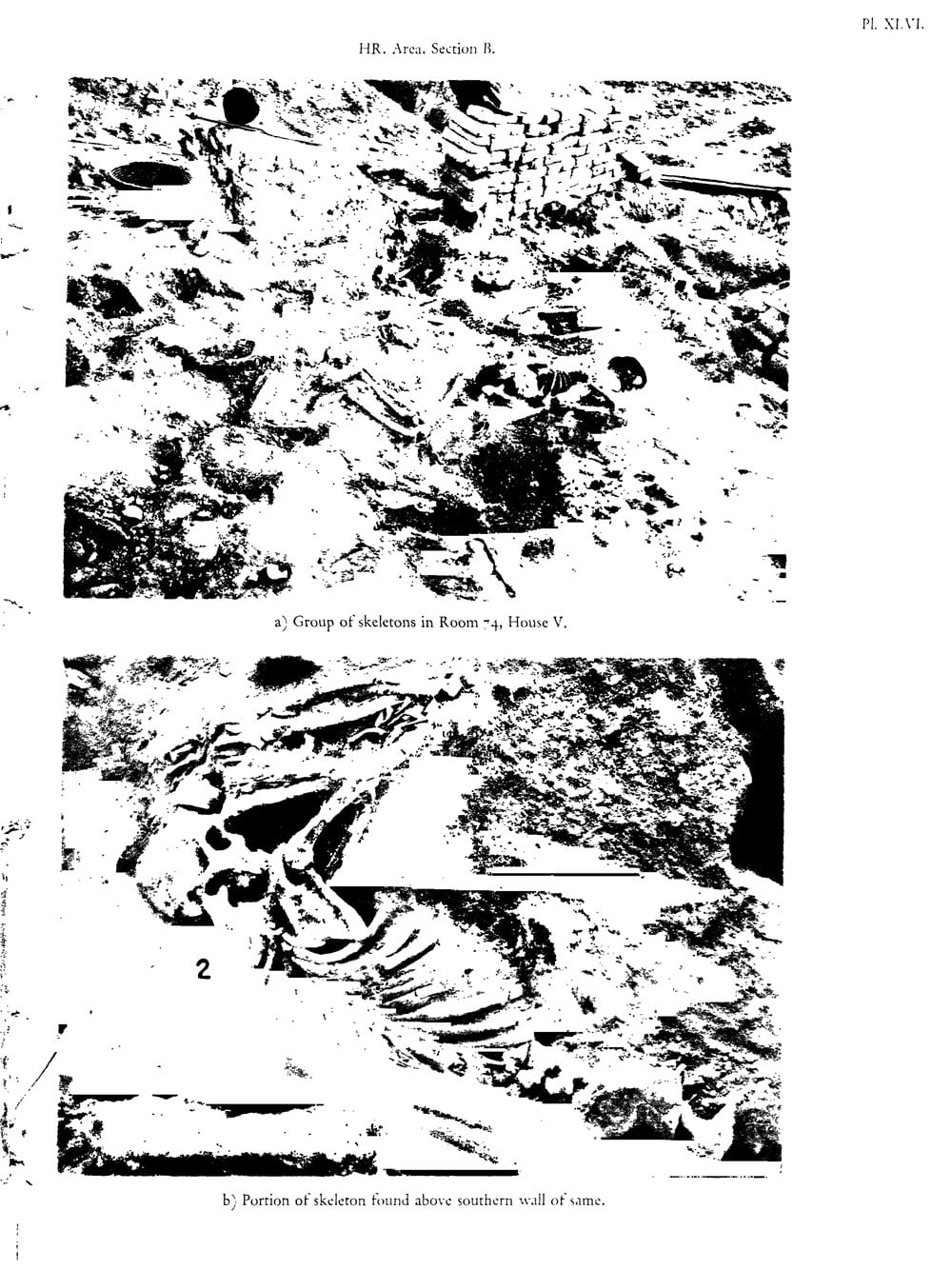
Skeletons found in Room 74 of House V in the HR area, with part of a skeleton found above the room's southern wall. Archival plate from the 1920s excavations. Image: Archaeological Survey of India, Plate XLVI in John Marshall (ed.), Mohenjo-daro and the Indus Civilization, 1931, via Digital Library of India and Internet Archive, public domain, resized.
Where the radiation story came from
None of the sources consulted cites a published measurement of radiation in the Mohenjo-daro skeletons or in the soil of the site. Ancient Aliens Debunked says the origin of the radiation claim is unknown and that it did not come from any of the scientists who dug the site, and no excavation report reviewed here mentions one.
In a 2018 blog post, Colavito summarized research by Philippe Hernandez that traced the idea to a 1966 Soviet book by Alexander Gorbovsky, the source Childress names. In the passage translated by Hernandez, Gorbovsky mentions a skeleton from India "which radioactivity was 50 times higher than normal" and does not name Mohenjo-daro.
According to Colavito, Gorbovsky drew on a 1962 Soviet article that in turn relied on a 1960 British report by W. V. Mayneord. In his account, that report described a single Egyptian bone from the British Museum, with radiation levels similar to those of modern people.
Colavito argued that later writers joined this misread figure to older accounts of a supposed massacre at Mohenjo-daro. The Soviet and British papers themselves were not opened for this check, so that chain is reported here as Hernandez and Colavito describe it.
The alternative view
Supporters of the nuclear idea point to the series' claim that skeletons lay face down in the street, "many holding hands," as signs of a violent and sudden end. Dales agreed that a few groups looked disordered, while the reports he reviewed tie most of them to different phases of the city rather than to one event.
They also cite a claim by the British researcher David Davenport that a central area of the site had been fused by heat. The series is quoted as saying he found "a 50-yard-wide epicenter at Mohenjo Daro," but no published study of melted material at the site was found for this check.
Finally, a sudden blast strong enough to kill a city would be expected to leave a layer of destruction across it. Dales found no such layer.
Where this leaves it
According to the reports reviewed by Dales, the roughly 37 skeletons from Mohenjo-daro came from different times and many lay in later graves rather than where they fell. No published test has shown that they or the site carry unusual radiation.
The nuclear account therefore rests on a radiation figure that cannot be traced to the city at all. Readers can learn more about Mohenjo-daro, the threats facing the site today and Harappan burials found in India.
How we checked this
Read for this check: the 1964 Expedition article by George F. Dales, the Ancient Aliens Debunked page on Mohenjo-daro, and the 2018 blog post by Jason Colavito. The Ancient Aliens and Childress quotes are known here only through those two pages, and Gorbovsky is quoted in Hernandez's English translation.
The text volumes of the excavation reports by Marshall and Mackay, the 1962 Soviet article and the 1960 Mayneord report could not be opened for this check. No interviews were conducted, earlier Ancient Origins coverage was not a source, and every quote was checked against a saved copy on November 3 and November 13, 2026.
How we label claims: see How we check evidence.
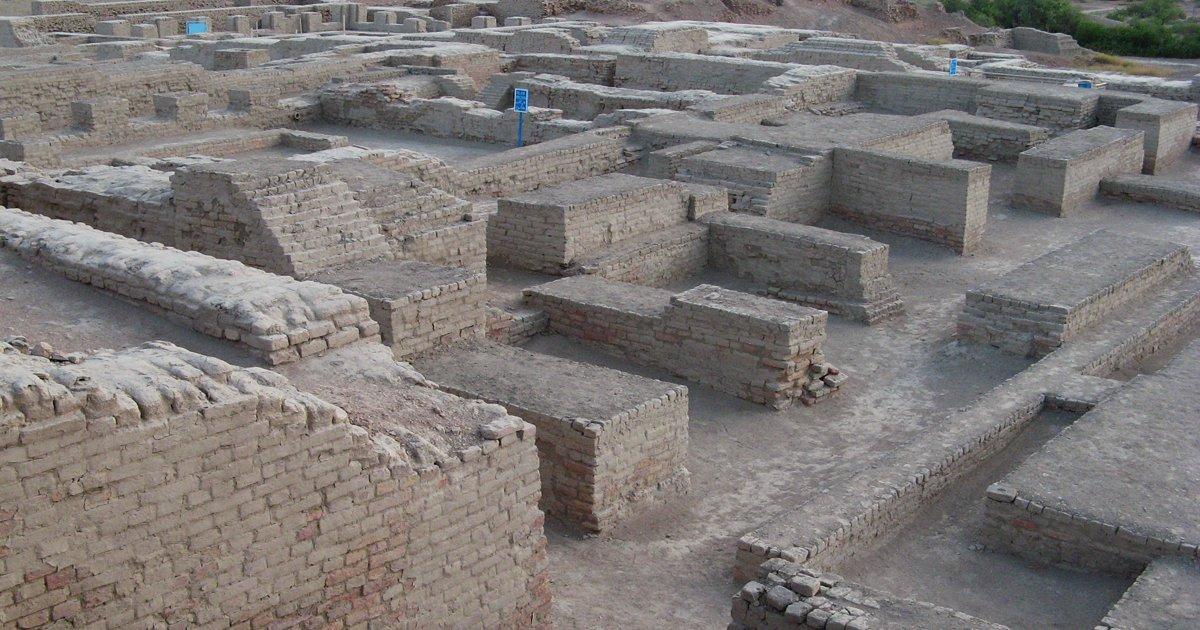
Excavated houses and streets at Mohenjo-daro, Pakistan. Photo by Comrogues, 2010, via Wikimedia Commons, CC BY 2.0 (https://creativecommons.org/licenses/by/2.0/), cropped and resized
By Aris Manus
Claim by claim
- Fringe: The people of Mohenjo-daro were killed by an ancient nuclear blast. Reason: the skeletons date to different times and the city shows no destruction layer.
- Established: Excavations from 1922 to 1931 found about 37 skeletons from the Indus period. Reason: Dales counted them from the published reports.
- Established: Many of the skeletons were later burials rather than bodies left where they fell. Reason: the excavators placed several groups above or after the older remains.
- Unverified: The skeletons or the site show raised radiation. Reason: no published measurement was found.
- Unverified: The radiation figure began as a misread report on an Egyptian bone. Reason: the trail is reported by Hernandez and Colavito, and the papers were not opened.
- Unverified: An area of the site was fused by heat. Reason: no published study of melted material there was found.
Sources
Dales, George F. (1964). The Mythical Massacre at Mohenjo-Daro. Expedition 6 (3). Penn Museum, penn.museum.
Colavito, Jason (2018). The Radioactive Skeleton of Mohenjo Daro: How Soviet Propaganda Spiraled into a Extreme Fringe History Claim. Blog post, May 16, 2018. jasoncolavito.com.
Ancient Aliens Debunked. Ancient Nuclear Warfare. ancientaliensdebunked.com.