Archaeologists have uncovered the largest early Neolithic timber hall ever found in Scotland, revealing sophisticated architecture and ceremonial practices that predate Stonehenge by centuries. In the same location, a Bronze Age weapons hoard has been found, complete with a sword and a gold decorated spearhead.
A Monument to Scotland's Agricultural Revolution
In a discovery that changes our understanding of Scotland's earliest farming communities, archaeologists from GUARD Archaeology have uncovered the remains of what they describe in a report as an "internationally significant" early Neolithic timber hall beneath what will soon become football pitches at Carnoustie High School in Angus. This remarkable structure, dating to approximately 4,000 BC, represents the largest early Neolithic timber hall ever discovered in Scotland and offers unprecedented insights into the lives and beliefs of the country's first agricultural settlers.
The main hall, measuring an impressive 35 meters (115 feet) long by 9 meters (30 feet) wide, was a permanent structure built of oak with opposed doorways near one end. Its massive roof was supported by paired timber posts, while the walls were constructed using wattle and daub panels - a sophisticated building technique that demonstrates the advanced architectural knowledge of these early Neolithic communities.
- 5000-Year-Old Prehistoric Temple Discovered On Scottish Island
- Neolithic Stone Balls: The Northern Rosetta Stone?
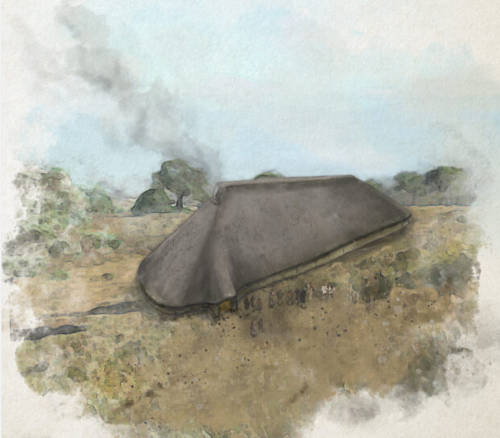
Artist’s impression of the Neolithic Hall found at Carnoustie. (GUARD Archaeology)
An Unprecedented Dual-Hall Complex
What makes this discovery truly exceptional is that the large hall was not built in isolation. Archaeological evidence reveals that a smaller companion hall, measuring 20 meters (66 feet) long by 8 meters (26 feet) wide, was constructed alongside it. This dual-hall arrangement was completely unique in Scotland during the Neolithic period, when such structures were typically solitary buildings within the emerging agricultural landscape.
Beverley Ballin Smith, co-author of the research report, emphasized the significance of this find:
"This monumental timber hall, completely alien to the culture and landscape of the preceding Mesolithic era, was erected by one of the very first groups of farmers to colonize Scotland, in a clearing within the remains of natural woodland. It was fully formed, architecturally sophisticated, large, complex and required skills of design, planning, execution and carpentry."
The excavation of the smaller hall revealed a large hearth containing charred cereal grains and hazelnut shells - clear evidence of feasting and celebrating activities. This suggests that the building served domestic functions related to food preparation and communal dining, while the larger hall held deeper ceremonial significance, similar to other ancient ceremonial sites found across Britain.
- Stepping Back in Time at Skara Brae: A Neolithic Settlement in the Heart of Prehistoric Orkney
- 3000-year-old Bronze Age Highlander Hoard Discovered in Scotland
Ritual Deposits and Long-Distance Connections
The larger hall yielded intriguing evidence of its ceremonial importance. Rather than domestic refuse, archaeologists discovered carefully deposited stone artifacts that offer "tantalizing traces" of the beliefs and rituals practiced by this early farming community. These deliberate depositions included fragments of Arran pitchstone, an axe made of garnet-albite-schist, smoky quartz from the Scottish Highlands, and local materials including agate, quartz, and chalcedony.
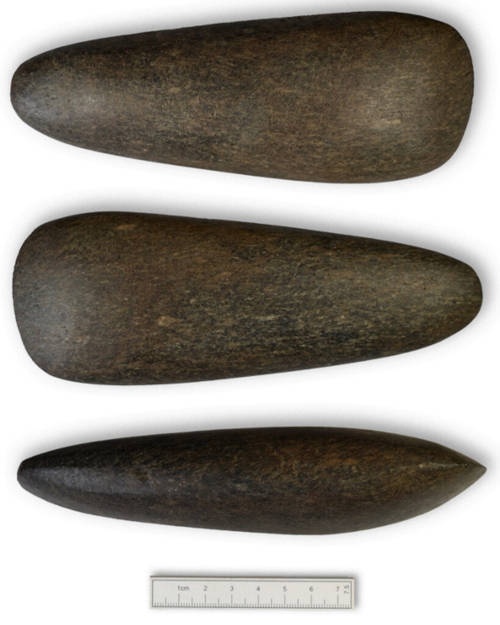
Different sides of Carnoustie Neolithic polished axe showing the sophisticated craftsmanship of Scotland's early farmers. (GUARD Archaeology)
The presence of materials from distant locations across Scotland suggests that the Carnoustie halls attracted visitors from far beyond the immediate area.
Alan Hunter Blair, who directed the fieldwork, noted:
"The halls were probably close to routeways where people might have congregated naturally at various seasons of the year. The availability of hazelnuts in autumn is a strong indicator that that season was an important one for meeting, feasting and celebrating."
The Bronze Age Legacy: A Warrior's Hoard
The archaeological story of Carnoustie doesn't end with the Neolithic period. Around 1400 BC, during the Bronze Age, people returned to this same significant location, apparently unaware of its ancient ceremonial importance. They established a settlement comprising roundhouses that were replaced multiple times over the following centuries until around 800 BC.
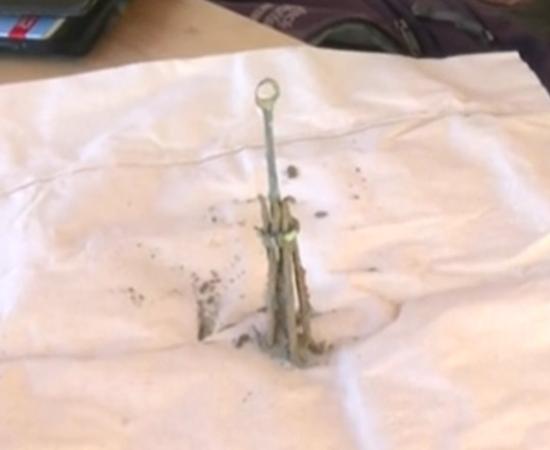
Within this later Bronze Age settlement, archaeologists made another extraordinary discovery: a rare and exceptionally well-preserved metalwork hoard dating to between 1118-924 BC. This treasure trove consisted of a bronze sword within its wooden scabbard, a spearhead decorated with a gold band around its socket, and a bronze sunflower-headed swan's neck pin, all wrapped in the remains of woolen cloth and sheepskin.
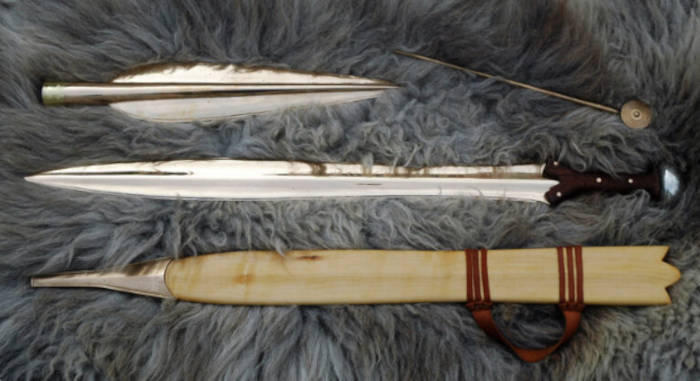
Replica of the Carnoustie Hoard. (GUARD Archaeology)
The preservation of organic materials in this hoard is exceptional, thanks to the antimicrobial properties of copper, which prevented decay of the wooden scabbard, textiles, and leather. The sword showed clear signs of combat use, with notches and rebound marks along its blades, while the spearhead contained a structural weakness that would have made it vulnerable in battle. Such Bronze Age weapon hoards are relatively rare finds that provide valuable insights into ancient warfare and ritual practices.

Left, The Carnoustie gold decorated bronze spearhead with distinctive gold band around its socket, demonstrating the wealth and status of Bronze Age warriors. Right. The Carnoustie bronze sword showing clear signs of combat use with notches and rebound marks along its blades. (GUARD Archaeology)
Implications for Understanding Early Scottish Society
This discovery fundamentally challenges our understanding of Scotland's earliest farming communities. Rather than simple subsistence farmers struggling to establish themselves in a new land, the Carnoustie evidence reveals sophisticated societies capable of complex architectural planning, long-distance trade networks, elaborate ceremonial practices, and social organization sufficient to construct and maintain large public buildings.
The dual-hall arrangement suggests a level of social complexity previously unknown for this period, with different buildings serving distinct functions within a unified ceremonial complex. The site's continued significance through multiple cultural periods suggests that certain landscapes held enduring sacred importance for ancient peoples, a pattern observed at other prehistoric Scottish sites.
A Modern Archaeological Treasure
The Carnoustie excavations were conducted by GUARD Archaeology as part of the planning process for new football pitches at Carnoustie High School. Kathryn Lindsay, Chief Executive of Angus Council, reflected on the unexpected significance:
"When we approved the development of two outdoor football pitches at Balmachie Road, no one imagined the process would reveal one of the most internationally significant archaeological discoveries in Scotland."
The comprehensive research findings have been published as "ARO60: Neolithic timber halls and a Bronze Age settlement with hoard at Carnoustie, Angus" and are freely available through Archaeology Reports Online, ensuring that this remarkable discovery remains accessible to researchers and the public alike.
The Carnoustie discoveries offer an unprecedented window into the lives, beliefs, and practices of Scotland's earliest farming communities, revealing a rich tapestry of human activity spanning nearly two millennia and demonstrating the sophisticated nature of early Scottish civilization.
Top image: The long Neolithic Hall at Carnoustie, with inset, aincient artifacts found and, right, replica of the Carnoustie weapon hoard. Source: GUARD Archaeology
By Gary Manners
References
GUARD Archaeology Ltd. (2025). "ARO60: Neolithic timber halls and a Bronze Age settlement with hoard at Carnoustie, Angus." Archaeology Reports Online. Available at: https://archaeologyreportsonline.com/reports/2025/ARO60.html
GUARD Archaeology Ltd. (2025). “The Monumental Neolithic Halls of Carnoustie.” Available at: https://www.guard-archaeology.co.uk/GALNews/
BBC News Scotland. (2025). "Large and ancient farmers' hall unearthed in Angus." Available at: https://www.bbc.com/news/articles/c5yljgr0k0do
The Times. (2025). "Stone Age timber halls and Celtic weapons found at Carnoustie." Available at: https://www.thetimes.com/uk/scotland/article/stone-age-timber-halls-and-celtic-weapons-found-at-carnoustie-b8pj58zhm