
On a hillside in Beijing's Changping district stands a stretch of wall built from rough stones and yellow loess, which had been filed under one dynasty. This summer, a celadon cup and Sui coins pointed to another. According to the Beijing Institute of Archaeology (BIA), the finds belong to the Sui dynasty, which ruled China from 581 to 618, and they make the site the first known Sui era Great Wall remains in Beijing. So how did a wall credited to one dynasty turn out to belong to the next?
The institute presented the result on October 31, 2026, at the closing event of the 2026 Beijing Public Archaeology Season, as Global Times and Beijing News report. At the same event, it returned to a second story that had first come to light earlier in the year: three ancient wooden boats buried about 7 meters, or roughly 23 feet, below the streets of Fengtai district, one of them branded again and again with a single character meaning "official."
A garrison built into the wall
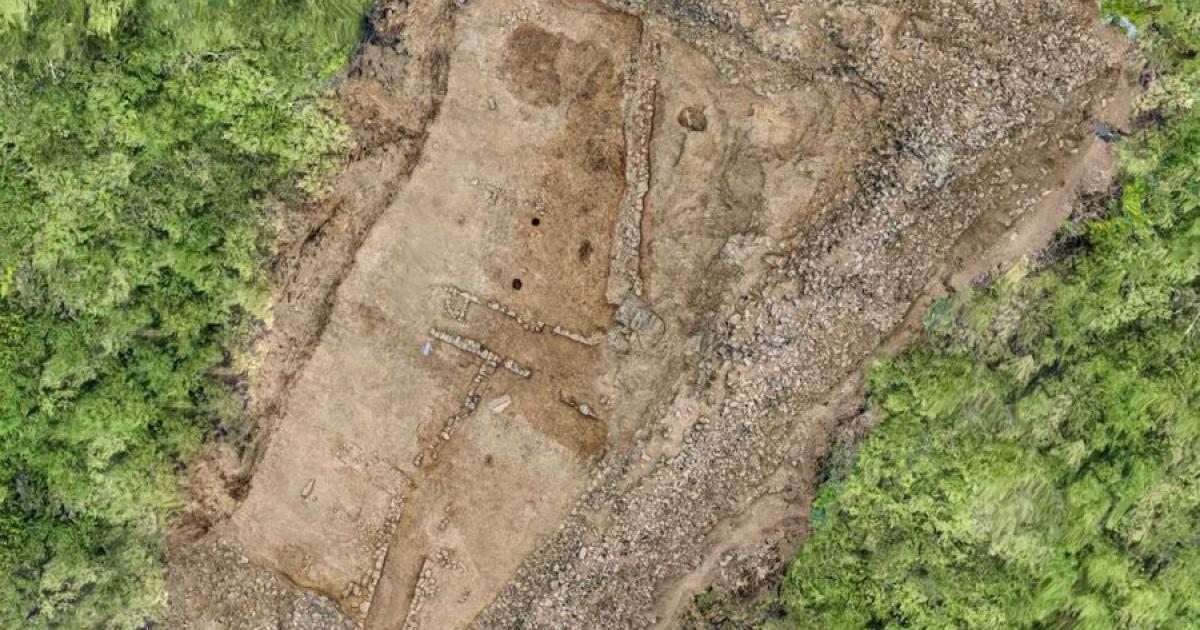
The site, known as the Dalinggou garrison, sits on an early Great Wall line in Changping. BIA researchers first identified it during a review of Beijing's early Great Wall in 2022 and 2023, and they excavated it from August 16 to October 9, 2026, uncovering 800 square meters (about 8,600 square feet), Global Times reports.
What emerged was a small military post built against the wall itself. Its northern side was formed by the existing Great Wall, and inside the enclosure the team found house foundations and retaining walls. Beijing News adds that the dig produced more than 60 objects of pottery, porcelain and metal, falling into three groups, namely building parts, everyday goods and weapons, from the Northern dynasties, the Sui and the much later Jin dynasty of 1115 to 1234.
Why two coins matter
The national Great Wall survey had classified the Dalinggou wall as Northern Qi, a northern state that ruled from 550 to 577. The new dig changed that picture. "Among the most significant finds were Sui-era celadon pottery and coins," Global Times writes, adding that they "provided key evidence for dating the site." Phoenix (ifeng) identifies the coins as Sui wuzhu, and Global Times credits the dating evidence to Shang Heng, an associate research fellow at the BIA.
Drawing on the finds, historical records and expert review, the BIA concluded that the garrison was used mainly during the Northern Qi and Sui periods, with some continued use in that later Jin dynasty. "This is the first discovery of Sui-era Great Wall remains in Beijing," Shang said, according to Global Times.
The result also reaches beyond Beijing. Shang told reporters that inscribed stones and beacon towers in neighboring Hebei and Shanxi had already hinted at a Sui Great Wall. Plotted on a map, he said, those clues sit mostly along lines previously identified as Northern Qi wall, which suggests the Sui may have reused large parts of the earlier fortification. However, this is the institute's working reading rather than a settled result, and it is a reminder that the Great Wall was built over generations and dynasties rather than in one campaign.
Rough stone and yellow earth
Visitors who know the Ming wall (1368 to 1644) would hardly recognize Dalinggou. According to the BIA, its walls were built mainly of roughly hewn stone bonded and filled with loess, around a core of mixed earth and stone. Shang described the method as relatively primitive next to the more refined Ming work, Phoenix reports, and he said it partly explains why so many early stretches of the wall in Beijing have collapsed so badly. Questions such as the oldest section of the Great Wall depend on knowing which dynasty laid which stones.
A short dynasty with long reach
World History Encyclopedia describes it as "a brief one with only two reigning emperors," Wendi and his son Yangdi, who unified China after the split of the Northern and Southern Dynasties period. The Sui dynasty's two emperors are remembered above all for public works on a vast scale. The same source says the Great Wall was "extended and reinforced" against the Eastern Turks, and it credits the Sui with China's Grand Canal, which joined the Yangtze and Yellow Rivers.
Three boats in an old river bend
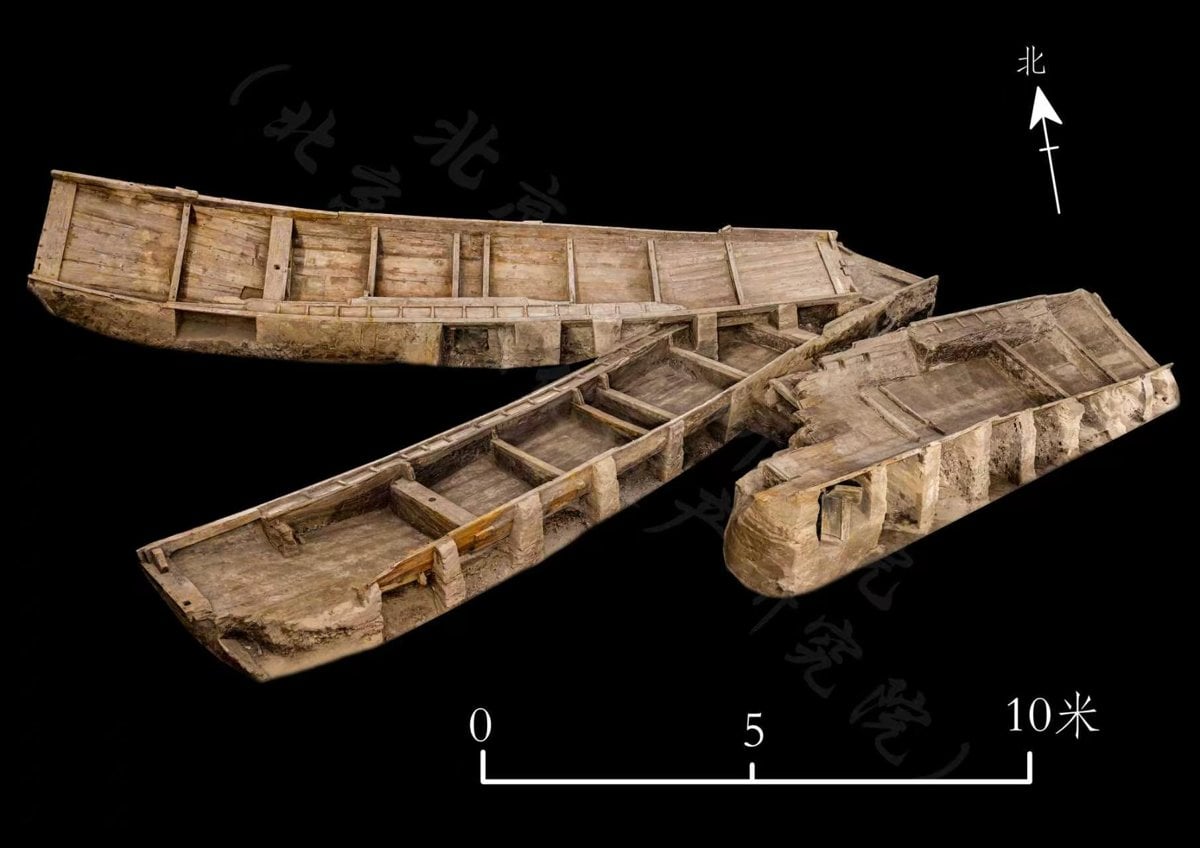
The three Eastern Han to Wei and Jin period boats from Fengtai, Beijing, known as Yongding River No. 1, No. 2 and No. 3, in a composite photo released with the scale in meters. Photo: Beijing Municipal Cultural Heritage Bureau, via Beijing News.
The second find comes from Fengtai, in the south of the city, and it is not new this autumn. The BIA excavated the site from November to December 2025, ahead of redevelopment at Wanquansi village, and the boats were publicized in March 2026, when the Fengtai Times reported that they had been shortlisted among 30 candidates for China's top ten archaeological discoveries of 2025.
All three are flat bottomed plank boats with square bows and long, slender hulls, lying in a bend of an ancient river channel 7 meters down, according to the Fengtai Times. Named Yongding River No. 1, No. 2 and No. 3, each is longer than 10 meters (about 33 feet). No. 3 is the largest at 15 meters (about 49 feet). No. 2 is the best preserved, Beijing News reports, measuring 14 meters (about 46 feet) with ten beams dividing it into nine compartments. Wood analysis shows the hulls are mainly hard pine, with mulberry used for joints and supports.
The most telling detail sits on No. 2. On the front of its beams and the inside of its stern planks, the excavators counted ten clearly branded seal script characters reading *guan*, meaning "official." Global Times says the mark indicates that the vessels were built or operated under official authority. Preliminary radiocarbon dates place the boats between the end of the Eastern Han and the Wei and Jin periods, the Fengtai Times reports, which is why they are described as about 1,800 years old. This early Jin is far older than the Jin that later reused the Dalinggou wall.
The builders joined bottom planks with tenon boards and wooden pegs, locked side planks with hooked rabbet joints, and fixed outer planks to deck planks with iron nails. Ding Lina, a research fellow at the BIA, said the methods resemble those of the Silk Road No. 1 boat from Xi'an. Global Times adds that scholars suggested a possible link to Roman era shipbuilding in the Mediterranean, and the Fengtai Times says the shared tenon board joints may be related to that technique. No one has yet shown how. "The Han-Jin period shipwrecks in Fengtai provide the first physical evidence of ancient inland water transport in Beijing and represent a major breakthrough in the archaeology of water transportation in northern China during that period," Ding said.
The people found with the boats
Not everything at Fengtai has an explanation yet. Inside the boats the team found a wooden paddle model, what may be woven matting and the skeleton of a woman found without her skull, whom the Fengtai Times describes as young. Two human skulls and many animal bones, from horses, cattle, sheep, pigs and dogs, lay around the hulls.
Ding said the team's preliminary view, based on the hulls, the old river course and nearby remains, is that the damaged boats were gathered in a river bend to await repair and then buried by a sudden flood. However, she suggested that the human remains may belong to people who drowned, in the flood or another incident, somewhat later than the period when the boats were in use. Who they were, and how they died, is not yet clear.
An early chapter for a canal city
In Han and Jin times the Yongding River was known as the Leishui. Ding described it as a river with plentiful water and an important route between the northern part of the North China Plain and the Central Plains. The Fengtai Times goes further and calls the official boats a prelude to Beijing's canal history, evidence that the river carried organized traffic centuries before the Sui and Tang canals reached the area.
The boat site now lies inside the Lize Financial Business District, far from the Changping hillside that has given the city its Sui wall.
How we label claims
Established: the Dalinggou dig, its size, the fort built into the wall, the Sui celadon and coins, and the BIA's attributed dating of the garrison to the Northern Qi and Sui with Jin reuse. Established: the three boats, their depth, sizes and joinery, and the ten *guan* brands. Disputed: that the Sui reused large parts of the Northern Qi wall in Hebei and Shanxi. Disputed: the Eastern Han to Wei and Jin date range, from preliminary radiocarbon results. Disputed: a link between the joinery and Roman era Mediterranean shipbuilding. Disputed: the flood explanation and the later drowning, both preliminary. Unverified: who those people were.
Aerial view of the excavated Dalinggou garrison in Changping, Beijing. Photo: Beijing Municipal Cultural Heritage Bureau, via Beijing News.
By Aris Manus
Sources
- Li Hang, Beijing discovers first Sui Dynasty Great Wall remains, along with 1,800-year-old shipwrecks, Global Times, November 1, 2026
- Zhan Shengjie, 北京丰台发现汉晋时期沉船,是中国北方发现的体量最大内河古船, Beijing News, October 31, 2026 (Chinese)
- 首次发现隋代长城遗存,北京考古再添系列新成果, New Yellow River via Phoenix (ifeng), November 1, 2026 (Chinese)
- 丰台汉晋沉船遗址入选2025全国十大考古发现初评, Fengtai Times, March 25, 2026 (Chinese)
- Mark Cartwright, Sui Dynasty, World History Encyclopedia