
Fact Check verdict: Fringe. Was the Sphinx built 10,000 years ago?
Verdict: Fringe. The idea that the Great Sphinx of Giza was carved around 10,000 BCE, thousands of years before the pharaohs, is not supported by the archaeology of the Sphinx and its temples, and other geologists have offered ordinary explanations for the weathering it rests on. That the Sphinx was carved in Egypt's Old Kingdom, as part of King Khafre's building programme at Giza around 2500 BCE, is Established. Which Fourth Dynasty king began the work, Khafre or his father Khufu, is Disputed.
Our labels for each part:
- The Sphinx was carved in the Fourth Dynasty as part of Khafre's monuments: Established.
- Khufu started the Sphinx and Khafre finished it: Disputed.
- The Sphinx is a few centuries older than Khafre, from Egypt's Early Dynastic period (the geologist Colin Reader): Disputed, and a minority view.
- Rain erosion shows the Sphinx is thousands of years older than the Old Kingdom (the geologist Robert Schoch): Fringe.
- Giza records the sky of 10,500 BCE, with the Sphinx marking the Age of Leo (Graham Hancock and Robert Bauval): Fringe.
What the evidence says
The Sphinx was carved out of the bedrock. Workers cut a U-shaped ditch into the limestone and shaped the rock left in the middle. That quarrying left a record, and the record ties the Sphinx to Khafre.
From 1979 to 1983 the archaeologist Mark Lehner, now of Ancient Egypt Research Associates (AERA), mapped the Sphinx, the Sphinx Temple in front of it and Khafre's Valley Temple next door, stone by stone. The geologist Thomas Aigner joined him. Many core blocks of the Sphinx Temple, some weighing up to a hundred tons, contain the same rock layers that run through the Sphinx's body, and in places a thin yellow marl band runs straight across neighbouring blocks. The blocks came out of the ditch around the Sphinx, so statue and temple belong to the same quarrying and building work.
Other details fix that work inside Khafre's programme. The Sphinx Temple was built after Khafre's Valley Temple and reuses its northern enclosure wall. The south side of the Sphinx quarry is the north side of the foundation of Khafre's causeway, the road that runs up to his pyramid, so the causeway came first and the lower Sphinx was cut later. A drainage channel cut along the causeway opens into a corner of the Sphinx quarry, which makes sense only if the channel was there before the quarry. The temple was left unfinished, which suggests the Sphinx was one of the last parts of Khafre's project.
Lehner's own summary is careful: "As certain as we can be about such matters, Khafre created most of the Sphinx. However, Khufu might have started it." He calls the links to Khufu "intriguing, but tenuous". The Egyptologist Rainer Stadelmann argued for Khufu. Lehner and Zahi Hawass wrote on the question in Archaeology magazine in 1994. This is the live debate among specialists, and it concerns a few decades within one dynasty.
The weathering argument has also been answered on geological grounds. In 1994 the geologist James Harrell of the University of Toledo agreed that rain and runoff can produce the rounded profiles seen on the Sphinx, but argued they can be explained just as well after the Old Kingdom. The Sphinx spent most of its history buried in windblown sand that soaked up rain and, at times, Nile floodwater, keeping the soft limestone wet for weeks or months while swelling clays and salt crystals broke it down. He also argued that the low-speed layer that Schoch's seismic survey found under the enclosure floor may simply be a natural layer of the rock rather than weathering, and noted that the speeds behind the Sphinx were lower than at the sides, which on Schoch's own reasoning would make the back older, the opposite of his claim.
AERA adds that the tomb of Debehen, often compared with the Sphinx because it shows mainly wind erosion, lies about 418 metres away and about 27 metres higher, in different rock layers. The Sphinx's soft layers also decay fast: large pieces fell from it in 1981 and 1988. On AERA's reading, nothing about its condition requires an age older than about 4,500 years.
The most serious geological case for an older Sphinx is far more modest. In a 2001 paper in Archaeometry, Colin Reader argued that the uneven pattern of erosion fits rainfall runoff, which he says Giza experienced until the late Fifth Dynasty, and that the Sphinx "may pre-date the reign of Khufu". Harrell, who disagrees with him, sums up Reader's date as older than Khafre "but only by a few hundred years". Even that date is thousands of years short of 10,000 BCE.
Then there is the question of who carved it. AERA says there is no archaeological evidence of earlier structures on the terrace where the Sphinx temples stand. When Schoch is asked where the older civilisation was, he points to Göbekli Tepe in Turkey, not to finds at Giza. None of the sources we checked, on either side of the debate, describe a settlement, tools, quarries or burials at Giza from around 10,000 BCE.
The alternative view
The case for a much older Sphinx deserves a fair hearing, because it comes partly from a trained geologist. The writer John Anthony West first advanced the idea and, in 1990, brought Robert Schoch of Boston University to Giza to examine the monument. Schoch says he went expecting the Egyptologists to be right. Instead he concluded that the deep fissures and rolling profiles on the Sphinx and the walls of its enclosure could only have been made by rain and running water, at a time much wetter than the last 5,000 years.
Schoch and West presented the argument to the Geological Society of America's annual meeting in San Diego in October 1991. Schoch then dated the Sphinx to between 5000 and 7000 BCE. "And I'm trying to be conservative," he told the Los Angeles Times. He published the case in KMT in 1992. He has since argued that seismic tests show deep weathering below the enclosure floor, that the head was recarved later, and that his latest work points to around 10,000 BCE. Even his critic Harrell wrote that Schoch "is an established scholar with laudable credentials, and so his views cannot be summarily dismissed."
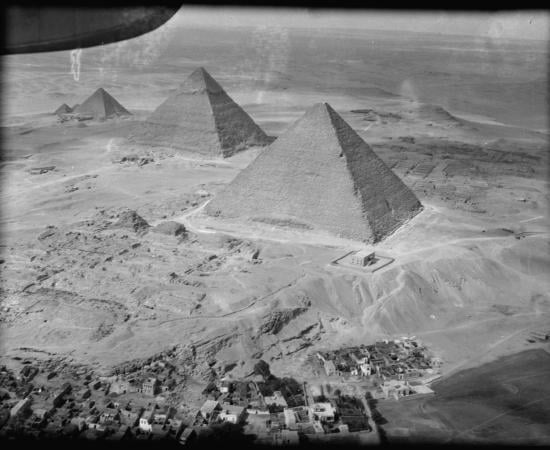
Graham Hancock and Robert Bauval took the idea further in Keeper of Genesis, published in the United States as The Message of the Sphinx. Building on the erosion argument, they proposed that Giza records the sky of 10,500 BCE, with the three pyramids mapping the stars of Orion's Belt and the lion-bodied Sphinx marking the start of the astrological Age of Leo. They connect that moment to Zep Tepi, the "First Time" of Egyptian texts.
In 1999 A. Fairall checked those alignments in the journal Astronomy and Geophysics. He found that the line of the two outer pyramids sits about 38 degrees from north, while Orion's Belt in 10,500 BCE was close to 50 degrees, and that the spring equinox of that year, although near the stars of Leo, "still lies decidedly in Virgo".
Where this leaves it
The Sphinx debate is a good example of how one line of evidence can pull against everything around it. Weathering is real and worth studying, and the argument has produced useful work on how Giza's limestone decays. But a date has to fit the quarry, the temples, the causeway and the people. The Sphinx sits inside a building sequence that runs through Khafre's monuments, and an older Sphinx would need an older culture with the skill, labour and food supply to carve it. No trace of that culture at Giza appears in any of the sources we checked. If new evidence turns up, we will change the label and say so.
How we checked this
We read the AERA pages, Schoch's own research page, both Harrell articles, the 1991 Los Angeles Times report, the book page on Graham Hancock's website and Fairall's note. For Reader's 2001 paper we read the abstract only, for Hawass and Lehner (1994) we confirmed the bibliographic record only, and Schoch's 1992 KMT article is cited as Harrell and AERA list it. Links were checked on 20 October 2026. For the wider picture, see our evidence guide to Göbekli Tepe, the Sphinx and Atlantis.
How we label claims: see How we check evidence.
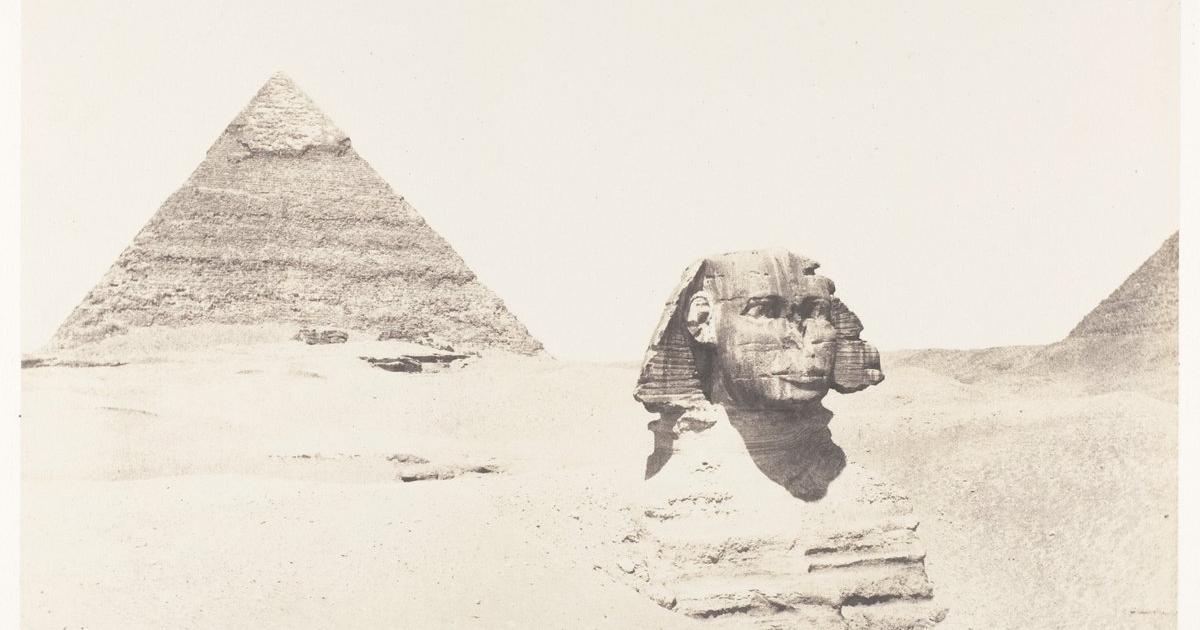
Image: Félix Teynard, Sphinx et Pyramides, 1851–52, The Met, public domain.
By Aris Manus
References
- Lehner, M. "Who Built the Sphinx? The Sphinx Temple Has the Answer." Ancient Egypt Research Associates (AERA).
- AERA. "Khafre's Monuments as a Unit."
- AERA. "Geology of the Sphinx."
- Hawass, Z. and Lehner, M. (1994). "The Sphinx: Who built it, and why?" Archaeology 47 (5): 30 to 41. Bibliographic record checked.
- Schoch, R. M. "The Great Sphinx." Research highlights page.
- KMT, Vol. 5 No. 2 (1994), contents listing Harrell's article. Schoch, R. M. (1992), "Redating the Great Sphinx of Giza", KMT 3 (2), is cited from Harrell and AERA and was not read directly.
- Harrell, J. A. (1994). "The Sphinx Controversy: Another Look at the Geological Evidence." KMT 5 (2): 70 to 74. Reproduced on Hall of Ma'at.
- Harrell, J. A. (2002). "Comments on the Geological Evidence for the Sphinx's Age." Hall of Ma'at.
- Reader, C. D. (2001). "A Geomorphological Study of the Giza Necropolis, with Implications for the Development of the Site." Archaeometry 43 (1): 149 to 165. Abstract read.
- Dye, L. (1991). "Sphinx's New Riddle: Is It Older Than Experts Say?" Los Angeles Times, 23 October 1991.
- Hancock, G. and Bauval, R. Keeper of Genesis / The Message of the Sphinx. Book page, Graham Hancock official website.
- Fairall, A. (1999). "Precession and the layout of the ancient Egyptian pyramids." Astronomy and Geophysics 40 (3): 3.4.