
A forested sandstone hill in the Indian state of Telangana holds one of the largest concentrations of megalithic remains reported in the state, according to the Times of India. The newspaper reports that a team of heritage researchers documented more than 1,500 burial structures on Rakasimitta hill, along with over 100 anthropomorphic stone figures that include two rare female representations. The New Indian Express writes that the researchers believe the site could rank among the five richest megalithic sites in India.
The findings come from a field survey, and no excavation or scientific dating has been reported. That matters for every number and date in this story. The Times of India notes that the claim about India's richest megalithic sites would require confirmation through detailed archaeological surveys and comparative studies, and the researchers have asked the state's archaeology department to document and study the hill.
A Hill of Dolmens Above the Kinnerasani
The site lies in the Rallachelaka area on the outskirts of Mamidigudem village, in the Palvancha mandal of Bhadradri Kothagudem district. The reports spell the hill both as Rakasimitta and as Rakasi Mitta. According to the Times of India, it sits in the Kinnerasani river basin at an elevation of 253 to 260 meters, in sandstone country with gentle slopes, and a stream that runs between it and a neighboring hill is believed to have supported prehistoric habitation.
The survey was carried out by Reddy Ratnakar Reddy, founder of the Matti Foundation and a heritage researcher, with Sangu Venkat Reddy, a research scholar in the history department at Kakatiya University, and a third researcher named in the Times of India and Deccan Chronicle as Kunj Raj Kumar. The New Indian Express gives the foundation's name as Mitti and the third researcher as K Rajkumar.
The burials are dolmens and dolmenoid cists, the box-like stone tombs found across much of peninsular India. The Times of India describes circular stone enclosures, passageways leading into burial chambers and square entrances, and in several cases arrangements for sealing those entrances with stone slabs. Some burials contain two to four stone sarcophagi, according to the same report.
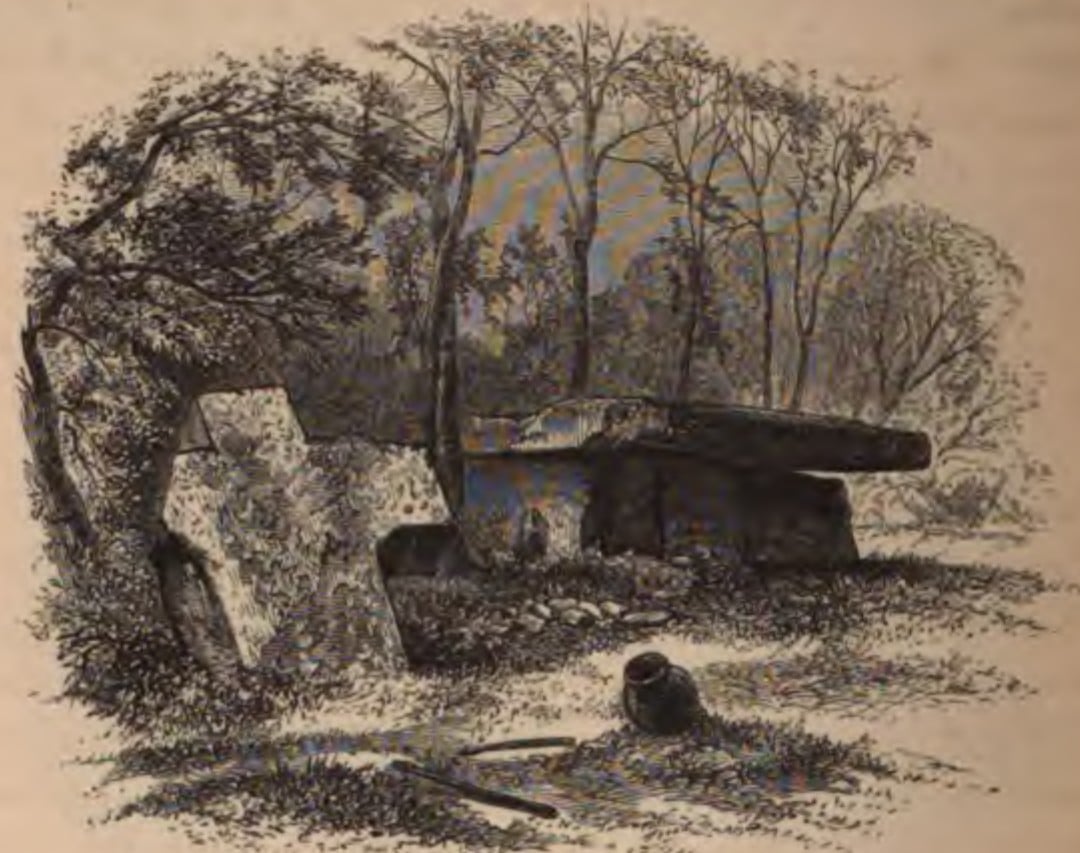
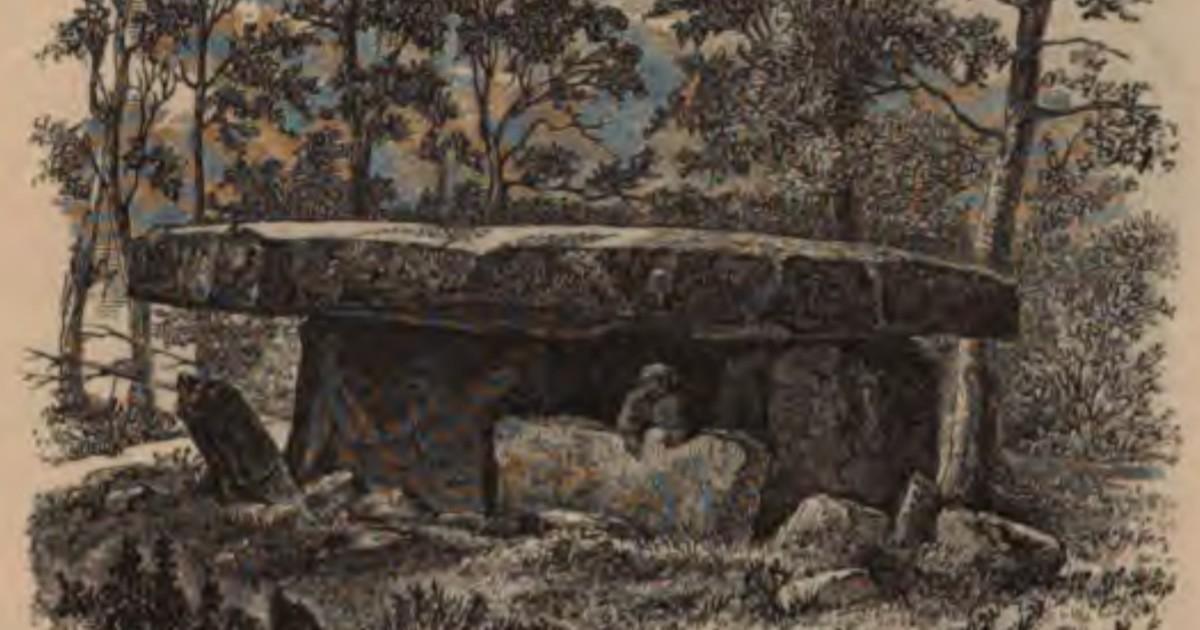
A dolmen with a cross-shaped stone beside it in the Nirmul jungle near the Godavari, published by James Fergusson in 1872 as "Dolmen with Cross in Nirmul Jungle." Historical illustration, not Rakasimitta. (Image: James Fergusson, Rude Stone Monuments in All Countries, 1872, via Internet Archive, public domain, cropped)
Rakasimitta's sandstone may help explain how the tombs look. A course module on the megaliths of South India, published on India's e-PG Pathshala platform, notes that the appearance of a megalith depends on the geology of its region. Dolmens in granite country tend to be built from large thin slabs, the module explains, while those in limestone or sandstone areas tend to have shorter and thicker slabs.
Stone Figures in Front of the Graves
The most striking feature of the hill is its stone figures. The Times of India reports that more than 100 anthropomorphic stones were identified across the hill, many of them standing in front of burial monuments, and that the team also recorded circular water troughs near some tombs. "Circular stone bases or pedestals were observed in front of some burial structures, while grinding hollows were found at several locations across the hill," said Ratnakar, in remarks quoted by the newspaper.
Two of the figures were identified as female, a find the Times of India counts among the most significant of the survey. According to the Times of India, one measures 1.88 meters (about 6 feet 2 inches) in height and bears a breast-like projection on its chest, which the researchers cited as a distinguishing female feature. The second stands 1.60 meters (about 5 feet 3 inches) tall. The New Indian Express gives their widths and thicknesses as well, at 2 feet 4 inches by 10 inches for the taller figure and 2 feet 2 inches by 9 inches for the second.
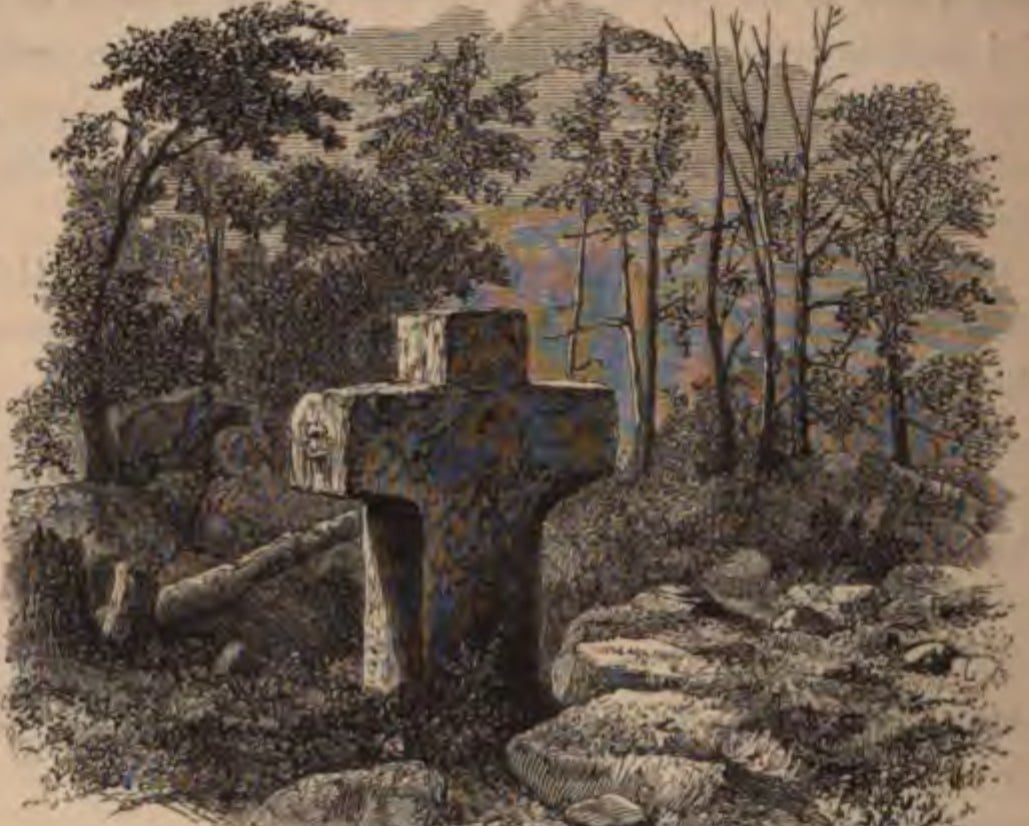
An upright stone at Katapur on the Godavari, published by James Fergusson in 1872 as "Cross at Katapur. From a photograph." Later scholarship lists Katapur among the sites with megalithic anthropomorphic statues. Historical illustration, not Rakasimitta. (Image: James Fergusson, Rude Stone Monuments in All Countries, 1872, via Internet Archive, public domain, cropped)
Figures like these have a long history in the region's archaeology. Anthropomorphic figures have been reported from several megalithic sites in southern India, particularly in the lower Godavari basin, the Times of India notes, but female representations remain uncommon. The researchers point out that one female figure had already been identified at Padugonigudem, and the Deccan Chronicle writes that the pair offers new opportunities to research female representation in megalithic society.
The area also has a record of earlier survey work. In 2015 The Hindu reported that history students led by Prof. K. P. Rao of the University of Hyderabad had recorded megalithic monuments and anthropomorphic statues in 2011 on a hill called Rakasi Mitta near Padugonigudem, in Gundala mandal. In September 2026 the Deccan Chronicle quoted Rao as saying that more than 40 figures had been identified at a site known locally as Rakshasi Mitta near Padugonigudem. The new reports place Rakasimitta near Mamidigudem in Palvancha mandal and do not say whether the two are the same hill.
Scholarly work on the region supports the point that female figures are rare. In an earlier paper in the Bulletin of the Indo-Pacific Prehistory Association, K. P. Rao, writing from Sri Venkateswara University, described the anthropomorphic statue as a feature noticed at only a few scattered sites in Andhra Pradesh, Karnataka and Tamil Nadu. He wrote that the figures carved from thick stone blocks are found in the districts of Khammam, Nellore and Warangal, and Bhadradri Kothagudem was once part of Khammam. The statues usually stand 5 to 8 feet tall, he noted.
Rao also observed that the sex of most such statues cannot be told, since they carry no sexual features. He listed only a handful of female figures, at Lingala, Tottigutta and Vedaya Palem, and wrote that no statue with male anatomical features had come to light. By analogy with communities that still include megaliths in their beliefs, he argued that the statues mainly represented ancestors. The e-PG Pathshala module likewise describes the female figure at Tottigutta and states that anthropomorphs are not found frequently in South India.
Dates That Still Need Testing
The researchers have provisionally dated the structures to between 1200 and 300 BC, according to the New Indian Express, and the Times of India describes the tombs as believed to date to that range. The Deccan Chronicle reports the same span. No radiocarbon or other scientific dates have been published for the site, so the range rests on the team's reading of the monuments.
That estimate fits the broad picture of South Indian megaliths. Rao wrote that megalithic practices in India began at about 1300 BC and continued actively until about 200 BC, and that the burials are generally associated with stone tools, black-and-red ware pottery and iron objects. Excavation at Rakasimitta would be needed to show whether its tombs hold the same kinds of material.
Older traces of people may also be present on the hill, and the Times of India reports that the team found microlithic stone tools that could point to human presence before the megalithic burials. The team has tentatively suggested occupation or visits as early as 10,000 BC, but the newspaper stresses that this estimate remains unverified and requires scientific dating. The New Indian Express describes the same figure as a preliminary estimate.
The survey also recorded a trident-shaped petroglyph engraved on a boulder, according to the Times of India.
What Comes Next
The researchers have called for a comprehensive archaeological survey, scientific investigation and conservation of the site, the Times of India reports, and urged the archaeology department and universities to document and protect the remains. They argue that Rakasimitta could help explain prehistoric settlement patterns, burial traditions and cultural practices in the region.
Other megalithic burial grounds in central India include the stone circles of Junapani near Nagpur and the Hirapur dolmen in Chandrapur district, and Telangana has another megalithic site at Mudumal. Whether Rakasimitta belongs among the largest of these sites will depend on the detailed survey and scientific dating that the survey team is now calling for.
A dolmen at Katapur in the Godavari region, engraved from a photograph and published by James Fergusson in 1872. This is a historical illustration of a regional dolmen and does not show Rakasimitta. (Image: James Fergusson, Rude Stone Monuments in All Countries, 1872, via Internet Archive, public domain, cropped)
By Aris Manus
Sources
- The Times of India. Reddy, U. Sudhakar. November 17, 2026. 1,500 megalithic burials, rare female stone figures found in Bhadradri.
- The New Indian Express. November 17, 2026. Megalithic treasure: 1,500 burial structures on a Telangana hill.
- Deccan Chronicle. November 16, 2026. Rare female stone figures found at megalithic site.
- Rao, K. P. Megalithic anthropomorphic statues: meaning and significance. Bulletin of the Indo-Pacific Prehistory Association 19: 111 to 114. DOI 10.7152/bippa.v19i0.11729.
- The Hindu. April 24, 2015. Take a peek into our past.
- Deccan Chronicle. September 5, 2026. Telangana is home to early stone sculptures.
- e-PG Pathshala (INFLIBNET). Megaliths of South India: Regional Variants. Pre and protohistoric cultures of India.
- Fergusson, J. 1872. Rude Stone Monuments in All Countries: Their Age and Uses. London: John Murray. Illustrations only.