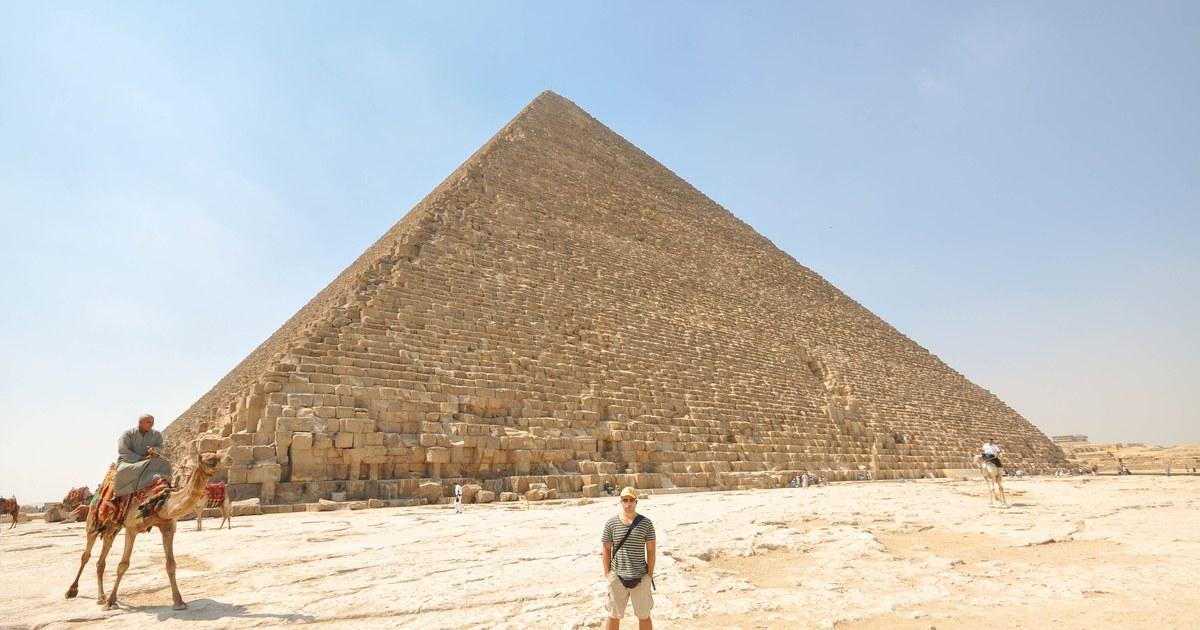

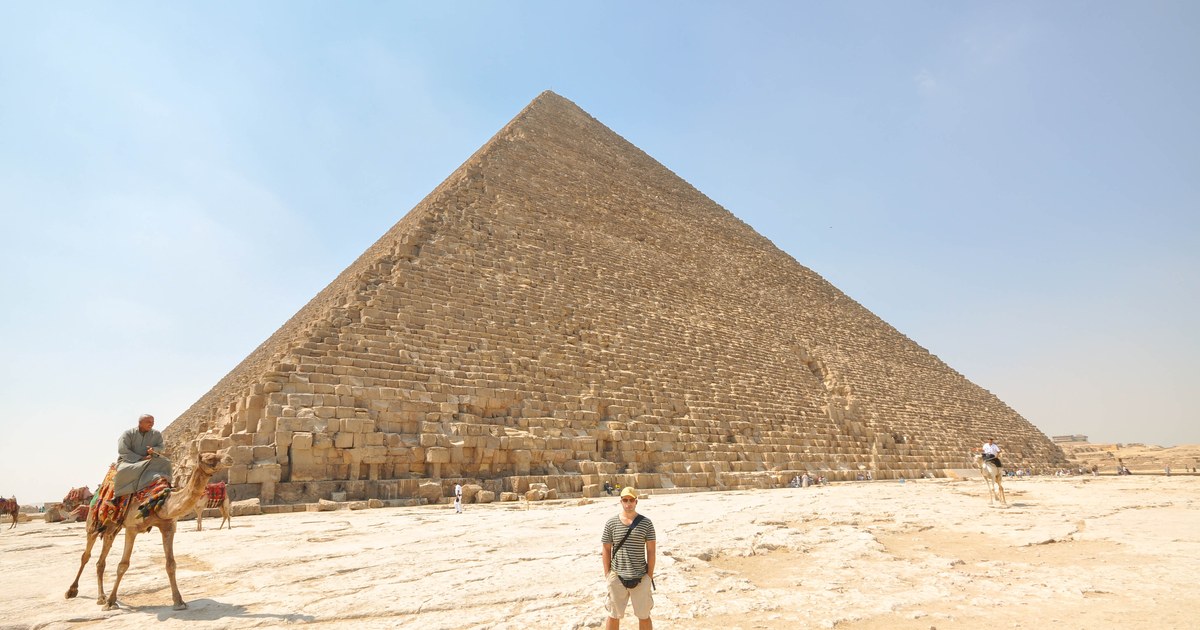
The stepped core blocks of the Great Pyramid of Khufu at Giza, whose smooth outer casing is now almost all gone. (Image: Jorge Láscar via Wikimedia Commons, CC BY 2.0, cropped and resized)
The clip runs a little over two minutes. Workers tilt a container and pour a wet gray mixture into a triangular wooden form divided into sections, and the finished pieces are offered as proof that the pyramid blocks of Egypt were cast on site rather than carved and dragged into place. X's trending summary of the story, updated on November 14, 2026, says viewers have split between praise for its creativity and dismissal of the result as brittle and unconvincing.
It is easy to see why the video lands. The blocks come out neat and the joints look tight, and anyone who has stood beside the Great Pyramid knows the nagging question of how people lifted so much stone. The clip also leans on a theory that is older than social media and was first argued by a materials scientist.
The Geopolymer Idea
The theory belongs to Joseph Davidovits, a French scientist who works at the Geopolymer Institute in Saint Quentin on the mineral binders he calls geopolymers. According to his Geopolymer Institute, he presented the hypothesis "that the pyramid blocks were cast as concrete, instead of carved" at the second International Congress of Egyptologists in Grenoble in 1979, and later set it out in a popular book, The Pyramids: An Enigma Solved.
In his account, workers softened crumbly limestone with water, mixed in clay, lime and natron, then carried the mud up in baskets and packed it into molds on the building site. The Institute's own summary says "The blocks thus consist of 90 to 95% of natural limestone aggregates with its fossil shells, and from 5 to 10% of geological glue." That detail matters, because it means the theory expects fossils in the blocks and tries to explain them. The Institute also reports casting a replica of a pyramid limestone block, though its own page gives the weight as four tonnes in one caption and twelve tonnes in another.
Davidovits does not claim that everything was cast. His site states "We have never claimed granite was artificial," and says the granite blocks inside the pyramid were split from boulders and dressed. The theory is about the limestone, which makes up the great bulk of the monument.
Specialists pushed back early. According to its bibliographic record, Chemical & Engineering News ran an item in May 1984 headlined "Pyramids are not made of polymers, say experts." The item itself could not be opened for this article.
The Strongest Lab Case
The best known scientific support came in 2006, when Michel Barsoum of Drexel University, with Adrish Ganguly and Gilles Hug, published a study in the Journal of the American Ceramic Society. The team used electron microscopes to compare samples of pyramid limestone with six limestone samples from around Giza.
Their abstract reports that the pyramid samples held tiny particles rich in silicon, combined with calcium and magnesium "in ratios that do not exist in any of the potential limestone sources." Some of those particles were also amorphous or nanocrystalline, which the authors read as a sign of fast precipitation from a solution. The same abstract admits that before this work, hard evidence for Davidovits's idea "remained elusive."
The claim was also narrower than the viral clip suggests. Drexel's news release said Barsoum argued that "the majority of the stones were carved and hoisted into place, crucial parts were not," with the outer and inner casing blocks and most likely the upper parts of the pyramids cast. Barsoum also said building the pyramids from cast stone alone would have needed an unattainable amount of wood and fuel to burn lime.
That is a serious result on a limited set of samples, published in a peer reviewed journal. It has stayed a minority view. Writing in the UCLA Encyclopedia of Egyptology in 2012, the geologist James Harrell placed the concrete argument on the scholarly fringes and said its claims "have been resoundingly refuted," citing work by Robert Folk and Donald Campbell in 1992 and by Harrell and Bret Penrod in 1993. That debate was lively at the time, and a reply in the same 1993 journal issue disputed the Harrell and Penrod analysis.
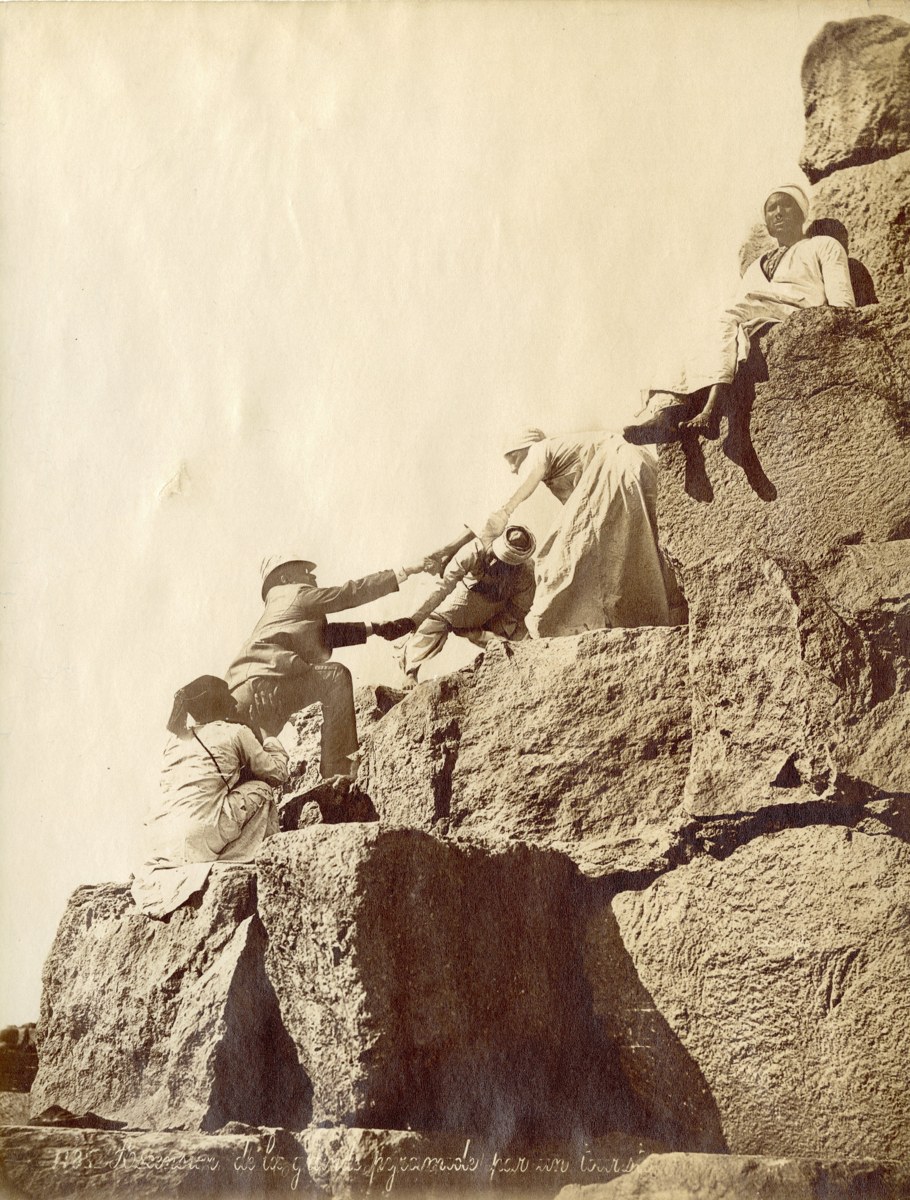
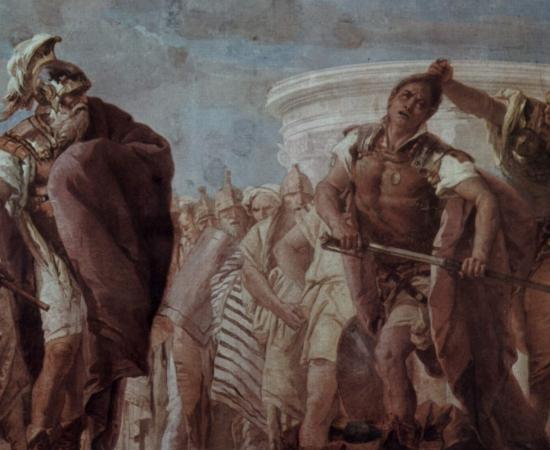
Guides help a tourist climb the core blocks of the Great Pyramid of Khufu, in an undated albumen print attributed to Félix Bonfils. (Image: Archivio fotografico Museo Egizio, Turin, INV02_001, via Wikimedia Commons, CC0, resized)
What the Stones Show
The geological case against casting rests on features in the stones themselves. In a 1991 paper in Concrete International, Campbell and Folk listed ripple lamination, repeated layering across many tiers of blocks, and calcite-filled fractures that stop at the edges of individual blocks. They also reported sharp cross sections of clams, fragile worm tubes and burrows made by animals living on the sea floor.
The same paper found the pores in the blocks highly irregular, where the casting theory predicted oval ones, and in some blocks the layering stands vertical. Campbell and Folk reported no geopolymer binder in the sample they examined, no sign of a cement binding loose grains, and block shapes and sizes that seemed too varied for molds.
Quarries, Tools and a Logbook
The quarries that supplied the stone are still there to see. Harrell describes one of the known limestone quarries right beside the Fourth Dynasty pyramid of Khafra at Giza. In an illustrated overview of Egyptian quarries written with Per Storemyr, he explains how softer stone was cut with copper and later bronze picks and chisels, and how "The picks were used to cut vertical trenches on three sides of an intended block" before it was undercut and broken free.
Tool marks survive on the finished monuments as well. Campbell and Folk wrote that quarrymen's marks are obvious on the Giza pyramid blocks and the stones of Khufu's boat pit. Even the harder stones of Khufu's complex show signs of cutting, such as the saw marks on a basalt slab from his pyramid temple now in Turin.
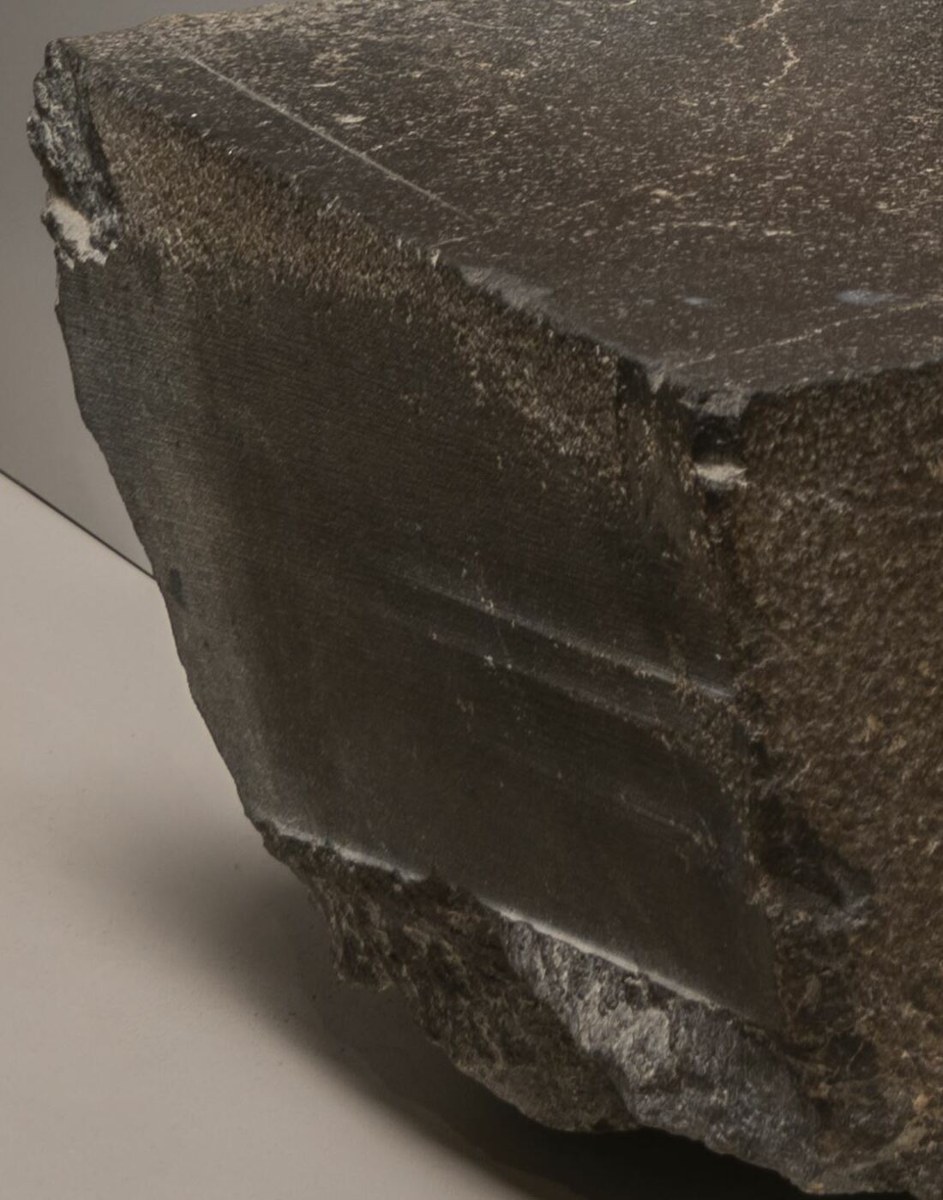
Saw marks on a basalt floor slab from the pyramid temple of Khufu at Giza, now in the Museo Egizio, Turin. (Image: Museo Egizio via Wikimedia Commons, CC0, resized)
Then there are the papyri, which date from the reign of Khufu himself. At Wadi el-Jarf on the Red Sea coast, the Egyptologist Pierre Tallet recovered what his publisher, the French Institute of Oriental Archaeology in Cairo, calls the oldest papyrus archive ever found in Egypt. Its logbooks, the so-called Diary of Merer, record the transport of limestone blocks "from the quarries of Tura to the Great Pyramid of Khufu at Giza, then under construction on the opposite bank of the Nile."
Day after day the inspector and his crew set off from Tura "loaded with stone, for Akhet-Khufu," the Horizon of Khufu, as the Great Pyramid was called. Tallet thinks the fine Tura blocks were most probably, though not exclusively, used for the outer casing, the very layer Barsoum suggested was cast. Tallet is careful to add that the diary contains "no mention of the construction techniques that were employed," so it records hauling and leaves the building methods unstated. You can read more about the logbook of Inspector Merer in earlier coverage.
Other finds fill in the logistics of moving heavy stone. At the Hatnub alabaster quarries, a team from the University of Liverpool and the French Institute found a ramp from Khufu's reign flanked by two staircases lined with post holes. Yannis Gourdon of the French Institute said that "Using a sled which carried a stone block and was attached with ropes to these wooden posts, ancient Egyptians were able to pull up the alabaster blocks out of the quarry on very steep slopes of 20 percent or more."
Water did much of the heavy lifting too. A 2024 study in Communications Earth & Environment led by Eman Ghoneim traced a buried branch of the Nile, which the team named the Ahramat Branch, running along the foot of the desert plateau beside the pyramid fields. The authors suggest it "played a role in the monuments' construction" and served as a waterway for workers and building materials. Earlier coverage looked at how pyramid builders moved materials by water, and how blocks were then raised on the monument itself is still argued over, including a recent proposal for integrated edge ramps.
What the Video Can and Cannot Show
A modern slurry poured into a modern mold shows that a material can be cast today, and that is all it shows. It does not test whether Old Kingdom blocks contain a geopolymer binder, it does not explain bedding and burrows that run through a block, and it does not account for the quarries, tool marks and shipping records that sit beside the pyramids.
The honest state of play is fairly clear. The mainstream answer is that the Giza pyramids were built from limestone cut in nearby quarries and finer stone shipped from Tura, moved by boat, sledge and ramp. Davidovits's theory and the Barsoum study remain on the record as a minority view, with a small set of samples still debated. The builders' real achievement was in planning, logistics and skill, and that story is written in the stone.
By Aris Manus
Sources
- Barsoum, M. W., Ganguly, A., and Hug, G. 2006. Microstructural Evidence of Reconstituted Limestone Blocks in the Great Pyramids of Egypt. Journal of the American Ceramic Society 89(12): 3788 to 3796. Abstract.
- Drexel University. December 2006. Riddle of the Great Pyramids of Giza: Professor Finds Some Building Blocks Were Concrete. News release via ScienceDaily.
- Campbell, D. H., and Folk, R. L. 1991. Ancient Egyptian Pyramids, Concrete or Rock. Concrete International 13(8). Abstract.
- Folk, R. L., and Campbell, D. H. 1992. Are the Pyramids of Egypt Built of Poured Concrete Blocks? Journal of Geological Education 40(1): 25 to 34. Bibliographic record only, article not read.
- Harrell, J. A., and Penrod, B. E. 1993. The Great Pyramid Debate, Evidence from the Lauer Sample. Journal of Geological Education 41(4): 358 to 363. Morris, M. 1993. How Not to Analyze Pyramid Stone, The Invalid Conclusions of James A. Harrell and Bret E. Penrod. Journal of Geological Education 41(4): 364 to 369. Bibliographic records only, articles not read.
- Chemical & Engineering News. May 21, 1984. Pyramids are not made of polymers, say experts. C&EN 62(21): 5. Bibliographic record only, article not read.
- Harrell, J. A. 2012. Building Stones. UCLA Encyclopedia of Egyptology.
- Harrell, J. A., and Storemyr, P. 2009. Ancient Egyptian quarries, an illustrated overview. Geological Survey of Norway Special Publication 12.
- Tallet, P. 2017. Les papyrus de la mer Rouge I, le Journal de Merer. Institut français d'archéologie orientale, MIFAO 136. English summary and translation excerpts.
- University of Liverpool. November 2, 2018. Ancient quarry ramp system may have helped workers build Egypt's Great Pyramids.
- Ghoneim, E., et al. 2024. The Egyptian pyramid chain was built along the now abandoned Ahramat Nile Branch. Communications Earth & Environment 5: 233.
- Archaeology Magazine. July/August 2022. Journeys of the Pyramid Builders.
- Davidovits, J. Geopolymer Institute. Are Pyramids Made Out of Concrete? (1) and FAQ for artificial stone supporters.