
On Kuroshima, a small island in Mishima Village in Japan's Kagoshima Prefecture, archaeologists have identified an eight-sided platform that appears to have been the foundation of a building roofed with tiles from China. The team is led by Professor Satoru Nakazono of the Faculty of Intercultural Studies at Kagoshima International University. The university presented the results at the Kagoshima Prefectural Office on October 26 and published a press release the next day.
According to the release, the structure at the Ōsato site measures about 8.9 meters from corner to corner across its upper surface, with sides reconstructed at about 3.4 meters. Its lower edge was a little larger, at an estimated 10 to 11 meters across. The team dates the platform to around the 12th century, at the end of Japan's Heian period, and links it to tiles of a Southern Song Chinese style that were produced in Ningbo.
An Eight-Sided Platform
The university's team has excavated at Ōsato on a continuing basis since 2014. In an area the release calls Locality 1, where the Chinese-style tiles are especially plentiful, the archaeologists had already recorded signs that the ground had been artificially leveled. That leveled ground now appears to have been a platform deliberately planned as an octagon, the release explains.
The excavators also suggest that rows of stones or stone facing may once have surrounded the platform, and they found several patches of burnt earth on and around it. Judging from the conditions of the find, the release states, the Southern Song tiles appear to belong with the platform. The Yomiuri Shimbun reports that the tiles came out of the ground in high density on the eastern side of the feature.
Nothing of the building itself survives above the foundation, which leaves its form open. Arkeonews, reporting on the find on November 17, notes that this is why the researchers cannot yet settle the architecture or the purpose of the structure. A preliminary report is due to appear in the journal Kikan Kōkogaku, issue 177, according to the release and the Yomiuri.
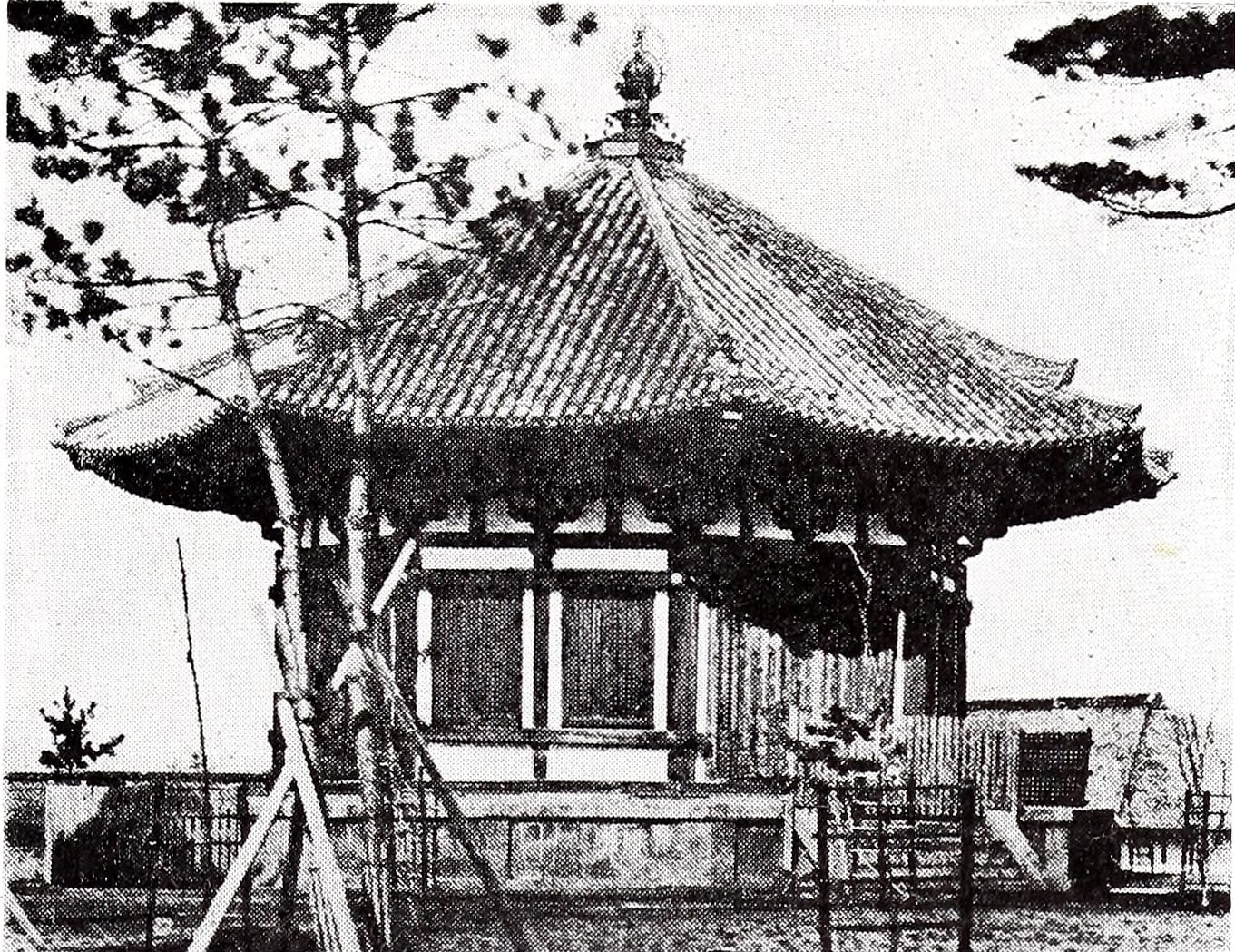
The Hokuendō, an octagonal hall at Kōfukuji in Nara, rebuilt in the early 13th century after a fire in 1180, as photographed for the same 1920 handbook. Shown for comparison only. (Image: Handbook of the Old Shrines and Temples and Their Treasures in Japan, Department of Education, Tokyo, 1920, fig. 120, via Internet Archive, public domain, cropped)
Tiles Made in Ningbo
The tiles are the reason Ōsato has drawn attention. According to the university, Southern Song style tiles have been found in Japan only in parts of Kyushu. They are concentrated at the Hakata site group in Fukuoka, the medieval international port, and from major sites nearby. Others have turned up in parts of Nagasaki Prefecture and along the lower Manose River on the western Satsuma Peninsula. Ōsato is the southernmost place in the Japanese archipelago where they have turned up.
Specialists once disagreed about where these tiles were made. Some argued that they were shipped from China, while others thought that Chinese craftsmen had come to Japan and made them locally, the release explains. In 2015 Nakazono and his colleagues found tiles in Ningbo made from the same molds as tiles from the Hakata and Hakozaki sites in Fukuoka. X-ray fluorescence analysis reported the same year showed matching compositions in tiles from the Hakata area, Mishima Village, the western Satsuma Peninsula and Ningbo. The result indicated that the tiles were produced in Ningbo and carried across roughly 1,000 kilometers of sea.
However, the tile finds had never come with a building plan. The release notes that there had been almost no clues to the kind of structures these tiles roofed, and that no platform had been confirmed at any of the sites where they occur. The Yomiuri reports that this is the first octagonal platform found at a Japanese site that has produced Southern Song tiles.
A Pagoda, a Hall or a Shrine
In the release, the researchers say they think the platform may have been the base of a religious building that stood in a secluded sacred spot to the south of the settlement. The Yomiuri adds that a Shinto shrine lies to the south of the site and that no later features overlie the main area, two points the team weighed in reaching its view.
Octagonal plans have a long history in East Asian religious architecture. The release cites examples close in date to Ōsato, among them the site of the octagonal nine-story pagoda at Hosshōji in Kyoto. It also names the octagonal three-story pagoda at Anrakuji in Nagano Prefecture, which it describes as the oldest surviving building in the Zen style. Octagonal pagodas also exist in China, the team notes, so the question of which tradition the Ōsato platform belongs to remains open.
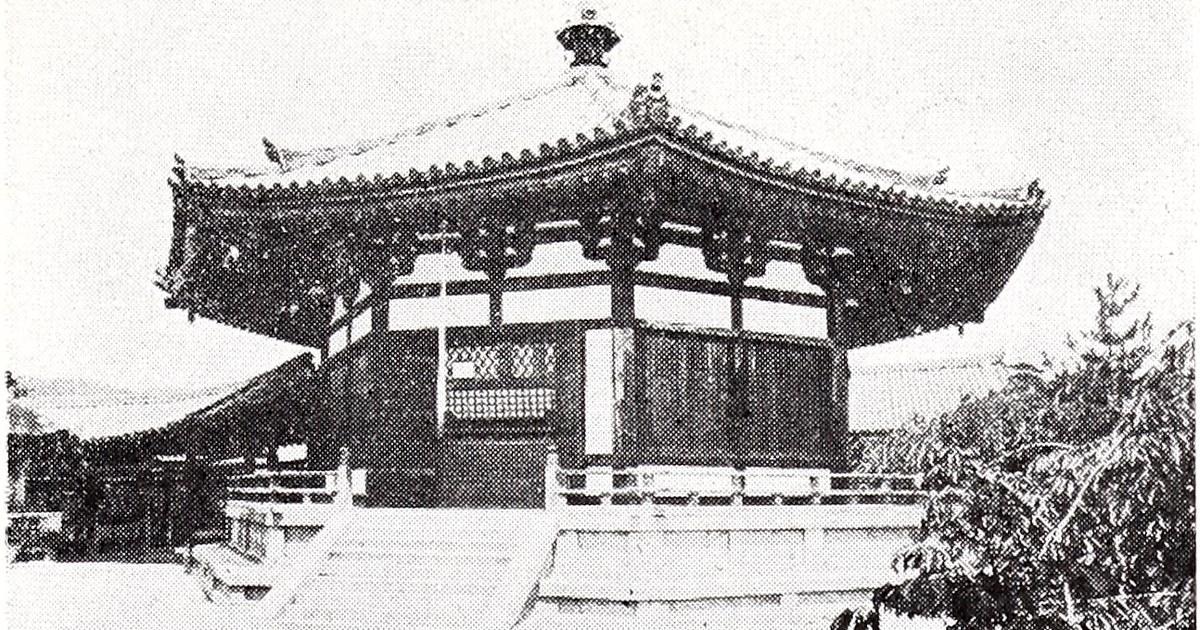
Only six octagonal halls survive in Japan, according to the Japanese Architecture and Art Net Users System, a reference dictionary of Japanese architecture, which names the Yumedono at Hōryūji as the oldest. It dates the Hokuendō at Kōfukuji to 1210 and the West Octagonal Hall at Hōryūji to 1250, and explains that such halls were raised by patrons devoted to a particular Buddhist deity or saint.
However, the team stops short of naming the building. The release weighs the tiles around the platform, the sacred setting, finds of such tiles at major temples and shrines in northern Kyushu and the fact that octagons in East Asia most often belong to Buddhist pagodas and halls. On that basis it proposes an octagonal pagoda or hall, or a memorial shrine building, as possibilities. Readers who want to compare another excavation can see the foundations of the Saiji temple pagoda in Kyoto.
Sulfur and the Song Trade
The island's place in medieval trade is part of the story. The release points to neighboring Iōjima, which it describes as the probable place of exile of the monk Shunkan. Iōjima was also a source of sulfur, one of the main exports in the trade between Japan and Song China, the release notes. The team concludes that Ōsato may have been an important point in a wide trading network.
The coast of Satsuma Province at Bōnoura, with the paired Sōken rocks, from the series Famous Places in the Sixty-odd Provinces by Utagawa Hiroshige, as titled on the print. Shown for regional context. (Image: Utagawa Hiroshige, 19th century, The Metropolitan Museum of Art, 2007.49.278, CC0 public domain)
Historians have traced that sulfur trade in some detail. In a paper published by Osaka University, historian Shinji Yamauchi writes that Japanese sulfur exports to China began at the end of the 10th century along with the Japan and Song trade. The sulfur was used mainly for gunpowder, he explains, because Song China had few volcanoes of its own. He notes that The Tale of the Heike describes sulfur mining and trading on Iōjima in the 12th or 13th century. In his reading, the sulfur was carried along the west coast of Kyushu to Hakata and shipped to China by Chinese merchants.
Historian Wataru Enomoto, writing in the journal Shigaku Zasshi, argues that Japan's trade with Song China was carried out by captains of Chinese descent based in Hakata, known as Hakata gōshu. These captains were bound in patron relationships to shrines, temples and other powers in Japan, he writes.
The Yomiuri, reporting in Japanese, says that the team drew on the same background. Citing the sulfur of Iōjima, the researchers said that "Kuroshima may have been one of the bases of the Japan-Song trade" (translated by Ancient Origins). Recalling that the Song merchants who led the trade lived in Hakata, they also speculated that "Song merchants may have lived on Kuroshima as well and put up the building on the octagonal base" (translated by Ancient Origins).
However, the release itself treats these links as unfinished work. It lists among the questions for future research whether Ōsato was a port of call for Southern Song ships and how it connected with Hakata, mainland Kyushu and the islands to the south. For a sense of the vessels that carried Song trade, see the finds from a Song dynasty shipwreck in the South China Sea.
A Window on the Southern Frontier
In the release, the team writes that the platform makes it more likely that the tiles roofed a religious building. The find also sheds light on buildings with this type of tile and on the southern border region of early medieval Japan, the researchers add. "I think we may have been able to contribute to progress in understanding how the Japan-Song trade actually worked in East Asia," Nakazono said, according to the Yomiuri (translated by Ancient Origins).
The excavation is part of a partnership between the university and Mishima Village linked to the Mishima Village and Kikai Caldera Geopark, according to the release. It also serves a research project funded by the Japan Society for the Promotion of Science to develop fully three-dimensional excavation recording. The release credits the residents of Kuroshima, who wanted to understand the history of their island, with helping keep the work going.
The Yumedono, an octagonal hall at Hōryūji in Nara, photographed for a 1920 handbook of Japan's temples, which dates the building to 739 and describes it as standing on a double platform. It is shown here as a comparison and does not depict Kuroshima. (Image: Handbook of the Old Shrines and Temples and Their Treasures in Japan, Department of Education, Tokyo, 1920, fig. 161, via Internet Archive, public domain, cropped)
By Aris Manus
Sources
- Kagoshima International University. October 27, 2026. Press release: Octagonal platform confirmed at the Ōsato site, Kuroshima, Mishima Village. In Japanese, with the full release as a PDF.
- The Yomiuri Shimbun. October 28, 2026. Octagonal building foundation confirmed at Ōsato site on Kuroshima. In Japanese.
- Arkeonews. Altuntaş, L. November 17, 2026. Unusual 900-Year-Old Octagonal Structure Discovered on Japanese Island.
- Nakazono, S. et al. 2015. Chō enkakuchi kōshō ni okeru dōhan kankei no kentō: Chūgoku to Nihon shutsudo no chūsei Chūgokukei gawara. Proceedings of the Japan Society for Archaeological Information 15: 64 to 68.
- Nakazono, S. et al. 2015. Nihon shutsudo no chūsei Chūgokukei gawara no keikō X-sen bunseki ni yoru sanchi suitei. Proceedings of the Japan Society for Archaeological Information 15: 100 to 105.
- Yamauchi, S. 2016. Export of Japanese Sulfur and World History from the 11th to the 16th Centuries. Osaka University History Education Research Group Report Series 13: 35 to 37.
- Enomoto, W. 2001. A Reconsideration of "Japanese Merchants" in Song China. Shigaku Zasshi 110 (2).
- Japanese Architecture and Art Net Users System (JAANUS). hakkakudou (octagonal hall).
- Department of Education, Bureau of Religions. 1920. Handbook of the Old Shrines and Temples and Their Treasures in Japan. Tokyo.
- researchmap. Satoru Nakazono. Researcher profile.