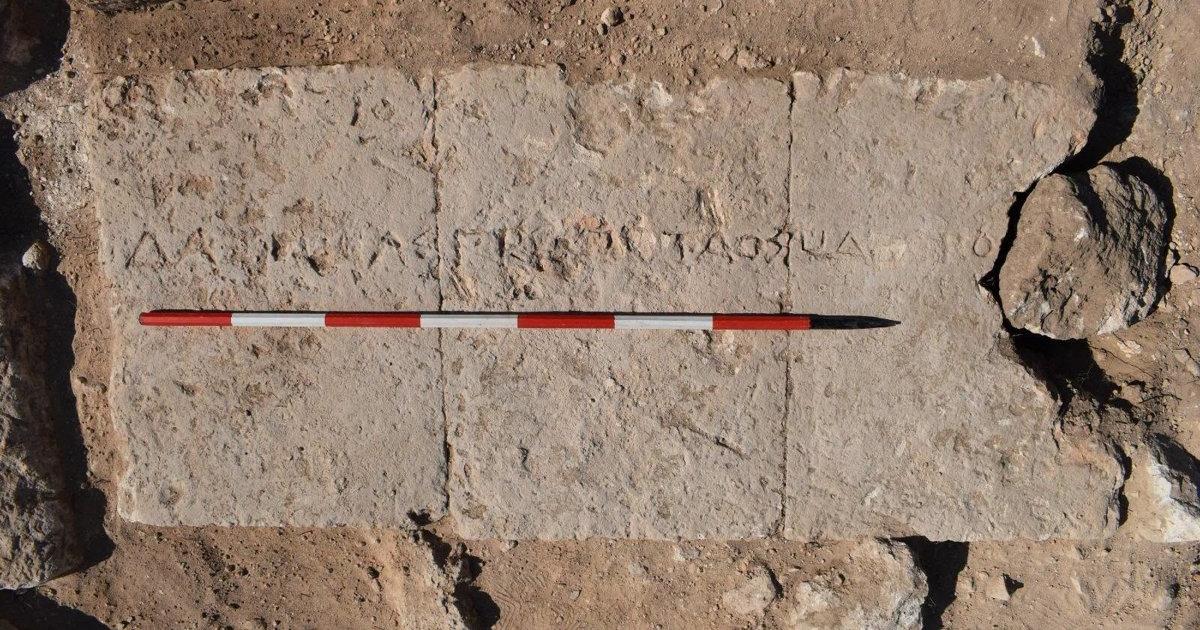

Three large stones lie side by side over a grave cut into the rock, and a single line of letters runs across all of them. When archaeologists read the first words, they found a woman's name, the name of her father, and a word that may say what she did in life. On October 29, 2026, the Soprintendenza Archeologia, Belle Arti e Paesaggio for the provinces of Brindisi, Lecce and Taranto presented the find, made in the Messapian Walls Archaeological Park at Manduria, at its headquarters in Lecce.
The burial is known as Tomb 17, and it is about 2,300 years old, dating to the fourth to third century BC. The people who study it think the woman inside may have held a priestly role in the cult of Demeter. They are careful to say this is a preliminary reading, and her name has not yet been made public.
A people with their own language
The Messapians lived in what is now Puglia, above all in the Salento peninsula, before Roman rule. Arkeonews describes them as a community with their own distinct language and inscription traditions, who developed close ties with the Greek world because of where they lived, between the Adriatic and Ionian Seas. Their language was Indo-European in origin, the Italian art magazine Stile Arte notes, and is known mainly through funerary and votive inscriptions and other short texts. It is still hard to interpret, so each new text adds to what scholars know about names, religious formulas and the social structure of the communities of pre-Roman Puglia.
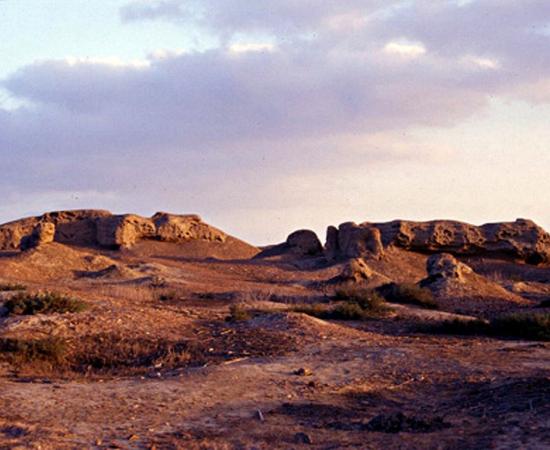
Manduria, about 22 miles (35 kilometers) east of Taranto, was one of the main centers of the Messapians, and its walls, gates and cemeteries still survive. Its neighbors included the Greek colonies of southern Italy such as Taras, modern Taranto. The place was already known to the Romans. Pliny the Elder, writing in the first century AD, recorded that "In the country of the Salentini, near the town of Manduria, there is a lake" that is "full to the brim, the waters of which are never diminished by what is taken out of it, nor increased by what is added."
The town has given up a moving find before, in an earlier Messapian tomb at Manduria that held a pig-shaped baby bottle.
A name and a title on the stone
Tomb 17 was carved directly into the bedrock and closed with three large stone slabs. On their outer face is a monumental inscription in the Messapic language, spread across all three blocks for a total length of about 5.9 feet (1.8 meters), according to Stile Arte.
The first epigraphic readings picked out three parts, the regional broadcaster Antenna Sud reports: a woman's name, a patronymic (her father's name) and a term linked to a priestly title. That term is thabara. Arkeonews explains that it is used in the genitive case, the grammatical form that shows belonging, so the line reads as the grave of a named woman, daughter of a named father, who held this title. Researchers interpret thabara as a title tied to a priestly role. However, Stile Arte stresses that its exact meaning still needs more study.
Arkeonews adds that the exact reading of her name and the full scope of her duties have not been disclosed.
Paint, a key and an incense burner
Inside, the walls of the grave still hold traces of painted plaster. A meander, the running geometric border familiar from Greek art, crosses the upper band in blue and red pigment. On the inner faces of the slabs, other images appear.
One of them has been read as a sanctuary key. Antenna Sud notes that in the Greek world the key was an attribute often linked to female priestly figures, and Arkeonews adds that Greek priestesses sometimes carried one as a sign of their duties at a sanctuary. Another painted shape may show a thymiaterion, a stand for burning incense during ceremonies.
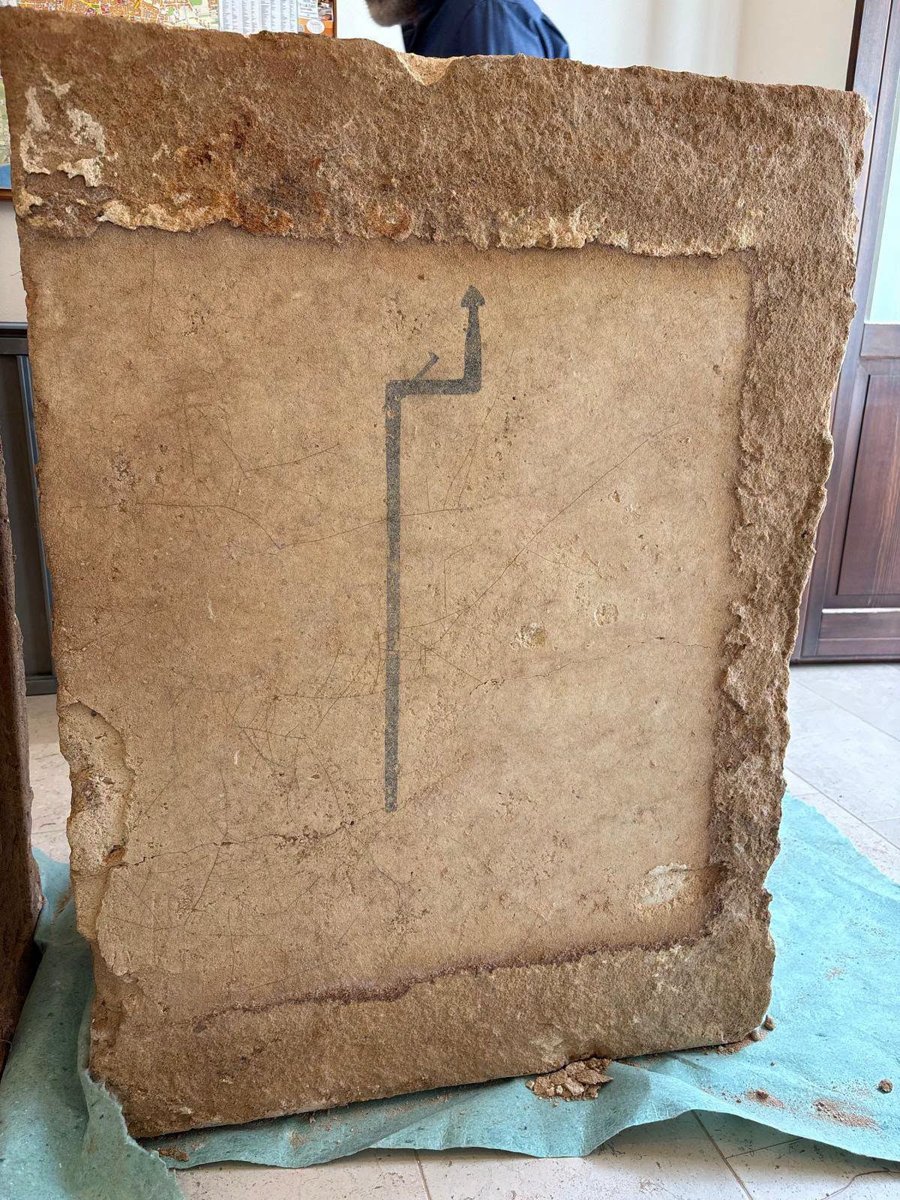
A painted symbol on a slab from Tomb 17, interpreted as a possible sanctuary key. Image: Soprintendenza Archeologia, Belle Arti e Paesaggio per le province di Brindisi, Lecce e Taranto.
A second text, and a goddess
The detail Arkeonews calls the most intriguing lies on the inner face of one slab. There, a second Messapic text was painted in four lines. Stile Arte, Antenna Sud and La Voce di Manduria describe it as blue, while Finestre sull'Arte and Arkeonews describe it as red and blue. Looters who broke into the tomb long ago damaged parts of it, and some passages are hard to read. Even so, the researchers found the word thabara again, along with a name provisionally reconstructed as Damatrioas.
That form may connect to Demeter, the Greek goddess of grain and the harvest. La Voce di Manduria, the local paper, describes her as a deity tied to the fertility of the earth, the cycle of life and the underworld, and Arkeonews notes that her worship also had connections with death. Her most famous festival was Demeter's secret rites at Eleusis, far to the east in Greece.
Taken together, the title, the key, the incense burner and the possible name of the goddess point the team toward a woman with religious duties, perhaps a priestess of Demeter. Every source treats this as a preliminary reading. Finestre sull'Arte calls it, for now, an interpretive hypothesis that further epigraphic and iconographic studies will have to verify.
What the looters left behind
Tomb 17 had been disturbed by grave robbers, and some of its original layout is gone. However, a few grave goods survived: bronze fibulae (dress clasps), a silver ring, a silver coin attributed to the mint of Taranto, and an iron object whose use is still being studied.
Arkeonews, citing the Italian press, reports that the ring shows a snake and the coin shows the head of Athena and Heracles fighting a lion. It also notes that any link between these images and the cult of Demeter remains speculative, and that the objects alone cannot prove the woman was a priestess. Only a few fragments of her bones survive, which makes it harder to learn about her as a person.
Twenty-four graves and a road
Tomb 17 was one result of a wider campaign funded by the Ministry of Culture in two parts of the park, the area of the East Gate and the southern sector, where a stratigraphic dig covered about 1,940 square feet (180 square meters). In total the team investigated 24 burials, most dating to the fourth and third centuries BC and many damaged by illegal digging. The pottery, ornaments and other grave goods recovered still offer new data on Messapian burial customs.
The work also traced how the city's defenses were built and rebuilt between the fifth and third centuries BC. The team found an ancient road that, in the third century BC, was laid over an area once used for burials, a sign that the town reorganized its space over time. The results were presented by Superintendent Antonio Zunno with archaeologists Vincenzo Ria, who is responsible for the Manduria area, and Stefania Montanaro of Ales S.p.A., with local officials in attendance.
What comes next
The study is far from over. The team plans to restore and consolidate the painted surfaces, carry out archaeobotanical analysis of samples taken during the dig, and complete the epigraphic study of both inscriptions. The Soprintendenza has suggested keeping the tomb where it was found, while the inscribed and painted slabs and the grave goods could go on display in the Manduria Archaeological Museum.
If the readings hold, Arkeonews writes, Tomb 17 could give direct insight into the religious authority of women in Messapian society.
How we label claims
Established: Tomb 17 at Manduria was cut into the bedrock and sealed by three slabs carrying a carved Messapic inscription. Established: the painted meander, the second four-line painted inscription, the looting, and the surviving fibulae, silver ring, Tarentine silver coin and iron object. Established: the 24 tombs dated mainly to the fourth and third centuries BC and the road laid over part of the necropolis in the third century BC. Disputed: that the outer text gives the woman's name and patronymic, and that the painted shapes are a sanctuary key and an incense burner. These are the team's first readings, backed by the inscription and the images, but still under study. Disputed: that thabara is a priestly title, that Damatrioas refers to Demeter, and that she served Demeter's cult. The title, the name and the painted objects support this preliminary interpretation, but every source says it still has to be verified and the meaning of thabara needs more study. Unverified: her name, age and exact role, which are unpublished. Unverified: the snake on the ring and the scene on the coin as cult symbols, which Arkeonews calls speculative.
The three slabs that sealed Tomb 17 at Manduria, with the carved Messapic inscription running across all of them. Image: Soprintendenza Archeologia, Belle Arti e Paesaggio per le province di Brindisi, Lecce e Taranto.
By Aris Manus
Sources
- Manduria, scoperta tomba dipinta con iscrizioni in lingua messapica, forse di una sacerdotessa di Demetra, Finestre sull'Arte (Italian)
- Oguz Buyukyildirim, 2,300-Year-Old Tomb with Two Inscriptions Discovered, May Belong to a Priestess of Demeter, Arkeonews, October 31, 2026
- Federico Bernardelli Curuz, Manduria, scoperta una tomba messapica dipinta: potrebbe appartenere a una sacerdotessa di Demetra, Stile Arte, October 31, 2026 (Italian)
- Nazareno Dinoi, Archeologia: a Manduria scoperta la tomba di una sacerdotessa del culto di Demetra, La Voce di Manduria, October 29, 2026 (Italian)
- Manduria, tomba monumentale svela segreti della civiltà messapica, Antenna Sud, October 30, 2026 (Italian)
- Pliny the Elder, Natural History 2.106, translated by John Bostock and H. T. Riley, via Perseus Digital Library