
The Mongol invasion of Japan in 1281 was one of the largest naval campaigns in history, if the numbers in the old records are right, and the seabed off Takashima Island still holds its wreckage. Now a team diving on a third ship from that fleet has found something new for the site: dice and game tiles from the daily life of the crew. Did the soldiers and sailors aboard pass the long hours of the campaign with games of chance? The finds suggest that some of them may have done so.
According to the Mainichi Shimbun, the city of Matsuura in Nagasaki Prefecture and Kokugakuin University announced the results on October 28, 2026. The team recovered five dice and 29 tiles, which the paper described as the first gaming objects found at the site, and Kokugakuin University also published its own report of the announcement, given by Professor Yoshifumi Ikeda, who leads the research.
The Stern of a Big Ship
The excavation began on October 2 and was planned to last 29 days, KTN Television Nagasaki reported, and the wreck lies about 150 meters (490 ft) offshore. Reports differ slightly on its depth, with the Yomiuri Shimbun giving about 18 meters (59 ft) and KTN about 19 meters (62 ft).
Divers exposed about 15 meters (49 ft) of the rear hull, including the stern, the Yomiuri reported, and RKB Mainichi Broadcasting said the team had to dig through more than one meter of seabed mud to reach it. Bulkheads dividing the interior and the bottom of the hull showed the construction typical of Chinese ships of the period, RKB added.
From the surviving section, Ikeda estimates that the vessel was around 30 meters (98 ft) long. That would make it bigger than the first wreck, at about 27 meters (89 ft), and the second, at about 20 meters (66 ft), according to the Yomiuri. NHK described it as possibly the largest of the three ships found so far. However, this figure is an estimate based on half a hull, and the full length has not been measured.
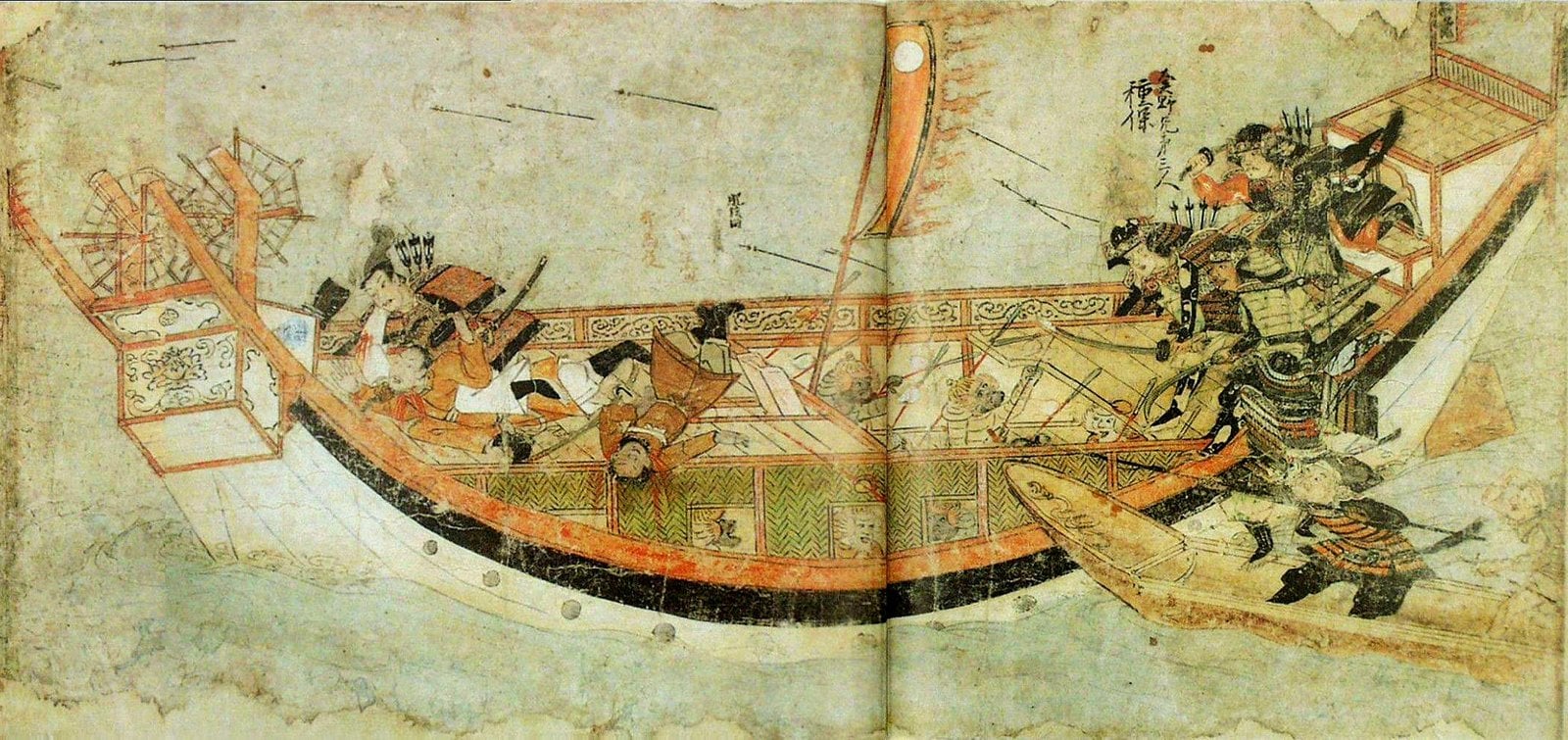
Japanese warriors board an enemy ship in a detail from the second scroll of the Mōko Shūrai Ekotoba. Image: Mōko Shūrai Ekotoba, circa 1293, public domain (Wikimedia Commons).
Dice, Tiles and a Kitchen
The Nagasaki Shimbun gave the fullest account of the small finds, and it reported that each of the five dice is about one centimeter (0.4 in) square. The 29 tiles measure about 3 by 1.5 centimeters (1.2 by 0.6 in) and are 0.4 centimeters thick, and their surfaces carry markings that look like the faces of two dice set side by side. The material they were made from has not yet been identified, and the paper said it will be studied by the team.
Nearby, divers found an iron object believed to be a kitchen knife, a pottery vessel resembling a grinding bowl and a large quantity of fish bones, the paper said. Fukuoka Now likewise reported the fish bones and the knife as clues to how food was prepared on board. Ikeda told the Nagasaki Shimbun that there may have been a galley or a food store in this part of the ship, and that the people working there may have played games.
He went further in an interview with KTN, where he suggested that the crew may have taken a break after cooking and played a game with the tiles. It is a vivid picture, but it is not possible to know when the games were played, and nothing in the reports shows that anyone was gaming on the night the fleet was wrecked.
A Game Known as Tianjiu?
Which game the tiles belonged to is still an open question, although RKB and TBS identified the tiles as tianjiu tiles, a set said to be one of the origins of mahjong. The Mainichi was more careful, saying the tiles resemble those of a game that came from China and are said to be the origin of mahjong tiles. Ikeda told the paper that they were most likely used for entertainment.
Tianjiu, sometimes translated as "Heavens and Nines," is a Chinese game played with domino tiles. In an 1895 article in the American Anthropologist, the writer W. H. Wilkinson described how such tiles came from dice:
"A domino is, of course, nothing but a pair of dice placed side by side (whence the mark across its face)," he wrote.
Wilkinson added that in tianjiu these pieces "still remain as dominoes, of wood, bamboo, or bone." That fits the description of marks like paired dice on the Takashima tiles. However, until the material, the markings and the full set are studied, the link to tianjiu remains a suggestion, and it does not make these the oldest mahjong tiles.
But it didn't end there. Researchers from Mongolia joined the announcement, and the Nagasaki Shimbun reported that they were surprised by the tiles, because Mongolia has a familiar game called daaluu that uses similar pieces. The head of the medieval research section at the Institute of Archaeology of the Mongolian Academy of Sciences told the paper that daaluu came from the East or the Chinese world, and that the next step is to find out when and how it arrived.
A Wreck Found in the Mud
The third wreck was first found in October 2023. As the Asahi Shimbun reported in 2024, its remains were spotted "in waters about 18 meters deep and 50 meters south of the second shipwreck site." In October 2024 the municipal board of education confirmed that the timbers and finds came from the 1281 invasion, known in Japan as the Battle of Kōan.
In April 2026 the team reported writing on a small wooden board from the ship's hold, which is about 12 by 25.2 centimeters (4.7 by 9.9 in), the Yomiuri said. Historians Kōji Saeki and Yoshiyuki Funada read Chinese characters on it, which may include a Yuan dynasty era date. The Yomiuri gave the reading as the 12th year of Zhiyuan (1275), while the Asahi said it could be the 12th or 13th year (1275 or 1276).
Funada told the Yomiuri that the Yuan forces may have seized a warship from the Southern Song dynasty and put it to use. That idea, like the role of the ship, remains unproven, and Ikeda told the Yomiuri that the vessel may have been a mother ship carrying fighting men. The Mainichi quoted him as saying that, given its size, it may have had living space on board.
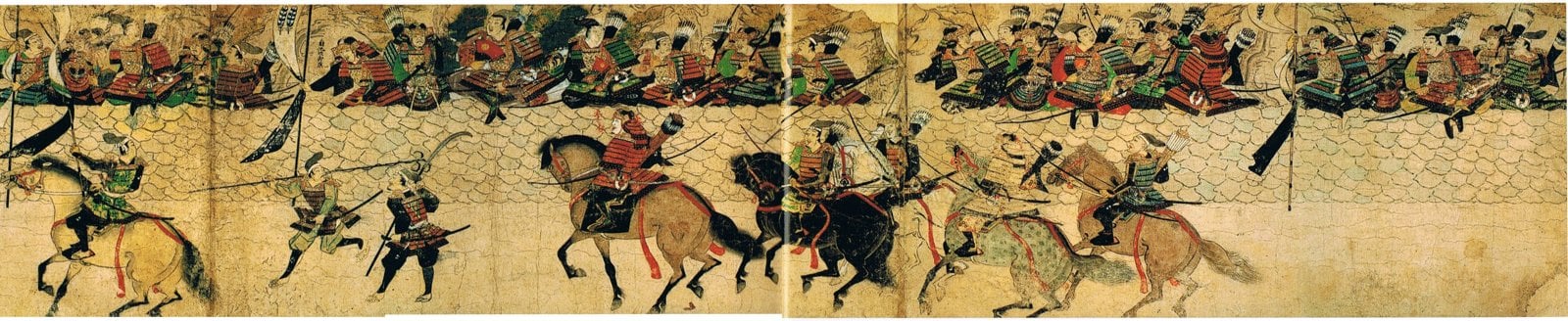
During the second invasion of 1281, Takezaki Suenaga and his men ride past the stone defensive wall where the warrior Kikuchi Takefusa is stationed. Image: Mōko Shūrai Ekotoba, circa 1293, public domain (Wikimedia Commons).
The Fleets of Kublai Khan
The ships at Takashima belonged to the second of the two failed Mongol invasions of Japan. Kublai Khan first sent a fleet in 1274, and Ikeda and his colleagues Randy Sasaki and Jun Kimura wrote in Current Science in 2019 that it was made up of 900 ships from Korea, which the samurai forces of Japan drove back.
In 1281 two fleets set out, one of 900 vessels from Korea and one of more than 3,000 from the Yangtze Delta, the authors wrote, citing historical records. They added that Chinese and Korean sources describe strong winds and waves near Imari Bay "sparing only one in ten ships." The storm of 1281 is commonly called kamikaze, or the divine winds, the paper notes.
The size of the fleet is still a matter of debate, and the Yomiuri repeated the traditional figure of about 4,400 ships said to have been destroyed. The Current Science authors were more cautious:
"If we believe the number of vessels mentioned in historical sources is correct, this invasion was the largest naval campaign and second only to the landing of Normandy in 1945," they wrote.
Archaeology at Takashima has a long record. The first wreck was revealed in October 2011, and a more complete vessel was found in 2014, according to Current Science, although the Asahi dates the identification of that second wreck to 2015. The Asahi reported that 384,000 square meters (95 acres) of the area "became Japan's first nationally designated underwater archaeological site in 2012." The Nagasaki Shimbun added that about 4,000 objects had been recovered from the site before this season.
What Comes Next
The 2026 season included specialists from national institutions in Mongolia and South Korea, the Nagasaki Shimbun and NHK reported. Fukuoka Now said further excavation is planned for 2027, and according to NHK, Ikeda hopes that Takashima will become a world center for underwater archaeology.
For now, the dice and tiles offer a small glimpse of ordinary life aboard a ship that was built for war. Who was on board, where the ship was built and which game its crew played are questions that only further work can answer.
*Japanese and Korean language reports were translated for this article, and statements from those reports are paraphrased.*
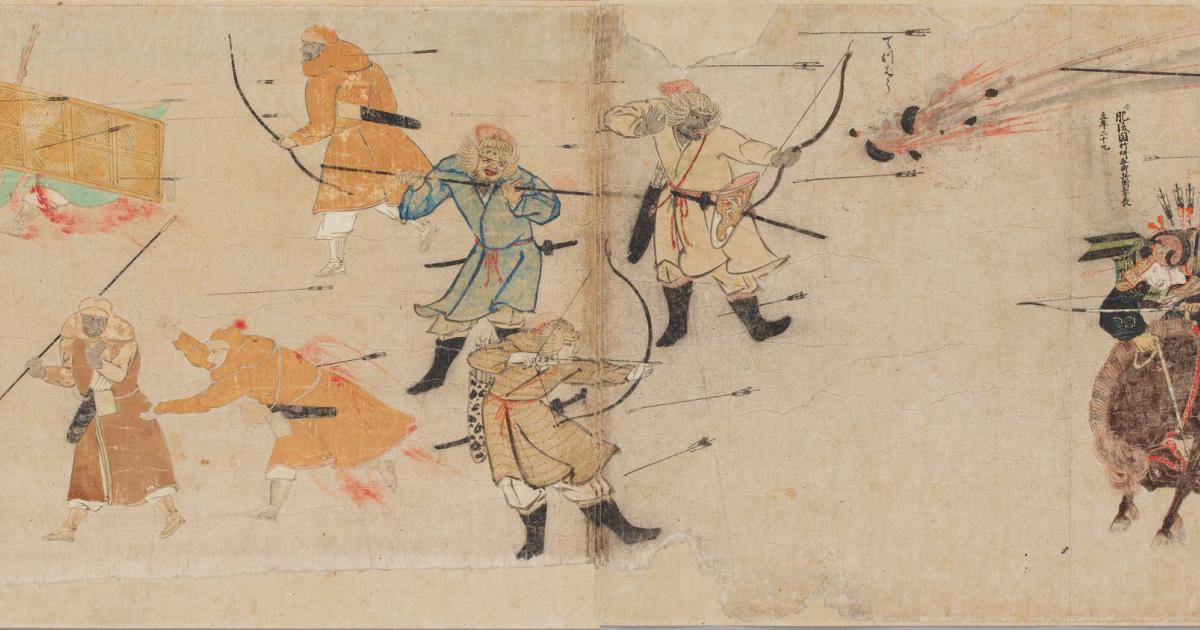
The samurai Takezaki Suenaga charges Mongol soldiers during the first invasion of 1274, in a scene from the Mōko Shūrai Ekotoba, the illustrated scrolls he commissioned. Image: Mōko Shūrai Ekotoba, circa 1293, public domain (Wikimedia Commons).
By Aris Manus
Sources
- Mainichi Shimbun. 2026. 元寇沈没船からサイコロ、マージャン牌起源の札 弘安の役戦場で. October 28, 2026. Via d menu news. Available at: https://topics.smt.docomo.ne.jp/article/mainichi/nation/mainichi-202610…
- Yomiuri Shimbun. 2026. 元軍の沈没船3号船は「全長30m級の大型艦」か. October 28, 2026. Available at: https://www.yomiuri.co.jp/local/kyushu/news/20261028-GYS1T00146/
- Nagasaki Shimbun. 2026. 元寇船員の娯楽道具か? サイコロや骨牌を発見. October 29, 2026. Available at: https://www.nagasaki-np.co.jp/kijis/?kijiid=be55aea5401b44ed90b5c0eb913…
- KTN Television Nagasaki. 2026. 麻雀の起源のゲーム? 牌とサイコロ発見 長崎県鷹島沖での元寇船調査. October 28, 2026. Available at: https://www.ktn.co.jp/news/detail.php?id=20261028009
- RKB Mainichi Broadcasting. 2026. モンゴル襲来=元寇の船から「遊び道具」初めて発見. October 30, 2026. Via d menu news. Available at: https://topics.smt.docomo.ne.jp/article/rkb/region/rkb-3042546
- TBS NEWS DIG. 2026. モンゴル襲来=元寇の沈没船から麻雀の起源「天九牌」発見. October 30, 2026. Available at: https://newsdig.tbs.co.jp/articles/-/3043513
- NHK. 2026. 松浦 3隻目元寇沈没船調査 マージャンはい起源の遊び道具確認. October 28, 2026. Available at: https://news.web.nhk/newsweb/na/nd-20261028de67113
- NHK World Japan (Korean). 2026. October 29, 2026. Available at: https://www3.nhk.or.jp/nhkworld/ko/news/20261029_ML06/
- Fukuoka Now. 2026. Mongol-invasion wreck reveals gaming pieces and ship's scale. October 30, 2026. Available at: https://www.fukuoka-now.com/en/news/mongol-invasion-wreck-reveals-gamin…
- Kokugakuin University. 2026. 池田榮史・研究開発推進機構特別招聘教授が鷹島沖海底調査結果を報告しました. October 28, 2026. Available at: https://www.kokugakuin.ac.jp/news/568046
- Asahi Shimbun. 2024. Third Mongol ship from 1281 attack confirmed off Nagasaki. The Asahi Shimbun Asia and Japan Watch. Available at: https://www.asahi.com/ajw/articles/15462801
- Yomiuri Shimbun. 2026. 鷹島沖の元寇船の木板に元の年号「至元十二年」との墨書. April 11, 2026. Available at: https://www.yomiuri.co.jp/local/kyushu/news/20260411-GYS1T00019/
- Asahi Shimbun. 2026. 元寇船の木板に漢字の元号 海底遺跡で発見、確認. April 2026. Available at: https://www.asahi.com/articles/ASV4B16DKV4BTOLB001M.html
- Ikeda, Y., Sasaki, R. and Kimura, J. 2019. Recent underwater investigations at Takashima: searching for the lost fleet of the Mongol Empire. Current Science, Vol. 117, No. 10, pp. 1635 to 1639. doi: 10.18520/cs/v117/i10/1635-1639
- Wilkinson, W. H. 1895. Chinese Origin of Playing Cards. American Anthropologist, Vol. 8. Available at: https://archive.org/details/jstor-658442