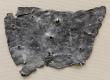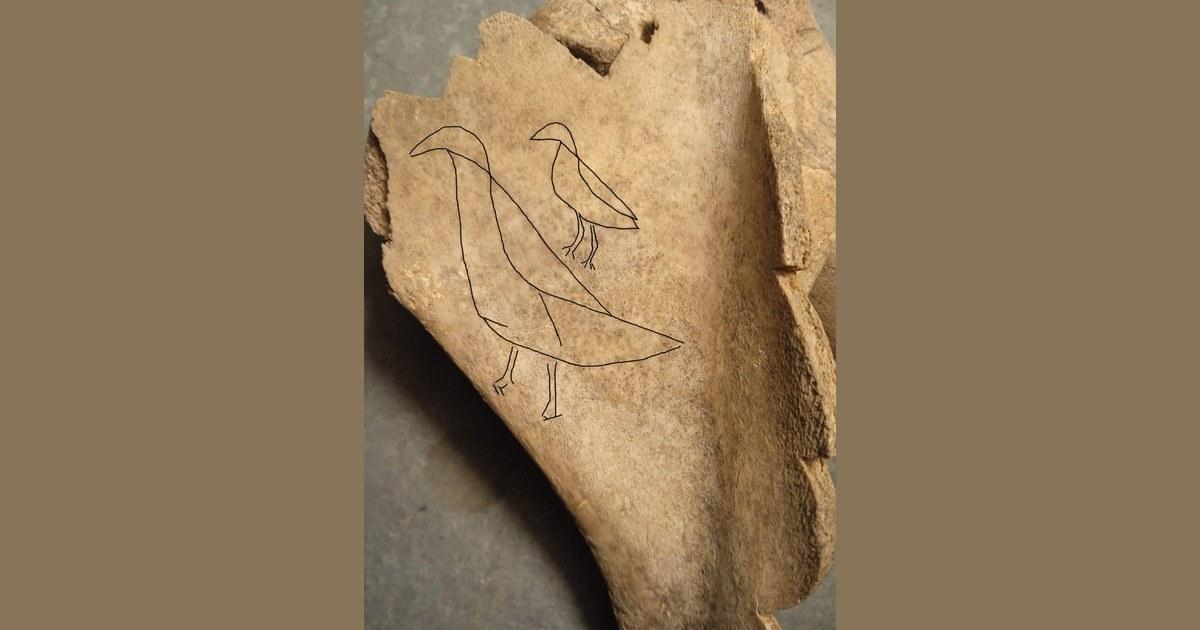

Someone in a small Greek town on the Black Sea finished a meal of mutton about 2,500 years ago and kept one of the bones. It was a shoulder blade from a sheep two to two and a half years old. Using a sharp tool, this person cut a row of teeth into its broad edge, gave its raised spine a wavy outline, and scratched two birds onto its outer face, both turned to the left, with folded wings and lines for their feathers.
On October 23, 2026, the Institute for the History of Material Culture of the Russian Academy of Sciences (IIMK RAS) announced a study of the bone by Sergei Solovyov and Alexey Kasparov, scholars of the State Hermitage and IIMK RAS, published in the institute's journal Arkheologicheskie Vesti (Archaeological News). Their suggestion is that the carved bone served in household rituals in which a person turned to Achilles for protection and well-being. But how does a hero of the Trojan War end up on a sheep bone at the edge of the Greek world?
An island at the mouth of two rivers
Berezan is a small island off the coast of southern Ukraine, where the estuaries of the Dnieper and the Southern Bug meet the Black Sea. In antiquity the settlement there was known as Borysthenes, and the Bryn Mawr Classical Review, reviewing a book on Berezan by the same Sergei Solovyov, describes it as very probably the first Greek colony in the region. In those days, the reviewer notes, the island was still joined to the mainland.
Its exact founding date is still debated, since the church historian Eusebius placed it in 647/6 BC, and according to the review, Milesians and possibly other Ionians were visiting the place regularly by the third quarter of the seventh century BC, with the first houses appearing at the end of that century. By the middle of the fifth century BC, neighboring Olbia and its dolphin money had become the main center of the area.
The bone was found in 1989, during excavations by the State Hermitage's Berezan Archaeological Expedition. According to IIMK RAS, it lay in a layer dated to the first half to third quarter of the sixth century BC, among broken pottery, bones of domestic animals and other traces of daily life. The researchers dated it from the pottery and from the position of the layer in relation to ancient buildings.
A bone worked with care
The institute's release is plain about what was done to the bone. After the meat was cooked, the scapula was deliberately worked. Teeth were cut into its broad edge, and its projecting ridge was shaped into waves. The two birds were scratched onto the outer surface with a sharp object, and extra strokes mark their folded wings and the pattern of their plumage (translated from the Russian).
According to IIMK RAS, it was the combination of the drawing and the shape that led the researchers to connect the object with religious ritual. However, the bone carries no inscription naming the hero, as GreekReporter points out, and the release itself never claims a certain answer.
Gull or crow?
The trickiest question was which birds the maker had in mind. Here the evidence points two ways at once. The settlement's seaside setting and the wavy ridge suggest gulls, which are common on Berezan. The outlines of the beaks and the strokes that mark the coloring look more like members of the crow family, especially the hooded crow (translated from the Russian).
The answer matters because, according to the release, birds played an important part in ancient Greek belief, and people watched their appearance and behavior to learn the will of the gods. The raven, for example, was linked with Apollo, whom the release names as one of the chief gods of Borysthenes and a patron of seafarers and the first settlers.
Achilles has his own claim on both kinds of bird. In the northern Black Sea, the release explains, he became a defender of settlements and their people. In ancient belief, his sanctuaries were guarded by wondrous birds that scholars link above all with gulls, while Greek culture also connects Achilles with the crow family. So either reading of the drawing, the authors argue, leaves room for a link to the hero's cult (translated from the Russian).
The hero who kept the sea
Most readers meet Achilles at Troy, the son of the sea goddess Thetis, as told in the pedigree of Achilles. Fewer know that Greeks around the Black Sea honored him as a protector of sailors. GreekReporter notes that sanctuaries dedicated to Achilles stood along the northern and western coasts of the sea.
The most famous was on Leuke, the White Island, which the Roman era writer Arrian described in his Periplus of the Euxine Sea in the second century AD. In William Falconer's 1805 translation, Arrian reports a temple and an old wooden statue of Achilles, hung with cups, rings and gems left as offerings. He also describes gulls, divers and coots that frequent the temple, and he writes, "Every day in the morning they take their flight, and having moistened their wings, fly back again to the temple, and sprinkle it with the moisture" (quotation trimmed at the end). The birds then sweep the pavement clean with their wings, Arrian adds.
Berezan itself later had a strong tie to the hero. The Bryn Mawr review records that in the first century AD the center of the worship of Achilles in the northwest Black Sea moved to the island. That came about six centuries after the bone was carved, so it cannot explain the find, though it shows how deeply the cult was rooted on this coast. The Greek habit of honoring great figures of the past is explored in why Greeks turned the dead into heroes.
A rite at home
If the authors are right, the bone belonged to a private household ritual, not to a public sanctuary. GreekReporter quotes Solovyov, a senior researcher at the IIMK RAS Center for Rescue Archaeology, in an English rendering of words first published in the institute's Russian release: "We assume this is an object used for a private ritual, with which a person addressed Achilles for his protection." In the Russian release he adds that the birds and the wavy, sea-like ridge both point to this connection, and that the exact content of the ritual is unknown to the researchers (translated from the Russian).
The institute is just as careful in its own words. It says the purpose of the scapula and its link with the cult of Achilles remain a supposition, and that the researchers have not been able to establish exactly how it was used (translated from the Russian). However, GreekReporter adds another caution, noting that the wave may stand for the sea but could also have been simple decoration.
So who held this bone, and what did they ask for? The sources do not say, and they give no account of how the bone was kept or handled.
Small things, large hopes
IIMK RAS says that finds like this one help researchers study the possible ritual practices of the ancient people of the northern Black Sea (translated from the Russian). A shoulder blade left over from a meal, reworked with care and scratched with two birds, may record what one household hoped for in a small town beside the sea.
Whether the birds are gulls or crows, and whether the person who carved them was thinking of Achilles at all, may never be settled.
How we label claims
Established: the find in 1989 at the Berezan settlement by the State Hermitage expedition, the dating of its layer to the first half to third quarter of the sixth century BC, the sheep's age, the cut teeth, the wavy ridge, the two incised birds, and the 2026 publication. Established: the cult of Achilles as a protector on the northern Black Sea coast, and Arrian's account of Leuke. Disputed: the founding date of Borysthenes, which Eusebius and the archaeology place about two decades apart. Unverified: that the birds are gulls or hooded crows, which the authors leave open. Unverified: that the bone was used in a private rite asking Achilles for protection, which IIMK RAS calls a supposition. Unverified: what the rite involved and who performed it.
The sheep scapula from the Berezan settlement, found in 1989 in a sixth century BC layer. In this published photo the two incised birds are traced in black to make the faint lines visible. Image: IIMK RAS.
By Aris Manus
Sources
- IIMK RAS, Ученые ИИМК РАН связали рисунок на древней бараньей лопатке с культом Ахилла, Institute for the History of Material Culture, Russian Academy of Sciences, October 23, 2026 (Russian)
- Ancient Greek Ritual Object Found in Black Sea May Reveal Unknown Worship of Achilles, GreekReporter, October 31, 2026
- Review of S. L. Solovyov, Ancient Berezan: The Architecture, History and Culture of the First Greek Colony in the Northern Black Sea, Bryn Mawr Classical Review 2000.06.01
- Arrian, Periplus of the Euxine Sea, translated by William Falconer (Oxford 1805), via ToposText