
Fact Check verdict: Fringe. The moai were carved from the island's own volcanic tuff with basalt picks, and field trials show that 18 people with ropes can walk a replica statue weighing more than four tonnes upright.
On the slopes of a volcanic crater on Rapa Nui, also known as Easter Island, hundreds of carved stone figures lie where their sculptors left them. Ancient Aliens has asked whether the islanders could ever have moved statues this heavy, so what does the evidence say?
Where the alien idea comes from
HISTORY's own YouTube description of a 2020 digital exclusive from the show's 12th season says ancient astronaut theorists suggest the statues "may not have been created by man" and were instead made by extraterrestrials.
The case made on the program turns on wood and rollers. In a transcript posted by the Ancient Aliens Debunked site, a speaker asks "how can you move a multi-ton statue if you have no trees for rollers?" and adds that the first four expeditions to the island, in the 1700s, never really saw a tree.
The size of the statues is what gives that question its pull. A 2012 report in Nature counted nearly 1,000 statues on the island, the largest weighing 74 tonnes and standing 10 meters tall.
What the evidence says
The stone for the statues came from the island itself, according to a 2025 study in PLOS ONE led by Carl Lipo of Binghamton University. It describes the crater of Rano Raraku as "the island's only source of suitable volcanic tuff for statue carving" and traces more than 95 percent of the statues to it.
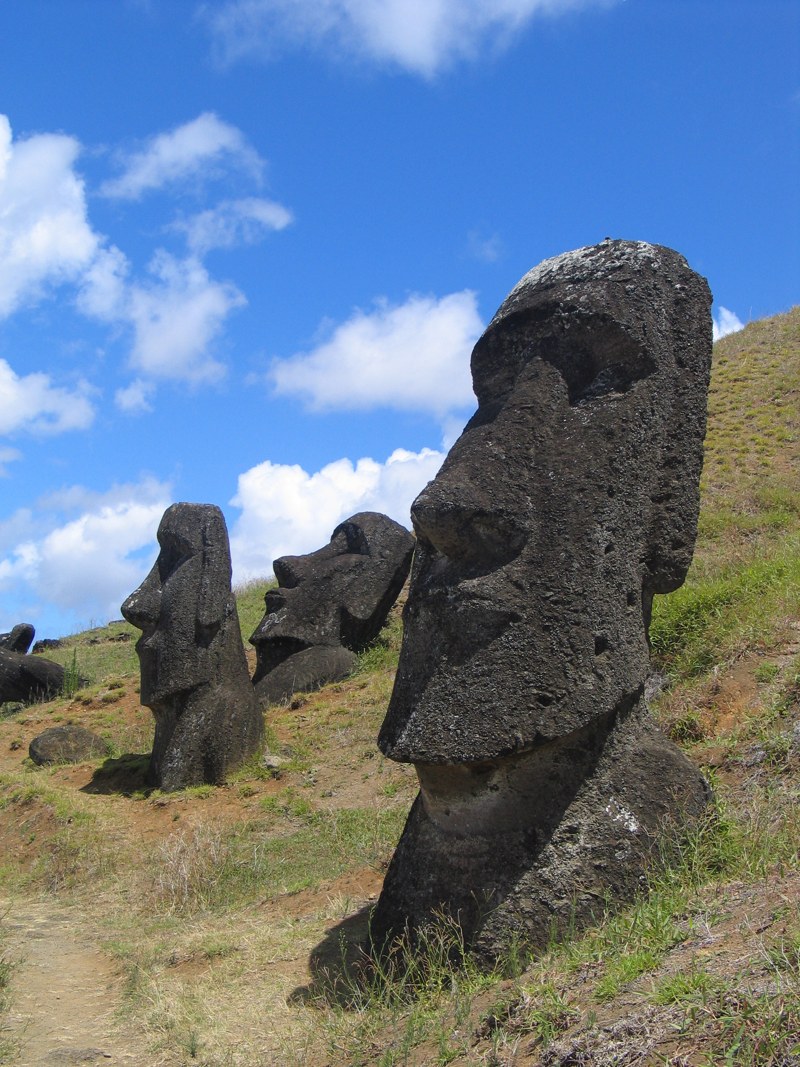
Moai on the slopes of Rano Raraku, the quarry where most of the island's statues were carved. Photo by Artemio Urbina, 2004, via Wikimedia Commons, public domain, resized.
Working from a 3D model of the quarry, the researchers recorded 426 statues in various stages of completion and 133 voids where finished statues had been taken out. They also found five bollards that likely served as anchor points for lowering statues down the slopes.
UNESCO's World Heritage listing for Rapa Nui National Park says the statues were carved with simple picks of hard basalt, called toki. The same listing describes a tradition of monumental sculpture built by a society of Polynesian origin "free from any external influence," with the moai representing ancestors.
How a statue walks
Rapa Nui oral tradition has long carried its own answer about how the statues traveled. Katherine Routledge, whose 1919 book reported the Mana Expedition's work, wrote that the statues along the island's tracks were said to be on their way to the platforms. She quoted an account given to an earlier visitor, "They walked, and some fell by the way."
Routledge also recorded a tradition of an old woman, cook to the image makers, who moved the statues "by supernatural power" until the workers ate a lobster without saving her any. In her anger, the account goes, she told the images to fall down, and the work stopped.
Her party searched for the routes such a journey would need until one of them, out riding, saw an old track west of Raraku where "along it every few hundred yards lay a statue." Routledge counted 27 statues on that road.
In 2012 Lipo and Terry Hunt, then of the University of Hawaii, put the walking idea to the test. Nature reported that a team of 18 people with three hemp ropes rocked a 4.4 tonne model from side to side and moved it 100 meters in under an hour.
Lipo argued that the statues' slightly forward center of mass and broad bodies suited them to this rocking motion. "They built these things to do this," he told Nature. Smithsonian magazine wrote that the statues "walked to their places, as islanders like to say."
In their 2025 paper in the Journal of Archaeological Science, summarized on Binghamton's repository, Lipo and Hunt analyzed 962 statues, including 62 lying along ancient roads. Over half of those road statues lie within 2 kilometers of Rano Raraku, a pattern they link to failures in transport. A 4.35 tonne replica built to road statue proportions covered 100 meters in 40 minutes with 18 people.
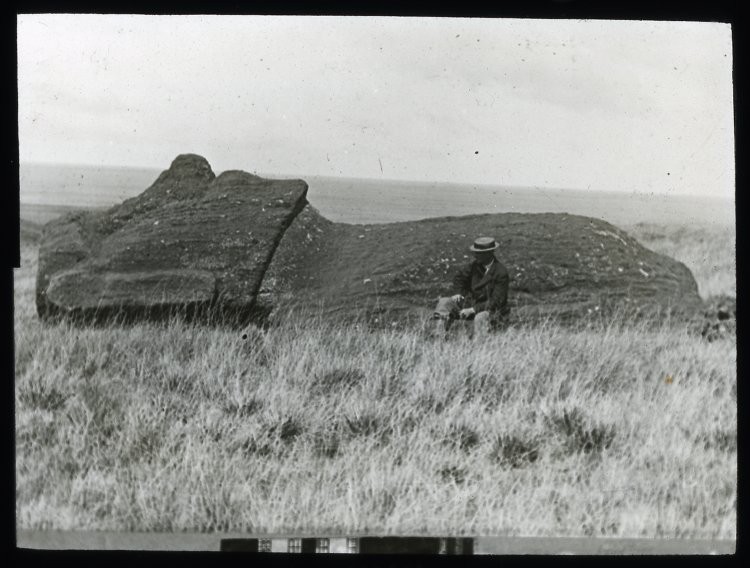
A fallen moai beside a statue road on Rapa Nui, with a seated man for scale, photographed during the Mana Expedition of 1914 to 1915. British Museum, Oc,G.T.1762. Lantern slide, author unknown, via Wikimedia Commons, public domain.
"The walking method required minimal resources and labor compared to horizontal transport hypotheses," the pair write, and they add that the result fits Rapa Nui oral traditions describing statues that walked from the quarry.
Walking a statue takes rope and people, which answers the question about rollers, and the island also had trees. Valentí Rull of Barcelona's Institute of Earth Sciences Jaume Almera reviewed the lake sediment record in 2020 and described how "palm-dominated forests" gave way to grass meadows. He concluded that the loss was gradual, with human and climatic causes, and that archaeological evidence shows the Rapanui civilization "remained healthy until European contact."
The alternative view
The walking explanation has serious critics among archaeologists who work on the island. Jo Anne Van Tilburg, director of the Easter Island Statue Project at the University of California, Los Angeles, told Nature in 2012, "What they did was a stunt and not an experiment." She argued that the team's model was an inaccurate copy of a real moai.
Van Tilburg's own team has shown that statues can be moved lying down on logs, Nature reported. Lipo and Hunt's 2025 abstract says several scholars have challenged walking on terrain, rope supply and weathering. The authors reply that those objections fail to account for the evidence. The argument is over which human method moved the statues, and none of the sources read for this check points to help from outside the island.
Where this leaves it
The people of Rapa Nui carved the moai from their own volcanic stone with basalt picks and moved them along roads to platforms across the island. Whether they walked the statues upright or dragged them lying down is still disputed, while help from aliens or imported technology finds no support in the sources.
Earlier Ancient Origins coverage reported on the 3D model of the Rano Raraku quarry and fact checked a similar question about how Baalbek's great stones were moved. Background on the island, which UNESCO listed as a World Heritage Site in 1995, is in the Easter Island atlas entry.
How we checked this
Read for this check were the PLOS ONE quarry study, the abstracts of the 2025 walking paper and Rull's review, UNESCO's listing, Nature, Smithsonian magazine and Routledge's book. The full walking papers sit on publisher pages that did not load from the network used for this check, so their findings come from the repository abstract and Nature.
The television claim is quoted from HISTORY's own description of its clip and from a transcript on the Ancient Aliens Debunked site, cited for the claim only. Earlier Ancient Origins coverage was not a source, and the labels are explained on the evidence standards page.
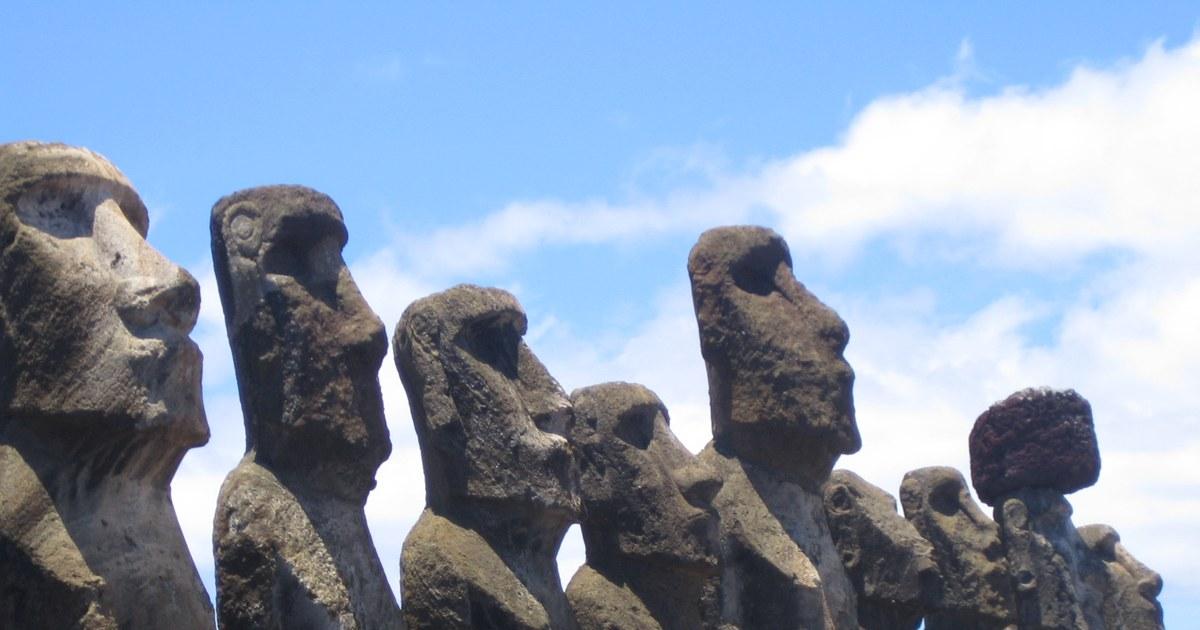
Moai on Ahu Tongariki, which UNESCO describes as the most colossal of the island's ceremonial platforms, with 15 statues. Photo by Bradenfox, 2007, via Wikimedia Commons, CC BY 3.0 (https://creativecommons.org/licenses/by/3.0/), cropped and resized
By Aris Manus
Claim by claim
- Fringe: The moai were too heavy to move without outside help from aliens or advanced technology. Reason: the statues were carved from local stone with local tools, and replica trials moved statues of several tonnes with ropes and small teams.
- Established: The moai were carved at Rano Raraku from the island's volcanic tuff. Reason: the PLOS ONE quarry study and UNESCO agree.
- Established: A team of 18 people with ropes walked a replica weighing more than four tonnes upright. Reason: Nature's 2012 report and the 2025 repository abstract.
- Established: Rapa Nui oral tradition says the statues walked from the quarry. Reason: Routledge recorded it in 1919, and later researchers report the same tradition.
- Disputed: The moai were moved upright by walking them along the roads. Reason: Lipo and Hunt argue for it, while Van Tilburg and other scholars reject it.
Sources
Lipo, Carl P., Terry L. Hunt, Gina Pakarati and others (2025). Megalithic statue (moai) production on Rapa Nui (Easter Island, Chile). PLOS ONE.
Lipo, Carl P., and Terry L. Hunt (2025). The Walking Moai Hypothesis: Archaeological Evidence, Experimental Validation, and Response to Critics. Journal of Archaeological Science. Abstract on the Binghamton University repository.
Rull, Valentí (2020). The deforestation of Easter Island. Biological Reviews 95, pp. 124 to 141, DOI 10.1111/brv.12556. Abstract record from Europe PMC.
UNESCO World Heritage Centre. Rapa Nui National Park. World Heritage List, property 715.
Callaway, Ewen (2012). Easter Island statues 'walked' out of quarry. Nature.
Laskow, Sarah (2012). How Easter Island Statues 'Walked' To Their Stations. Smithsonian magazine.
Routledge, Katherine (1919). The Mystery of Easter Island. Project Gutenberg edition.
HISTORY (2020). Ancient Aliens: The Easter Island Mystery (Season 12). YouTube. Cited for the claim only.
Ancient Aliens Debunked. Easter Island. Transcript of Ancient Aliens, cited for the claim only.