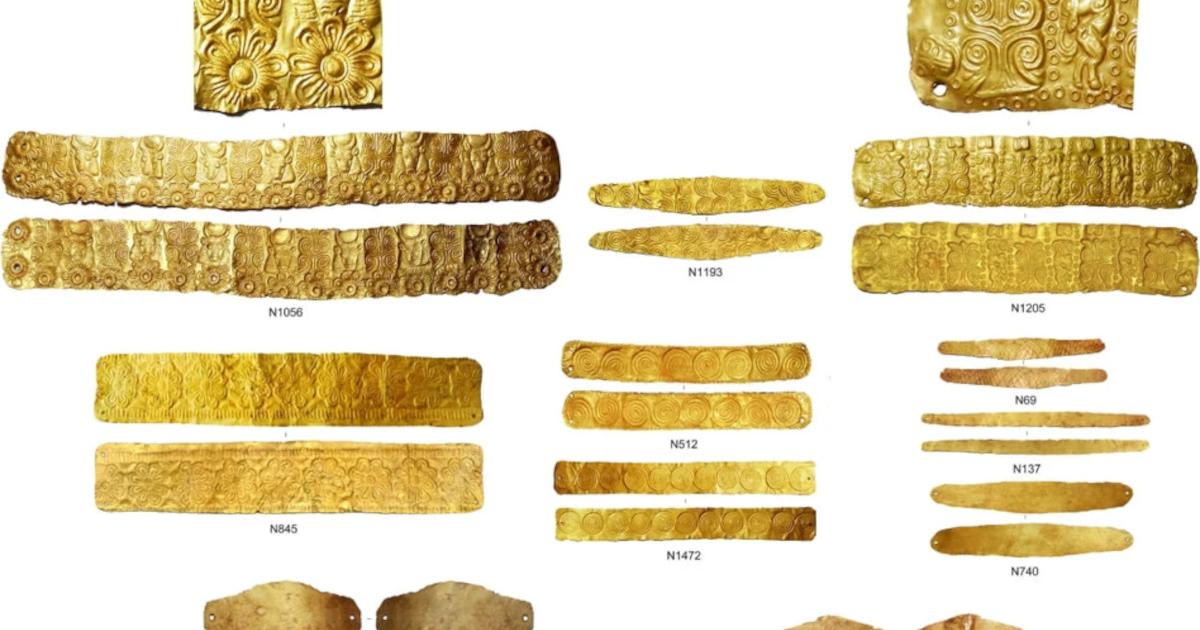

Discovery of a collection of valuable gold diadems in elite Bronze Age tombs in Cyprus that are believed to be about 3,400-years-old indicates that local craftsmen employed artistic motifs developed by civilizations around the Mediterranean. The finds in Hala Sultan Tekke Late Bronze Age cemetery proves that Cypriot goldsmiths incorporated Egyptian, Minoan, Mycenaean, and Near Eastern styles in their local funerary customs.
A new study published in the Oxford Journal of Archaeology, by Professor Peter M. Fischer of the University of Gothenburg, investigates nine diadems and two mouthpieces found in seven chamber tombs and one shaft tomb. Hala Sultan Tekke, which was a busy port city in Larnaca, flourished from 1630 to 1150 BC, at which time the modern Larnaca Salt Lake used to be a bay providing one of the best natural ports on the island.
The city prospered through copper production and manufacture of purple-dyed textiles and ceramics. Excavations discovered some luxury items that had been imported from different corners of the world such as lapis lazuli imported from Afghanistan, amber imported from the Baltic regions, and carnelian imported from India, proving that merchants reached Cyprus from across the ancient world.
- Swedish Expedition Strikes Gold Within Royal Tombs in Cyprus
- 3500-Year-Old Tombs in Greece Reveal the Lost Techniques of Mycenaean Goldsmiths

Location of Hala Sultan Tekke on Cyprus, with a drone overview depicting City Quarters 1–4 and Area A (the cemetery). The Larnaca Salt Lake lies to the north, and the Mediterranean sea is to the east. (Photograph and map by Teresa Bürge and Peter M. Fischer/Oxford Journal of Archaeology).
A Child Buried with Gold
Among the most striking discoveries came from Chamber Tomb RR, a multi-generational burial containing the remains of at least 34 people. In its earliest layer, dated to around 1350 BC, archaeologists uncovered the skeleton of a child aged between four and five. A gold diadem remained in its original position across the child’s forehead.
The child was also buried with a necklace made from 68 gold beads, four gold earrings, a silver pendant depicting an Anatolian deity, a silver ring with a triple spiral, and a carved cylinder seal. This rich burial suggests that high social standing was inherited through family connections and not limited to adults.
Egyptian Bulls and Mycenaean Rosettes
The largest ornament is a 34.2-centimeter-long diadem associated with a woman aged between 35 and 40. It is decorated with seven frontal bull heads, featuring a sun-disk-like form between their curved horns - an image closely associated with the Egyptian god Apis. The bulls are surrounded by palm-based floral designs and eight-petalled rosettes, motifs commonly found in Mycenaean art.
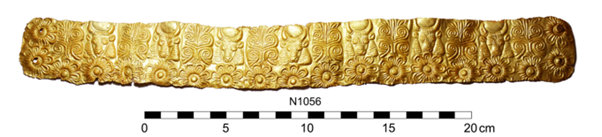
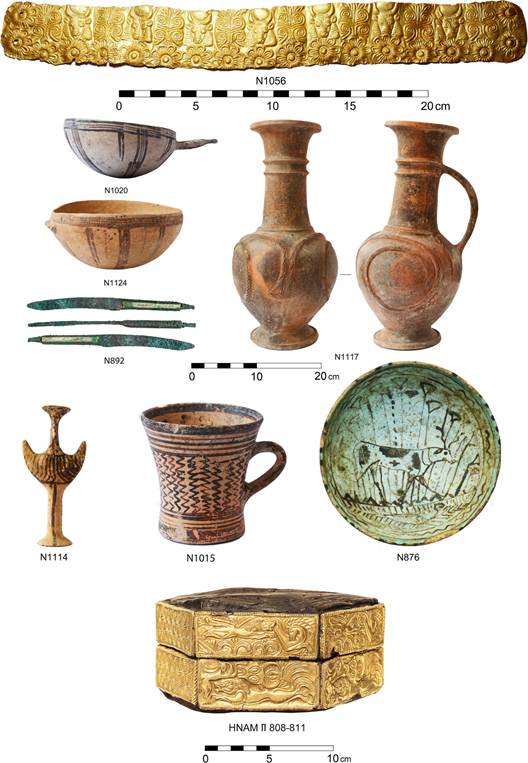
The Bull diadem N1056 from Chamber Tomb XX and its context. (Photographs by P.M. Fischer); the gold-plated wooden box (inv. no. HNAM Π 808-811): Photographic Archive of the Hellenic National Archaeological Museum, Athens; ©Hellenic Ministry of Culture – Hellenic Organization of Cultural Resources Development (H.O.C.RE.D). (Oxford Journal of Archaeology)
This diadem challenges assumptions about Bronze Age symbolism. Although bulls were widely associated with masculine power, its presence in a woman's grave suggests the image carried broader social or religious meaning in Cypriot society. Another heavy ornament, the Ibex-feline diadem, includes running ibexes, rosettes, and feline heads—possibly lions. Since lions were not native to Cyprus, their presence further highlights the influence of Near Eastern and Egyptian traditions.
- Civilization's Midnight: The Late Bronze Age Collapse
- Copious Copper Supplies Made Cyprus a Trading Center
Worn in Life and Death
The researchers distinguish the nine diadems from two smaller, plain gold mouthpieces. The heavier diadems show signs of wear, indicating they were likely used during important ceremonies in life before being placed in tombs. The smaller, lighter diadems and the mouthpieces show no signs of wear and were probably made specifically for funerary rites to mark the deceased’s transition into the afterlife.
Despite the international motifs, the study argues that the diadems represent local Cypriot production. The decorations were created by pressing thin gold sheets against carved matrices. The gold itself was likely imported, possibly from Nubian mines in Egypt or from Ada Tepe in present-day Bulgaria.
The tombs themselves were simple pits cut into clay and discreetly marked, a modest exterior that may have discouraged grave robbers. The collapse of the chamber roofs ultimately protected these treasures for millennia, leaving us with a remarkable glimpse into the interconnected world of Bronze Age Cyprus.
Top image: 3,400-year-old gold diadems from Cyprus reveal Bronze Age trade across the ancient Mediterranean. Source: P.M. Fischer/ Oxford Journal of Archaeology
By Gary Manners
References
Fischer, P. M. 2026. CULTURAL FUSION IN LATE BRONZE AGE GOLDWORK: DIADEMS AND MOUTH-PIECES FROM HALA SULTAN TEKKE, CYPRUS. Oxford Journal of Archaeology. Wiley. Available at: https://onlinelibrary.wiley.com/doi/10.1111/ojoa.70012