
At the southern tip of Spain's Atlantic coast, the Cape Trafalgar lighthouse stands on a low rocky island tied to the mainland by a strip of sand. The winds of the Strait of Gibraltar push the dunes around it, and the sea offshore later lent its name to Nelson's battle of 1805. Under that sand, archaeologists from the University of Cádiz have found two stone tombs that the dunes keep trying to swallow. Now a study published in PLOS One on November 11, 2026, has dated the people buried inside them, and the dates are later than anyone would expect for a megalithic tomb.
Two Tombs Under a Moving Dune
The site sits on what geographers call a tombolo, an island joined to the coast by sand. The paper by Eduardo Vijande-Vila and colleagues describes it as a rocky outcrop of sandstone and shell conglomerate covered with fossil and mobile dunes, "just 44 km from the African continent." A survey in 2000 had noted what looked like a small cist grave almost buried by a dune. When the team cleared it in May 2021, the supposed cist turned out to be the start of a stone corridor leading down to a chamber cut into the bedrock. They called it Tomb I.
A year later, in May 2022, the team found Tomb II about 180 meters to the southeast. Only the tops of a few upright slabs showed at first, but once a dune about 3 meters high had been dug away, the excavators found a tholos, a round chamber reached by a short corridor and roofed with a false dome of stone. The University of Cádiz announced the second tomb on June 7, 2022, and described a necropolis about 4,000 years old. That was the discovery story, and the new paper adds the dates and a sharper question.
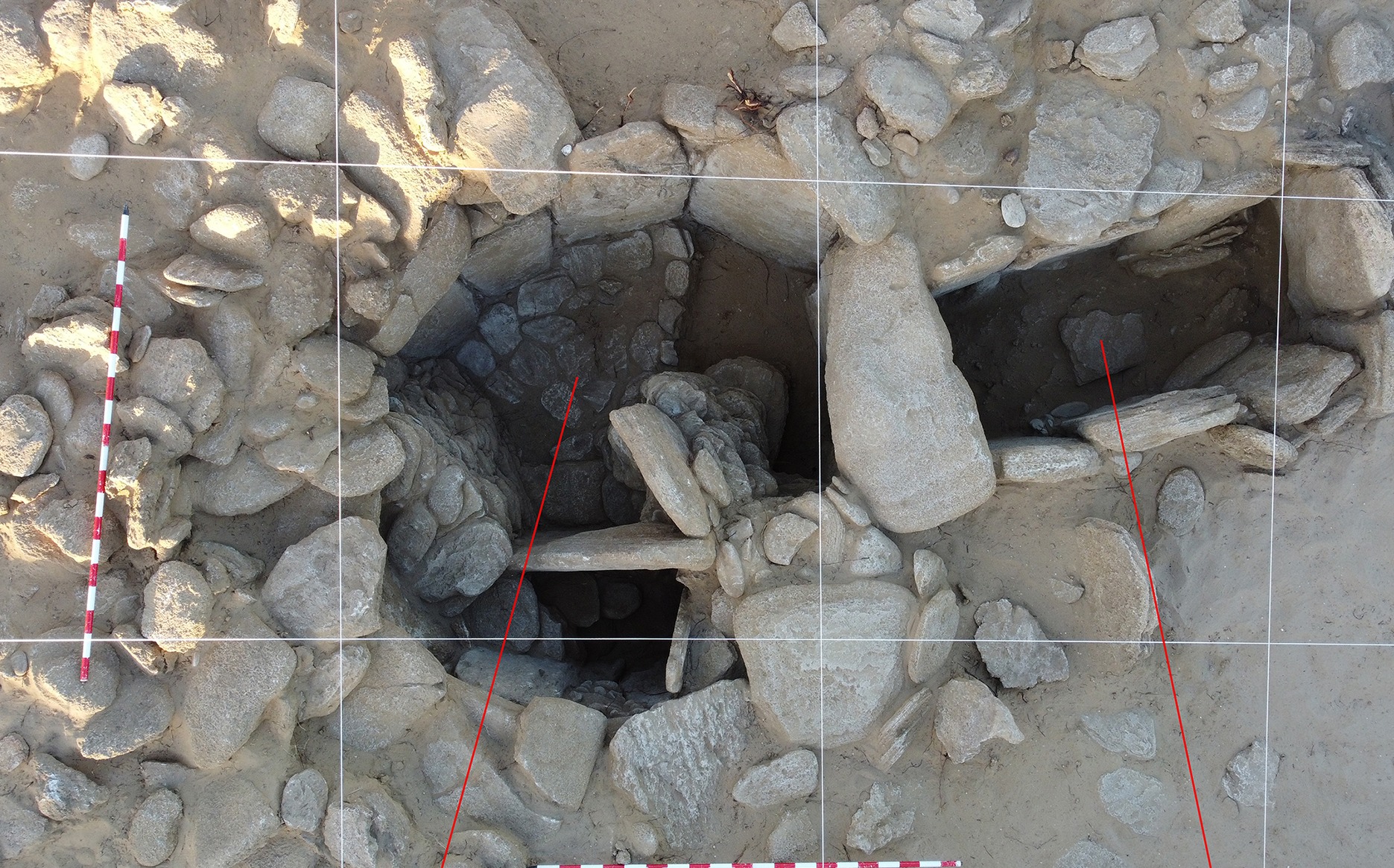
Aerial view of Tomb II at Trafalgar, the tholos with its short corridor and round chamber, after the dune that covered it was removed. (Image: Vijande-Vila et al. 2026, PLOS One, Fig 8A, CC BY 4.0. Cropped.)
Twenty People and Sixteen Dates
The two tombs yielded 1,081 human bones and teeth, 869 from Tomb I and 212 from Tomb II, and by counting repeated parts such as jawbones the team arrived at a minimum of 13 individuals in Tomb I and 7 in Tomb II. Most of the remains had been moved and stacked over time, the usual pattern when a community reopens the same grave for generations.
Only one person in Tomb I still lay as she had been placed, an adult woman in the chamber, and radiocarbon dating shows she was the last burial before the chamber was closed. Later, people used the corridor instead, and at its far end a group of at least five individuals lay under a pile of stones that sealed the chamber entrance.
The team obtained radiocarbon dates on 16 individuals and ran them through Bayesian statistical models. The result is that both tombs were "active simultaneously between 1875 and 1625 cal BC," a span the authors also describe as "a 240-year period." Within Tomb I, the chamber was used first, from about 1875 to 1700 BC, and the corridor mostly later. One skull in that corridor came out younger, between 1610 and 1440 BC, which the authors read as a single later burial or reuse. Tomb II seems to have been used for only a few decades, perhaps because its roof was unstable. A pillar of three upright slabs had been added inside, a repair job on a building set in shifting sand.
Gold, Silver and an Ivory Comb
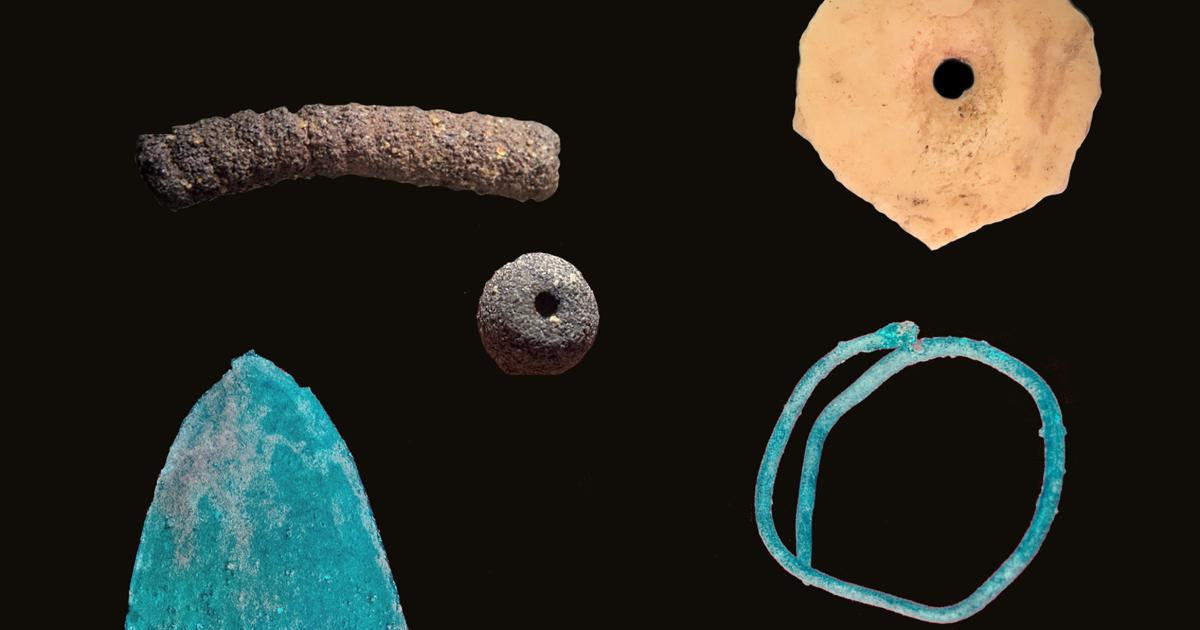
The woman in Tomb I did not go into the ground empty handed. According to the paper, she was buried with "two gold earrings, three necklace silver beads, an ivory comb, and several green mica beads." Tomb I also held a disc-shaped shell and a perforated shell. Tomb II offered less, with a copper earring, a copper arrowhead from the stone mound over the tomb and one green bead, and both copper pieces are rich in arsenic. Speaking to the Spanish science news agency SINC, Juan Jesús Cantillo, the study's corresponding author, said she must have been a person of high standing in her community.
None of these materials came from the cape. The gold earring the team analyzed is 87.68 percent gold and 12.3 percent silver, a mix the authors compare with gold objects from Copper Age sites in southwest Spain such as Valencina de la Concepción, home of the Montelirio tomb where archaeologists counted some 270,000 beads. The silver beads point toward eastern Iberia or the Iberian Pyrite Belt, though isotope tests would be needed to be sure. The green beads are muscovite mica, colored by chromium, from a source still unknown. The ivory comb most likely came from Africa, with an Asian origin not excluded. For people living 44 kilometers from Africa, that is hardly a shock, and the authors see the sea as central to how they traded and how they thought about their dead.
Built New, or Borrowed?
This is where the story turns, because from about 2200 BC, the authors write, communities across much of southern Iberia were giving up big collective tombs in favor of individual graves in stone cists. In the southeast this went with the rise of El Argar, a more hierarchical society that buried its dead one by one. When Bronze Age people did use megaliths, they usually reused monuments raised centuries earlier, as with the Bronze Age dolmens in southern Spain that researchers have studied with new technology. The great Neolithic and Copper Age monuments, such as the megalithic tombs of Malaga at Antequera, belong to that older world.
Trafalgar may break that pattern, since the 2000 survey of the tombolo turned up pottery and stone tools from the early second millennium BC and much older Paleolithic tools, with nothing in between to suggest an earlier tomb-building phase. The dunes matter too. An abandoned tomb on this cape would be buried by sand fairly quickly, so it is hard to picture one standing open for centuries, waiting for reuse. On that basis the authors write, "we propose as a hypothesis that the Trafalgar tombs were constructed during the Bronze Age, but this hypothesis can only be confirmed through OSL dating." Optically stimulated luminescence measures when grains of sediment last saw daylight, so it could date the sand under the stones.
The authors are careful to keep the other door open. They note that "the alternative hypothesis that the chambers were cleared of skeletal remains from an earlier phase should not be completely ruled out," as has been argued for some other Iberian tombs. If the hypothesis holds, though, Tomb II's earliest dates are the most recent known for a tholos in southern Iberia, which makes it "one of the latest of its type." That is the source of the "last builders" idea, and the authors put a question mark on it in their own title.
Holding On to an Old Way
Why would anyone still bury their dead together when the neighbors had moved on? The paper reads the choice as "ideological and cultural resistance by communities in the Strait of Gibraltar to the social individualisation processes that were under way in other regions." That is an interpretation of choices made at the graveside, though a reasonable one. Earlier communities in Spain had shared their graves for thousands of years, as a community burial in Neolithic Spain shows. At Trafalgar, that old habit seems to have lasted into a new age, with a little imported gold and ivory added.
Exactly who these people were is still an open question, and the team is now running ancient DNA, isotope and disease studies on the bones to learn more about their diet, health and where they grew up.
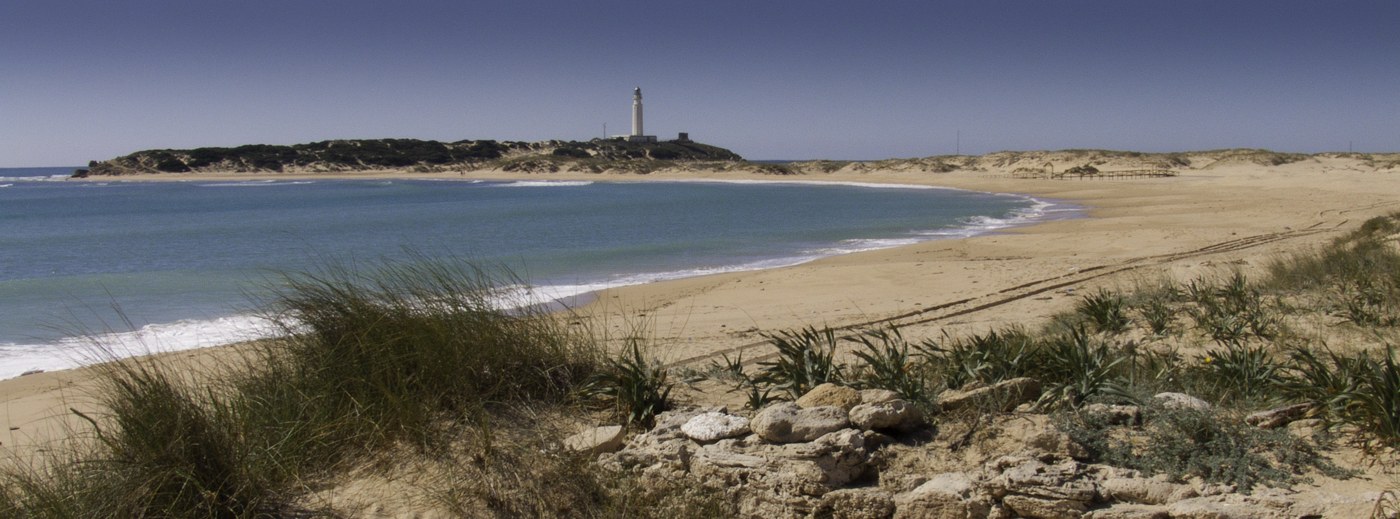
Cape Trafalgar and its lighthouse seen across the beach and dunes from the Caños de Meca side in 2013. This general view of the cape is not an excavation photo. (Image: Gus Kisal via Wikimedia Commons, CC BY 3.0)
The Sand Has the Last Word
The authors think more tombs may lie under the dunes. "It cannot be ruled out that future geophysical surveys can locate new tombs," they write, although dune sand makes those surveys difficult. Both tombs have been backfilled for protection, and 3D models let the public see them. The site lies inside the La Breña and Marismas del Barbate Natural Park, and the same wind that preserved it now works against it. Keeping the tombs visible, the paper warns, "would require constant maintenance." For now, the sand that hid these people for nearly 4,000 years is covering them up again.
Grave goods from the two Trafalgar tombs: a gold earring, a green mica bead, two silver beads, a pale cylindrical bead, an arsenic-rich copper arrowhead, a copper earring and an ivory comb. Edited: panel letters and scale bars removed. Vijande-Vila et al. 2026, PLOS One, Fig 15, CC BY 4.0
By Aris Manus
Sources
- Vijande-Vila, E., Becerra-Martín, S., Morell-Rovira, B., Díaz-Zorita Bonilla, M., Molina-Piernas, E., Muñoz-Muñoz, A., et al. 2026. The last builders of megaliths in the South of the Iberian peninsula? The Bronze Age necropolis of Trafalgar (Barbate, Cádiz, Spain). PLOS One 21(11): e0359220. Published November 11, 2026.
- SINC, Agencia de Noticias Científicas. November 12, 2026. Oro, plata y marfil en una necrópolis megalítica del cabo de Trafalgar.
- Universidad de Cádiz. June 7, 2022. Investigadores de la UCA confirman la existencia de una necrópolis megalítica de 4.000 años en el cabo de Trafalgar. Portal UCA.