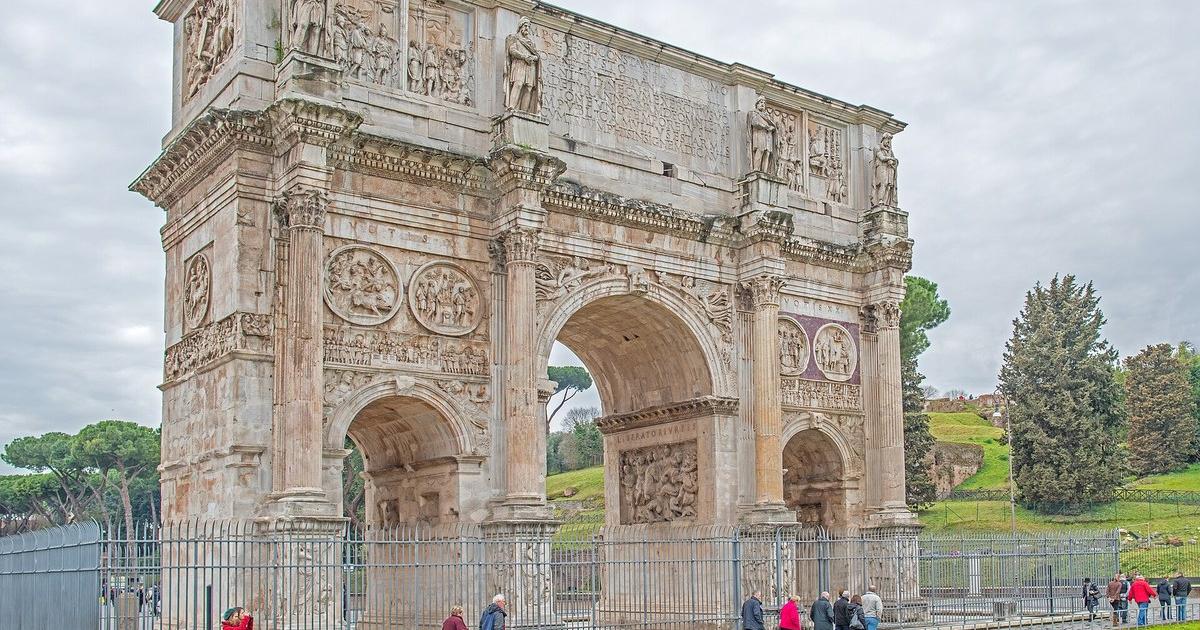

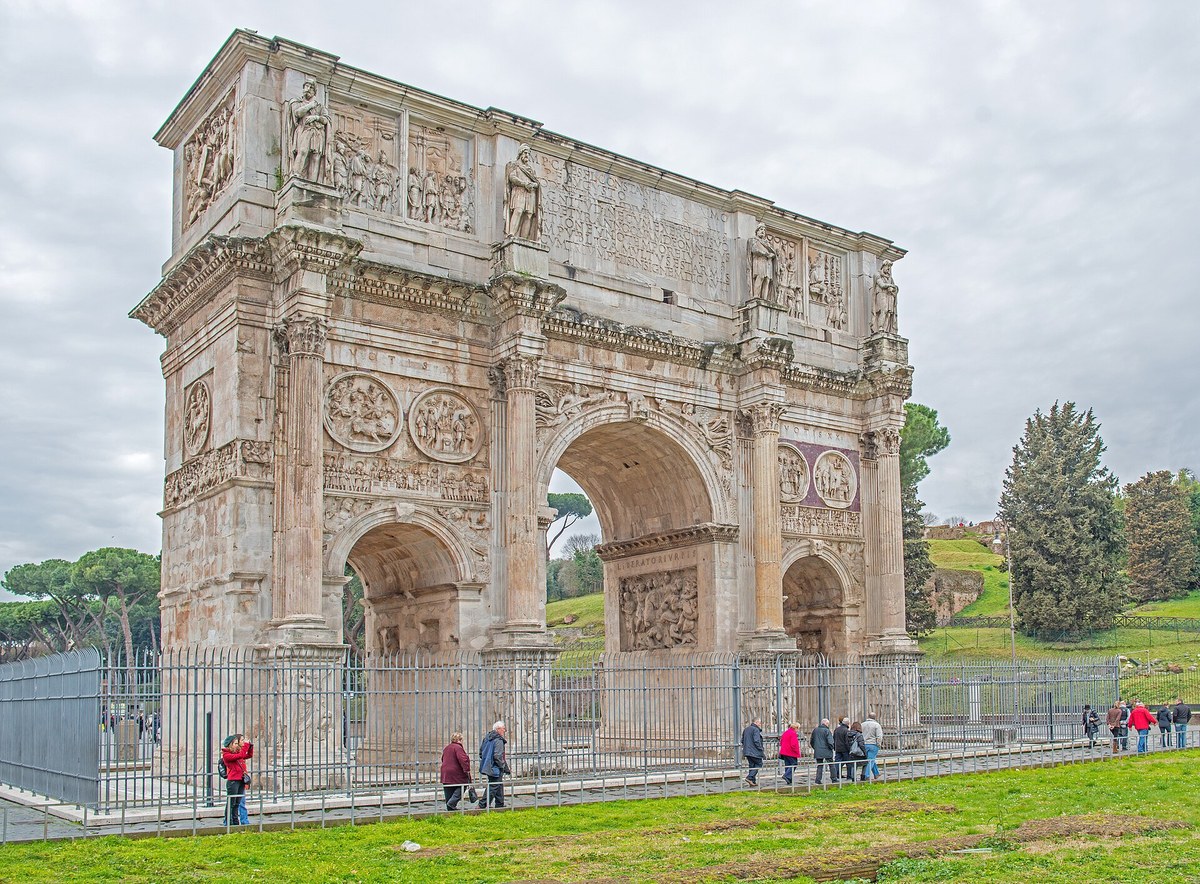
The Arch of Constantine in Rome, which the Senate dedicated in AD 315, photographed in February 2013 behind its modern protective fence. Credit: Bengt Nyman, Wikimedia Commons, CC BY 2.0. Resized, uncropped.
Reports published on November 6, 2026, by Anadolu Agency and The Guardian described a proposed 250-foot (76-meter) triumphal arch for Washington. According to Anadolu Agency, the monument would stand near the Potomac River and Arlington National Cemetery. The triumphal arch itself is a much older form, and its Roman examples carried a more specific and more varied set of messages than the word triumphal suggests.
Public Processions and Permanent Honors
The Parco archeologico del Colosseo, which manages the Roman Forum and the arches around it, describes the Arch of Constantine as standing on the route followed by triumphal processions. A triumph itself was a ceremony, a procession through the city. An arch was a permanent structure that could commemorate a victory, honor a ruler or celebrate a family, without necessarily marking that ceremony.
That distinction matters because surviving arches were not all built by the person they honor, and not all of them mark a formal triumph. For the two imperial arches discussed below, the Colosseum Park attributes the construction of the Arch of Titus to his brother Domitian, while the Arch of Constantine carries an inscription recording its dedication by the Senate. Patrons, honorees and purposes varied with the place and the period, and the inscriptions are often the best guide to who wanted what remembered.
A useful counterexample to any emperors-only rule stands in northern Italy, at Verona. The ArcheoVeneto record, produced with the University of Padua and the regional archaeological superintendency, describes the Arch of the Gavi there as a first century AD monument built by an important local family, the gens Gavia, to celebrate itself. It originally stood along the Via Postumia outside the Roman city.
The same record notes that the Verona arch was dismantled in 1805 because it was considered an obstacle to traffic and rebuilt in 1932 in a different spot. Inscriptions on it honor members of the family and name its architect, given in the record's Italian form as Lucio Vitruvio Cerdone. The Gavi arch shows that the form could serve private prestige as well as imperial power.
Titus and the Spoils of Jerusalem
The Arch of Titus stands at the foot of the Palatine, beside the Roman Forum, where the Clivus Palatinus begins its climb toward the hill. According to the Colosseum Park, it was built by Domitian, the last emperor of the Flavian dynasty, in memory of his brother Titus, who was already deified. The inscription on the side facing the Colosseum records that status, and the Encyclopaedia Romana dates the arch to some time after Titus died in AD 81.
The events it commemorates came about a decade earlier than that. The Park links the arch to Titus's victory in the Jewish War of AD 70, when Jerusalem was captured. James Grout's Encyclopaedia Romana dates the triumphal procession shown in the reliefs to AD 71. The surviving arch therefore looks back on that procession from a distance of roughly a decade or more, and it did not yet exist when the procession took place.

Relief on the inner wall of the Arch of Titus in Rome, showing soldiers carrying objects from the Temple in Jerusalem, including the menorah, in a triumphal procession. The arch was built after Titus's death in AD 81. Photographed in August 2013. Credit: Jebulon, Wikimedia Commons, CC0. Resized, uncropped.
The Park describes a single archway in Pentelic marble. Inside, one panel shows the imperial quadriga led by the goddess Roma, with Titus crowned by a winged Victory. The other shows Roman soldiers carrying spoils from the Temple of Jerusalem, which the Park identifies as silver trumpets, the Table of Shewbread and the Menorah. A relief of Titus carried aloft by an eagle fills the center of the vault.
These panels are a Roman account of a Roman victory, carved for a Roman audience after the fact. Samuel Ball Platner and Thomas Ashby's 1929 topographical dictionary adds that the arch was taken down in 1822 and rebuilt by Giuseppe Valadier, who restored much of the attic and the outer halves of both piers in travertine. Readers interested in the commander behind the monument can find more on Titus's military record.
Constantine and the Reused Past
The Arch of Constantine, which the Colosseum Park calls the largest honorary arch to survive, tells a different kind of story. The Park says it celebrates Constantine's victory over his rival Maxentius at the Milvian Bridge on October 28, 312. According to the Park, the inscription records that the Senate dedicated the monument to him on July 25, 315, for the decennalia at the start of the tenth year of his reign.
What makes the arch distinctive is how its sculpture was assembled. The Park explains that most of the relief decoration was taken from other imperial monuments and arranged to a unified Constantinian design. Reliefs from the ages of Trajan, Hadrian and Marcus Aurelius sit alongside new Constantinian work in the lower sections, and the faces of earlier emperors were recarved in Constantine's likeness.
The Getty Art and Architecture Thesaurus defines spolia as reused architectural materials, usually pieces built into a new fabric, a term used especially for ancient and medieval instances of the practice. The Park reads the choice as deliberate, arguing that images of earlier, celebrated emperors were meant to legitimize Constantine's power and present him as restoring the empire. That is the Park's interpretation of the program, and it presents the arch as a message about continuity with earlier rulers.
From Rome to Paris
Roman arches also survive in the former provinces, such as the triumphal arch at Orange in southern France, and the form was revived much later in Paris. According to the Centre des monuments nationaux, Napoleon signed an imperial decree on February 18, 1806, ordering an arch in honor of the Grande Armée.
The first stone was laid on August 15, 1806, but Napoleon did not see the arch finished. The Centre des monuments nationaux describes a project that was suspended after his fall, rededicated under Louis XVIII to the Army of the Pyrenees and finally assigned to the armies of the Revolution and the Empire under Louis-Philippe.
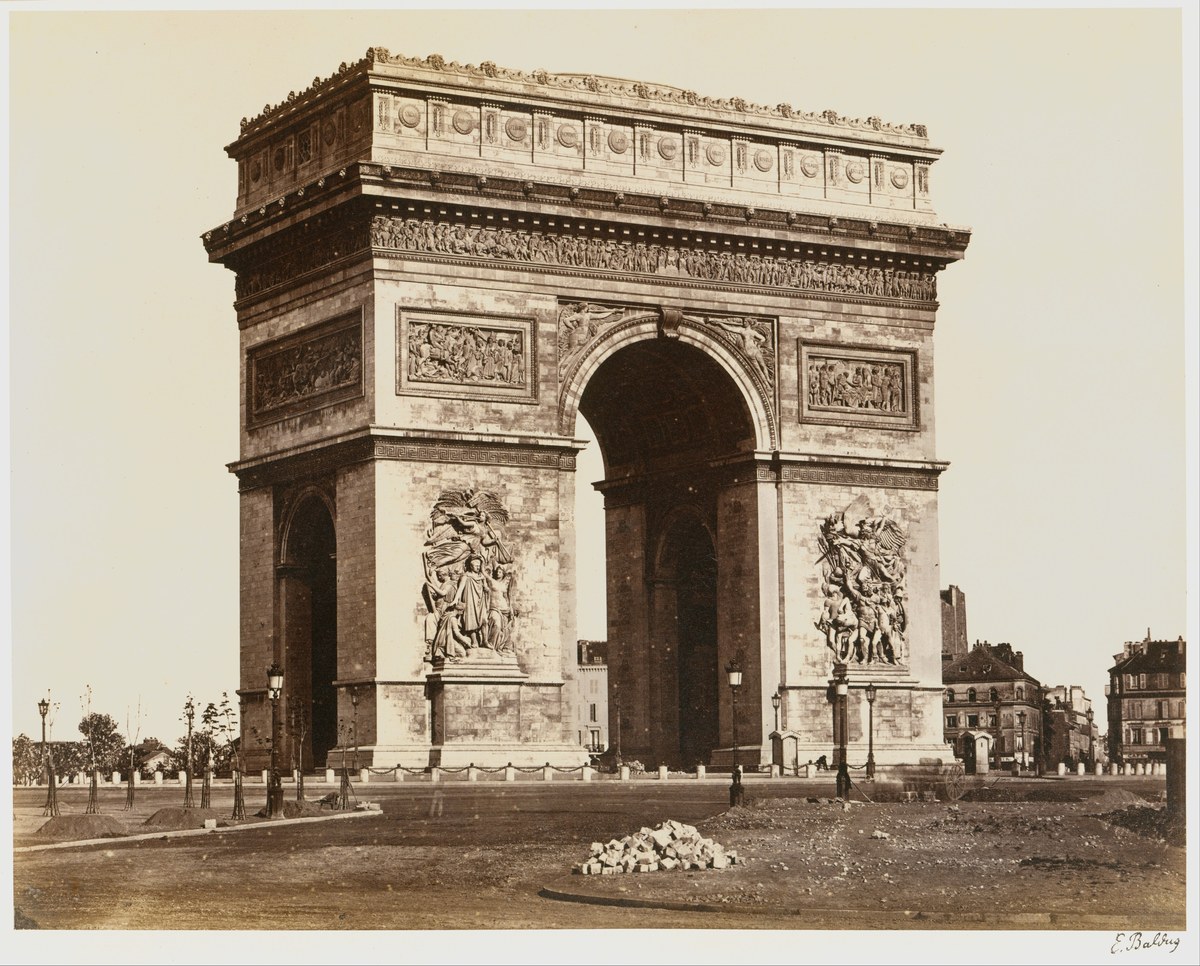
The Arc de Triomphe de l'Étoile in Paris, in an 1860s albumen silver print from a glass negative by the photographer Édouard Baldus, now in The Metropolitan Museum of Art. The arch was ordered in 1806 and inaugurated in 1836. Credit: The Metropolitan Museum of Art, accession 44.55.6, object record, CC0. Resized, uncropped.
The arch was inaugurated on July 29, 1836, after 30 years of work, in a low-key ceremony because of fears of an attack on the king, the Centre des monuments nationaux reports. Its architects took direct inspiration from ancient models, according to the same source. The single opening recalls the Arch of Titus, while the attic and Corinthian order draw on the Arch of Constantine.
The Paris arch kept its Roman-derived form while its patrons and honorees changed, which is a fitting coda to the Roman story. Begun under Napoleon, it was rededicated under Louis XVIII to the Army of the Pyrenees and finally assigned under Louis-Philippe to the armies of the Revolution and the Empire. The arches of Titus, Constantine and the Gavi family each answered a specific question about who deserved to be remembered and by whom, and that question is still written into the stone.
By Aris Manus
Sources
- Cakmak, Busra Nur. November 6, 2026. US judge temporarily blocks construction of Trump's planned Washington arch. Anadolu Agency.
- Sainato, Michael, and agency. November 6, 2026. Federal judge temporarily halts building work on Trump's triumphal arch. The Guardian.
- Getty Research Institute. Art and Architecture Thesaurus, spolia (ID 300133149).
- Parco archeologico del Colosseo. Arch of Titus.
- Parco archeologico del Colosseo. Arch of Constantine and Meta Sudans.
- Platner, Samuel Ball, and Thomas Ashby. 1929. A Topographical Dictionary of Ancient Rome. Entry Arcus Titi. LacusCurtius transcription.
- Grout, James. Arch of Titus. Encyclopaedia Romana.
- ArcheoVeneto. Arco onorario romano dei Gavi presso Piazzetta Castelvecchio, Verona. In Italian.
- Centre des monuments nationaux. Genesis and first stone and Histoire de l'Arc de triomphe. In English and French.