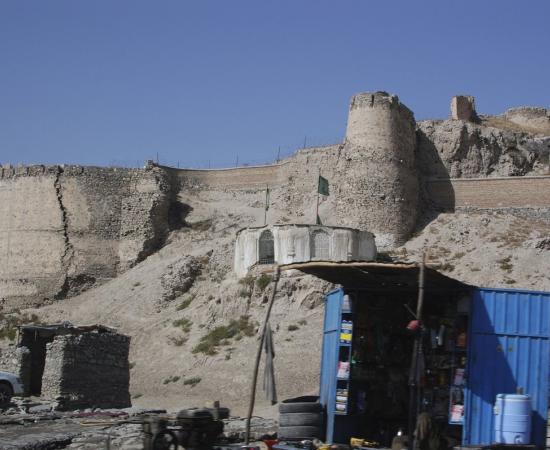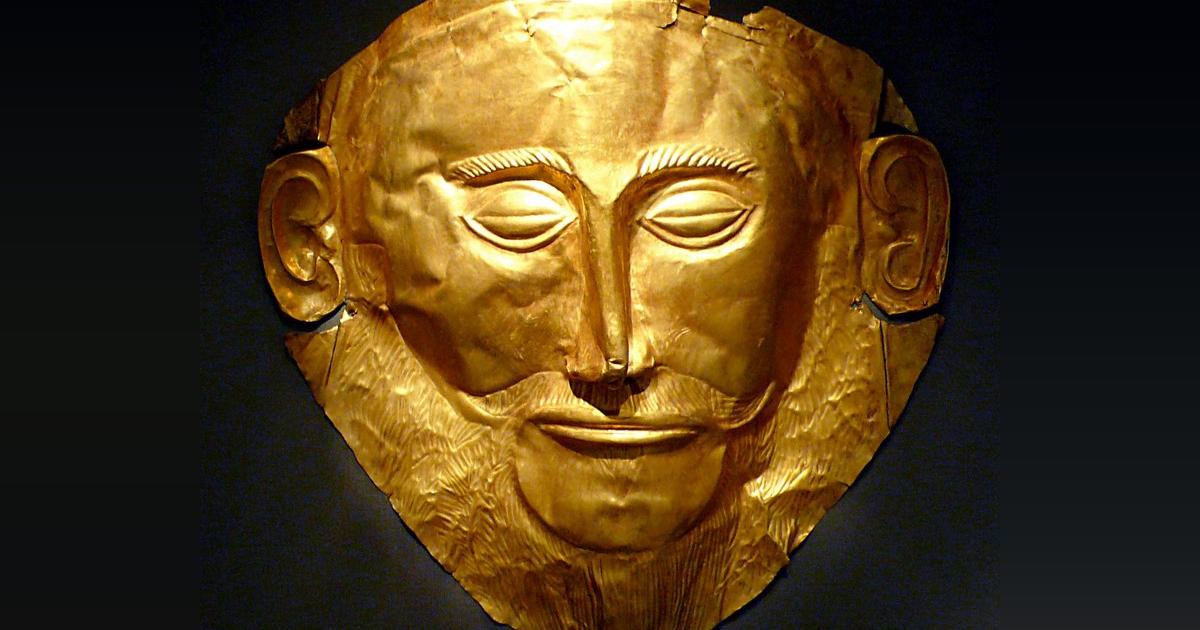

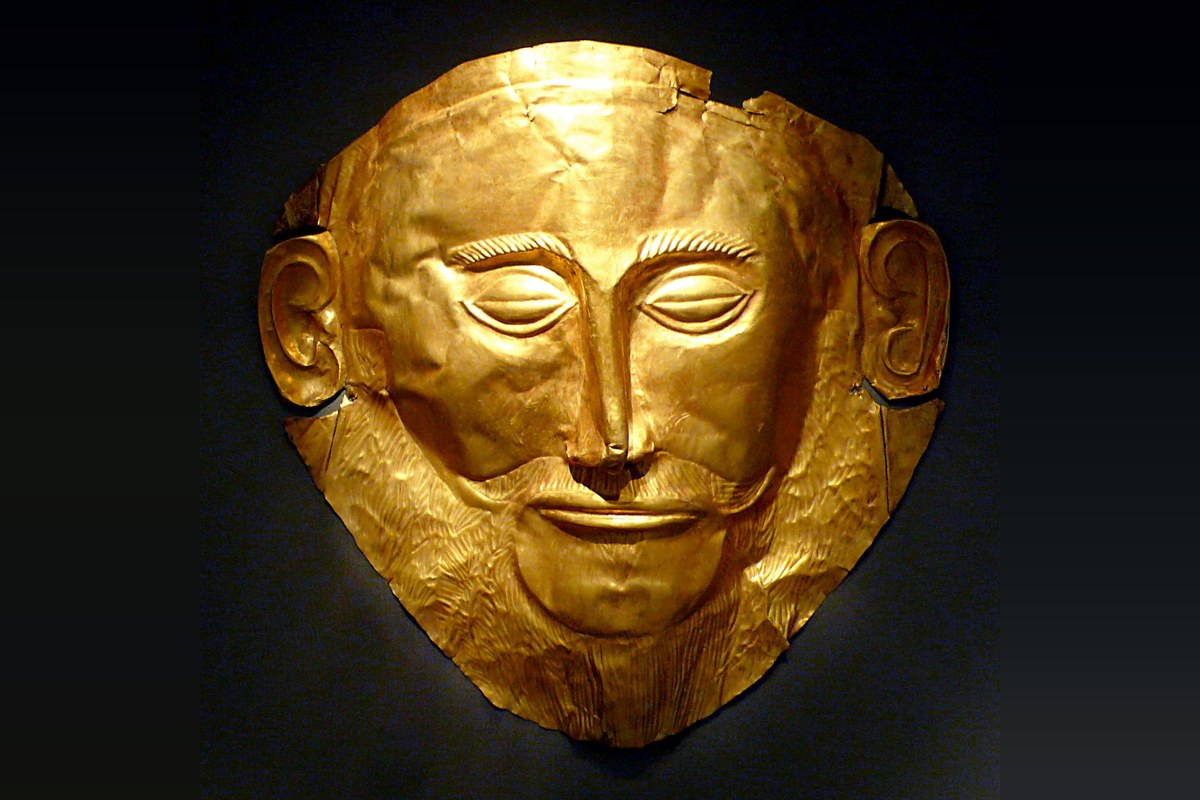
The so-called Mask of Agamemnon, a gold mask from Grave Circle A at Mycenae, now in the National Archaeological Museum, Athens. It is named after the legendary king, but the Shaft Graves of Mycenae date to around the 16th century BC, centuries before the 1334 to 1184 BC range that later Greek tradition gave the Trojan War. Background extended to fit a wider frame. (Photo: Xuan Che, via Wikimedia Commons, CC BY 2.0)
A bow is a small gesture, but on a beach before Troy it carries the weight of a whole social order, and that is the question at the heart of a scene that set X talking on November 8, 2026. A trending story that day gathered fan reactions to a clip from Christopher Nolan's The Odyssey, the July 2026 film starring Matt Damon as Odysseus and Benny Safdie as Agamemnon.
According to the X trending summary, the clip "shows Matt Damon as Odysseus respectfully bowing to Benny Safdie's imposing Agamemnon, the commander of the Greek coalition against Troy, on a hazy beach with striking helmets." The same summary says that "Fans noted surprise since Odysseus ruled Ithaca independently," while others read the moment as military rank inside an alliance of kings. Peter Bradshaw's review in The Guardian describes Damon's Odysseus as "the military commander from Ithaca appointed by the Greek king Agamemnon." So why would one king bow to another at all?
A King Among Kings
The short answer is that Homer's Greeks did not share power equally, and the Iliad says so from its first lines. In A. T. Murray's translation on the Perseus Digital Library, the quarrel that drives the poem breaks out between "Atreus' son, king of men, and brilliant Achilles" (Iliad 1.7). The Greek phrase there is anax andron, lord of men, a title Homer keeps returning to for Agamemnon.
Book 1 also shows what that title allows a man to do. Forced to give up his own captive, Agamemnon demands a replacement and threatens to take the prize of Achilles, of Aias or the prize "of Odysseus I will seize and bear away" (1.137 to 138). He then takes Briseis from Achilles so that Achilles will learn "how much mightier I am than you" (1.185 to 186). However, the same book marks the limits of that power. Achilles answers "Now I will go back to Phthia" (1.169), and the poem's opening lines warn that his wrath "brought countless woes upon the Achaeans" (1.2).
The Scepter of Zeus
Homer gives Agamemnon a symbol to match his rank, and he brings it out while the whole army watches. In Book 2 he rises before the assembly holding a scepter with a divine pedigree, and Murray's translation records the moment:
"Then among them lord Agamemnon uprose, bearing in his hands the sceptre which Hephaestus had wrought with toil."
Hephaestus gave it to Zeus, Zeus to Hermes, Hermes to Pelops, and it passed down through Atreus and Thyestes until Agamemnon received it, "that so he might be lord of many isles and of all Argos" (2.100 to 108). Homer also calls him by the stock phrase poimena laon, which Murray renders "shepherd of the host" (2.243). In Book 9 the old counselor Nestor puts the theory into words, telling Agamemnon "thou art king over many hosts, and to thee Zeus hath vouchsafed the sceptre and judgements" (9.97 to 99).
One Hundred Ships Against Twelve
The numbers in the Catalogue of Ships, the great roll call of Book 2, make the same point in plainer terms. The men of Mycenae, Corinth and the towns around them sail under "lord Agamemnon, captain, with an hundred ships" (2.576), and Homer adds that he "led a people far the most in number" (2.580). The citadel of Mycenae itself heads that list of places.
Odysseus, by comparison, commands the Cephallenians of Ithaca and the nearby islands and mainland. He is "the peer of Zeus in counsel," Homer says, but "with him there followed twelve ships with vermilion prows" (2.636 to 637). The Greek text on Perseus gives the same numbers, hekaton (100) at line 576 and duodeka (12) at line 637. Aias brings twelve ships from Salamis as well (2.557), so Odysseus was far from the only modest contingent on the beach.
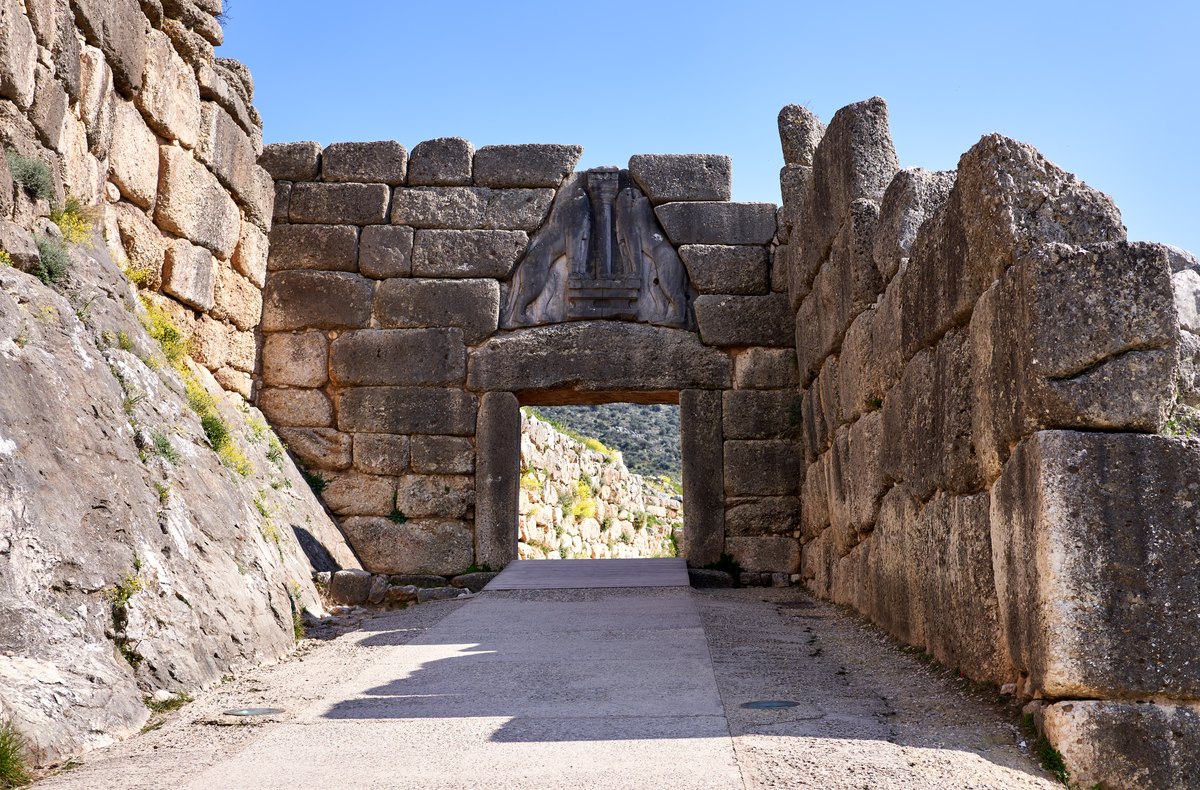
The Lion Gate at Mycenae, the citadel that heads the list of Agamemnon's towns in the Catalogue of Ships. (Photo: George E. Koronaios, via Wikimedia Commons, CC0)
The Staff in Odysseus' Hand
But it didn't end there. Book 2 shows Odysseus wielding that scepter himself, after Agamemnon tests the army by suggesting they sail home, and the men stampede for the ships until Athena sends Odysseus to stop them. He goes straight to Agamemnon and "received at his hand the staff of his fathers, imperishable ever" (2.185 to 186).
With that staff in his hand, Odysseus turns the army around, and he does it rank by rank. To ordinary soldiers he says, "In no wise shall we Achaeans all be kings here" (2.203), and he adds "let there be one lord" (2.204), the one king to whom Zeus has given the scepter. When Thersites, whom Homer calls a man "of measureless speech," rails at Agamemnon, Odysseus "with his staff smote his back and shoulders" (2.212 and 2.265). He acts with borrowed authority, and that is what makes him effective.
The same pattern returns in Book 9, when Agamemnon offers gifts to win Achilles back. Nestor chooses the envoys, naming Phoenix, Aias "and goodly Odysseus" (9.169), and lays his command "chiefly upon Odysseus" (9.180 to 181). When they reach the hut of Achilles, it is Odysseus who leads the way (9.192).
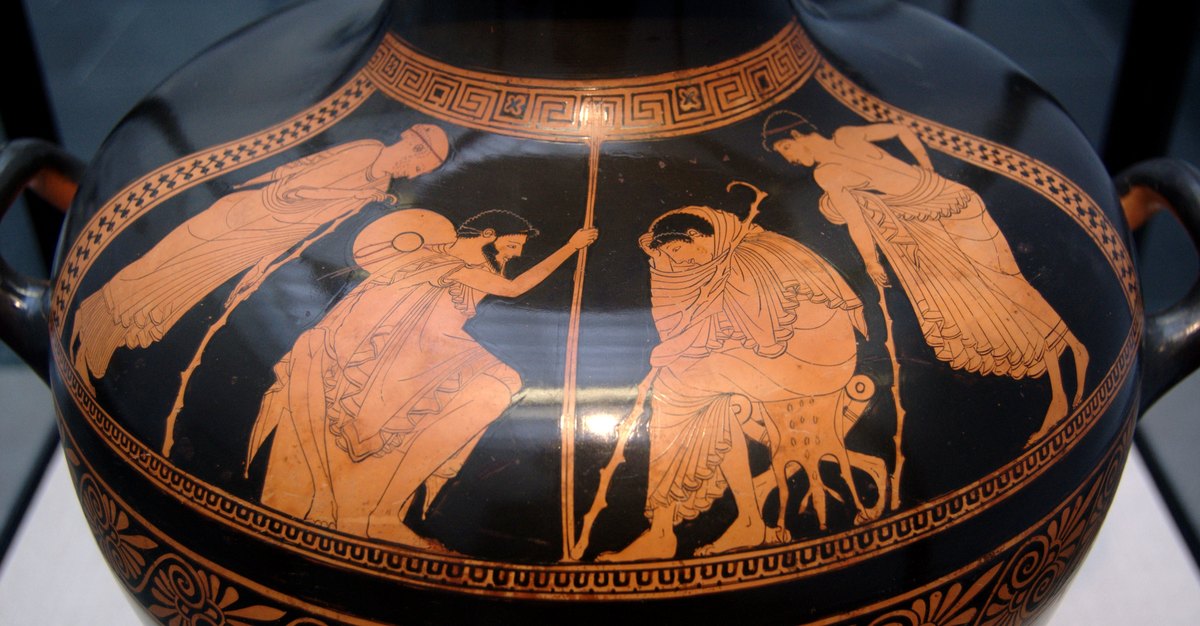
Phoenix and Odysseus before Achilles in the embassy of Iliad Book 9, on an Attic red-figure hydria attributed to the Kleophrades Painter, about 480 BC. Staatliche Antikensammlungen, Munich, Inv. 8770. (Photo: Bibi Saint-Pol, via Wikimedia Commons, public domain)
An Oath He Invented
Why was the king of Ithaca at Troy at all, if he ruled Ithaca in his own right? Homer does not tell that story, which comes from later tradition preserved in the Library and Epitome attributed to Apollodorus. In J. G. Frazer's translation, it was Odysseus (Frazer's Ulysses) who advised Tyndareus, faced with a crowd of suitors for Helen, to "exact an oath from all the suitors that they would defend the favoured bridegroom against any wrong that might be done him in respect of his marriage" (Library 3.10.9).
When Helen was carried off to Troy, Agamemnon sent a herald to each of the kings and "reminded them of the oaths which they had sworn" (Epitome 3.6). Odysseus, according to the Epitome, "not wishing to go to the war, feigned madness," until Palamedes exposed the trick by seizing his son Telemachus and drawing a sword, and he went to the war after all (Epitome 3.7). In this later version, the clever king was bound by the very oath he had designed.
Wanax and Basileus
How far does any of this reflect the real Bronze Age? The Linear B tablets, clay records written in an early form of Greek, use two titles that match Homer's words, and the first is wa-na-ka, or wanax. Dartmouth College's Aegean Prehistoric Archaeology course notes that at Pylos and Knossos "only one wanax appears to have existed at either place," and Thomas G. Palaima, in his 1995 study of the title, writes, "The wanax is the central figure of authority in Mycenaean society."
The second title is qa-si-re-u, the ancestor of basileus, the ordinary Homeric word for a king. On the tablets, the Dartmouth course explains, this man was "some kind of chief or leader of a small group, in one case a group of bronzesmiths." Palaima counts wanax in the singular in 271 of its 276 uses in Homer, while basileus is applied to all the single heroes, and in the plural to several leaders within one community, Ithaca among them.
In Palaima's account, once the palaces and their wanax were gone, the local holders of the qa-si-re-u title became "the chief power figures" of the regions. However, he also warns against building a picture of Mycenaean kingship on the image projected by the Homeric epics. The war itself is harder still to pin down, since later Greek tradition dated it between 1334 and 1184 BC, the Dartmouth course notes, and it concludes that "belief or disbelief in the historicity of the Trojan War becomes in the end an act of faith, whichever position one adopts." Agamemnon and Odysseus remain figures of legend, whatever Mycenaean civilization may have lent them.
The Man Who Bows
So the bow that puzzled fans has a long pedigree. In the Iliad, the overlord holds the scepter of Zeus and the largest fleet, while the king of Ithaca arrives with twelve ships and a reputation for counsel. Yet it is Odysseus who turns the army back from the ships, silences Thersites and leads the embassy to Achilles. The man who bends his head is the one who keeps the army at Troy, and there is still much to learn about the palace kings whose titles Homer's heroes inherited.
By Aris Manus
Sources
- Homer. Iliad. Translated by A. T. Murray. Perseus Digital Library. Books 1, 2 and 9, with the Greek text checked at Perseus.
- Apollodorus. Library and Epitome. Translated by J. G. Frazer. Perseus Digital Library: Library 3.10.9, Epitome 3.6 and Epitome 3.7.
- Palaima, Thomas G. 1995. The Nature of the Mycenaean Wanax: Non-Indo-European Origins and Priestly Functions. University of Texas PASP.
- Dartmouth College. Aegean Prehistoric Archaeology. Lesson 25, Lesson 27 and Lesson 16.
- X. November 8, 2026. Odysseus Bows to Agamemnon in Nolan's Odyssey Scene. Trending story.
- Bradshaw, Peter. July 15, 2026. The Odyssey review. The Guardian.
- Minton, Matt. Everything We Know About Christopher Nolan's The Odyssey. Variety.