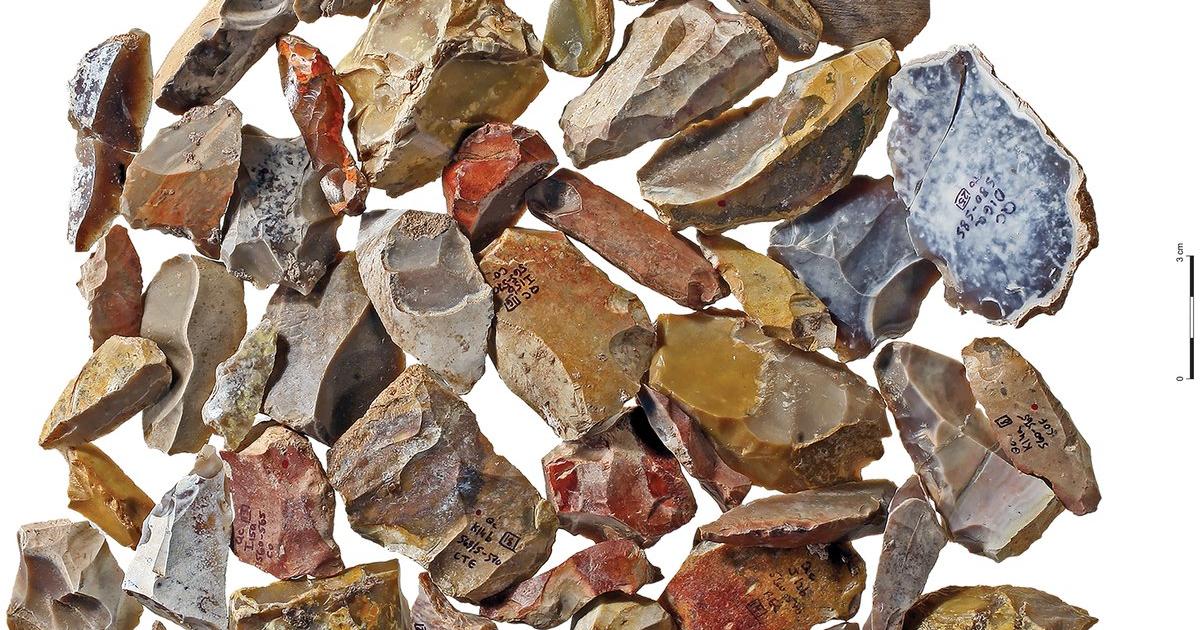

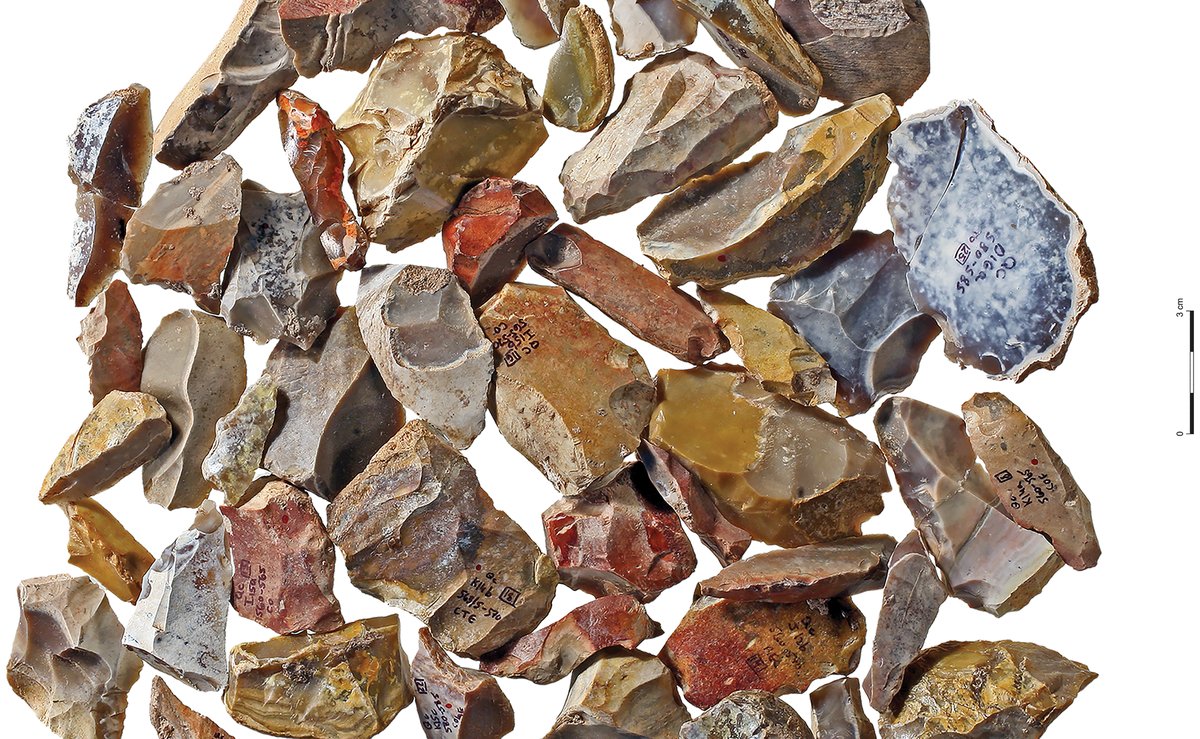
Patinated "old" flint items from Qesem Cave, Israel, which the cave's inhabitants are thought to have collected and brought back. Cropped and resized from Figure 3 of Efrati 2021. (Image: Bar Efrati, Cambridge Archaeological Journal, 2021, photographs credited to Sasha Flit and Pavel Shrago, CC BY 4.0)
Anyone who has carried home a beach pebble will recognize the impulse, and a group of researchers in Israel has now pushed it back to the Middle Pleistocene. In a new study, they propose that early humans were collecting and keeping objects with no obvious practical use from at least about 500,000 years ago, and that these keepsakes may have helped build the human sense of self. Could a handful of stones really carry that much weight?
The findings, published in the journal Evolutionary Anthropology on October 19, 2026, come from Ran Barkai, Ella Assaf, Bar Efrati, Tal Simon, Liad Mudrik and Yoav Ram, most of them based at Tel Aviv University. The paper is a hypothesis paper. It reviews earlier finds and proposes what the authors call a "souvenir niche," rather than reporting a new excavation. The newly publicized study reached the press this month through the Israeli news agency TPS-IL, carried by J-Wire, and through i24NEWS.
What Are the Objects?
The first exhibit comes from Qesem Cave, near the city of Kafr Qasim. According to the new paper, small round and colorful pebbles were brought into the cave starting about 400,000 years ago and throughout its 200,000 years of use. They show no evidence of practical use. A 2018 study by Assaf in the Journal of Lithic Studies described 17 such pebbles, all smaller than the smallest pebbles used for toolmaking at the site, and traced at least some of them to a stream channel about 1 to 1.5 km (0.6 to 0.9 mi) east of the cave.
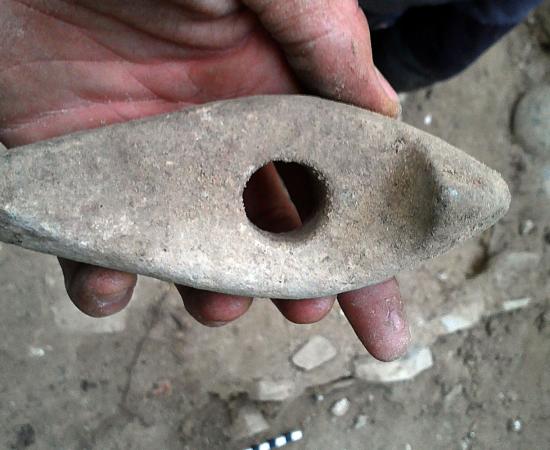
The second comes from the Sakhnin Valley in the Lower Galilee. There, the authors write, "about ten of over 200 surveyed handaxes were shaped around fossil imprints or geological features in the flint nodule," with those features kept at the center of the face. Such nodules are harder to knap, the paper says, and were avoided in ordinary handaxe production.
The third is a set of old, weathered flint tools picked up and reworked at the Late Acheulean sites of Revadim and Jaljulia and at Qesem Cave. Most of their aged surface, known as patina, was left in place.
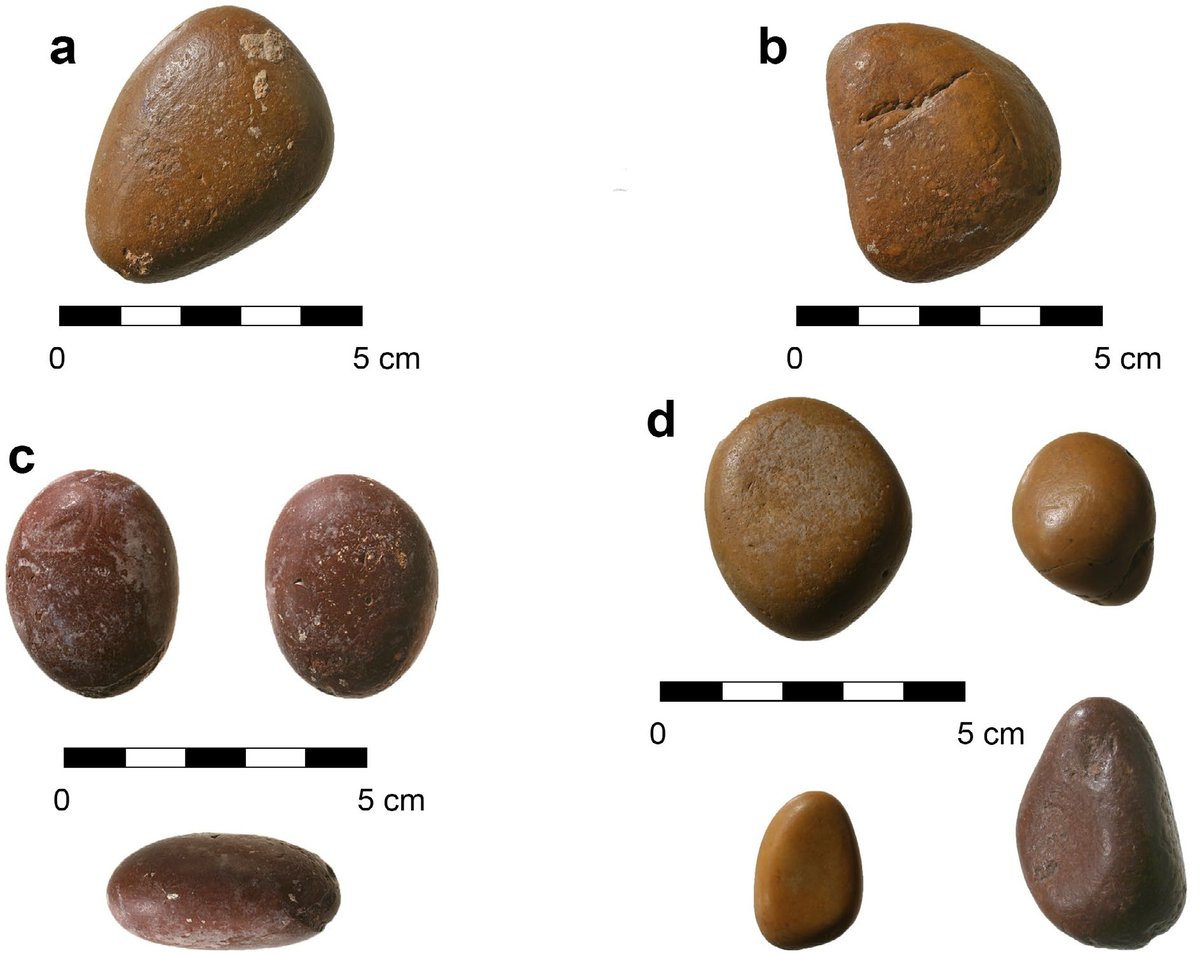
Panels a to c show flint pebbles from the archaeological layers of Qesem Cave. Panel d shows pebbles found in a stream channel east of the cave, for comparison. Resized from Figure 4 of Assaf 2018. (Image: Ella Assaf, Journal of Lithic Studies, 2018, photographs credited to Pavel Shrago, CC BY 4.0)
An Old Story of Recycling
The recycled flints are not new to science. Tel Aviv University announced in 2022 that Efrati and Barkai had examined 49 tools with two lifecycles from one layer at Revadim, a site dated to about 500,000 years ago, finding that the old edges had mostly been used for cutting and the new ones for scraping. Efrati had already discussed patinated scrapers from Qesem in a 2021 Cambridge Archaeological Journal paper titled "Memory Scrapers," part of the same research thread followed in this account of Qesem Cave recycling.
What is new is the leap from objects to minds. The paper proposes that personal keepsakes acted as portable external memory devices that did more than cue recall. By offering a durable material trace, they may have helped owners tell experienced events from imagined ones, what the paper calls source monitoring. Over many generations, the authors suggest, routine keepsake use could have favored the brain systems behind autobiographical memory and the sense of self.
Yoav Ram, of Tel Aviv University's School of Zoology, put it this way to i24NEWS: "When ancient people brought a colorful stone or an old tool they found in the field into a cave, that object may have helped them remember a significant event or meeting for the rest of their lives."
Why 500,000 Years Ago?
The paper links the timing to ecological change. Prey body size in the Levant declined through the Pleistocene, the authors write, and the elephant disappeared around 400,000 years ago, pushing hunters toward smaller prey and new territories. Barkai explained to J-Wire: "The disappearance of large animals, particularly elephants, required early humans to develop new hunting methods and become familiar with hunting grounds inhabited by animals such as fallow deer and wild cattle."
On this reading, a pebble or a reworked tool from a new hunting ground became a personal link to a place. The people involved, it should be said, were not necessarily members of Homo sapiens. The paper places the behavior "among ancestral rather than modern human populations," and the Qesem objects belong to what archaeologists call the Acheulo-Yabrudian Cultural Complex, dated by Efrati to about 420,000 to 200,000 years ago.
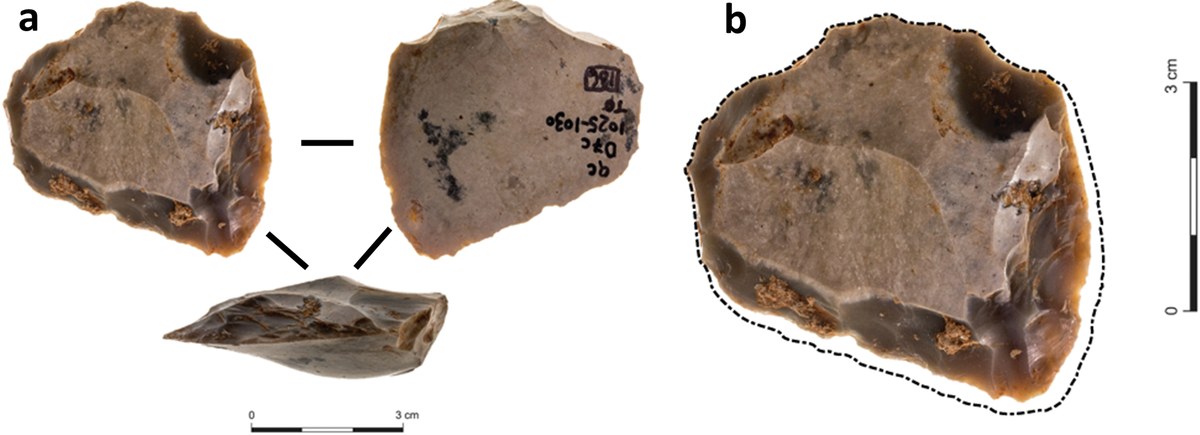
A recycled scraper from Qesem Cave that keeps the shape and colors of an older, fully patinated blank. The dashed line in panel b marks the original outline. Resized from Figure 1 of Efrati 2021. (Image: Bar Efrati, Cambridge Archaeological Journal, 2021, photographs credited to Sasha Flit and Pavel Shrago, CC BY 4.0)
How Strong Is the Evidence?
Promising, but the objects themselves cannot speak to motive. The authors are open about this. They list rival explanations, including aesthetics for its own sake, raw material caching and craft practice, and concede that authentication of memories might have been achieved through language alone. Of their own tests, they write that "the weakest is wear," since light use traces can reflect handling as easily as keeping.
There is also a question of interpretation drift. In 2018 Assaf suggested the Qesem pebbles were selected for their aesthetic traits, while the new paper reads them as valued for "aesthetic, mnemonic, or sentimental reasons." The Sakhnin handaxes, meanwhile, come from surface collections. Paleoanthropologist John Hawks of the University of Wisconsin-Madison, writing on his blog in March about the earlier Sakhnin report, noted that the team had suggested a Late Acheulean date of roughly 500,000 to 200,000 years ago without excavating datable profiles.
Hawks also pointed to a famous cautionary case. Emily Flanders and Alastair Key, in the Journal of Archaeological Science in 2023, concluded that the West Tofts handaxe from England, long cited for the fossil shell at its center, "was likely an average utilitarian tool produced on a flawed but conveniently thin flint nodule." With such sparse evidence, Hawks wrote, "it may not be possible to show that a particular artifact, however special-looking, really had anything special about it." He added that a localized cluster like Sakhnin "might help understand how much intention there was to the creation of these fascinating objects."
The memory hypothesis, then, is indicative rather than conclusive. The authors propose ways to test it, from microwear and patina studies to checking whether curated items cluster around hearths, and from behavioral experiments to brain training studies. According to J-Wire, they stress that this is a hypothesis, not proof that every unusual stone was a keepsake. Until those tests are run, the idea of Homo Memorabiliaxis remains less a finding than a carefully argued question.
By Aris Manus
Sources
- Barkai, Ran, Ella Assaf, Bar Efrati, Tal Simon, Liad Mudrik and Yoav Ram. October 19, 2026. Homo Memorabiliaxis: Souvenirs and the Evolution of Autobiographical Memory and Self. Evolutionary Anthropology 35(4): e70051. DOI 10.1002/evan.70051.
- Israel, David (TPS-IL). November 9, 2026. Ancient humans may have used collected objects to shape memory evolution. J-Wire.
- i24NEWS. November 9, 2026. Ancient humans may have kept souvenirs 500,000 years ago.
- Assaf, Ella. 2018. Paleolithic aesthetics: Collecting colorful flint pebbles at Middle Pleistocene Qesem Cave, Israel. Journal of Lithic Studies 5(1).
- Efrati, Bar. 2021. Memory Scrapers: Readymade Concepts and Techniques as Reflected in Collecting and Recycling Patinated Lower Palaeolithic Items at Qesem Cave, Israel. Cambridge Archaeological Journal 31(2): 337 to 347.
- Tel Aviv University. March 21, 2022. Unravelling Recycling Practices from 500,000 Years Ago.
- Hawks, John. March 31, 2026. Ancient handaxes made from geodes. John Hawks blog.
- Flanders, Emily and Alastair Key. 2023. The West Tofts handaxe: A remarkably average, structurally flawed, utilitarian biface. Journal of Archaeological Science 160: 105888. Abstract consulted.