
In Almaty's Nauryzbay district, a Saka burial mound at Karagaily has yielded a cast-gold bear despite having been looted in antiquity. Archaeologists from the Almaty Museums Association recovered the ornament during emergency excavations supported by the city administration.
In reports published on November 5, 2026, Kazakhstan Today and Qazinform relay the city administration's preliminary date of the fourth to third centuries BC. Small holes in the ornament's base have prompted a headdress interpretation, but what was the little gold bear made to adorn?
What the Mound Still Held
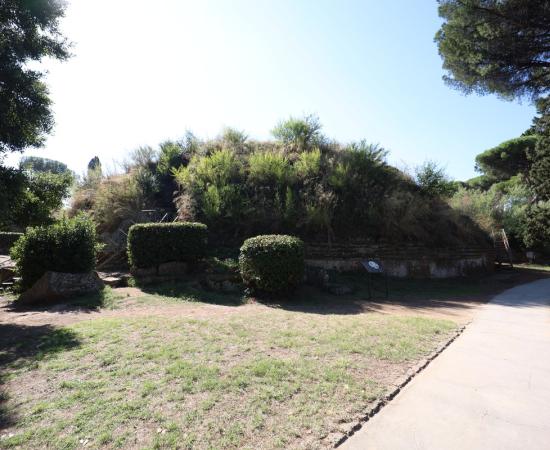
The mound measures about 25 to 26 meters (82 to 85 ft) across and about 2.5 meters (8 ft) high, according to the reported city statement. Qazinform describes a looters' pit roughly 3 meters (10 ft) deep at its center, with pottery fragments, human remains and the gold ornament scattered by the disturbance.
The bear stands on its hind legs on a flat plate, holding a short cylindrical object between its front paws. The History Blog describes holes at each corner of the base and identifies the object between the paws as a vessel, an interpretation of the modeled figure.
Interpreting the Perforated Base
Kazakhstan Today and Qazinform report that researchers believe the holes were used to attach the bear to a headdress, with Qazinform describing sewing it onto fabric. However, the reports present this as an interpretation of the perforated base, not an identification of a complete surviving headdress.
Kazakhstan Today quotes Lyazzat Sagyndykova, director of the Almaty Museums Association, on the bear's place among other finds:
"The bear figurine is unique in Kazakhstan. No similar finds have previously been discovered. This find allows us to trace cultural parallels across Eurasia, from the Black Sea region to the Altai," she said.
Qazinform compares the bear with the Issyk Golden Man's headdress finial and a small leopard figurine found at Kok-Kainar in 2014, also interpreted as a headdress ornament. These comparisons concern separate discoveries, not objects recovered alongside the Karagaily bear.
Issyk and the Wider Goldworking Tradition
The Issyk, or Esik, barrow lies about 50 kilometers (31 mi) east of Almaty, separate from the Karagaily burial ground. Archaeology.kz's heritage entry describes research in 1969 and 1970, when excavators found an undisturbed side burial beside a central grave that had been looted in antiquity.
The side burial contained more than 4,000 gold objects, an iron sword and dagger, a bronze mirror and vessels, providing the basis for a costume reconstruction with a tall, animal-decorated headdress. The entry also records written signs on a silver bowl from Issyk.
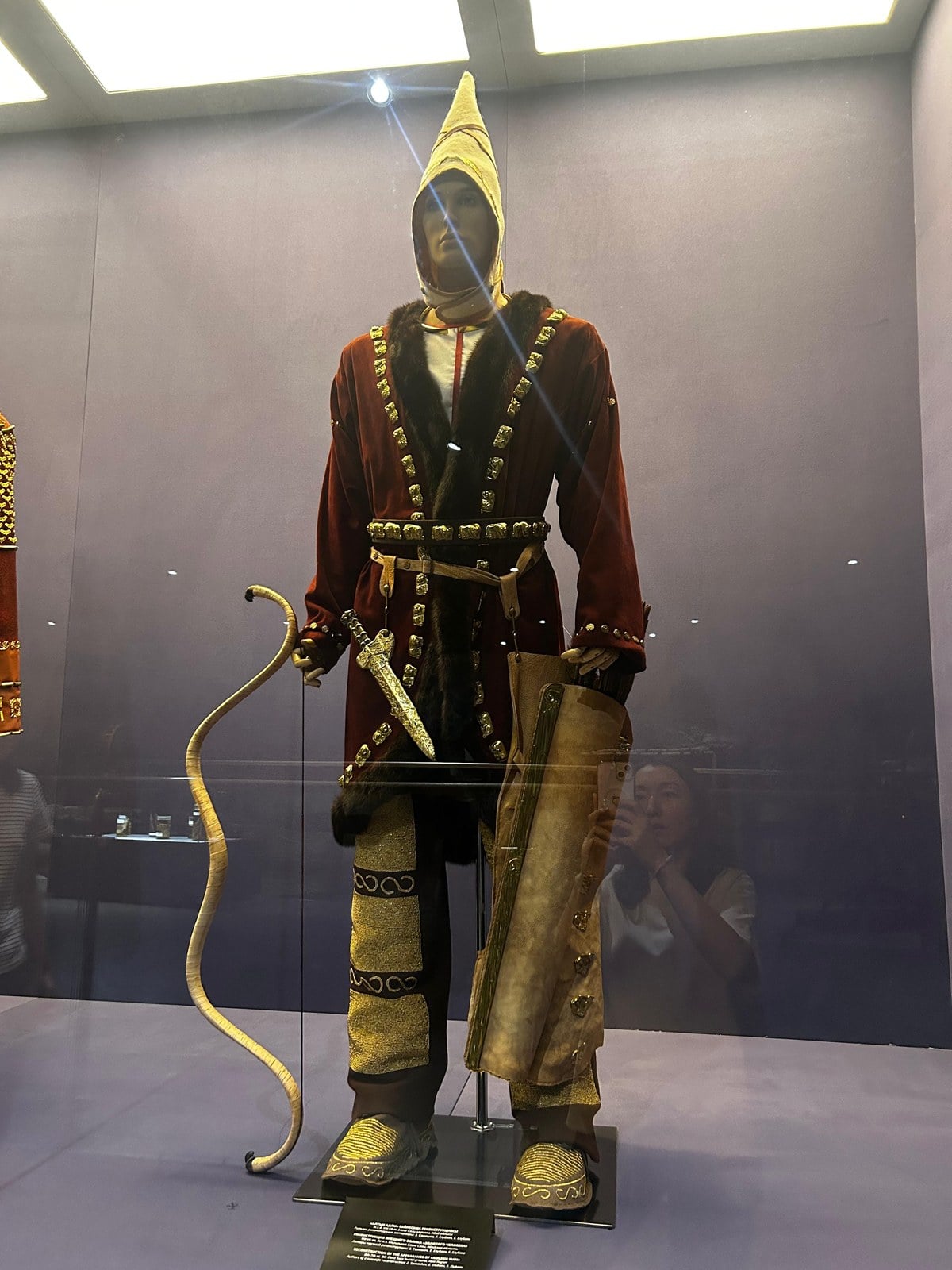
Museum reconstruction of a Golden Man costume at the National Museum of the Republic of Kazakhstan. Comparative costume context, not the Karagaily find. Resized for display. Photo: PlainVector, via Wikimedia Commons, CC0.
In 2018, archaeologists at Eleke Sazy in East Kazakhstan found an undisturbed teenage archer's burial in Kurgan 4. In 2021, University of Cambridge coverage of a Fitzwilliam Museum exhibition described jewelry, clothing ornaments and about 2,000 gold microbeads, roughly 1 millimeter across, sewn onto his shoes.
That exhibition illustrates the wider tradition of Scythian and Saka goldwork, including bird-shaped headdress plaques from Eleke Sazy Group VII, Kurgan 3, separate from the archer's burial in Group II, Kurgan 4. They provide another example of animal imagery on Saka headgear, but cannot establish the Karagaily bear's original use.
Human Remains in the Looted Mound
But the gold was only part of the find. Preliminary observations reported by Kazakhstan Today and Qazinform point to four adults and three children, with the exact number still being established.
Marat Nurpeisov, a senior researcher at the Almaty Museums Association, explained why the count matters in the statement reported by Kazakhstan Today:
"The unusually large number of human remains in a single mound is of particular interest, as such burials are atypical for Kazakhstan. Mounds of a comparable size were generally intended for the burial of one or two people," he said.
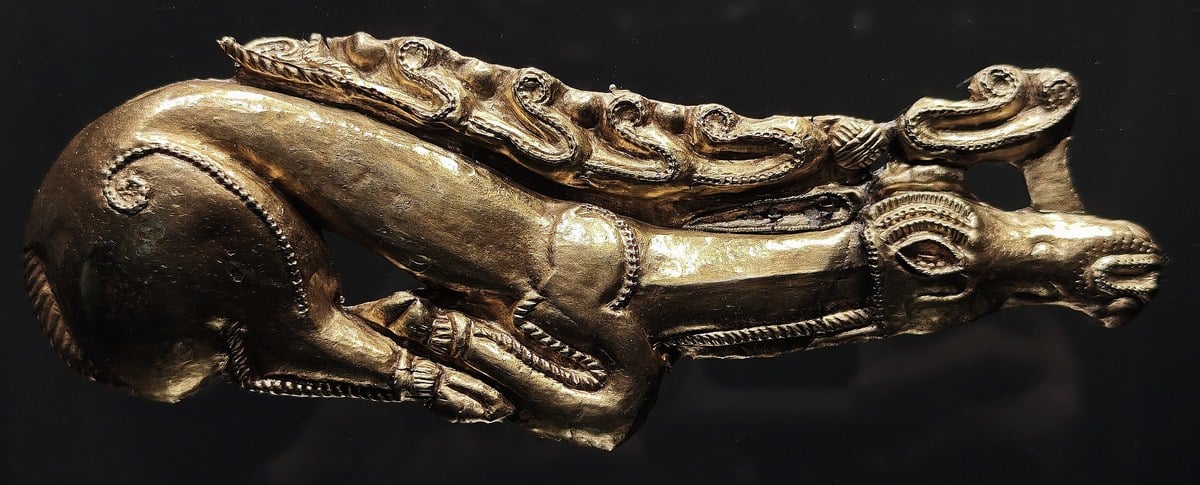
Scythian gold stag plaque from Tápiószentmárton, Hungary. Comparative animal-style goldwork, not the Karagaily bear or an Almaty find. Resized for display. Photo: Elekes Andor, via Wikimedia Commons, CC BY 4.0.
Arkeonews says researchers cannot yet establish whether the people were buried together or at different times, because looting disturbed the original positions of bones and objects.
The People Behind the Ornament
Kazakhstan Today and Qazinform report that anthropological study is planned while work at Karagaily continues, with key finds expected to reach the Almaty Museum's displays after investigation and scientific analysis.
However, Arkeonews notes that the bear's symbolic meaning is still undetermined. Who chose this animal for the ornament, and what did it mean to them?
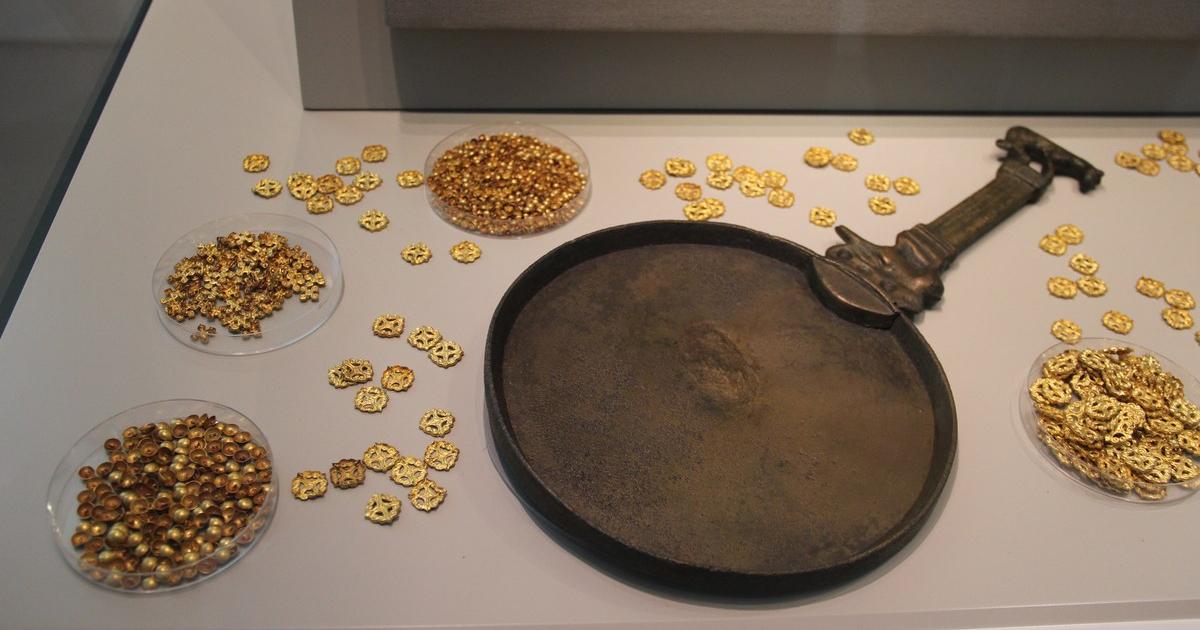
Scythian gold ornaments and a decorated mirror on display in the Altes Museum, Berlin. Comparative goldwork, not the Karagaily bear or excavation. Resized for display. Photo: Gary Todd, via Wikimedia Commons, CC0.
By Aris Manus
Sources
- Kazakhstan Today. November 5, 2026. Rare Saka-era gold bear ornament unearthed in Almaty burial mound.
- Qazinform (Adlet Seilkhanov). November 5, 2026. Rare Saka-era gold bear figurine unearthed at archaeological site in Almaty.
- The History Blog. November 6, 2026. Gold bear found in Kazakhstan kurgan.
- Arkeonews (Leman Altuntaş). November 2026. A Gold Bear Emerges from a Looted 2,300-Year-Old Tomb.
- Archaeology.kz. Issyk, the barrow.
- University of Cambridge (Tom Almeroth-Williams). October 14, 2021. The Fitzwilliam Museum reveals how the Saka people made history and great art.