

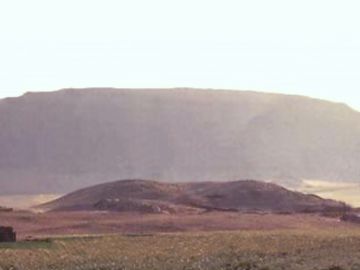
Photo: Wannabe Egyptologist, CC BY-SA 3.0 via Wikimedia Commons Source
The pyramid of Ahmose was built during the reign of Ancient Egyptian king Ahmose I, around 1550 to 1525 BC, at Abydos in Upper Egypt. It was the final royal pyramid constructed in Egypt, as later rulers chose not to be buried in pyramids. Unlike earlier royal pyramids, this structure was designed from the outset as a cenotaph rather than an actual tomb.
The pyramid now appears as a shallow hill roughly 10 meters high. It sits within an unusual complex that includes a valley temple near the Nile, at least four temples surrounding the pyramid, and to the south a pyramid for the king's grandmother Tetisheri, a symbolic tomb of Osiris, and a terrace temple. Excavations took place from 1899 to 1904, with further work continuing since 1993.
- Country
- Egypt
- Region
- Africa
- Kind of site
- Smooth-sided pyramid, Egyptian pyramids, cenotaph
- Part of
- Abydos
- Located in
- Matruh Governorate, Egypt
- Coordinates
- 26.1757° N, 31.9378° ECoordinates from Wikidata
- Reference
- Wikidata Q402041
- Encyclopedia
- Wikipedia article
Nearby places
Open in the Atlas →- Wah-Sut 0.7 km (0.4 mi)
- Abydos 2.2 km (1.3 mi)
- Umm el-Qa'ab 3.0 km (1.9 mi)
- Shunet el Zebib 3.4 km (2.1 mi)
- Pyramid of Sinki 3.5 km (2.1 mi)
- Lepidotonpolis 18 km (11 mi)
Place data from Wikidata (CC0). Ancient Origins has not yet reviewed this entry in depth.














Recent comments