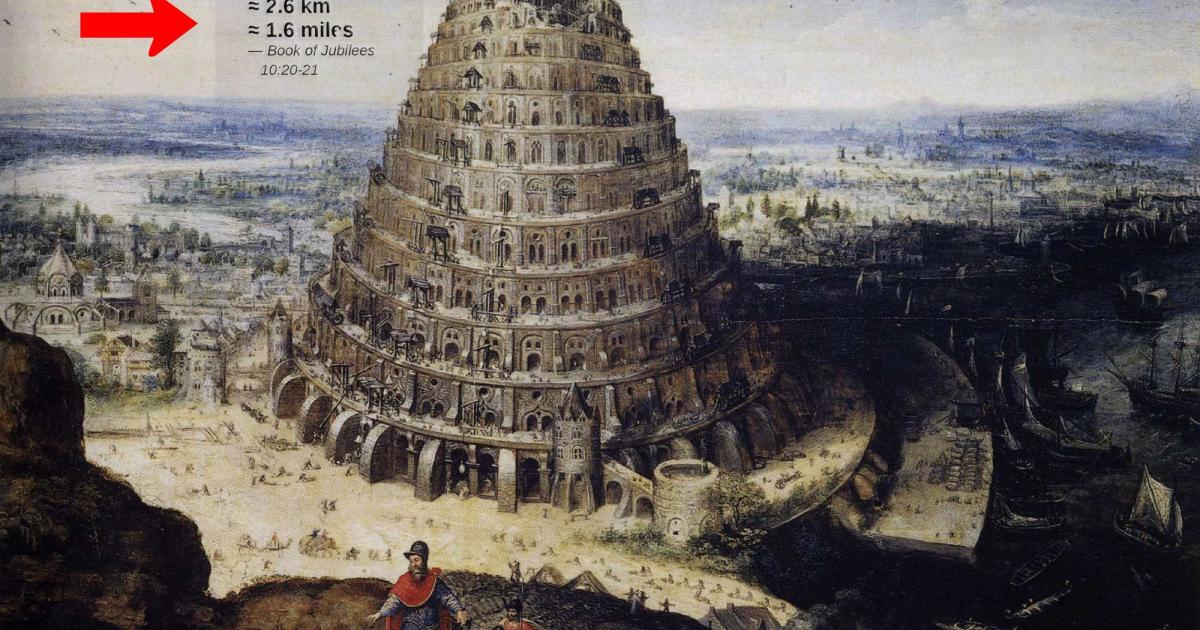

The story of the Tower of Babel is one of the most misread passages in all of Scripture. Most people know the outline: humanity tried to build a tower to the sky, God knocked it down, and scattered the people across the earth. A simple morality tale, a myth about arrogance or a story that ends in confusion and dispersal?
But that is not the story the ancient texts tell.
The Book of Jubilees, an ancient Jewish text found among the Dead Sea Scrolls, states that the builders of Babel worked for forty-three years. The tower they constructed reached a height of 5,433 cubits and 2 palms, roughly 1.6 miles into the sky.
The Third Book of Baruch records that the builders did not want to reach heaven, they took tools and attempted to physically pierce it, demanding to know whether it was made of clay, brass, or iron.
And Flavius Josephus, the first-century Jewish historian, writes that the man behind the project, Nimrod, was building a fortress against God. A structure so vast and so unified that no flood, no divine judgment, could ever destroy it again.