Roberto Volterri

Profile picture for user Roberto Volterri
Dr Roberto
Volterri

Born in Rome, Dr Roberto Volterri graduated in archaeology with an experimental thesis in archaeometry in the mid-'80s after previous university studies in Biology.  As an academic, he worked in university research (Archaeometallurgy) for more than 40 years, after he took the very important position as “Field Engineering and Advertising Manager” in an electronics industry (also Motorola), for about 10 years. Currently he continues to collaborate with the University of Rome II for studies using Scanning Electron Microscopy on metallic materials. He has been dealing with archaeometallurgy studying findings of all metals through amenable survey techniques, such as Scanning Electron Microscopy (SEM), X-ray Diffractometry and Energy Dispersion Microanalysis (EDS). He then dedicated himself to more articulated research in the historical-archaeological context, but framed from a 'frontier' point of view. In addition to about 350 articles dedicated to the 'mysterious' issues published in the Arcani, Abstracta and Hera (of which he was also the Scientific Consultant), from around 2000 to 2009/2010., he participated in radio broadcasts (Totem, on RTL 102.5) and television both on RAI (Voyager) networks and on private broadcasters (Stargate and Il Sogno dell'Angelo) and has published over 40 books since 1976. Eight of his books are now at the Library of the University of Yale) and four others are at the Library of the Congress in Washington, D.C.

His books are available at the following sites:

https://www.amazon.it/volterri/s?k=volterri

https://www.ilgiardinodeilibri.it/autori/_roberto_volterri.php

https://orbis.library.yale.edu/vwebv/search?searchArg=Roberto+Volterri&searchCode=GKEY%5E*&limitTo=none&recCount=50&searchType=1&page.search.search.button=Search

It would be very hard to hope to find some of the artifacts described in Archeologia Dell’Impossible in some museum. Why? It's simple: because ... they do not exist or have never existed. At least 'officially'. This work, therefore, would like to fill this gap and should be understood as a real manual of "heretical archeology", indispensable to all those researchers of the unknown who want to face an experimental study on "possible ancient technologies", with the indispensable mental openness necessary to undertake a road full of obstacles, but above all with full respect for scientific orthodoxy.


Member for

7 years 6 months

View Recent Blogs

One day in early August in the fourth century AD, something strange happened in Rome. Those who were outside braving the heat, walking on the Esquiline Hill would have glanced at the sky to notice a curious cloud formation - very different certainly from the compact cloud cover typical of snowfall - and would have been astonished to see snowflakes drifting down to earth – in the heat of summer! Some may have fled to escape this manifestation of divine wrath while others may have tentatively stretched out a hand to catch them and see them evaporate like real snowflakes. Someone noted and recorded the event. The Miracle of the Snow by Masolino da Panicale. Christ and the Blessed Virgin
In the heart of the Esquiline Hill in Rome, third century AD Emperor Licinius Gallienus enjoyed the tranquility of the Horti Liciniani, a luxurious complex of ancient Roman villas with large gardens and outdoor rooms originally built in the first century BC. By the mid-17th century, the impressive Villa Palombara, home of Massimiliano II Savelli, Marquis of Palombara (1614-1685) occupied this land. The romantic vine-covered remains and buried Roman statues among the rubble and ruins of the erstwhile gardens painted the Esquiline landscape with a nostalgic magic. [[{"type":"media","view_mode":"media_large","fid":"85597","attributes":{"alt":"The Villa Palombara opposite the Nymphaeum of Alexander in a map engraved by Giovanni Battista Falda (1676).(Public Domain)","class":"media-image","height":"316","style":"width: 610px; height: 316px;","typeof":"foaf:Image","width":"610"}}]] The Villa Palombara opposite the Nymphaeum of Alexander in a map engraved
Counting from December 25, using the Julian calendar, Twelfth Night – January 6 – takes place on the last night of the ‘ Twelve Days of Christmas’, marking the coming of the Epiphany, celebrating the revelation (theophany) of God manifesting as Jesus Christ. Superstition also has it that this is traditionally the date to dismantle the Christmas tree and its decorations, but where did the tradition of decorating a tree to celebrate the birth of Jesus, originate in the first place? [[{"type":"media","view_mode":"media_large","fid":"81620","attributes":{"alt":"St Boniface cutting down the Oak dedicated to Thor by Emil Doepler (1905) (Public Domain) St Boniface cutting down the Oak dedicated to Thor by Emil Doepler (1905) (Public Domain)","class":"media-image","height":"326","style":"width: 610px; height: 326px;","typeof":"foaf:Image","width":"610"}}]] St Boniface cutting down the Oak
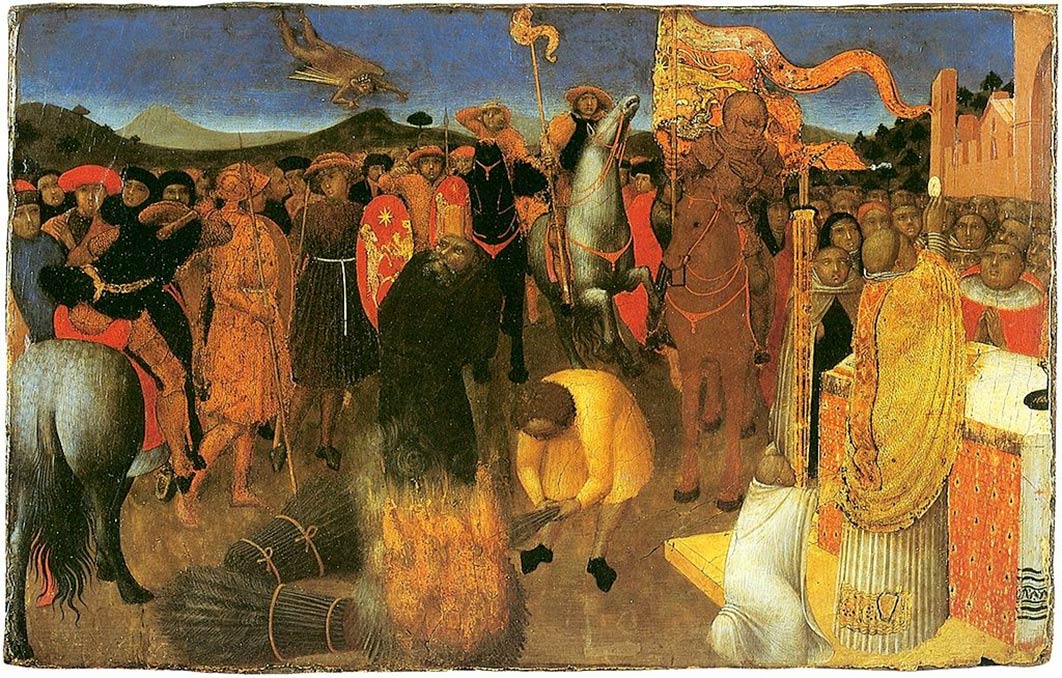
" Penitenzàgite! (Do penance)", shouted Gherardo Segarelli, a young and eccentric peasant, with flaming, hallucinated eyes and a long beard, as he wandered barefoot, wrapped only in a cloak, in the streets of Parma, Italy in 1260. The period of the 13th and the beginning of 14th centuries was marked by the development of the most exalted, almost crazy and sometimes extremely violent exponents of heretical movements, that irked the Catholic Church and led to the burning of the heretics. Just after 1226, the year of the death of Francis of Assisi, two very distinct movements saw the light: that of the ‘Conventuals’, the more moderate; and that of the Spirituals, the followers of Joachim of Celico (Cosenza), better known
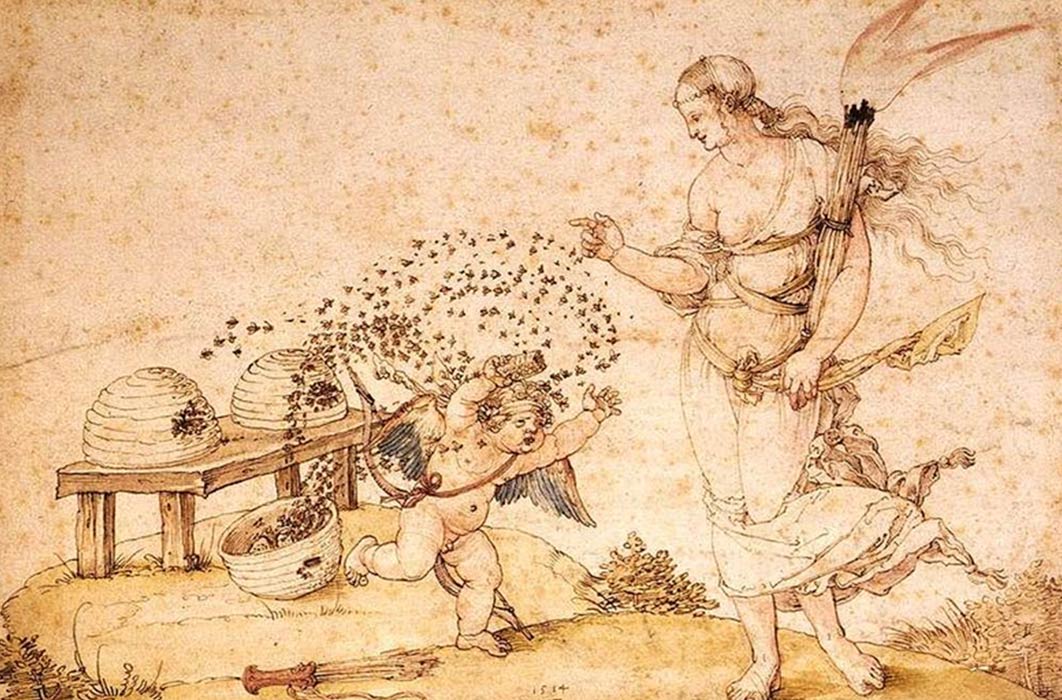
“ Sì come schiera d'ape, che s'infiora /as a host of bees, which blooms” said Dante Alighieri in Paradiso, XXXI, v.7 The Popol Vuh, the sacred book of the mythology of the Maya, tells how the bee was born from an 'universal beehive' that represents paradise and that the gods sent the bees to earth to promote the spiritual elevation of mankind, removing him from ignorance and barbarism. The Maya culture also provides a scientific rational to the disappearance of these little insects. A few years ago, the World Watch Institute issued a warning that a third of the beehives in the United States were disappearing due to bees dying. This may not have the same sensational value as huge