nrushton

Profile picture for user nrushton
Neil
Rushton

Neil Rushton is an archaeologist and freelance writer who has published on a wide variety of topics from castle fortifications to folklore. Recently he has been exploring the confluence between consciousness, insanity and reality and how they are affected through the use of a wide variety of psychotropic drugs. His first novel, Set the Controls for the Heart of the Sun, explores these issues to the backdrop of Syd Barrett and Pink Floyd. He also writes a blog-site devoted to the mythology and reality of the faeries: https://deadbutdreaming.wordpress.com/

Member for

9 years 10 months

View Recent Blogs

The faeries appear in folklore from all over the world as metaphysical beings, who, given the right conditions, are able to interact with the physical world. They’re known by many names but there is a conformity to what they represent, and perhaps also to their origins. From the Huldufólk in Iceland to the Tuatha Dé Danann in Ireland, and the Manitou of Native Americans, these are apparently intelligent entities that live unseen beside us, until their occasional manifestations in this world become encoded into our cultures through folktales, anecdotes, and testimonies. [[{"type":"media","view_mode":"media_large","fid":"26830","attributes":{"alt":"Middle-Earth-like elves by artist ","class":"media-image","height":"396","style":"width: 610px; height: 396px;","typeof":"foaf:Image","width":"610"}}]] Middle-Earth-like elves by artist (Araniart/ CC BY 3.0 ) In his 1691 treatise on the faeries of Aberfoyle, Scotland, the Reverend
Just as with the appropriation of Pagan sacred sites by Christian authorities, as recommended by Pope Gregory I to St Augustine in the late sixth century, there was a natural tendency in the late Antique and early medieval Christian world to convert previously well-observed Pagan festivals to newly designated religious observances. This usually took the form of imposing Saints’ Days on established festivals, such as the celebration of the apostles Philip and James at the Spring festival of Beltane (May 1) or constructing feast days to mark incidents in the gospels such as The Presentation of Christ and the Purification of the Virgin Mary at the time of Imbolc (February 1), which was a Pagan festival associated with the goddess

Just as with the appropriation of Pagan sacred sites by Christian authorities, as recommended by Pope Gregory I to St Augustine in the late sixth century, there was a natural tendency in the late Antique and early medieval Christian world to convert previously well-observed Pagan festivals to newly designated religious observances. 

Faerie-type entities have always been an important component of British and Irish folklore. In the Aarne-Thompson-Uther Motif Index of Folk Literature (ATU) there are over 500 motifs within folktales that include the faeries, many of which are from Britain and Ireland. Whatever the true ontology of these supernatural entities, it is evident they have had an intrinsic cultural role throughout recorded history and played a part in the storytelling of every generation since the Middle Ages, and perhaps even earlier. The folklore collected by Medieval chroniclers was almost certainly the culmination of centuries of oral tradition, and by the time it was recorded in earnest from the 19th century, it represented belief systems stretching back at least a thousand years
Throughout the world, prehistoric and pre-industrial shamanic cultures have rendered painted imagery onto rock faces; often in deep cave systems, but also in above-ground shelters. This rock art ranges in date from Palaeolithic designs in Europe, Australia and Asia through to the near-contemporary images of the San culture in southern Africa and the designs of indigenous cultures of North America and the Amazon basin. Until the mid-20th century the consensus anthropological view was that the rock art — while probably having magical meaning to the people who painted it — represented scenes from the natural environment, such as people, animals and landscapes. But as a greater anthropological understanding of indigenous shamanism developed, most especially through the work of Mircea Eliade

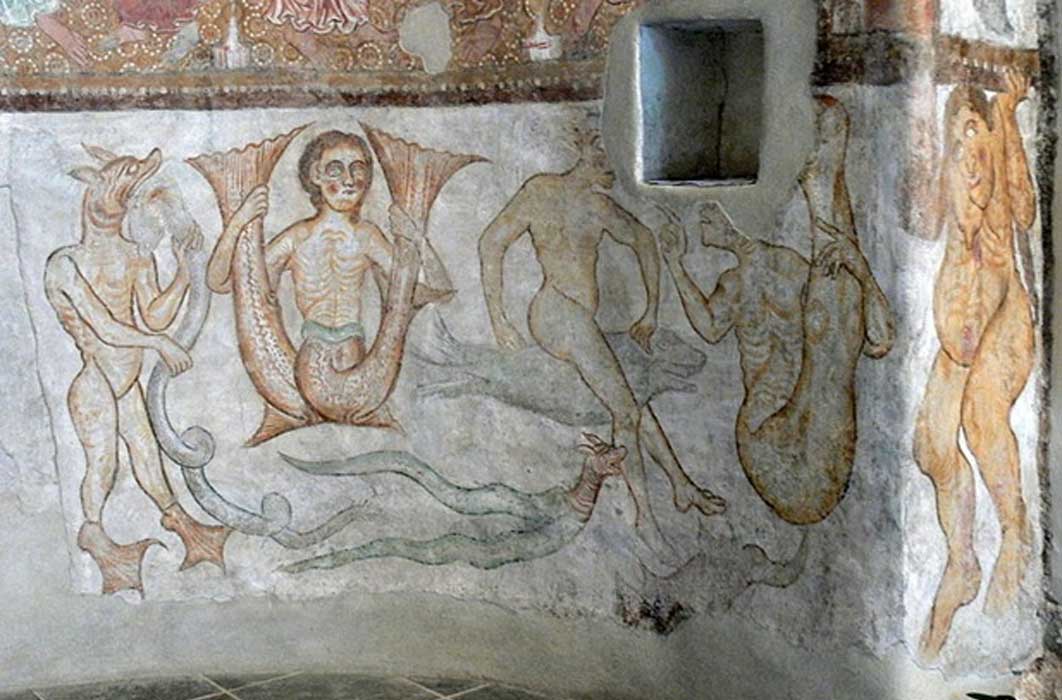
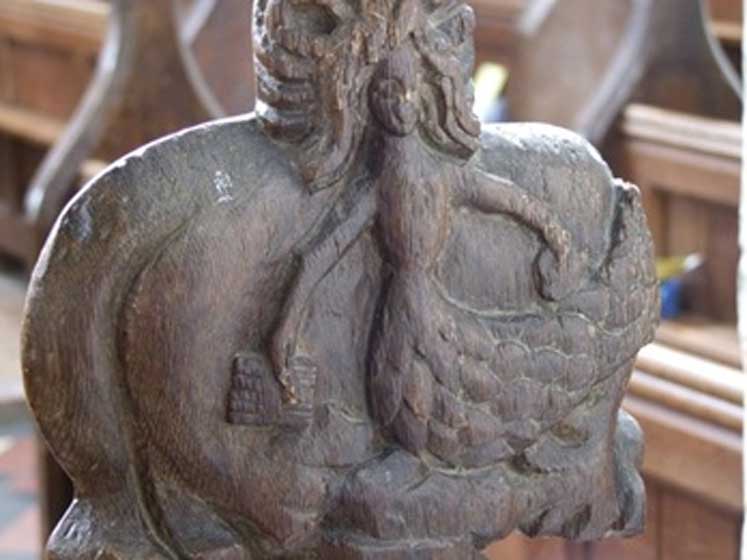
Why would an ancient, folkloric, but non-Biblical, character such as a mermaid find its way into so many medieval European churches? And can such mermaid imagery and symbology be correlated with the more overt pagan symbols of the Green Man and Sheela na gig?

14th-century mermaid bench-end at St Mary’s church, Ivinghoe, Buckinghamshire (Image: Courtesy John Vigar)

Why would an ancient, folkloric, but non-Biblical, character such as a mermaid find its way into so many medieval European churches? And can such mermaid imagery and symbology be correlated with the more overt pagan symbols of the Green Man and Sheela na gig? [[{"type":"media","view_mode":"media_large","fid":"60426","attributes":{"alt":"14th-century mermaid bench-end at St Mary’s church, Ivinghoe, Buckinghamshire (Image: Courtesy John Vigar)","class":"media-image","height":"457","style":"width: 610px; height: 457px;","typeof":"foaf:Image","width":"610"}}]] 14th-century mermaid bench-end at St Mary’s church, Ivinghoe, Buckinghamshire (Image: Courtesy John Vigar ) Common Pagan Symbols in Churches There are numerous stone sculptures and wood carvings in European medieval churches that depict what may appear to be non-Christian imagery. Most discussed are those of the Green Man and the Sheela na gig, which have found various interpretations, from pagan
Until recently, it was believed that monasteries were lax and inefficient in distributing alms to the poor, but Dr. Neil Rushton’s research indicates that monastic almonries in medieval England were effective in relieving the plight of the poor, up until the Dissolution of the Monasteries. Throughout the medieval period monastic houses, and their dependent hospitals, were the largest providers of poor relief in England (as through Europe), and were effectively the only institutional administers of social welfare for the approximate 15 per cent (higher in years of famine) of the population who were wholly or partly dependent on charity to survive. Most monasteries were obliged to fulfil the legal obligations placed on them by their founders and benefactors to allocate