Jason Jarrell

Jason
Jarrell

Jason Jarrell is a student of archaeology, philosophy, and Egyptology. 

His first full book is Ages of the Giants: A Cultural History of  the Tall Ones in Prehistoric America, co-written with Sarah Farmer.


Ages of the Giants

By Jason Jarrell and Sarah Farmer

For more than a century now across the eastern portion of North America, burials of ancient people who possessed a very tall stature have been uncovered. Ages of the Giants utilizes actual archaeological reports and the records of American Antiquarians, along with numerous historical chronicles and press accounts to document the cultures of a distinct sub-population of large, powerfully-built individuals of extraordinary height who inhabited ancient North America for thousands of years. The product of a decade of research, including fieldwork at ancient sites and the study of thousands of pages of archaeological literature, Ages of the Giants traces the history of the ancient Tall Ones across four millennia, and features in-depth descriptions of the cultures they founded, as well as their traditions, cosmology, and settlement patterns.

Get it at LULU.co

Member for

10 years

View Recent Blogs

The modern era has witnessed an incredible surge in the popularity of all forms of media concerning the mythology of the ancient Mesopotamians. Fueling this ever-growing trend are the writings of a number of researchers who propose connections between several Sumerian myth cycles and the theory that the human race was engineered or created by a group of extraterrestrial beings. Known as Ancient Astronaut Theory, this field is largely reliant upon the translations of cuneiform tablets supposedly made by Zecharia Sitchin, whose series of Earth Chronicles books form the foundation upon which the modern church of the alien gods has been built. Central to Sitchin’s narrative is a group of mythic beings known as the Anunnaki, whom he claimed crossed
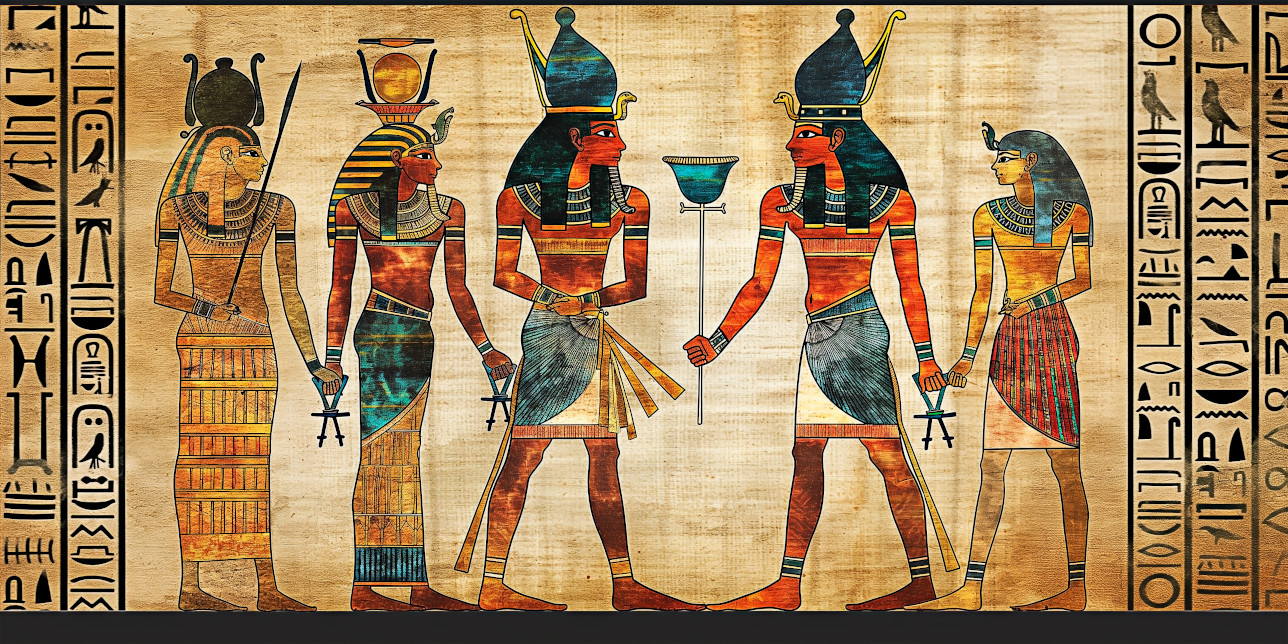
The long history of Egyptian afterlife writings began during the 3rd millennium BC, when the body of compositions known as the Pyramid Texts were carved onto the walls and coffins of the pyramids of Old Kingdom rulers at Saqqara, the necropolis of the ancient capital of Memphis. The function of the writings was to ensure that the ‘spiritual’ components of the deceased—the Ba and the Ka—were reunited after separating upon the death of the material body. The unification of these spiritual elements caused the deceased to be reborn as an Akh, which may be described as a transcendent, celestial being. As summarily explained by James Allen (2005:7): “At death, the ka separated from the body. In order for an individual

The long history of Egyptian afterlife writings began during the 3rd millennium BC, when the body of compositions known as the Pyramid Texts were carved onto the walls and coffins of the pyramids of Old Kingdom rulers at Saqqara, the necropolis of the ancient capital of Memphis. The function of the writings was to ensure that the ‘spiritual’ components of the deceased—the Ba and the Ka—were reunited after separating upon the death of the material body.

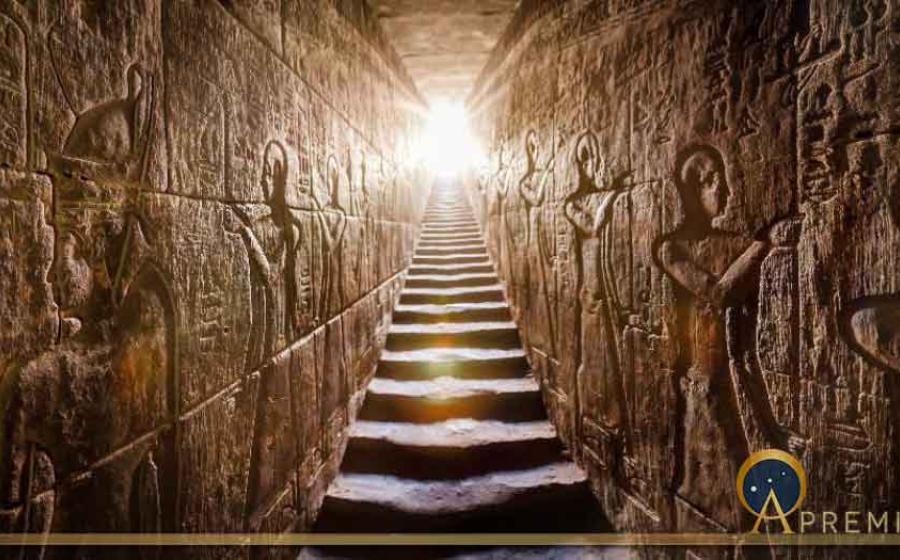
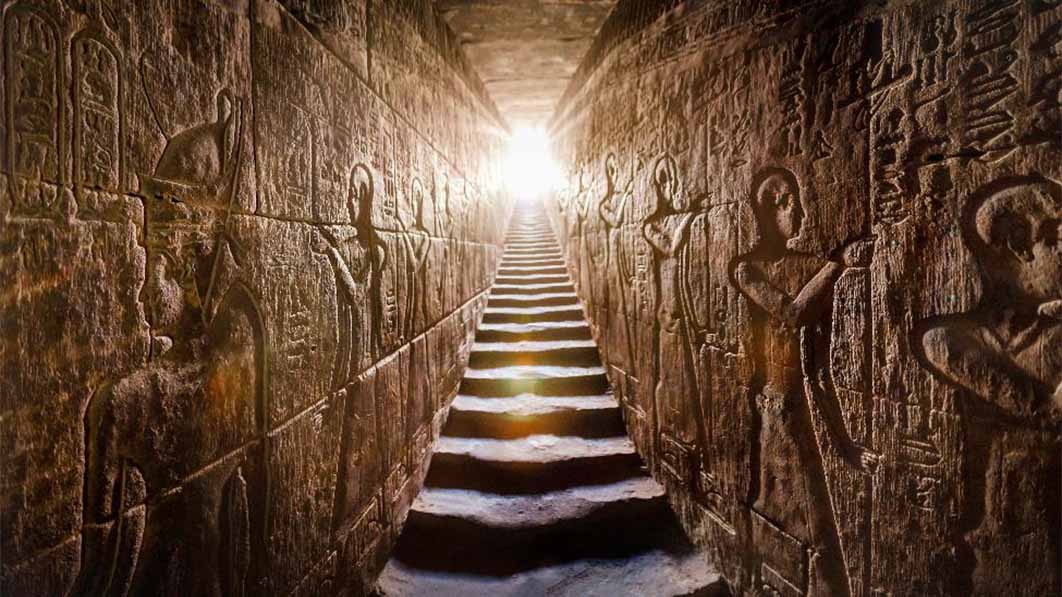
The temples of ancient Egypt represent one of the most enduring monumental expressions of religion and cosmology in the history of the world, serving as the very heart of pharaonic culture for nearly three thousand years. Over the course of the millennia, the temples and their associated ideology survived eras of great internal crises, such as the civil upheavals of the First Intermediate Period (2181–2055 BC) and the politicized religious reforms of the Amarna Period (1353-1322 BC). The temples also thrived during later eras of foreign occupation. During the Late Period (664-332 BC), Egypt twice fell under the rulership of the Achaemenid Empire, but the Persian rulers—who revered Egyptian traditions—allowed temple practices to continue. In 332 BC, the Persian dominance
The Pseudo-Aristotelian Hermetica are a core subgroup of Arabic Hermetic texts which take the form of discourses and letters of the philosopher Aristotle to Alexander the Great. The texts concern an array of subjects, including cosmology, the fabrication of amulets and talismans, and astrological knowledge. In these texts, Aristotle claims to have originally learned the knowledge that he passes on to Alexander from the legendary sage Hermes Trismegistus, who was also the central figure of a body of philosophical, astrological, and alchemical writings composed in Greco-Roman Egypt between roughly 300 BC and 400 AD. Although the Pseudo-Aristotelian Hermetica (hereafter PsAH) and related writings have been dated to the ninth century AD, these Arabic texts are now proven to have carried
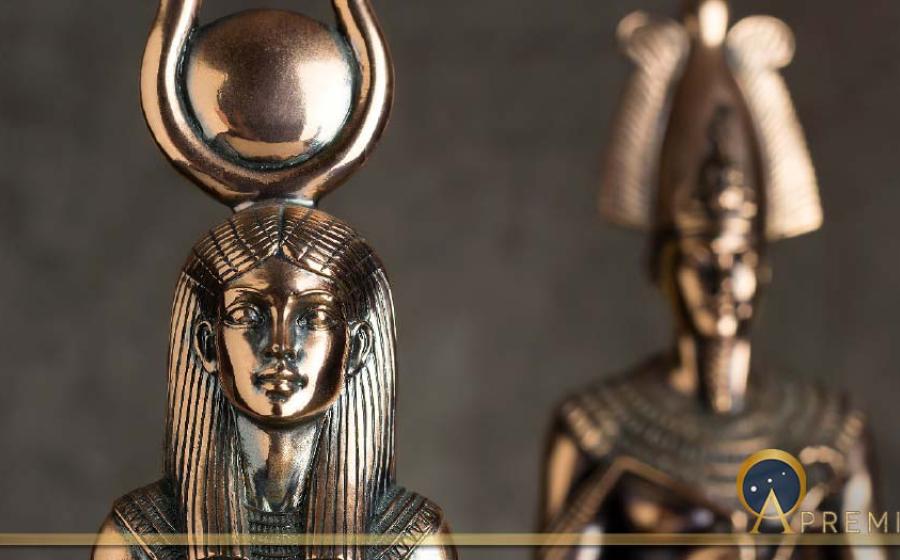
The Korê Kosmou or Pupil of the Eye of the World is a Hermetic text dating to the third century AD. The Greek text was preserved from antiquity by Johannes Stobaeus of Macedonia as part of his Anthology, hence its abbreviated reference as SH23 ( Stobaean Hermetica 23). While most Hermetic writings take the form of fictional dialogues between Hermes Trismegistus and his students, the Korê Kosmou is one of several texts (including SH23-27 and the alchemical Letter of Isis the Prophetess) in which the knowledge is transmitted from Isis to her son Horus. The Korê Kosmou is the product of several older sources weaved together into a single text, resulting in a narrative which serves as a virtual compendium
The Hermetica are a collection of ancient texts composed in Egypt between roughly 200 BC and 400 AD, attributed to the legendary sage Hermes Trismegistus and his followers. As is well known to scholars of philosophy and the esoteric, Hermes Trismegistus was a literary fictional character, representing a merger of the Greek Hermes and Egyptian Thoth, both of whom were associated with communication between worlds and the journeys through the Otherworld in their respective mythologies. This perfectly suits the Hermetica, the product of a fusion of Middle Platonic and Egyptian philosophical and cosmological concepts occurring in Egypt during the Ptolemaic and Roman Imperial periods. There is also a strong Hebrew element in the Hermetica, resulting from the influence of the