
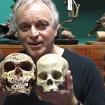
Danny Vendramini describes himself as an evolutionary detective. His main area of interest is theoretical biology, plugging holes in the Darwinian paradigm and resolving long standing questions of human evolution.
As an atheist and Darwinian scholar, Vendramini's work is anchored in evidence based research and deduction, but it’s his artistic imagination and scientific creativity that distinguishes his evolutionary theories.
“You need two kinds of scientists,” says Vendramini. “Those that are into experimentation, detailed observation and analysis. They're unquestionably the backbone of scientific progress. But you also need a few left-field people who can look at the big picture and envisage new paradigms and possibilities.”
Vendramini was born in Alice Springs, in the Australian outback. He had successful careers as a theatre director, TV producer and award-winning film director and scriptwriter - before turning to evolutionary biology.
He currently lives in the Blue Mountains, west of Sydney. He has two daughters with the writer, Dr. Rosie Scott; Josie, a journalist, filmmaker and actor; and Bella, actor and bestselling author of Biting the Big Apple, and Naked in Public.


Neanderthal predation occurred for about 50,000 years, not a long time considering the attenuated 5,000,000 evolution of humans from arboreal apes. But what made it such a formative evolutionary mechanism was its traumatic nature. Being raided at night by a ferocious spear wielding predator with super-human strength and a taste for human flesh and fertile females must have been terrifying and stressful. In a 2005 paper on the heritability of emotional traumas, I theorized that traumatic experiences in multicellular animals can be encoded into a part of the genome called noncoding DNA (ncDNA) and inherited. [ii]
This genetic process, which I call teemosis, imprinted the emotional memory of Neanderthal predation into the human genome, where it continues to subliminally influence modern human behavior. It’s also expressed in myths and legends of monsters and other night stalkers. Sadly, it’s also what drives war, xenophobia, morbid jealousy and genocides. But it also gave us our most cherished human emotions, love, altruism, creativity and art. For better or worse, Neanderthal predation made us who we are.
Danny Vendramini
To read more, visit www.themandus.org