

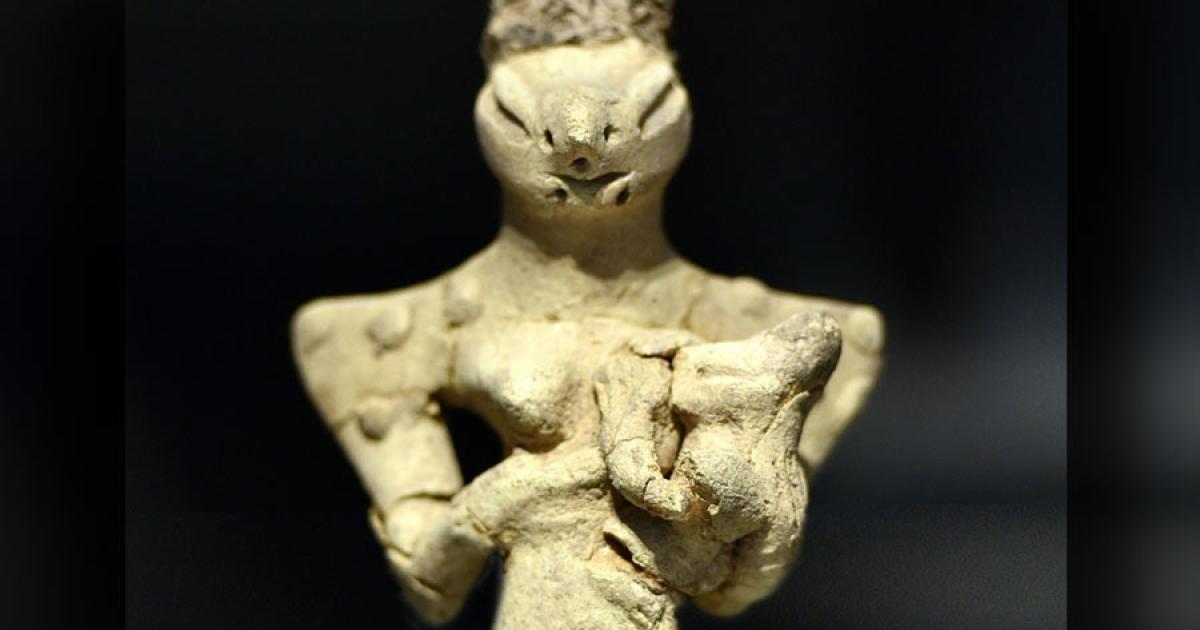

It is a commonly accepted view in mainstream archaeology that civilization started in ancient Mesopotamia with the great civilization of Sumer in what is now modern-day Iraq. However, at the beginning of the 20th century, archaeologists excavating at Tell Al’Ubaid in Iraq made an unusual discovery when they unearthed several 7,000-year-old artifacts which appear to represent humanoid figures with reptilian features.

Examples of the Ubaid lizardmen discovered in Iraq. (Mary Harrsch / CC BY 2.0)
Understanding Ubaidian Culture
The Ubaidian culture is a prehistoric culture in Mesopotamia that dates between 4000 and 5500 BC. As with the Sumerians, the origins of the Ubaidian people is unknown. They lived in large village settlements in mud-brick houses and they had developed architecture, agriculture and farmed the land using irrigation.
- Eridu: The Sumerian Garden of Eden and the Oldest City in the World?
- Ancient Mesopotamia and the Rise of Civilization
The domestic architecture of the Ubaidians included large T-shaped houses, open courtyards, paved streets, as well as food processing equipment. According to the Metropolitan Museum of Art, some of these villages began to develop into towns, temples began to appear, as well as monumental buildings such as in Eridu, Ur and Uruk, the major sites of the Sumerian Civilization. Sumerian texts explain that Ur was believed to be the first city.

Tell al-Ubaid is a small tell discovered near Ur in southern Iraq. (David Stanley / CC BY 3.0)
Discovering Ubaid Lizardmen Figurines at Tell Al’Ubaid
The main site where the unusual artifacts were discovered is called Tell Al’Ubaid – although figurines were also found in Ur and Eridu. The Al’Ubaid site is a small mound of about half a kilometer (0.3 mi) in diameter and two meters (6.56 ft) above ground. First excavated by Harry Reginald Hal in 1919, male and female figurines were found in different postures. Most of the figurines appear to be wearing a helmet and have some kind of padding on the shoulders.
Other figurines were found to hold a staff or scepter, possibly as a symbol of justice and ruling. Each figurine has a different pose but the strangest of all is that some female figurines hold babies suckling milk, with the child also represented as a lizard-type creature.

Lizard-headed nude woman nursing a child, from Ur, Iraq, c. 4000 BC, now at Iraq Museum. (Osama Shukir Muhammed Amin FRCP / CC BY-SA 4.0)
Ubaid Lizardmen: The Prehistoric Lizard Figurines
The figurines are presented with long heads, almond shaped eyes, long tapered faces and a lizard-type nose. What exactly they represent is completely unknown. According to archaeologists, their postures, such as a female figure breast-feeding, do not suggest that they were ritualistic objects. So what did these Ubaid lizardmen represent?
- Enki: The Epic Mesopotamian Water God Who Saved Humanity
- The Great City of Uruk Became Sumerian Powerhouse of Technology, Architecture and Culture
Whatever they were, they appear to have been important to the ancient Ubaidian people. We know that the serpent was a major symbol used in many societies to represent a number of gods, for example, the Sumerian god Enki, and the snake was used later on as the symbol for the Brotherhood of the Snake, supposedly an ancient secret society. Is there a link between the symbol of the snake and the representations of lizards? For now, these questions remain unanswered.
Top image: Ubaid Lizardmen Source: CC by SA 4.0























Comments
Mate, you really are a
Permalink
In reply to What? What ancient serpentine by Tsurugi
Mate, you really are a massive knob. All you do is comment on everything as tho your an expert on all subjects.your a sad wanker
What? What ancient serpentine
Permalink
In reply to Ur? Could that be Ur of the by yemiO (not verified)
What? What ancient serpentine trinitarian order are you talking about? And what do the words "sepentine" and "trinitarian" mean in the context in which you use them?(For example, by "serpentine" do you mean "reptile", or do you mean "winding, twisting")
I find the statues to be interesting because of the ubiquitous global association of the "serpent" with wisdom, knowledge, enlightenment....a symbolism that stems from deep antiquity, as do these figurines.
Ur? Could that be Ur of the
Permalink
Ur? Could that be Ur of the Chaldeans, the ancient civilization from where Terah, father Abraham set out to go to Canaan before Abraham his son was formerly called by God to complete that journey? It also suggests to me that there is an ancient, serpentine trinitarian order that was used to spiritually enslave humanity. This will explain the response of God as a trinity that offers salvation.
nothing hidden that shall not
Permalink
nothing hidden that shall not be revealed
Bill, of course not. Humans
Permalink
In reply to simple explanation by Bill Morrow (not verified)
Bill, of course not. Humans 7000 years ago had no imaginations. All of their art and literature can only depict actual things they saw.
At least that's according to the "scientific approach" so many of these article expound.