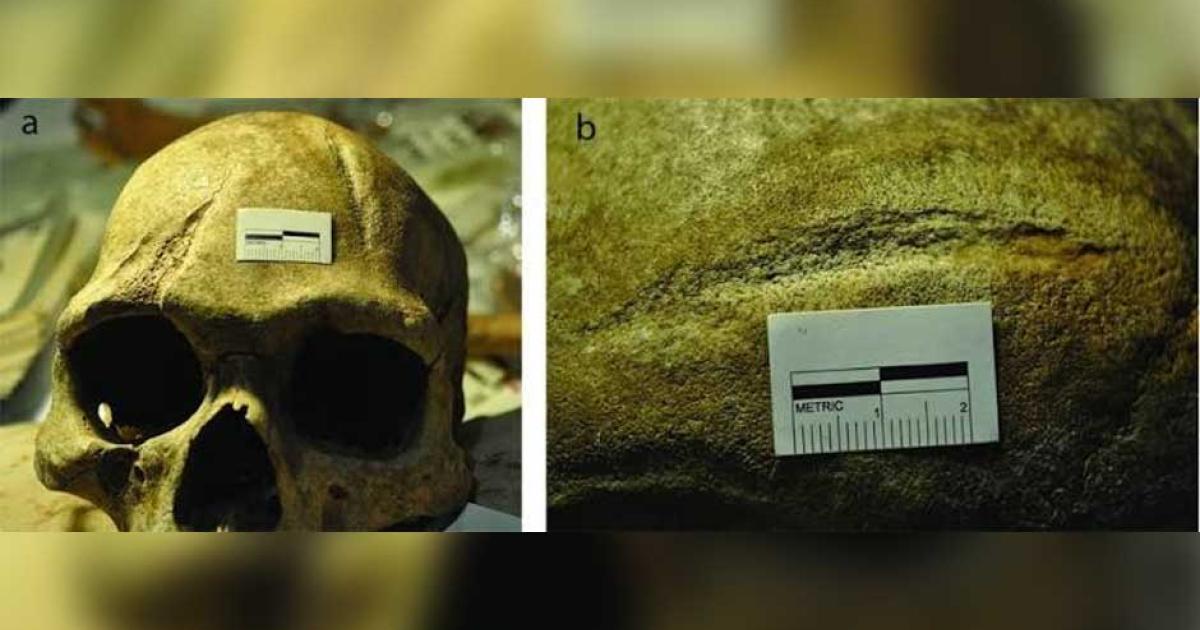

A skull partly exposed by erosion beside the Darling River in north-western New South Wales carried a wound that looked startlingly like the work of a sharp blade. The burial was later dated to the mid thirteenth century, approximately six centuries before European settlement reached the region. That chronology turns one injured skull into a difficult forensic question.
‘Our old people back then did not have a blade like that.’ - Baakandji elder William Badger Bates
The remains were found after erosion or animal activity disturbed a shallow Aboriginal burial and left part of the skull visible. The man became known as Kaakutja, meaning ‘elder brother’. His injuries were documented during excavation and analysis recorded by ABC TV’s Catalyst. The published study concluded that traditional sharp-edged wooden weapons, including lil-lils and fighting boomerangs, could fit the dimensions of the trauma and could have caused the fatal wounds.
That conclusion does not identify a particular weapon, and the skeletal evidence alone cannot establish a foreign visitor or contact. This article revisits the question rather than treating the answer as settled. It examines the shape of the injuries, the limits of sharpened mulga wood in reported tests, and comparisons with sharp-blade trauma. Could a wooden weapon have produced this particular wound or does the evidence leave room for a different explanation?
Between 13:20 and 14:00 in the video, Baakandji elder Mr William Badger Bates explains that boomerangs do not slice bone. In his view, the trauma was caused by a sword rather than a mulga-wood weapon. The author argues that this is supported by engineering calculations: mulga wood has a perpendicular compressive strength of approximately 120 megapascals (MPa), according to the Salisbury Research Facility in Brisbane, while skull-bone strength is reported as 130–210 MPa along its radial and parallel axes. The angled skull cut between the two values gives a required pressure of approximately 160 MPa when calculated using the Hankinson formula. Two tests using a 50 mm × 5 mm mulga blade on cattle shoulder bone as a surrogate found that, under such force, the sharpened wood buckled, failed and stopped cutting after approximately 1 mm of penetration.