

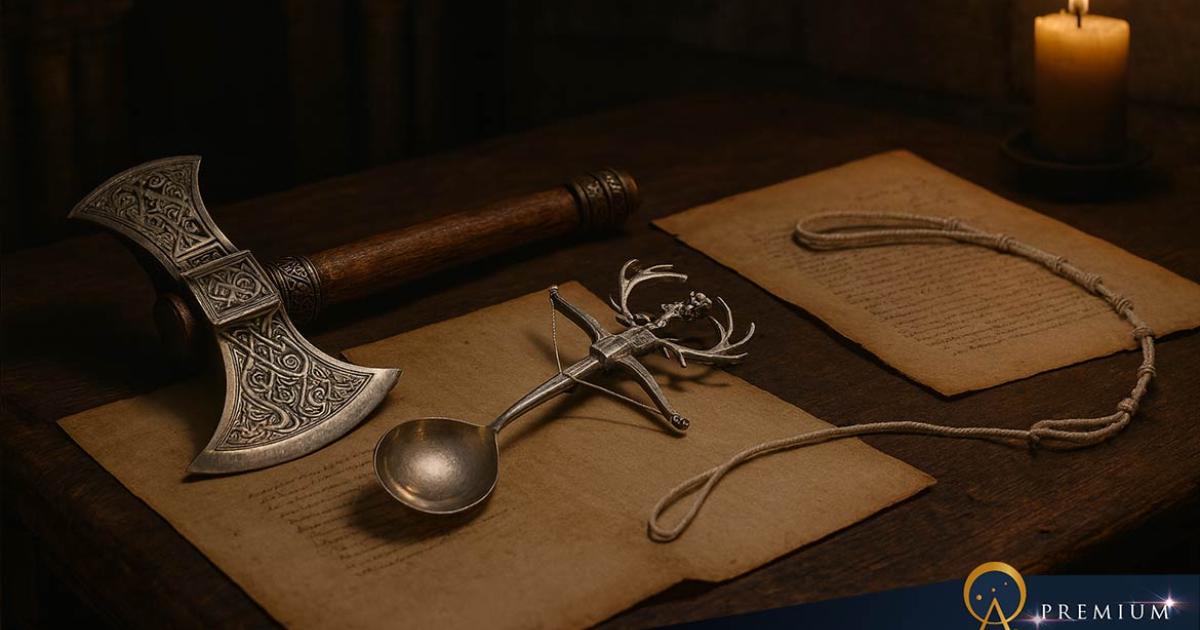
Lying at the intersection between myth and history, between the dying embers of pagan tradition and the rising flame of Christian faith, lies a collection of medieval artifacts that defy simple explanation.
Three objects: A silver-inlaid Viking axe, an ornate crossbow spoon, and a mysterious white cord. They are symbolic of the profound spiritual and cultural transformations that swept across medieval Europe, each bearing symbols and stories that blur the boundaries between the sacred and the secular, the practical and the miraculous. Like pieces in a medieval cabinet of curiosities, these artifacts invite us to glimpse the complex worldview of our ancestors, where divine intervention walked hand-in-hand with daily life, where pagan gods stood alongside Christian saints, and where the most ordinary objects could carry the most extraordinary meanings. Through careful examination of the Mammen Axe's enigmatic engravings, the crossbow spoon's ceremonial significance, and St. Thomas Aquinas's angelic belt, we see into the medieval mindset, where the line between reality and legend was as fluid as the silver inlay that adorns a warrior's weapon.
Axe of Ambiguity: Decoding the Double Meaning Behind the Viking Mammen Axe

The famous Mammen Axe from 970 CE, housed at the National Museum of Denmark (Wikimedia Commons)
Date: 970
Museum: National Museum of Denmark (Nationalmuseet), Copenhagen, Denmark
Origin: Bjerringhøj, Mammen, Jylland, Denmark
Materials: Brass, iron, silver
Dimensions: 40.5 × 9.7 cm
Museum number: C133
The Viking Age, characterized by seafaring prowess and warrior culture, left an indelible mark on history. One of the most intriguing artefacts from this era is the Mammen Axe, found in 1986 in a chamber-rave in Mammen, Denmark, alongside many other objects. A symbol that goes beyond its martial functionality, it is made of iron with silver inlay. The axe is decorated in the so-called Mammen style, which is named after this particular find. The style emerged in the 900s and survived until around 1000.
Delving into the axe’s intricate artistic details, we discover a double meaning that reflects the spiritual duality between pagan and Christian influences.

Like this Preview and want to read on? You can! JOIN US THERE ( with easy, instant access ) and see what you’re missing!! All Premium articles are available in full, with immediate access.
Top image: The three mysterious artifacts (Concept Image - GPT)
By Lorris Chevalier





















