
Scientists have kept human brain organoids alive and maturing in the laboratory for more than five years, some even reaching seven years, setting a new longevity record and showing that these tiny clusters of cells track the passage of time much like a developing human brain. The breakthrough, published in Nature on 19 August 2026, comes from a team led by Paola Arlotta at Harvard University and the Broad Institute. It opens new windows onto later stages of brain development that were previously inaccessible in the lab.
Brain organoids are three-dimensional models grown from human pluripotent stem cells. Roughly the size of a peppercorn, they contain more than a million cells and spontaneously organize into structures resembling the cerebral cortex. Until now most organoids survived only a few months and largely mirrored early prenatal stages. By optimizing culture conditions with an activity-permissive medium, the researchers extended the life of excitatory neurons far beyond previous limits.
Over years in culture the organoids continued to change. Single-cell RNA sequencing of more than 424,000 cells from 110 organoids revealed cell-type-specific maturation that paralleled human brain development: early organoids matched first-trimester gene expression, later ones shifted toward second-trimester and then postnatal patterns. After one year they showed signatures similar to a newborn brain; by five years they resembled aspects of a young child’s cortex.
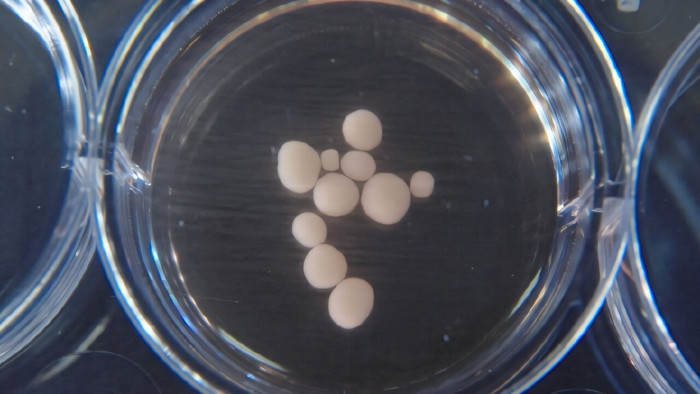
Lab grown brain organoids. (Arlotta et al. /Nature)
Organoids Record and Recall Developmental Time
Epigenetic clocks based on DNA methylation confirmed that the organoids’ biological age matched the time spent in vitro with striking precision. Whole-genome methylation profiling showed progressive changes that tracked culture duration and mirrored ageing in living human brains.
“Once we analyzed the organoids, we realized that they didn’t just survive for five years, they continued to change, develop and mature over time,” Arlotta said.
In a striking chimera experiment, researchers mixed neural progenitors from older organoids with those from much younger ones. The older cells rapidly produced late-born neuronal types, skipping earlier developmental steps. This demonstrated that the progenitors retain a cellular “memory” of the time already spent maturing. The past is engraved at the molecular level, allowing cells to jump ahead rather than restart the developmental program.
- How the Human Brain Evolved Its Extraordinary Complexity
- Ancient DNA Reveals Secrets of Human Brain Development
The organoids also developed glia, formed synapses and spines, and generated coordinated electrical network activity for at least two years. Myelination appeared over time, further echoing postnatal brain maturation. Importantly, the researchers emphasize that these structures lack sensory input, complex architecture and the connections needed for consciousness or higher cognitive functions. They remain simplified models, not miniature brains.
New Tools for Studying Disease and Late Development
Human brain development spans nearly two decades—far longer than in other species—making late stages difficult to study. Animal models cannot fully capture human-specific processes. Long-lived organoids now allow scientists to observe postnatal-like maturation in a dish and to investigate disorders such as autism, schizophrenia, epilepsy and neurodegenerative conditions that emerge over years.
“The brain can continue to develop outside the context of a person for this unprecedented amount of time,” Arlotta noted. The team has already begun using the models to explore disease mechanisms and screen potential therapies. Because organoids can be generated from a patient’s own cells, the approach also supports personalised research.
- What Made the Human Brain Unique in Evolution?
- Stem Cells and the Future of Understanding Human Origins
Previous organoid longevity records stood at under two years. The new work demonstrates that, with improved media and careful culture, these systems can remain viable and informative for many years. The full dataset—transcriptional, epigenetic and functional—is being shared with the research community so others can build on the findings without repeating the long-term effort.
While questions remain about the ultimate lifespan of organoids and how closely they can model the fully adult brain, the study proves that human brain tissue can continue its developmental programme far longer outside the body than anyone expected. The results mark a major advance in stem-cell modelling and bring researchers closer to understanding the prolonged, uniquely human timeline of brain maturation.
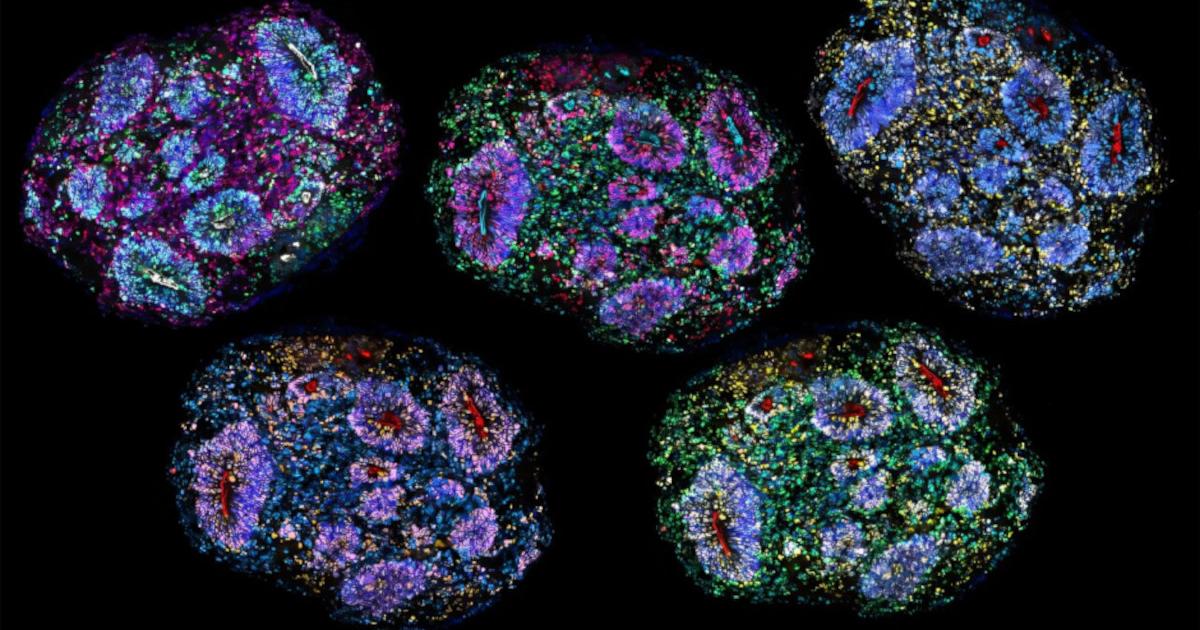
Top image: Fluorescent microscopy image of human brain organoids showing different cell types in green and red. Source: Irene Faravelli and Noelia Antón-Bolaños/Nature
By Gary Manners
References
Arlotta, P. et al. (Faravelli, I., Antón-Bolaños, N., Wei, A. et al.). 2026. Human brain organoids record the passage of time over multiple years. Nature. Available at: https://doi.org/10.1038/s41586-026-10877-x
Daily Mail. 2026. World’s oldest lab-grown human brains reach seven years old. Available at: https://www.dailymail.co.uk/sciencetech/article-16075377/oldest-lab-grown-brains-seven.html
Pattison, K. 2026. Brain organoids reach longevity milestone. Broad Institute / Harvard. Available at: https://www.broadinstitute.org/news/brain-organoids-reach-longevity-milestone
Pattison, K. 2026. Lab-grown brain ‘organoids’ set longevity record. FAS Current Available at: https://current.fas.harvard.edu/stories/lab-grown-brain-organoids-set-longevity-record