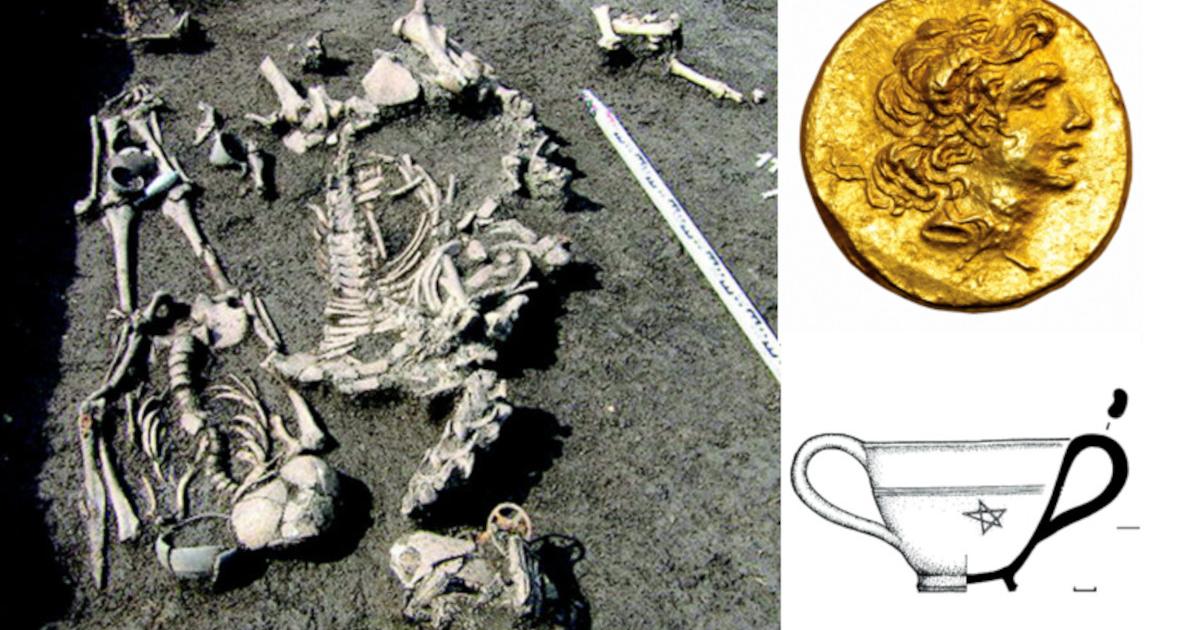

A young horseman buried more than 2,000 years ago in southern Russia went to his grave with weapons, his horse and a gold coin tucked beneath his jaw. Beside him lay a modest grey drinking cup scratched with a pentagram — a mark his community trusted to protect the dead. Archaeologists studying the Maeotian necropolis of Vinogradny 1, near Krymsk in Krasnodar Krai, now say his burial sat at the center of a far larger ritual landscape. The find, reported by Arkeonews, opens a rare window on how status, protection and hopes for the afterlife came together in one warrior grave.

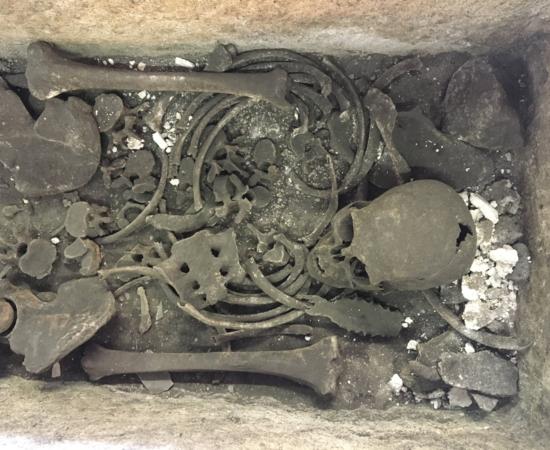
The warrior and his horse, excavated in Burial 52 at Vinogradny 1. (Abramzon et al., Russian Archaeology, 2026).
A horseman at the center of sacred ground
Vinogradny 1 holds 155 graves. The settlement beside it flourished between the 5th and 3rd centuries BC, but the cemetery that later covered the ground was in use from the 2nd century BC into the 1st.
At its heart the excavators found a circular sacred space roughly six meters across, parts of it covered in ash. A narrow rectangular shaft dropped about two meters into natural clay, with nine steps leading down towards the water table, and a single gold stater lay at the bottom — read by the study's authors as a votive offering. Only two major complexes occupied this inner zone. Burial 97 held the complete skeletons of three horses and a young bull, plus remains of a cow, dog and pig and part of an adult human pelvis, an assemblage the researchers interpret as commemorative and sacrificial. Horses had held a central place in steppe burials long before this, as the Scythian horse lords of the region show.
- Sarmatian Warrior Identified in Reused Burial Mound
- Ancient Sarmatian Warrior Unearthed During Russian Road Works
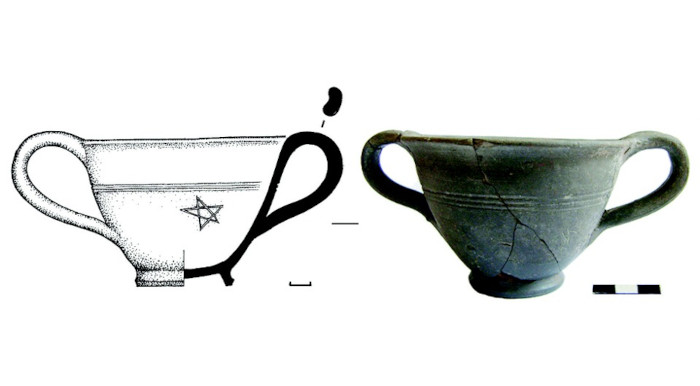
The grey-clay kantharos from Burial 52, with the scratched pentagram shown in the accompanying drawing. (Abramzon et al., Russian Archaeology, 2026).
What the pentagram was doing in a warrior's grave
Burial 52 belonged to a man of about 25 to 30. An adult horse lay beside him, kitted out with iron bits, wheel-shaped cheekpieces and a girth buckle. An iron spearhead, a javelin head, an arrowhead and a knife marked him as a fighter, while sheep and pig bones suggest food set aside for the dead. Such richly outfitted horsemen's graves recur across the steppe, from the Scythian warrior buried in a golden cloak to the man found with an arrowhead still lodged in his spine.
Among the grave goods sat a small two-handled kantharos, and across its body someone had scratched a pentagram. The authors treat the sign as an apotropaic device, meant to turn harm away, while noting that antiquity also linked five-pointed stars to healing and to the heavens. Similar marks turn up on ceramics and amulets from the Greek and eastern Mediterranean worlds, and the Bosporan region has yielded several counterparts, some tied to soldiers or war. It belongs to the same instinct that produced ancient objects for warding off the evil eye.
- 1,400-Year-Old Elite Avar Warrior and Horse Burial Unearthed in Romania
- Rare Artifacts and Full Horse Skin Found in Medieval Siberian Burial
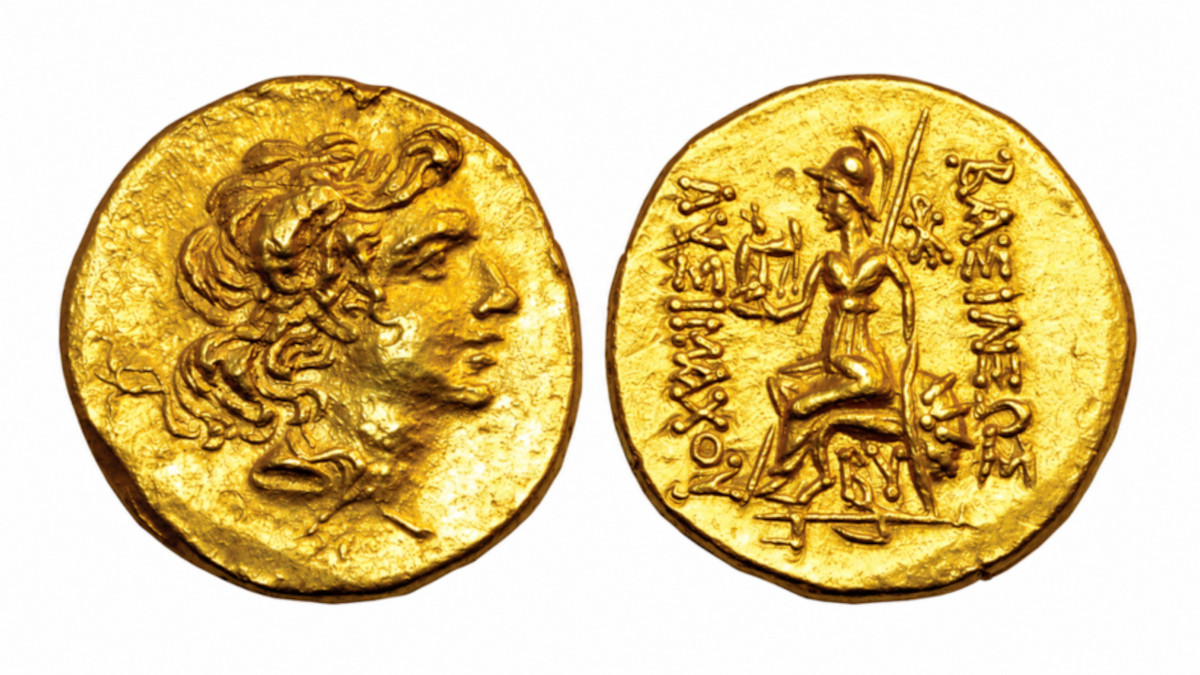
Gold Lysimachus-type stater, with the deified Alexander the Great on the obverse and Athena on the reverse. (Abramzon et al., Russian Archaeology, 2026)
Gold as payment for the journey into death
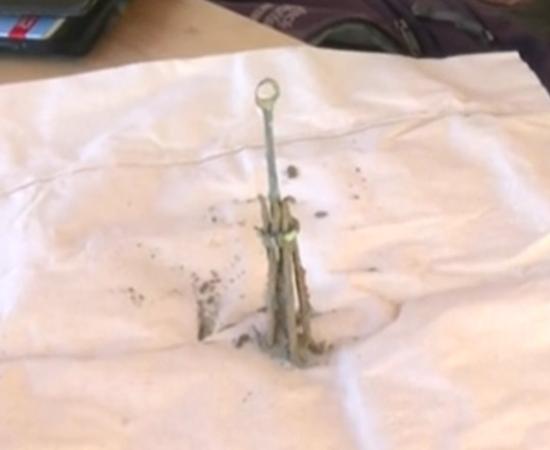
The second striking object came from beneath the warrior's lower jaw: a Lysimachus-type gold stater weighing 8.16 grams. One face carries the deified Alexander the Great wearing the horn of Ammon, the other the goddess Athena seated with Nike balanced in her hand. The researchers read its position as a likely example of Charon's obol, the coin placed with the dead as payment to the ferryman of Greek myth. Ancient Origins has described how such spirit coins were laid in or on the mouth of the deceased.
The ritual shaft produced a second stater of the same type, giving one cemetery two separate uses for a coin that is rare in the Bosporan area; the study calls its appearance in a Maeotian grave unique.
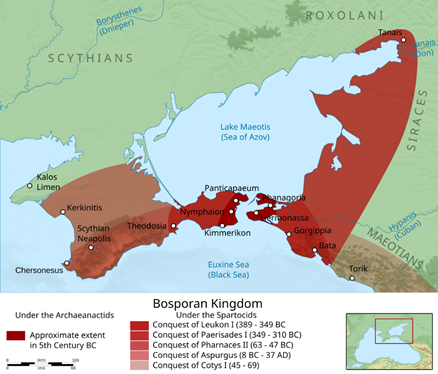
Map showing the growth of the Bosporan Kingdom around the northern Black Sea, the region in which Vinogradny 1 lies (CC BY-SA 4.0).
A Maeotian community facing the Mediterranean
The imported glass alabastron points the same way. Vessels of that kind appear at sites from Cyprus and Syria to Italy and the northern Black Sea, yet had never before been recorded in the Kuban region. Vinogradny 1 lay near the eastern frontier of the Bosporan Kingdom, the Greek-led power that dominated the northern Black Sea, and its late gold issues are tied to the age of Mithridates Eupator — a world in which Maeotian communities were drawn into Mediterranean trade and politics.
His horse and weapons said what he had been in life. The pentagram and the coin may have been meant to serve him on a journey his mourners believed still lay ahead.
Top image: The warrior remains in situ at the Maeotian necropolis of Vinogradny, Russia. Inset, coin and jug with pentagram. Source: Abramzon et al., Russian Archaeology, 2026
By Gary Manners
References
Abramzon, M. G., de Callataÿ, F., Treister, M. Y. and Shevchenko, N. F. 2026. First-century BC complexes with gold Lysimachus type staters from the Maeotian necropolis of Vinogradny 1. Russian Archaeology, 3, 206–220. Available at: https://doi.org/10.7868/S3034577426030152
Altuntaş, L. 2026. A Magical Pentagram and a Gold Coin Found With an Elite Warrior Inside a Sacred Circle. Available at: https://arkeonews.net/a-magical-pentagram-and-a-gold-coin-found-with-an-elite-warrior-inside-a-sacred-circle/
Greek Reporter. 2026. 2000-Year-Old Warrior Buried With Greek Gold Coin and Mysterious Pentagram. Available at: https://greekreporter.com/2026/10/02/warrior-grave-greek-gold-coin-mysterious-pentagram/
Spitz, E. 2026. Ancient Warrior Grave With Pentagram Jug. All That's Interesting. Available at: https://allthatsinteresting.com/russia-ancient-maeotian-warrior-grave