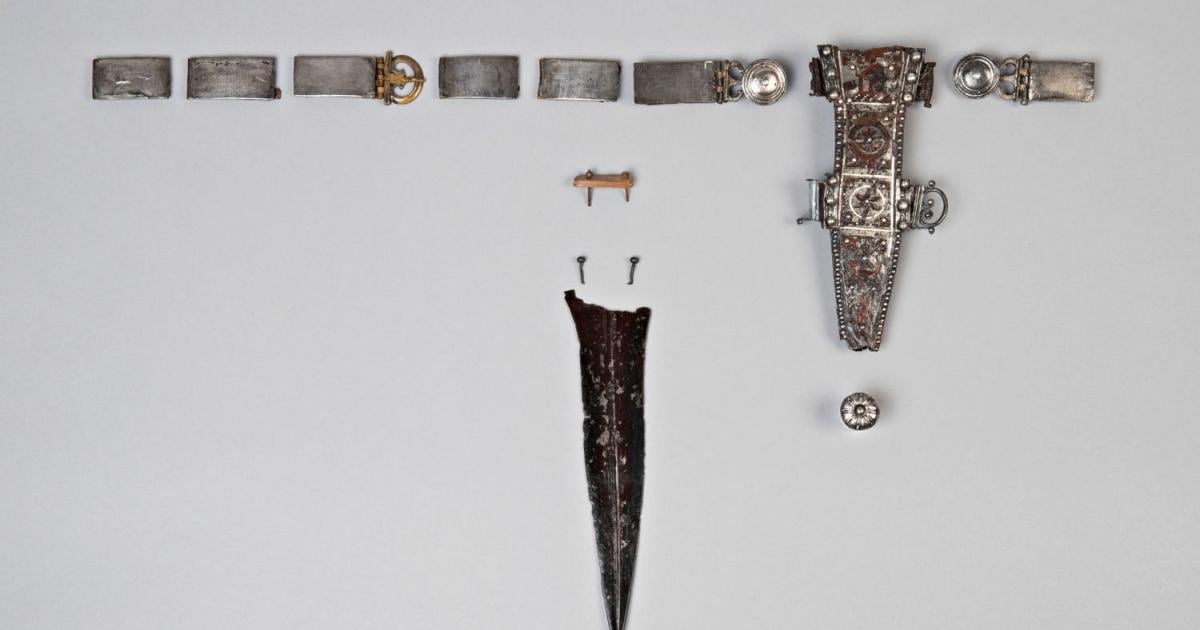

Archaeologists at Leiden University have reopened the case of a man found at the bottom of a well at the Roman fort of Velsen, near the North Sea coast of North Holland, and a fresh study of his skeleton has found further evidence that he was stabbed many times. Amateur archaeologists dug into the well in 1977 and found his almost complete skeleton there, and he had company. According to Leiden University, the well also held "a military belt, a dagger, a ring, a brooch and a soldier's sandal." For almost fifty years, nobody could say how he ended up there.
On Monday, October 26, 2026, Leiden University announced that the case had been reopened. Archaeologists Mark Driessen and Carol van Driel-Murray have edited a new open access book, Victims of Violence from the early Roman fort Velsen 1 (Netherlands), published by Sidestone Press, and its results read like a police file. The man was probably a Roman soldier, but who killed him is still an open question, and the authors say so plainly.
A fort on the edge of the sea
Velsen 1 is the name archaeologists use for the first of two Roman forts at the site. La Brújula Verde reports that it was "a military camp with its own harbor, founded around AD 15 or 16," and that coins found there suggest it supported the campaigns of Germanicus after the Roman defeat at Teutoburg in AD 9. A second, later fort at Velsen came after it.
The well with the skeleton was not the only one on the site. By the time archaeologists Morel and Bosman published their study of the find in 1989, La Brújula Verde notes, "28 wells had already been documented on the site." Several held human remains, but only one held a nearly complete skeleton. That was well 2, and that is the man at the center of this case.
The victim in the well
Leiden says that at around 1.90 meters he "was surprisingly tall for the time and very muscular." That is about 6 feet 3 inches. In the early 1980s, that size led archaeologists to suggest he might have been a Frisian, one of the fierce fighters of the North Sea coast who lived around the fort.
The new team tested that idea against his teeth. According to Leiden, "isotopes in the man's tooth enamel indicate a childhood spent in Southern Europe." Enamel forms in childhood and records traces of local food and water, so the result points far from the Dutch coast. The book's abstract adds that he, "as well as two others found in a nearby well, were not local to the region."
The researchers think, judging by his kit, he was more likely a regular soldier than an officer, because he carried a worn Roman dagger and his belt was put together from different pieces. The sheath was another matter. Leiden calls it "pure Roman bling," and Archaeology magazine describes "a new iron sheath decorated with silver and red and yellow enamel." The same report says he wore "an iron ring with a glass-paste stone depicting either the god Mars or perhaps Alexander the Great."
What the bones say
Here the case turns from mystery to crime, because over several years the team used isotope, forensic and osteoarchaeological analysis, along with 3D imaging. Leiden says the researchers "found further evidence of stab wounds on the skeleton, including on the inside of the ribcage, and numerous perforations in the pelvis."
Using 3D models, they reconstructed how the wounds were made. The wounds, Leiden reports, "were most probably caused by a Roman military dagger, presumably the dagger that lay with the man in the well." Archaeology magazine identifies that weapon as a pugio with a blade about 9 inches long. That makes the dagger the prime exhibit, though the researchers stop short of calling it proven.
The sheer number of wounds is what struck the experts. "Forensic experts said this was a very brutal murder," Driessen told Leiden University. "It shows that the perpetrator or perpetrators were extremely angry at this man. It must have been a furious and targeted act of revenge." Driessen believes this makes a defensive fight at the fort a much less likely cause of death.
The way the body was disposed of adds another clue. La Brújula Verde reports that the body was placed in the well still dressed and covered with stones, pieces of millstones and household waste. According to the same report, Morel and Bosman argued in 1989 that an enemy would have looted the silver decorated dagger, so they thought Romans had buried him.
Tacitus takes the stand
For decades, the leading suspect came from a book written almost a century after the events. The Roman historian Tacitus tells in his Annals how the Frisians revolted in AD 28 over a tax paid in ox hides. In the Church and Brodribb translation, the trouble began when "Olennius, a first-rank centurion, appointed to govern the Frisii, selected hides of wild bulls as the standard according to which they were to be supplied."
The tax collectors were seized and hanged, and Olennius fled and "found refuge in a fortress, named Flevum, where a by no means contemptible force of Romans and allies kept guard over the shores of the ocean." Archaeologists identify Flevum with Velsen, though La Brújula Verde notes "there is no definitive proof."
A dead soldier in a well at a besieged fort makes a tidy story, but Driessen and Van Driel-Murray did not accept it, according to Leiden, "because it lacks empirical evidence." As Van Driel-Murray put it, "Written sources and archaeological finds often tell different stories." Ancient sources assume the Romans left the area north of the Rhine around AD 28, while the archaeology shows a much longer Roman presence.
Six scenarios and a favorite suspect
As for who did it, Driessen refuses to hand down a single verdict. "We're trying to solve an ancient murder with modern methods and are not choosing one theory," he said. "In the natural sciences, a single explanation is the norm. But with an archaeological case like this with human actors it's much more accurate to work with multiple scenarios."
The book's abstract says it "invites readers to evaluate six plausible scenarios." Leiden spells out three of them. In one, Frisians killed him during an attack on the fort, perhaps out of anger about taxes, as Tacitus described. In another, he was a deserter executed by the military command. In a third, one or more members of the local population killed him in retaliation. This article does not list the remaining scenarios, because the press material does not name them.
The authors do have a favorite suspect, and according to Leiden, "Driessen and Van Driel-Murray think it most likely that the murder was committed by fellow soldiers in retaliation for misconduct." In that version, the man was killed by his own comrades. However, Van Driel-Murray admits there is no absolute certainty. "We challenge readers to reach their own conclusion based on the research," she said.
The case stays open
The skeleton is back in storage at the National Museum of Antiquities in Leiden. Leiden University says the museum hopes to include his story in its future permanent exhibition on the Netherlands during the Roman Empire. The authors would even like a novelist to take it on, and Van Driel-Murray said, "We'd like to pass the story onto a writer of historical fiction who could produce a novel or script about it."
He is not the only Roman soldier whose death archaeologists have tried to read from the bones. Readers may recall another Roman soldier buried with a dagger in his back, and the seven Roman soldiers dumped in a well in Croatia. The man at Velsen still has no name, no unit and no date of death. The evidence is on the table, and the jury is the reader.
How we label claims
Established: the 1977 discovery in well 2 at Velsen 1, the belt, dagger, ring, brooch and sandal, multiple stab wounds including inside the ribcage and in the pelvis, a height of about 1.90 meters, the isotope signal of a southern European childhood, and the book's six scenarios. Disputed: that the wounds came from the dagger found in the well, which the researchers call most probable. Disputed: that he was a regular soldier, which his worn dagger and patched belt suggest and his fine sheath does not. Disputed: whether the ring shows Mars or Alexander. Disputed: any link to the Frisian revolt of AD 28, which Tacitus and the long tie between Flevum and Velsen suggest but the researchers reject for lack of empirical evidence. Disputed: that fellow soldiers killed him for misconduct, the authors' preferred scenario among six. Unverified: his name, his unit and his date of death.
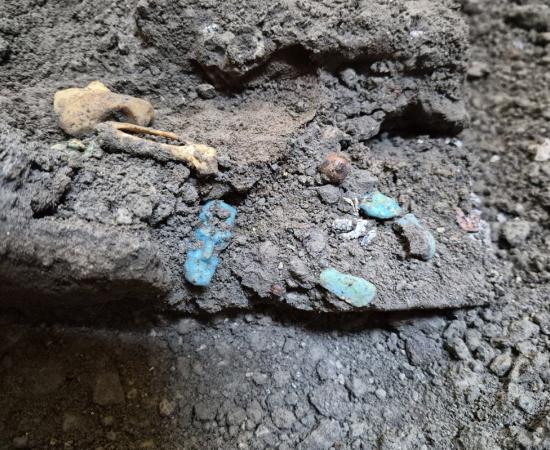
The military belt, dagger sheath and other finds recovered from well 2 at the Roman fort of Velsen 1. Image: Leiden University.
By Aris Manus
Sources
- Linda van Putten, Solving an ancient cold case: Roman was brutally murdered, Leiden University, October 26, 2026
- Mark Driessen and Carol van Driel-Murray (eds.), Victims of Violence from the early Roman fort Velsen 1 (Netherlands). Scenarios for a cold case review, Analecta Praehistorica Leidensia 56, Sidestone Press, 2026
- Antonio García, Was This Roman Soldier Murdered by His Own Comrades? Archaeologists Reopen a 2,000-Year-Old Cold Case, La Brújula Verde, October 27, 2026
- Archaeologists Reexamine Remains Found at Roman Fort in the Netherlands, Archaeology, Archaeological Institute of America, October 29, 2026
- Tacitus, Annals, Book 4, chapters 72 and 73, translated by Alfred John Church and William Jackson Brodribb, Wikisource/Book_4)