
Immortalized throughout the ages in song, scripts, TV series, and movies, the Viking Age has left a legacy far beyond the raids undertaken centuries ago. Viking pursuits ranged from plunder to exploration. One lasting legend is the Ulfberht sword. Any enemy who saw this weapon in the hands of an experienced Viking warrior understood immediately that it was more than a status symbol; it was a deadly tool. The properties of the steel made its resistance to other swords devastating in battle. This blade was created during an era when blacksmiths did not understand materials science or high-energy physics. Still, they had an intrinsic understanding of bog iron, smelting, and pattern-welding techniques.
- Was It Just a Boss Spying on His Workers? First Viking Age Tower Found in Denmark
- Viking Berserkers – Fierce Warriors or Drug-Fuelled Madmen?
The Mystery of the Broken Ulfberhts
At the Neues Museum in Berlin, Germany, thousands of tourists and admirers come to view the relics of Viking weaponry, including the swords bearing the Ulfberht inlay. Yet some of these truly legendary blades only survived down the ages in pieces, which seems quite surprising for a weapon so renowned, nearly unbreakable, and capable of slicing through chainmail. For decades, no one could truly explain why these separate metal fragments even existed.
Genuine Ulfberht swords were forged in a specific process from steel that was specially treated for ultimate flexibility, making them shatter-proof in battle. If a Viking warrior did indeed fall in battle, holding one, the blade still couldn’t be destroyed. It had to be heated and bent so that the dead warrior’s spirit wouldn’t haunt the living. As a result, there is only one explanation for any broken sword bearing the Ulfberht name. Those pieces of broken metal found in fragments were never a genuine Ulfberht sword to begin with.

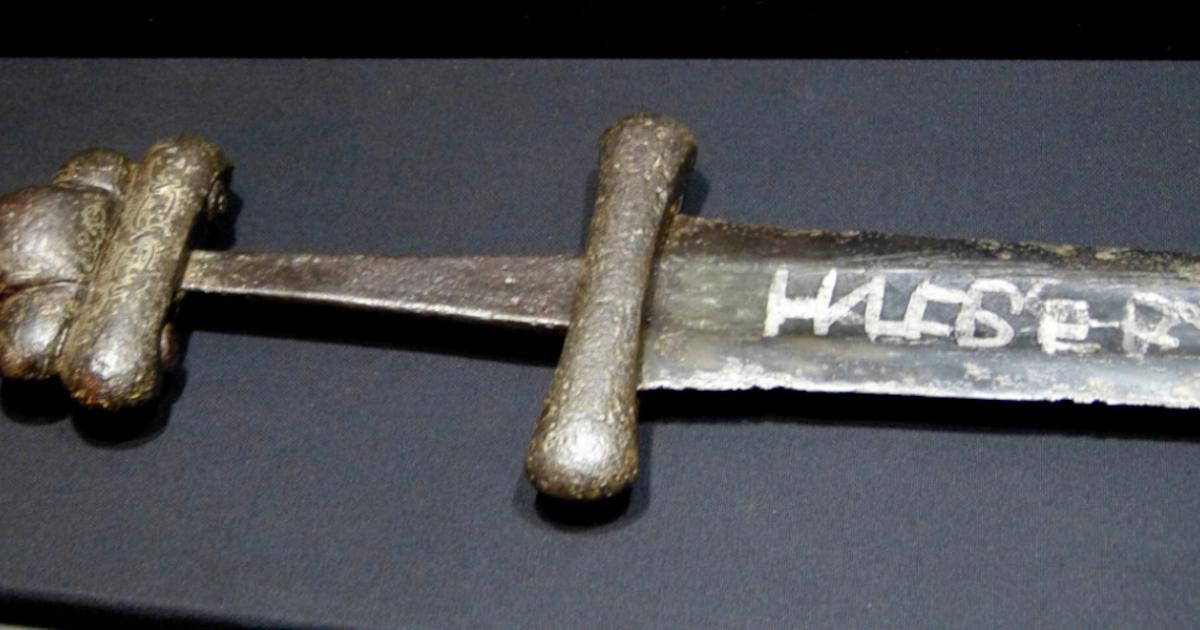
An authentic ninth-century Ulfberht sword displaying the famous +VLFBERHT+ inscription. Found in the Old Rhine near Mannheim and now preserved in the Germanisches Nationalmuseum, the blade represents one of the finest examples of Viking Age metallurgy and inspired modern efforts to recreate its remarkable forging process. (Anagoria/CC BY 3.0)
The Legend of the Ulfberht
Despite the iconic image of Vikings with horned helmets and long swords in a shield wall, most Vikings actually fought with axes or spears. Only the wealthiest warlords were able to invest in the ultimate sword-the Ulfberht. Produced during a brief window from 800 to 1000 AD, these deadly blades were considered the pinnacle of battlefield technology, and their methods of creation were closely guarded secrets so that others couldn’t easily profit off the master blacksmith’s craft.
- The Great Heathen Army: Viking Coalition Becomes an Anglo-Saxon Nightmare
- Ornate Prehistoric Bronze Sword Excavated In Denmark
Rick Furrer’s Reconstruction
For over a thousand years, no one managed to produce a specific, metallurgically accurate replica Viking sword using the same specific method from hundreds of years ago. That calculus completely changed when blacksmith Rick Furrer of Door County Forgeworks in Wisconsin set out to recreate the ancient metallurgical process, paying close attention to every nuance, while merging archaeological evidence with modern-day chemistry. His journey through this trying process was filmed for a 2012 PBS Nova documentary that culminated in what no modern blacksmith had achieved up to that point: a faithful reproduction of the most formidable sword seen since the ancient and medieval worlds, respectively.
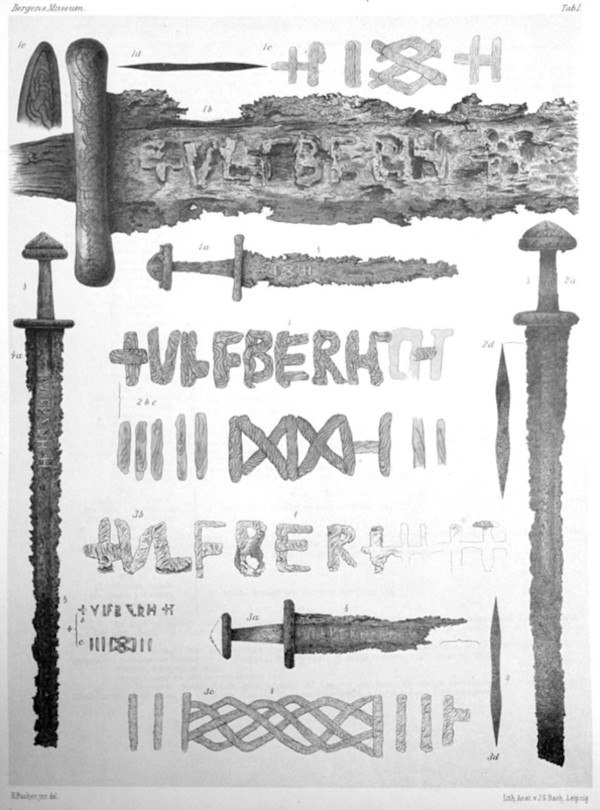
Plate I from Anders Lorange's 1889 study of Viking Age swords illustrates several authentic Ulfberht blades from the Bergen Museum, including enlarged drawings of the famous +VLFBERHT+ inscriptions that became central to identifying these elite medieval weapons. (Anders Lorange/Public domain)
How Iron Became Legendary Steel
To turn iron ore into steel, it must be melted down to separate the real iron from any leftover remnant of the rock it came from originally. Still, the inherent softness of iron means another element must be added to increase its strength under pressure. That element is carbon, which is introduced through charcoal or coal, as either can bond with the iron during the high heat of the forging process, transforming the metal into steel.
- What’s a Viking Sword? What’s not? The Distinctions of Norse Weaponry
- A Step Closer to the Mysterious Origin of the Viking Sword Ulfberht
Why Ulfberht Was Unlike Any Other Sword
Medieval European swords weren’t only low in carbon, but riddled with impurities, or slag. These impurities weakened the iron by making it more brittle. Medieval fires weren’t hot enough to liquify iron and separate it from the slag, which is why most steel was actually adulterated. Hammering the metal was seen as one of the few ways to remove the inclusions. Yet an analysis of Ulfberht metal found an absence of slag and, interestingly enough, triple the content of normal medieval steel for the time. Though no written records of its production survive, chemical analysis can speak for those who are no longer here to witness the modern replication process unfolding.
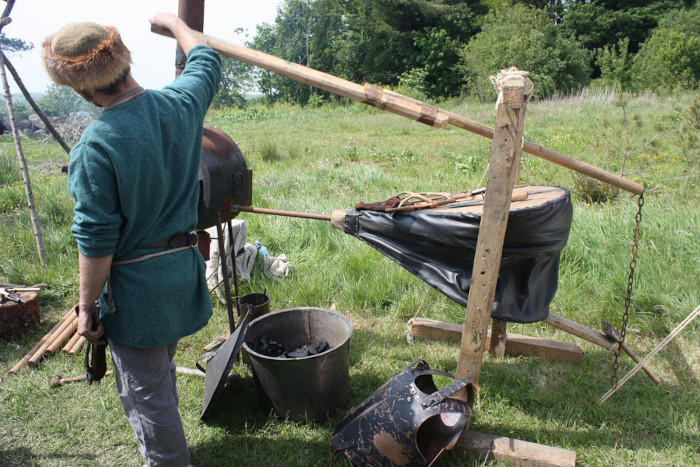
A reenactor operates a traditional bellows during a Viking Festival demonstration at Delamont Country Park, illustrating the type of airflow system medieval blacksmiths relied upon to reach the intense forge temperatures required for producing high-quality steel weapons such as the legendary Ulfberht swords. (Rossographer/CC BY-SA 3.0)
Forging Steel Centuries Ahead of Its Time
Evidence of crucible steel production in Europe doesn’t appear until hundreds of years after the last Ulfberht sword had even been forged, and the methods remain unknown. Fragments of charred bone may have been used instead of only charcoal in the fires. With every clang of the hammer, the steel itself would have been slowly infused with the spiritual power of the animal or ancestor the bones came from. The blade was created from a single steel ingot, hammered for numerous hours until it finally came into shape. This was no simple task. It is difficult to attain the perfect shape for the weapon because iron atoms form into crystalline structures known as dendrites, their rigid borders defined by carbon atoms. Once shaped, the sword was eventually heated and then rapidly cooled so that the metal could continue to harden. Finally, the metal was polished by a grinding stone to strengthen its atomic structure and treated with an etching acid to reveal the inlay.
- A Deadly Formula - Why Viking Weapons and Armor Were So Effective
- Ragnar Lothbrok: Legendary Hero or Historical Figure?
A Frankish Name on a Viking Legend
The origin of the Ulfberht name is a mystery to this day. Ulfberht sounds like a name out of the epic poem Beowulf; it is not Scandinavian but Frankish. The Franks, for significant parts of their history ranging from Charlemagne down to his ill-fated grandson, Charles the Bald, had to face numerous Viking raids that changed the face of medieval Europe. The Franks’ empire under Charlemagne bordered Viking kingdoms such as that of King Gudfred, who ruled in present-day Denmark.
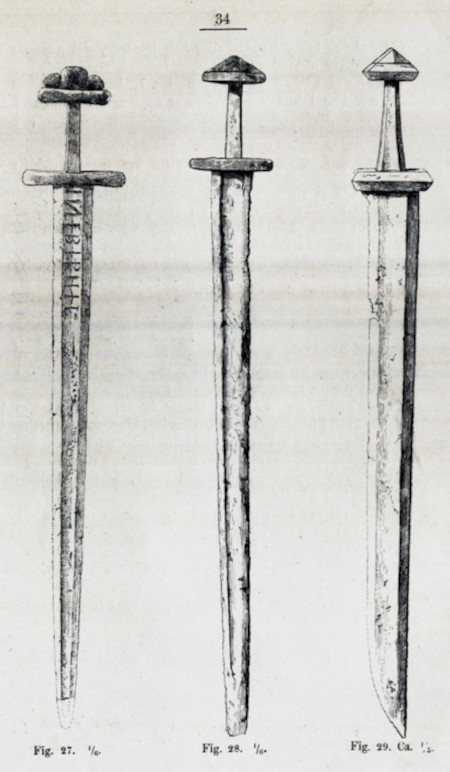
Plate 34 from Ingvald Undset's 1878 study of Norwegian antiquities illustrates an authentic Viking Age Ulfberht sword (left) with its characteristic UFBERH+T inscription. Among the earliest scholarly depictions of these elite weapons, the illustration helped establish the foundation for modern research into Viking metallurgy. (Ingvald Undset/Public Domain)
The Sacred Name Behind a Legendary Sword
The technique of inlaying the name of the sword may speak for the dead. The name was usually written with a cross before the U and another between the letters h and t, meaning it could have honored a religious figure such as an abbot or a location like a monastery. This would not have concerned the pagan Vikings. Other theories suggest that Viking warriors on their way to a raid would pass through modern-day Germany, and the wealthy among them would purchase an Ulfberht sword from Frankish artisans. Some researchers believe that the swords were taken as Viking ransom or plunder from defeated Frankish warriors in battle.
The Legacy of Ulfberht Swords
In a study published in the History of Antique Arms, archaeologist Ann Feuerbach found evidence of Ulfberht swords being forged around the year 935 AD for King Athelstan of England, whose nephews (and other supporters) received an Ulfberht sword before they became rulers in their own right. This suggests that more than pagan hands wielded the deadly blade. These swords went into battle with a myriad of warriors – Christians, pagans, or even those who balanced the old gods with Christian customs. The crosses flanking the inscription may have symbolized the religious convictions and the divine right of kings, but not every warrior lifted the sword to defend that right. While some Ulfberht blades were made for the first King of England’s court, others were forged by a collection of different smiths from other regions, with a host of different traditions, giving each sword a unique name that summoned the power of their ancestors to watch over them in battle.
Top Image: An authentic 10th-century Ulfberht sword displaying the famous +VLFBERHT+ inscription. These elite Viking Age blades were forged from exceptionally high-quality steel and inspired modern bladesmith Rick Furrer's successful recreation of their manufacturing process. Source: (Wolfgang Sauber/CC BY-SA 4.0)
By Ramsey Hardin
References
National Geographic. “These Are Some of the World's Most Spectacular Viking Artifacts.” Accessed July 24, 2026. https://www.nationalgeographic.com/history/article/these-are-some-of-the-worlds-most-spectacular-viking-artifacts
NOVA. “Secrets of the Viking Sword.” Season 39, Episode 13. PBS, October 10, 2012. Accessed July 24, 2026. https://www.pbs.org/video/nova-secrets-viking-sword/.
Petri, Ingo. “VLFBERHT Swords: Origin, Material, and Manufacture.” History Compass 17, no. 4 (2019): e12529. https://doi.org/10.1111/hic3.12529
Rayne, Elizabeth. “Nobody Could Replicate This Unbreakable Viking Sword for 1,000 Years. One Man Just Figured Out How.” Popular Mechanics, July 23, 2026. https://www.popularmechanics.com/science/archaeology/a73047940/unbreakable-viking-sword/
Society for Combat Archaeology. “The Ulfberht Project: Reconstructing a Viking Age Sword.” Accessed July 24, 2026. https://combatarchaeology.org/research-2/the-ulfberht-project-reconstructing-a-viking-age-sword/
The Metropolitan Museum of Art. “Sword, Germanic or Scandinavian, ca. 850–900.” Accessed July 24, 2026. https://www.metmuseum.org/art/collection/search/34990